


 Get to WhatsApp

Our manager will contact you
within 15 minutesт
Get More Catering Clients: 9 Marketing Channels for 2026
How to Market Your Catering Business: A Practical Guide for 2026
Get More Catering Clients: 9 Marketing Channels
⚡ Quick Answer
As an expert in SEO and digital marketing for catering with extensive hands-on experience, I put together the most effective tools for attracting clients and growing sales in this space. Right away I want to be direct: in your niche, there is a core combination of three to four channels that will reliably bring you both private and corporate clients — SEO, Google Ads, a content-driven blog, and Facebook/Instagram advertising. Everything else amplifies brand recognition but these four are your revenue engine. This is exactly how to get catering clients systematically rather than waiting for referrals. Master catering marketing through these core channels, scale them with budget and consistency, and you can realistically be attracting dozens of new clients every month. You can also order promotion for your catering business through my agency on an all-inclusive basis. Submit your application through the contact form.
What’s Inside This Guide
- — Channel 1: SEO as the long-term foundation of client acquisition.
- — Channel 2: Google Ads and remarketing for immediate lead flow.
- — Channel 3: Deep service page optimization for every event type.
- — Channel 4: An information blog that answers what clients actually search for.
- — Channel 5: Local SEO and neighborhood-level geographic targeting.
- — Channel 6: Google Business Profile as a direct lead source.
- — Channel 7: Social media marketing on Instagram, Facebook, and LinkedIn.
- — Channel 8: YouTube for showcasing events and building brand authority.
- — Channel 9: Marketing packaging, promotions, and psychological hooks.
- — How to Win Corporate Catering Clients: A Step-by-Step Guide.
Channel 1: SEO as the Long-Term Foundation of Client Acquisition
If you are thinking about where to focus your marketing energy for the next twelve to twenty-four months, organic search is the answer. Not because it is the fastest channel — it is not — but because it is the only one that builds a compounding asset. A well-optimized page that ranks for “wedding catering Los Angeles” or “corporate lunch delivery Manhattan” generates inquiries every month without a recurring cost attached to each one. That kind of economics is hard to match.
The challenge with SEO for food and event businesses is that most companies approach it too broadly. They try to rank for “catering company Los Angeles” — a phrase dominated by established players with years of authority — instead of building depth across specific event types, neighborhoods, and service categories where the competition is far thinner and the buyer intent is much clearer. Someone searching for “kosher catering for corporate event in Brooklyn” is not browsing for ideas. They have a specific need and a decision to make.
The long-tail advantage in catering SEO:
A single well-built page targeting “outdoor wedding catering services in San Diego” may rank within three to four months because almost no competitor has built that page with real depth. The visitor who finds it through that query is already pre-qualified. They need exactly that service in exactly that location. That is the quality of lead organic search produces when the strategy is specific enough.
Technical SEO matters here too and is routinely ignored by food businesses. Site speed on mobile is critical — most catering inquiries happen on a phone, often when someone is actively planning an event. If your site loads slowly, visitors leave before they see what you offer. Image optimization is especially important for food businesses where high-quality photography is a selling tool: large uncompressed images that look beautiful in a design mockup can kill page performance in practice. Schema markup for local businesses, events, and menu offerings is another underutilized asset that can improve how your site appears in search results and in AI-generated answer surfaces.
For a thorough understanding of what professional search optimization for food and event businesses covers and how it is structured end to end, the dedicated resource on SEO for catering companies is worth reading before you make any investment decisions. And if you want realistic expectations about how long organic results take to materialize — including what to expect at three, six, and twelve months — the guide on realistic SEO timelines and what they mean for your business gives an honest benchmark.
Channel 2: Google Ads and Remarketing for Immediate Lead Flow
While organic search builds over time, Google Ads produces results from the moment your campaigns go live. For a catering operation that needs bookings in the next thirty to ninety days, paid search is the most reliable way to generate qualified inquiries quickly. The catch is that it requires more precision than most business owners realize — and without that precision, budgets disappear with very little to show for them.
The most common mistake catering operations make with Google Ads is targeting terms that are too broad. “Catering” as a standalone keyword attracts people who might be looking for jobs, recipes, equipment suppliers, or event inspiration — not someone with a budget and a date. The campaigns that convert efficiently target intent-specific phrases: “catering for office lunch delivery,” “wedding catering quote request,” “graduation party catering near me.” These phrases cost more per click in some cases, but the conversion rate is dramatically higher because the intent is unambiguous.
If you want to understand how your competitors are allocating their paid search budgets and where they are concentrating their spend, the analysis tool covered in the guide on how to find your competitors’ Google Ads budget gives you a practical method for reverse-engineering their strategy before you finalize your own.
Remarketing is often worth more than the original click:
Event planning decisions are rarely made on a first website visit. A prospect who looked at your wedding packages page but did not inquire is still a warm lead. Remarketing ads — shown to that visitor as they browse Instagram, watch YouTube, or search for related terms — keep your brand present during their decision period. The conversion cost from remarketing is typically a fraction of the cost from cold acquisition.
Landing page design is where most Google Ads campaigns either succeed or fail. An ad about “corporate office catering New York” that sends visitors to a generic homepage with no mention of corporate services has already lost the lead. The landing page needs to mirror the ad’s promise precisely: corporate catering services, with relevant photos, pricing context, client testimonials from businesses, and a frictionless inquiry form that asks for minimal information upfront. Every extra field on a form is a percentage of leads you do not receive.
Budget expectations for a well-run Google Ads program in the catering space typically start around $1,500 to $2,500 per month in ad spend, with management fees on top of that. Competitive metropolitan markets like New York, Los Angeles, Chicago, and Miami will require more. The cost per lead in this category, when campaigns are properly structured, typically runs between $25 and $90 depending on the event type and geographic market.
Channel 3: Deep Service Page Optimization for Every Event Type
This is the structural decision that separates catering websites that generate organic leads consistently from those that sit quietly without producing much. Most businesses in this industry have a homepage, a general services page, a gallery, and a contact form. That structure gives search engines almost nothing to work with. It cannot rank for specific event types because there are no specific pages. It cannot appear in neighborhood searches because there is no geographic depth. It covers one query — the brand name — and nothing else.
The answer is building dedicated, genuinely deep pages for every major service category and event type. Not thin pages with two paragraphs and a photo. Pages that treat each event type as its own distinct topic, addressing the specific concerns, typical costs, logistics, menu options, and planning considerations relevant to that event. This approach accomplishes two things simultaneously: it gives search engines specific, relevant content to rank for specific queries, and it gives prospective clients the information they need to feel confident reaching out.
- ➤Wedding catering page: ceremony formats, menu customization, staffing ratios, venue coordination
- ➤Corporate buffet and office lunch delivery page: ordering minimums, dietary accommodations, recurring schedule options
- ➤Birthday and private party catering page: guest count ranges, setup options, alcohol service considerations
- ➤Funeral reception catering page: sensitivity in tone, appropriate menu formats, typical logistics
- ➤Holiday party and seasonal event catering: themed menus, December booking timelines, corporate entertainment formats
- ➤Dietary-specific catering pages: vegan catering, kosher catering, gluten-free menus, halal-certified options
Each of these pages should include a substantial FAQ block that answers the questions prospective clients actually ask before calling. How far in advance do you need to book? What is included in the per-person price? Do you provide staffing? Can menus be customized for dietary restrictions? What happens if the guest count changes? These questions get searched directly — “how far in advance should I book a caterer for a wedding” is a real query with real search volume — and answering them on your pages captures that traffic while also reducing friction for buyers who are close to making a decision.
Channel 4: An Information Blog That Answers What Clients Actually Search For
The blog section of a catering website is one of the most underused lead generation assets in the industry, and the businesses that invest in it consistently outperform their competitors in organic visibility over a twelve-to-eighteen-month horizon. The reason is straightforward: people planning events spend weeks or months researching before they make any booking decisions, and a company that is present and genuinely helpful during that research phase earns trust that translates directly into inquiries.
The content that works for catering businesses is not general food industry commentary. It is specific, practical, question-answering content that matches exactly what a real person types into a search engine when they are in the early or middle stages of planning an event. “How much does catering cost for 100 guests in Chicago?” “What is the difference between a buffet and a plated dinner for a corporate event?” “How to plan food for an outdoor wedding in summer?” “Is it cheaper to hire a caterer or rent a venue with in-house catering?” These are genuine buyer questions, and the businesses that answer them with real depth capture traffic that converts at rates significantly higher than paid traffic from cold audiences.
Blog content also handles objections before they happen:
A prospect who has read your article on “What to ask a caterer before signing a contract” arrives at their first conversation with you already feeling informed and already associating your brand with expertise. That psychological positioning is worth more than any individual sales tactic. You have already done part of the selling before the first call takes place.
Publishing frequency matters less than quality and strategic targeting. Four well-researched articles per month that each answer a specific question buyers are genuinely asking will outperform twelve thin, generic pieces every time. The goal is not content volume — it is coverage of the specific queries that bring buyers who are ready to plan and book. If you want a clearer picture of how to structure content so it actually generates inquiries rather than just traffic, the analysis of how to get 1,000 visitors a day to your website covers the content architecture behind consistent organic traffic growth.
Content Plan for Catering Topics: 2-Month Framework
| Period | Article Topic | Target Buyer Intent |
|---|---|---|
| 1 | How much does catering cost for 50, 100, and 200 guests in New York? | Commercial — budget research |
| 1 | Corporate office lunch delivery vs. full-service catering: which format fits your event? | Informational — format comparison |
| 1 | How far in advance should you book a wedding caterer? A planner’s timeline | Informational — early-stage planning |
| 1 | Vegan catering menu ideas for corporate events: what companies are ordering now | Commercial — dietary-specific search |
| 1 | What to ask a caterer before signing a contract: 12 questions that protect your event | Informational — vendor evaluation |
| 2 | Kosher catering in Los Angeles: what it involves and how to find a certified provider | Commercial — niche local search |
| 2 | Birthday party catering for adults: format options, typical costs, and what is trending | Commercial — private event search |
| 2 | Outdoor summer wedding food: what works, what does not, and how to plan for heat | Informational — practical planning |
| 2 | Holiday office party catering: how to handle dietary restrictions for a large team | Commercial — seasonal corporate search |
| 2 | Catering vs. food truck for events: a practical comparison with real cost examples | Informational — format decision |
Channel 5: Local SEO and Neighborhood-Level Geographic Targeting
Most catering businesses operate within a defined geographic radius — they serve specific cities, districts, and neighborhoods. That geographic specificity is actually an advantage in search, not a limitation, because it means you can build visibility in a much more targeted way than a national brand and convert that visibility at a higher rate because the buyer is looking for exactly what you are: a local provider who knows the area and can service their venue.
Neighborhood-level targeting is one of the most underutilized tactics in local digital marketing for food businesses. Instead of building one page for “catering services in Chicago,” building separate pages for the Loop, Lincoln Park, Wicker Park, River North, and Hyde Park captures searches with geographic intent at a level of specificity where almost no competitor has built any content at all. “Corporate catering River North Chicago” is a real search with commercial intent and almost no competitive pressure. A well-built page targeting that phrase can rank within two to three months and generate inquiries from exactly the kind of client — downtown corporate — that most catering operations want more of.
The same principle applies to venue-specific optimization. If you regularly serve events at specific venues in your area — hotel ballrooms, event spaces, parks, museums — building pages or blog content around those venues (“catering for events at [Venue Name]”) can capture searches from people who have already selected their venue and are now looking for a caterer who has experience there. That specificity is enormously reassuring to a buyer who wants to reduce risk.
Channel 6: Google Business Profile as a Direct Lead Source
A fully optimized Google Business Profile is one of the fastest ways to appear in local search results for high-intent commercial queries, and it is one of the few marketing assets that can generate direct phone calls and messages without the visitor ever visiting your website. For catering businesses, which depend heavily on local discovery and trust, this is a channel that deserves consistent, ongoing attention rather than a one-time setup.
Most businesses set up their GBP listing once and leave it largely untouched. The companies that generate the most leads from this platform treat it as an active marketing channel: publishing weekly posts about upcoming availability, seasonal menus, and recent events; adding new photos consistently from every event they service; actively soliciting reviews from clients after each booking; responding to every review — positive and negative — within twenty-four hours; and using the Q&A section to pre-answer the questions prospective clients ask most frequently.
Reviews are the GBP currency that matters most:
A profile with forty reviews averaging 4.8 stars will appear more prominently in local pack results than a profile with five reviews and a 5.0 average. Volume of reviews signals consistent business activity. The cadence of new reviews signals ongoing relevance. Building a systematic review request process — a follow-up message to every client after their event — is one of the highest-return activities a catering operation can invest in.
Category selection in GBP deserves more attention than it usually receives. Beyond the primary “Catering Food and Drink Supplier” category, secondary categories like “Wedding Service,” “Corporate Event Planner,” “Food Delivery Service,” and “Party Planner” expand the range of searches your profile can appear for. Service descriptions within GBP should use the natural language of buyers — the same phrases they type into searches — rather than formal marketing copy. For a comprehensive guide to optimizing every element of your listing, the detailed walkthrough on Google Business Profile optimization covers the full setup and ongoing management process.
Channel 7: Social Media Marketing on Instagram, Facebook, and LinkedIn
For a catering operation, social media serves a function that is slightly different from what it does for software companies or professional service firms. The primary asset is visual — food photography and event documentation — and the primary goal is building the kind of appetite-level desire and aspirational association that converts browsers into buyers. Done well, social media shortens the decision cycle significantly because a prospect who has been following your account for three months arrives at their first inquiry already trusting your quality.
Instagram is the most commercially relevant platform for food and event businesses. The visual format is perfectly suited to the product, the audience includes both private event planners and corporate event coordinators, and the advertising platform allows targeting by location, life events (recently engaged, recently moved), interests, and behavior. Reels that show behind-the-scenes event setup, food preparation, and beautifully served presentations perform consistently well because they satisfy curiosity while demonstrating competence.
- ➤Instagram: event photography, Reels showing setup and food styling, Stories with behind-the-scenes content, paid promotion to local audiences
- ➤Facebook: community engagement in local event planning groups, retargeting campaigns to website visitors, event-specific promotional posts
- ➤LinkedIn: targeted outreach and content for corporate event coordinators, HR managers, and office administrators who book recurring catering
- ➤Pinterest: wedding and event mood board presence, which drives long-tail discovery from people in early planning stages
- ➤TikTok: short-form video content showing food preparation, event transformation sequences, and day-in-the-life content for brand awareness
LinkedIn deserves specific mention for businesses that want to grow their corporate client base. How to attract clients for catering at the corporate level is fundamentally different from attracting private event bookings, and LinkedIn is the platform where the decision-makers live. Office managers, executive assistants, corporate event planners, and HR coordinators who organize company events are all reachable through LinkedIn’s targeting, both organically through content and through paid campaigns. A post about how your team handled a 200-person corporate conference luncheon, with specific logistics details and a client testimonial, positions your business directly in front of the people who make those booking decisions.
Channel 8: YouTube for Showcasing Events and Building Brand Authority
YouTube is consistently overlooked by catering businesses, and that oversight is a missed opportunity. As the second-largest search engine globally, YouTube surfaces relevant results for queries like “corporate catering ideas,” “how to choose a wedding caterer,” and “catering setup time-lapse” — searches that come from exactly the buyers who are actively planning events. A channel that publishes consistently useful and visually compelling content in this space builds authority and generates inquiries from a source that most competitors are not even present in.
The content format that works best for food and event businesses on YouTube is not polished brand video. It is practical, specific, and visually engaging content that either answers a real planning question or demonstrates your operation in action. A setup time-lapse showing a corporate event going from an empty venue to a fully staged buffet is compelling, specific, and completely replicable as a content format. A walkthrough video explaining “how we handle food for outdoor summer events — temperature management, setup timing, and backup planning” answers a genuine question while demonstrating expertise.
Client testimonial videos recorded at the end of events — with permission — are among the most conversion-effective content formats available. A real client, at the event you just serviced, describing why they chose you and how the experience went is worth more than any amount of professional copywriting. It is social proof in its most authentic and compelling form, and it works across multiple platforms: YouTube, your website, Instagram, and Facebook.
Channel 9: Marketing Packaging, Promotions, and Psychological Hooks
This channel is less about a digital platform and more about how your offer is structured and communicated. The best marketing for catering businesses is not just about being visible — it is about making the decision to choose you easier, more logical, and more emotionally compelling than choosing a competitor. That is packaging and offer design, and it is a lever that works across every other channel simultaneously.
Pricing transparency is one of the most powerful conversion tools available to a catering operation and one of the most underutilized. Most businesses in this category make potential clients request a quote before they can access any pricing information. That friction eliminates a significant percentage of prospects who do not want to initiate a sales process before they have a rough sense of whether the service fits their budget. Publishing starting prices, per-person ranges, and package summaries on your website converts browsers into inquiries at a measurably higher rate than keeping all pricing locked behind a contact form.
Promotional hooks that work in the catering space:
Early booking discounts for events more than six months out, complimentary tasting sessions for bookings above a guest count threshold, a free menu consultation with no obligation, and a “first corporate order” discount for new business accounts are all hooks that reduce the perceived risk of making a first booking. Lower the barrier to a first transaction and repeat business follows naturally.
Package naming and structuring also affects conversion in ways that are easy to underestimate. A “Silver, Gold, Platinum” structure invites clients to compare packages against each other. A “Date Night Package,” “Executive Team Lunch Package,” and “Full-Service Wedding Package” structure invites clients to self-select based on their situation. The second approach converts better because the buyer does not have to translate abstract tier names into their specific context — the package name does that work for them. This is a small change that consistently makes a meaningful difference in inquiry rate and average booking value.
How to Win Corporate Catering Clients: A Step-by-Step Guide
Corporate accounts represent some of the most valuable client relationships a catering operation can build. A company that orders lunch for its team three times a week, or books quarterly all-hands event catering, or runs a monthly board dinner is worth many times more in lifetime revenue than a single private event. Yet most catering businesses approach corporate client acquisition the same way they approach private events — waiting for inbound inquiries rather than actively pursuing these relationships.
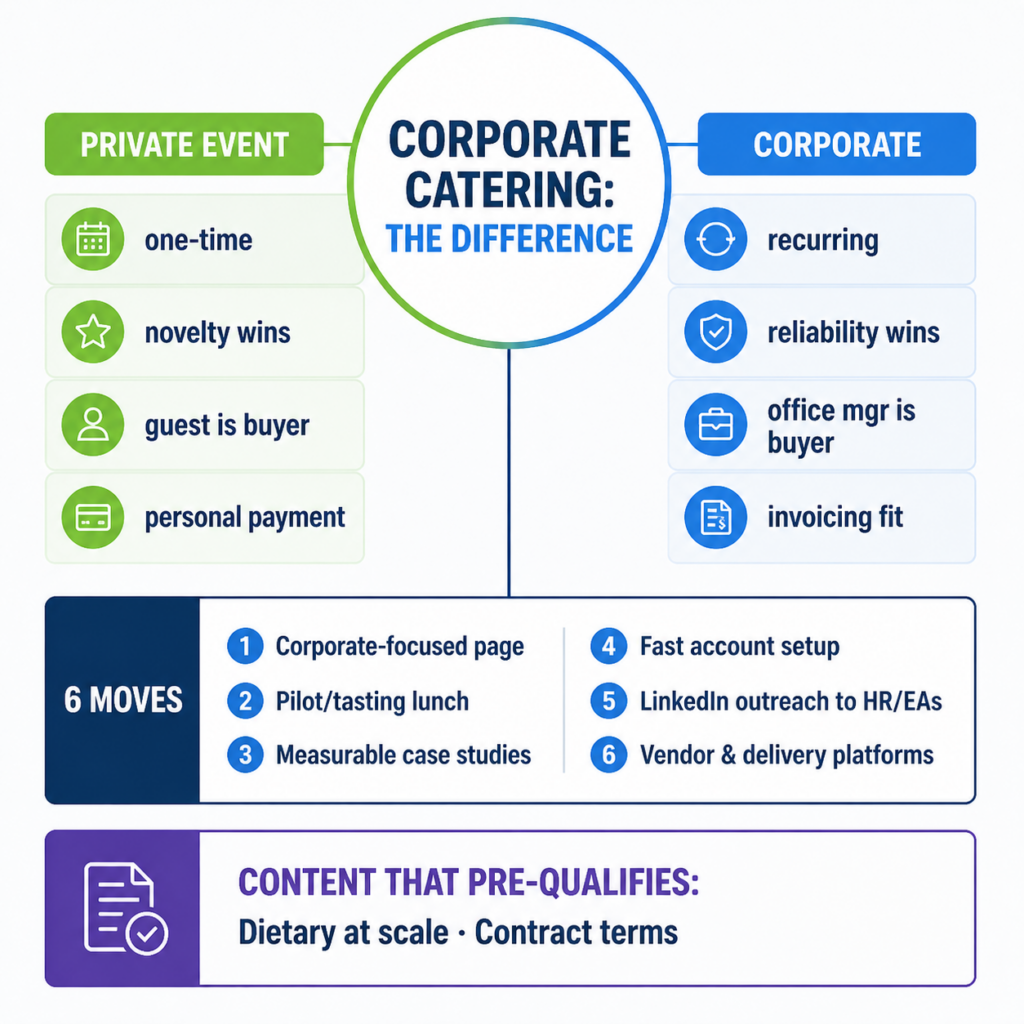
How to get catering clients in the corporate sector requires a different approach because the buyer is different. Corporate decisions are made by office managers, executive assistants, HR coordinators, or department heads — not individual consumers making a personal choice. The decision criteria are different: reliability and consistency matter more than novelty, dietary accommodation capability matters enormously, invoicing and payment processes need to fit corporate accounting systems, and volume flexibility is a key requirement.
- ➤Build a dedicated corporate catering page that speaks directly to office managers and event coordinators, not event guests
- ➤Offer a no-commitment tasting or pilot lunch for prospective corporate accounts — a physical demonstration of quality removes more objections than any sales conversation
- ➤Publish case studies from existing corporate clients that describe the logistics, volume, and frequency of the service in specific terms
- ➤Create a streamlined corporate account setup process with clear documentation, invoicing options, and a dedicated account contact
- ➤Reach HR directors and office managers directly through LinkedIn with personalized outreach that references the specific scale and type of their business
- ➤List your services on corporate vendor platforms and food delivery aggregators that serve business districts in your city
Digital marketing for catering in the corporate segment also means producing content that addresses corporate-specific concerns. Articles like “How to manage dietary restrictions for a team of 150” or “What to look for in a recurring corporate catering contract” attract exactly the decision-makers you want to reach and demonstrate expertise in the specific challenges they face. This content builds credibility before any sales conversation starts.
Channel Performance Comparison: Investment, Cost, and Timeline
| Channel | Approximate Monthly Investment | Time to Measurable Results |
|---|---|---|
| Organic SEO (full-service) | $1,000 – $3,500 | 3–6 months for rankings; 6–12 months for consistent leads |
| Google Ads (search + remarketing) | $1,500 – $5,000 (ad spend + management) | 2–4 weeks for first leads; 2 months for optimization |
| Service page SEO build-out | $300 – $800 per page (one-time) | 2–4 months per page to reach competitive positions |
| Blog content program | $600 – $2,000 (3–5 articles/month) | 4–8 months before organic traffic becomes consistent |
| Local SEO + neighborhood pages | $400 – $1,200 | 6–12 weeks for local pack improvements |
| Google Business Profile management | $200 – $500 | 4–8 weeks for visible local ranking improvements |
| Instagram + Facebook SMM | $800 – $2,500 (content + ad spend) | 4–8 weeks for paid; 3–6 months for organic growth |
| YouTube channel development | $1,000 – $3,000 (production + publishing) | 4–9 months before consistent search traction |
| Offer packaging and promotions | $300 – $800 (copywriting + design) | Immediate improvement in inquiry-to-booking conversion rate |
Additional Ways to Find and Attract Clients for Your Catering Operation
Beyond the nine core channels, several supplementary approaches consistently produce results for food and event businesses that invest in them systematically. The common thread across all of them is presence in places where your buyers are already looking — before they start a formal search process.
Event vendor directories and wedding planning platforms are among the most targeted lead sources available in this niche. Platforms like The Knot, WeddingWire, Zola, and Thumbtack receive consistent traffic from buyers who are actively comparing vendors. A complete, review-rich profile on two or three of these platforms generates inquiries from prospects who have already committed to hiring someone — they are simply deciding who. That buyer is dramatically warmer than someone encountering a paid ad for the first time.
- ➤Wedding and event directories: The Knot, WeddingWire, Zola, Thumbtack, Bark
- ➤Corporate food delivery platforms: ezCater, Fooda, or regional corporate food ordering services
- ➤Venue partnership programs: formal referral agreements with event spaces, hotels, and conference centers in your service area
- ➤Wedding planner and event coordinator referral networks: a single trusted planner who recommends you consistently is worth more than most paid advertising channels
- ➤Chamber of Commerce and local business association membership: direct access to the corporate buyers who plan recurring business events
Email marketing to past clients is another consistently underused channel for how to attract clients for catering on a recurring basis. A past client who was satisfied with their wedding reception catering may not immediately think of you when their company needs a quarterly event — but a well-timed email that mentions corporate services, includes a seasonal menu update, or offers a referral incentive can reactivate that relationship. The cost of marketing to someone who already trusts you is a fraction of the cost of acquiring a new client through paid advertising.
How to grow catering business through partnerships with complementary vendors is a strategy that many established operations credit as one of their most consistent lead sources. Florists, photographers, DJs, event planners, venue coordinators, and wedding officiant services all work with the same buyers you do. A formal referral arrangement — whether commission-based or reciprocal — with even three or four reliable vendor partners can produce a steady stream of pre-qualified referrals without any ongoing marketing spend. The trust transfer from a referral by a vendor the client already likes is enormous.
Yelp and review aggregators for local food businesses:
Yelp remains a significant driver of local discovery for food businesses in major US cities. A managed Yelp presence — with recent reviews, current photos, accurate service information, and prompt responses to messages — generates inquiries that would not otherwise find you through Google alone. In cities like San Francisco, New York, and Chicago, Yelp’s local food and service search volume is substantial enough that ignoring it is leaving a meaningful lead source unmanaged.
If you want to understand what accessible, well-structured search optimization looks like at a price point that works for a growing catering operation, the affordable SEO services page covers the specific plans and what each tier includes in practical terms.
Why World SEO Agency Is the Right Partner for Your Catering Business
→ Industry Expertise in Digital Marketing and Advertising for Catering Businesses
We work with food, hospitality, and event businesses specifically — not as one category among dozens but as a primary focus area. Our team understands the buyer psychology, the seasonal dynamics, the competitive pressures of local food markets, and the specific content strategies that convert event planners and corporate buyers into paying clients. That domain knowledge is reflected in every campaign we build and every piece of content we produce.
→ 90-Day Performance Commitment
On our top-tier plan, we commit to measurable progress within 90 days. If we have not delivered against the targets defined at the start of your engagement within that window, we continue working at no additional charge until we do. This is not a promotional phrase — it is written into the agreement. We take on clients we have assessed as viable for this commitment, which means we approach every project with a clear strategy before work begins.
→ Affordable Pricing
Our plans are designed to be accessible to catering operations at various stages of growth — not just enterprise businesses with large marketing budgets. Quality digital marketing should not require enterprise-scale spending to produce real results. Our pricing reflects the actual cost of serious, full-service work without the overhead that inflates fees at larger agencies.
→ All-Inclusive System With No Hidden Costs
Every component described in your plan is included in the stated price. Content production, technical SEO work, link acquisition, reporting, and communication are all covered. Nothing is billed separately after the agreement is signed. We operate this way because transparency in commercial relationships produces better outcomes for both sides over the long term.
→ Working Locally in the US and Globally
We work with catering and hospitality businesses across the United States — including major markets like New York, Los Angeles, Chicago, Houston, Phoenix, Philadelphia, San Antonio, San Diego, Dallas, and Miami — as well as internationally. Whether your operation serves a single metropolitan area or multiple cities, our geographic strategy adapts to match your actual service territory and competitive landscape.
Want to order promotion for your catering business? Get a consultation from an SEO expert. Submit your request.
❓ Frequently Asked Questions
— Is it realistic to attract corporate clients through digital marketing alone without cold outreach?
Yes, but it requires the right content targeting corporate decision-makers specifically. A well-optimized corporate catering page combined with LinkedIn presence and a GBP listing consistently generates inbound inquiries from office managers and event coordinators without any cold outreach.
— How quickly can Google Ads generate catering inquiries after launch?
Most campaigns see first inquiries within two to three weeks of launch. Optimization — improving ad copy, landing pages, and targeting — typically takes sixty to ninety days before the cost per lead stabilizes at an efficient level.
Starting with a tightly defined geographic radius and two or three specific event types keeps early spend focused and produces data faster than broad targeting.
— What is the single most effective social platform for attracting wedding catering clients?
Instagram, consistently. The visual format matches the product perfectly, the audience includes actively engaged couples, and Reels content showing event setup and food styling generates organic reach that Facebook alone no longer provides reliably.
— Should a catering operation publish pricing on its website?
Publishing starting prices and per-person ranges increases inquiry volume meaningfully. Buyers who see no pricing often move to a competitor who gives them a reference point. Starting-from figures filter out unqualified leads while converting more of the qualified ones who were on the fence about reaching out.
— How many Google reviews does a catering business need to rank well in the local map pack?
There is no fixed threshold, but profiles with thirty or more reviews averaging above 4.5 stars tend to outperform thinner profiles consistently. The cadence of new reviews — receiving them regularly rather than in a burst — also signals ongoing business activity to the ranking algorithm.
— Is YouTube worth the effort for a small catering team with no video production experience?
A smartphone and good natural lighting are enough to start. Setup time-lapses, food preparation clips, and brief client testimonial recordings filmed at events require no professional equipment. Consistency matters more than production quality at the early stage of channel development.
Even a channel with twenty focused videos answering specific buyer questions will generate more trust and more inquiries than no video presence at all.
— What content converts best on a catering website for corporate clients specifically?
Case studies that describe the logistics, volume, and outcome of specific corporate events in concrete terms. A corporate buyer wants to know you can handle their scale reliably — and a story about serving a 180-person quarterly all-hands with three dietary tracks and a two-hour setup window answers that question better than any general service description.
— How long does local SEO take to produce visible results for a catering business?
Google Business Profile improvements typically show within four to eight weeks. Local pack ranking changes for competitive terms take two to five months depending on how well-established your profile is and how active the competition is in your specific geographic market.
— Is it worth being on multiple event vendor directories simultaneously?
Two or three well-maintained profiles outperform eight thin, outdated ones every time. Choose the platforms your specific buyer type uses — The Knot and WeddingWire for private events, ezCater and Thumbtack for corporate — and maintain those actively rather than spreading effort across too many simultaneously.
— What is the most common reason catering websites get traffic but no inquiries?
The contact form asks for too much information before establishing trust, or the call to action is buried below content that does not quickly answer the visitor’s primary question: can you handle my event, and roughly what will it cost? Fixing those two elements typically produces an immediate improvement in conversion rate without any additional traffic.
— Does catering marketing work differently in smaller cities compared to major metros?
The fundamentals are the same, but the competitive intensity is lower and the geographic radius for each campaign can be wider. In smaller markets, a single well-optimized GBP listing and a modest blog content program can produce top local visibility within three to four months — significantly faster than the same effort in a major metropolitan market.