Get to WhatsApp

Our manager will contact you
within 15 minutesт
How to Find and Hire a Good SEO Expert: Complete Guide for Business Owners
Written in-house: How to Actually Speak Your SEO Specialist’s Language

How to Find and Hire a Good SEO Expert: Complete Guide for Business Owners
A complete guide on how to find and hire a good SEO expert — step by step, from sourcing and vetting professional qualities to the platforms, tools, KPI setting and analytical metrics involved in hiring. It saves you time and money and makes your website promotion as effective as possible against your key objectives. Stay on the same wavelength as your SEO specialist!
What a Real SEO Expert Must Know — In Order of Priority
Before you can evaluate whether a candidate knows what they need to know, you need a framework for what that knowledge actually looks like in priority order. Not every SEO skill is equally important for every situation — but there is a hierarchy of competencies that distinguishes practitioners who will produce results from those who will produce activity without results.
| Competency | Why It Matters | How to Test It |
|---|---|---|
| Competitive analysis and strategy | Without understanding the competitive gap, all subsequent work is misdirected | Ask them to walk through a competitor analysis of your actual category |
| Technical audit and remediation | Technical problems suppress all other optimization work regardless of quality | Ask them to identify the top three technical issues on your site in fifteen minutes |
| Keyword research and intent mapping | Targeting the wrong queries produces traffic that doesn’t convert | Ask them to explain the intent difference between two similar-looking queries in your category |
| On-page optimization | Poor page structure wastes the authority that link building produces | Ask them to critique a specific page from your site and explain what they would change and why |
| Content strategy and production | Content is what creates the ranking opportunities that authority building amplifies | Ask them to propose a content architecture for your site’s primary topic cluster |
| Link acquisition methodology | External authority is what determines whether a site can compete against established incumbents | Ask for live URL logs from a recent link building campaign with domain quality context |
| Local SEO (if applicable) | Local search has different ranking signals from organic — missing this distinction produces wrong priorities | Ask them to explain the difference between map pack and organic ranking signals |
| Analytics and performance measurement | Without proper measurement, it is impossible to know whether the campaign is working | Ask them to describe the measurement framework they would set up for your campaign |
| Algorithm update awareness | Practitioners who don’t track algorithm changes apply outdated methodology to current conditions | Ask them to explain how the last major update affected their client campaigns and what they did about it |
| Client communication and reporting | Poor reporting creates mistrust even when the campaign is working well | Ask for a sample monthly report and evaluate whether it connects campaign activity to business outcomes |
The hierarchy above is deliberate. Strategy and technical foundation appear first because all subsequent work depends on them — a specialist who executes excellent on-page optimization on a crawlability-compromised site produces minimal ranking movement regardless of how skilled they are at page-level work. Content and link building appear in the middle because they are the primary growth engines once the foundation is solid. Analytics and communication appear last not because they are least important, but because they are support functions that amplify the value of the other competencies rather than driving results independently.
Where to Find SEO Specialist: Platforms Ranked by Reliability
The question of where to find seo specialist involves more nuance than most hiring guides acknowledge. Different platforms attract different types of practitioners, have different verification standards, and produce different quality distributions. Understanding these differences is what allows you to allocate your search time efficiently rather than evaluating every candidate on equal footing regardless of where they came from.
| Source / Platform | Quality Signal | Recommended For |
|---|---|---|
| Specialist’s own website + case studies — Best option | Very high — shows investment in their professional identity and provides detailed evidence of methodology and results | All business types — this is the most reliable starting point for evaluating genuine expertise |
| Direct referral from trusted business network | High — the referring party has direct experience with delivery quality | Any business with a network of peers in comparable industries or markets |
| Clutch.co (verified reviews) | High — requires verified client identity for reviews and shows engagement duration patterns | B2B businesses evaluating agencies or senior consultants at higher investment levels |
| LinkedIn (professional profile + recommendations) | Medium-high — profile history and endorsement patterns reveal genuine professional trajectory | B2B businesses and those seeking practitioners with specific industry backgrounds |
| Industry conferences and events (speakers) | Medium-high — practitioners who present at credible events have typically demonstrated expertise to a peer audience | Businesses seeking high-level strategic consultants rather than execution-focused practitioners |
| Google search for your location + specialty | Medium — practitioners who rank well for competitive local SEO queries are demonstrating their own skills | Local businesses seeking practitioners with demonstrated local search expertise |
| Agency directories (non-paid listings) | Medium — varies significantly by directory; non-paid listings have higher signal value than paid ones | Businesses creating a long list of candidates for structured evaluation |
| Upwork (senior tier profiles only) | Medium — top-rated profiles with extensive project history and detailed reviews provide useful signals | Smaller businesses with limited budgets seeking project-based or part-time support |
| Facebook groups and communities | Low-medium — community contributions provide some signal but verification is difficult | Businesses seeking introductions through community trust rather than platform verification |
| Fiverr (standard listings) | Low — price-competitive environment attracts practitioners who underdeliver at the volume required for meaningful results | Very limited scope tasks only — not appropriate for ongoing campaign management |
| Generic freelance marketplace mass listings | Low — low barrier to entry means high variance in quality with limited verification infrastructure | Not recommended for ongoing campaign work in competitive markets |
| Cold outreach responding to your social posts | Very low — practitioners who solicit business through reactive cold outreach rarely represent the highest capability tier | Not recommended — use as an introduction point at most, never as a primary evaluation source |
The pattern in the table above is deliberate. The highest-signal sources are those where the practitioner has invested in building a verifiable professional identity over time — their own website with documented case studies, a strong referral network, a verified review profile with multi-year engagement history. The lowest-signal sources are those where entry barriers are minimal and self-presentation is the primary differentiator. How to find a SEO expert effectively means weighting your search toward the higher-signal sources rather than applying equal evaluation effort across the full range.
Why the specialist’s own website is the most reliable starting signal:
A practitioner who has invested in building a professional website with detailed case studies, documented methodology, and named client references is demonstrating several things simultaneously: they are serious enough about their practice to invest in their own online presence, they are confident enough in their results to present them in detail, and they have the technical literacy to build and maintain a credible web presence — which is directly relevant to the work you are hiring them to do for you. The absence of a professional website from a practitioner claiming to be a senior specialist is itself a meaningful data point.
For businesses in specific geographic markets, finding a practitioner with deep local competitive knowledge is often more important than finding one with the most impressive global portfolio. A SEO expert in Los Angeles with established editorial relationships in the LA market and a history of competitive local campaigns will typically outperform a national practitioner applying generic methodology to a market they don’t know deeply. The same logic applies in other large competitive markets — a New York SEO expert with specific experience in that market’s competitive dynamics brings advantages that no resume credential can replicate.
Pricing Models, Experience Levels, and What Fair Compensation Looks Like
| Engagement Model | Typical Rate Range | Best For / Notes |
|---|---|---|
| Monthly retainer — junior (0–2 years) | $300 – $800/month | Low-competition local niches only; limited strategic capability |
| Monthly retainer — mid-level (3–5 years) | $800 – $1,500/month | Moderate competition markets; good for small businesses with patient timelines |
| Monthly retainer — senior ($1,500–$2,000+) — Optimal balance | $1,500 – $2,000/month | Best value for most businesses — complete scope, real expertise, competitive results. Most recommended tier. |
| Monthly retainer — expert level (7+ years) | $2,000 – $5,000/month | Competitive national markets; businesses with significant organic revenue at stake |
| Agency retainer — full service | $2,500 – $15,000+/month | Multi-channel campaigns requiring coordinated team execution |
| Hourly consulting — mid-level | $75 – $150/hour | Project-specific advisory; limited for ongoing campaign work |
| Hourly consulting — senior | $150 – $300/hour | Strategic advisory, audits, second opinions on existing campaigns |
| Hourly consulting — expert / specialist | $300 – $600+/hour | Complex technical problems, enterprise situations, international campaigns |
| Project-based — technical audit | $500 – $3,000 (one-time) | Due diligence before acquisition, campaign reset, new site launch |
| Project-based — content strategy | $1,000 – $5,000 (one-time) | Keyword research, content architecture planning, competitive gap analysis |
| USA-focused campaign (domestic) | $1,500 – $8,000/month | Competitive US market; requires practitioner with domestic market knowledge |
| International / multi-market campaign | $3,000 – $20,000+/month | Requires specialist with genuine cross-market experience and editorial network |
| Local SEO specialist (single city) | $500 – $2,000/month | Service businesses, local practices, single-location retailers |
| E-commerce specialist (platform-specific) | $2,000 – $6,000/month | Large catalog sites, Shopify/WooCommerce, competitive product categories |
| Performance-based (revenue share) | 5% – 15% of organic revenue increase | Rare; only credible for e-commerce with clean attribution; requires complex tracking setup |
The $1,500 to $2,000 monthly SEO retainer range appears as the optimal balance point for a specific reason: at this investment level, the economics can support a genuinely complete campaign scope — technical monitoring, consistent content production, meaningful link acquisition, and proper reporting — without the overhead structure of a large agency inflating the cost. Below this range, something is being cut from the scope. Above it, additional investment should be justified by genuine additional scope requirements — more competitive markets, more content volume, more complex technical situations — not by higher practitioner overhead.
Understanding how to hire a best SEO expert at the right price requires separating the cost question from the value question. A $500 monthly program that produces nothing costs more per acquired customer than a $2,000 monthly program that produces twenty qualified leads per month. The comparison that matters is not monthly fee but cost per outcome — which requires that you define what the outcome should be before evaluating any pricing proposal.
How to Evaluate Candidates Before Making Any Commitment
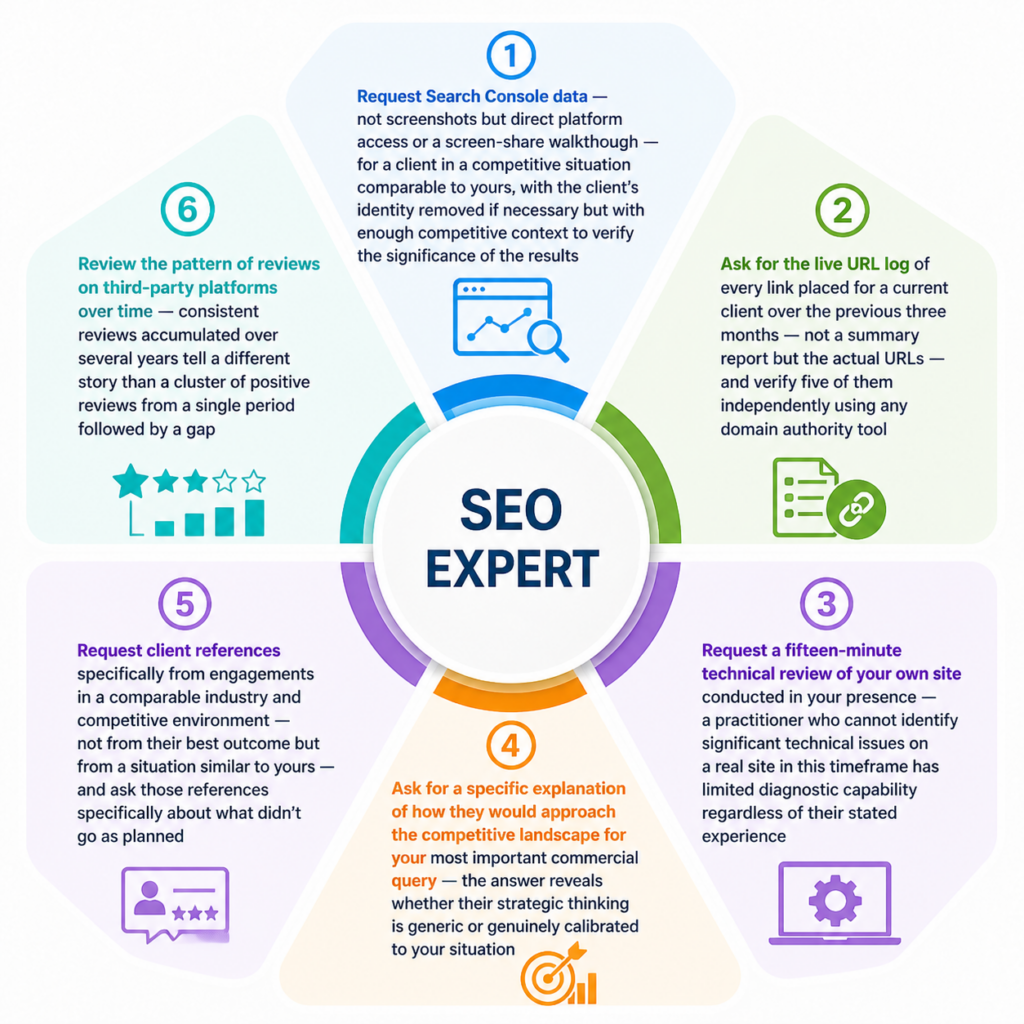
The evaluation process that most reliably separates capable practitioners from incapable ones runs through a specific sequence that differs meaningfully from standard hiring interviews. The goal is not to assess general knowledge — it is to assess whether the candidate can produce a specific outcome in a specific competitive environment, and whether the evidence they provide supports that claim.
- ► Request Search Console data — not screenshots but direct platform access or a screen-share walkthrough — for a client in a competitive situation comparable to yours, with the client’s identity removed if necessary but with enough competitive context to verify the significance of the results
- ► Ask for the live URL log of every link placed for a current client over the previous three months — not a summary report but the actual URLs — and verify five of them independently using any domain authority tool
- ► Request a fifteen-minute technical review of your own site conducted in your presence — a practitioner who cannot identify significant technical issues on a real site in this timeframe has limited diagnostic capability regardless of their stated experience
- ► Ask for a specific explanation of how they would approach the competitive landscape for your most important commercial query — the answer reveals whether their strategic thinking is generic or genuinely calibrated to your situation
- ► Request client references specifically from engagements in a comparable industry and competitive environment — not from their best outcome but from a situation similar to yours — and ask those references specifically about what didn’t go as planned
- ► Review the pattern of reviews on third-party platforms over time — consistent reviews accumulated over several years tell a different story than a cluster of positive reviews from a single period followed by a gap
How to find a good SEO expert through the evaluation process is largely a matter of asking questions that require specific answers rather than questions that invite impressive-sounding generalities. “What is your approach to link building?” produces a description of a methodology. “Can you show me the last ten links you placed and explain why you chose those targets?” reveals whether the methodology description corresponds to actual execution.
The evaluation question that reveals the most about a practitioner’s capability:
Ask them to describe a campaign that didn’t perform as expected and what they did about it. Practitioners with genuine experience have clear, specific answers to this question because setbacks in competitive campaigns are inevitable and how they are handled is precisely what distinguishes capable practitioners from those who manage good situations well but struggle when conditions are difficult. Practitioners who cannot describe a specific setback and their specific response to it have either limited experience or a managed presentation that isn’t showing you the full picture.
The question of how to hire the best seo consultant for your situation also involves understanding the difference between a generalist and a specialist. A generalist practitioner has experience across many industries and campaign types — which produces breadth of pattern recognition but can mean shallower knowledge of the specific competitive dynamics in your category. A specialist with concentrated experience in your industry — healthcare, legal, e-commerce, SaaS — brings depth that a generalist cannot fully replicate. For most businesses, the specialist is the better choice when one is available with a verifiable track record in the relevant vertical.
Review Management as Part of SEO Evaluation
Before you hire seo expert, checking their reputation through third-party review platforms is not optional — it is one of the most reliable signals available. The pattern of reviews over time, the specificity of the feedback, and the practitioner’s response to negative reviews all reveal things about their professional character that no interview or portfolio presentation can substitute for.
The primary tools for researching a practitioner’s reputation and for managing your own business’s review presence once the campaign is underway are:
- ► Clutch.co — the primary B2B review platform for agencies and senior consultants, with verified client identities and detailed project descriptions that provide specific outcome context
- ► Google Business Profile reviews — for practitioners with a local business presence, Google reviews provide accessible public feedback with verifiable timestamps
- ► Trustpilot — higher-volume consumer review platform that provides useful signals for agencies serving broader client bases
- ► LinkedIn recommendations — written endorsements from named colleagues and clients with verifiable professional identities provide higher-signal feedback than anonymous reviews
- ► Brand24 / Mention — brand monitoring tools that reveal where and how the practitioner or agency is discussed across the web beyond their own controlled platforms
KPIs, Contract Provisions, and Staying Aligned Throughout the Engagement
How to hire a SEO expert is only the first half of the challenge. The second half is structuring the engagement in a way that keeps both parties aligned on what success looks like and what happens if it doesn’t materialize on the agreed timeline. Most business owners who have had disappointing experiences with search specialists describe not a complete absence of activity but a gradual drift between what was promised and what was delivered — a drift that was never caught because there was no agreed measurement framework that would have made it visible.
The contract structure that prevents this drift has several mandatory elements. Specific deliverable quantities for every major campaign component — the exact number of links per month, the exact number of content pieces, the exact number of pages technically optimized, the keyword set being tracked. A performance milestone provision that defines what measurable outcome should be observable at defined intervals — not a promise of specific rankings, which no ethical practitioner can make, but a commitment to a defined level of campaign activity and a defined trajectory of performance improvement. Data ownership provisions confirming that you retain direct access to your own Search Console data throughout the engagement. And exit terms that allow you to terminate the engagement with no more than thirty to sixty days notice after any initial commitment period.
The KPIs that matter most are those that connect campaign activity to business outcomes rather than to activity metrics. Non-branded organic sessions trending upward month over month tells you that the campaign is expanding the site’s reach to people who didn’t already know you. Organic-attributed conversion events — contact form submissions, phone clicks, appointment bookings, purchases — connect the traffic to revenue potential. Cost per organic-sourced lead, calculated monthly and compared to the campaign investment, is the metric that tells you whether the program is producing returns that justify continuation relative to alternatives.
The KPIs that most often appear in reports but least reliably predict business outcomes are: total keyword rankings count (which can increase dramatically through rankings in positions forty through sixty that produce no actual traffic), domain authority score (which is a third-party estimate that doesn’t directly correlate with revenue), and raw organic sessions without conversion tracking (which measures traffic volume without any indication of whether that traffic has commercial relevance). When a practitioner’s monthly report is dominated by these metrics without connecting them to conversion data, ask specifically why conversion tracking is not the primary focus of the performance narrative.
The contract provision most business owners forget to include:
A clause confirming that all content produced during the engagement belongs to you — not to the agency or consultant — and that all platform access (Search Console, Google Analytics, Google Business Profile) remains in your ownership throughout the engagement and after it ends. Without this provision, some practitioners create dependencies that make it difficult or expensive to transition to a new provider. The practitioners with genuine delivery confidence have no reason to resist this clause — they want you to stay because the results are good, not because leaving is structurally difficult.
Finding the right find seo expert is ultimately a research and verification process rather than an inspiration process. The practitioners who are genuinely capable of producing the results you need are identifiable through the evidence they have accumulated, the specificity of their answers to specific questions, and the pattern of feedback from clients who have worked with them over extended engagements. None of these signals require exceptional technical knowledge to interpret — they require deliberate attention and the willingness to ask harder questions than most hiring processes include.
How to find a SEO expert who stays aligned throughout the engagement comes down to defining success clearly before the engagement starts and building the measurement infrastructure to verify whether that definition is being met. The specialists who resist that framework are the ones whose results don’t survive scrutiny. Those who embrace it — who help you define meaningful KPIs and build transparent reporting around them — are the ones worth hiring.
Why World SEO Agency for Your SEO Partnership
The framework described throughout this guide — specific deliverables, transparent reporting, performance accountability, aligned KPIs — is the operational model World SEO Agency was built around. Here is what working with us actually involves in practice.

→ 90-Day Performance Commitment
Every engagement includes documented performance milestones achievable within the first ninety days, written into the agreement with specific and verifiable targets. At the INDUSTRY LEADER tier, a financial performance commitment is tied to specific ranking targets for the agreed query set. The commitment is contractually backed — not a marketing phrase that disappears between the proposal and the contract. This is the standard that every business owner should require from any SEO partner, and it is the standard we hold ourselves to on every engagement.
→ Affordable Pricing
Pricing at World SEO Agency is structured around the actual scope required for the specific competitive environment — assessed honestly before any commitment is made. Every proposal includes itemized deliverable quantities. No add-ons appear at month three, no tool subscriptions are passed through as separate charges, and the total annual cost is calculable from the first conversation. Our starting retainer sits precisely in the $1,500 to $2,000 range identified throughout this guide as the optimal balance point between comprehensive scope and accessible investment.
→ All-Inclusive System Without Hidden Payments
Technical work, content production, link acquisition, local optimization, reporting, and account management are all included in the monthly package price. One invoice. Same amount. Every month. The structure eliminates the supplementary billing model that inflates the effective cost of most agency engagements well above their headline prices and creates the billing surprises that undermine client confidence in otherwise productive relationships.
→ Working in the USA and Worldwide
World SEO Agency serves clients across the United States — New York, Los Angeles, Chicago, Houston, Miami, Dallas, Phoenix, Seattle, Atlanta, and San Diego — and internationally in London, Dubai, Sydney, Toronto, and Singapore. For businesses evaluating whether local market knowledge matters for their specific campaign objectives, these are active operating markets with established editorial relationships and competitive landscape knowledge, not occasional project locations.
Want to order SEO services for your business? Get a consultation from a World SEO Agency expert. Send a request.
Frequently Asked Questions
What is the most reliable way to verify that a practitioner’s case studies are genuine and current?
Request a screen-share walkthrough of Search Console data for the client referenced in the case study — not a PDF export, but the live platform — with enough competitive context to assess the significance of the results. Ask what the site’s traffic and ranking profile looked like when the campaign started, what the competitive landscape looked like at that point, and what the current performance is. Practitioners with genuine results can answer all three parts of this question in specific detail. Those with curated case studies that don’t reflect current performance typically cannot.
Is it better to hire seo expert as a freelancer or through an agency for an ongoing campaign?
For campaigns requiring coordinated execution across multiple components simultaneously — technical work, content production, link building, and reporting all running in parallel — an agency model provides the execution capacity that a solo freelancer structurally cannot match regardless of their individual skill level. For strategic advisory, diagnostic work, or campaigns in categories where one practitioner’s deep expertise is more valuable than coordinated multi-person execution, a senior freelancer or consultant may be the better choice.
The hybrid model — where a senior practitioner provides strategic direction and a small specialized team handles execution — produces the best outcomes for most mid-market businesses. This is effectively what most boutique agencies with senior leadership provide at the $1,500 to $3,000 monthly tier.
How do I know if the SEO consultant I am evaluating is keeping up with current algorithm changes?
Ask them specifically how the last two major Google core updates affected their client campaigns and what adjustments they made in response. The practitioners who track algorithm updates actively can describe the impact on specific client verticals and the specific strategy changes they implemented. Those who don’t can describe the update in general terms — because that information is publicly available — but cannot describe specific campaign-level responses because they didn’t have any.
What should I do if my campaign is three months in and I’m not seeing any results?
First, distinguish between absence of results and absence of activity. Request a complete deliverable log — every link placed with live URLs, every piece of content published with performance data, every technical change implemented with before-and-after data. If the contracted scope was delivered as promised, three months is typically within the normal ramp-up period for organic campaigns and is not grounds for cancellation. If the scope was not delivered, you have contractual grounds for remediation regardless of timeline.
Can a practitioner who does well on their own website necessarily replicate those results for clients?
Partially but not completely. A practitioner who ranks their own site for competitive queries demonstrates real capability — they cannot have faked their own organic performance. But managing their own content strategy and managing campaigns across different client industries, competitive situations, and site architectures simultaneously requires coordination and execution capacity that solo self-optimization doesn’t develop. Verify client results independently rather than treating self-site performance as a complete proxy for client delivery capability.