


 Get to WhatsApp

Our manager will contact you
within 15 minutesт
What is SEO? A Complete Guide to Search Engine Optimization in 2026
14 Years of SEO Expertise Distilled Into One Guide. Learn What Actually Works
What is SEO? A Complete Guide to Search Engine Optimization
Over 14 years of practice, more than a thousand websites promoted, millions of dollars spent on link experiments, and work across dozens of industries — I accumulated all of this so you don’t have to start from scratch. This guide is the concentrated result of that experience. What is SEO in a deeper sense than it first appears, how the sequence of work actually functions, and what the main secret is: you need to practice search optimization consistently and organically, extracting maximum value from each tool and stage — first internal optimization until you reach a defined traffic threshold, then developing the blog and scaling the project, then organic link building, then paid links and additional tools to grow domain trust and increase your sales. Now, in order, in full detail.
— What is SEO — a working definition beyond the textbook version.
— How search engines actually work and what they are trying to do.
— How does SEO work in practice — the three-layer model.
— Technical SEO: the foundation everything else depends on.
— On-page SEO: optimizing what search engines read on your pages.
— Off-page SEO and link building: how authority is built externally.
— Local SEO: ranking where geography determines the outcome.
— Content strategy: the long game that compounds over time.
— Keyword research: how to find what your audience is actually searching for.
— The tools SEO practitioners use to research, monitor, and improve campaigns.
— Measuring SEO performance: what matters and what doesn’t.
— AI search and what it changes about optimization strategy.
— Why is SEO important — and why the case for it keeps getting stronger.
— Frequently asked questions.
What Is SEO — A Working Definition Beyond the Textbook Version
Let me give you the SEO definition that actually reflects how the discipline functions rather than how it is described in introductory marketing courses. Search Engine Optimization is the practice of structuring a website — its technical architecture, its content, and its external authority signals — in a way that makes it the most credible and accessible answer to a specific category of user queries. That is the complete version. Everything else — the keyword tactics, the link acquisition strategies, the Core Web Vitals targets — is implementation detail in service of that single objective.
The introductory version — “getting your website to rank higher on Google” — is not wrong, but it is incomplete in ways that lead to poor decisions. It implies that ranking is the goal when it is actually the mechanism. The goal is commercially relevant organic traffic that converts to customers. Rankings are what produce that traffic. The distinction matters because it changes what you optimize for: a site that ranks first for a query nobody searches, or that ranks for queries that attract browsers rather than buyers, has achieved the ranking objective and failed the business objective simultaneously.
The working definition that guides good campaigns:
What is SEO in the sense that actually matters for a business? It is the systematic process of making your website the most credible, accessible, and useful answer to the queries your prospective customers use when they are looking for what you sell. Everything else — the technical work, the content creation, the link acquisition — is infrastructure in service of that outcome. When you lose sight of it, campaigns drift toward vanity metrics and away from revenue.
The phrase “what is SEO marketing” comes up frequently in this context, and it is worth addressing directly. Search optimization is not separate from marketing — it is a marketing discipline that operates through organic search channels rather than paid ones. The distinction is that paid search requires continuous investment to maintain visibility: stop spending, stop appearing. Organic search builds authority over time that continues producing visibility after the initial investment has been made. This compounding characteristic is what makes well-executed organic campaigns eventually produce the lowest cost per acquired customer of any digital marketing channel.
The formal name — Search Engine Optimization — signals something important about its scope. It is not search engine ranking. It is optimization, which implies a continuous process of improvement across multiple dimensions simultaneously. A campaign that fixes technical issues in month one and then considers the technical component “done” is not optimizing — it is completing a task. Genuine optimization involves ongoing monitoring, iteration, and adaptation as the competitive landscape, the algorithm, and the site itself evolve. The campaigns that produce durable results are those designed around this continuous improvement model rather than around a fixed list of tasks to complete.
How Search Engines Actually Work and What They Are Trying to Do
Before understanding what is seo and how it works, you need to understand what a search engine is trying to accomplish — because the entire discipline is built around serving that objective better than competing websites do. A search engine is fundamentally a recommendation system. When a user submits a query, the system attempts to identify the most useful response from the full universe of indexed content and present it in the order of estimated relevance and credibility. The ranking is the recommendation. The optimization is the practice of making your content a better recommendation candidate for the specific queries you care about.
The technical process runs in three stages. Crawling: search engine bots traverse the web by following links from page to page, discovering and retrieving content. Indexing: the retrieved content is analyzed, categorized, and stored in a massive database organized for rapid retrieval based on query signals. Ranking: when a user submits a query, the system retrieves the most relevant candidates from the index and orders them according to hundreds of signals designed to estimate which result will best serve the user’s intent.
The signals that influence ranking fall into three broad categories: relevance signals (does this page address what the user is looking for?), authority signals (is this page from a credible source on this topic?), and quality signals (is this page technically accessible, user-friendly, and substantively valuable?). Effective search optimization improves the site’s performance across all three simultaneously rather than focusing on one to the exclusion of the others.
What search engines cannot do that matters for your strategy:
Search engines cannot directly observe whether a user found an answer useful — they can only observe behavioral signals that correlate with satisfaction, like whether the user clicked back to the results page immediately after visiting a site. This is why user experience quality matters to rankings: a page that technically answers a query but is frustrating to navigate produces behavioral signals that indicate low satisfaction, and those signals feed back into ranking decisions over time.
How Does SEO Work in Practice — The Three-Layer Model
What is seo in digital marketing when you strip away the category definitions and look at the actual work? It operates through three interconnected layers that must all be functional for a campaign to produce durable results. No single layer is sufficient on its own. Technical excellence without content gives search engines nothing to rank. Content without technical accessibility gives search engines nothing to crawl. Both without external authority gives search engines no signal that the site should be trusted over established competitors. The three layers work together or they don’t work at all.
The sequence in which these layers are developed matters. Technical foundation first — a site that cannot be efficiently crawled and rendered cannot benefit from content or link investment regardless of quality. On-page optimization second — ensuring the content that exists is properly structured and aligned with the queries it is intended to serve. Content development third — expanding the site’s topical coverage to capture a wider range of commercially relevant queries. External authority building fourth — acquiring the editorial credibility signals that allow the site to compete against established incumbents. This sequence is not arbitrary; it reflects the dependency structure of the discipline.
| SEO Component | What It Covers | Primary Ranking Signal It Addresses |
|---|---|---|
| Technical SEO | Crawlability, site speed, indexation, schema, mobile | Accessibility and quality signals |
| On-page optimization | Title tags, headings, internal links, content structure | Relevance signals |
| Content creation | Blog, service pages, landing pages, guides | Relevance and topical authority |
| Link building | Editorial links from credible external sites | Authority signals |
| Local SEO | Google Business Profile, citations, reviews | Geographic relevance and trust |
| Keyword research | Query intent analysis, volume, competition | Strategic targeting foundation |
| Core Web Vitals | LCP, INP, CLS — user experience performance | Page experience signals |
| E-E-A-T development | Author credentials, entity signals, trust markers | Expertise and trustworthiness signals |
| Analytics and tracking | GA4, Search Console, rank tracking, conversion events | Performance measurement and iteration |
| International SEO | Hreflang, multilingual architecture, market-specific content | Geographic and language targeting |
1) Technical SEO: The Foundation Everything Else Depends On
Technical SEO addresses the infrastructure that allows search engines to efficiently discover, crawl, render, and index your site’s content. It is the least visible component of the discipline from a user perspective — most of what happens here is invisible to anyone visiting the site — but it is the most foundational. A technically broken site cannot benefit from excellent content or strong link profile. The content exists; the links exist; but the machinery that allows search engines to access and evaluate that content is compromised, so the investment in the other components produces reduced returns.
The components that most frequently cause technical problems on real sites are crawl budget misallocation — where search engine bots waste their crawl allocation on irrelevant or duplicate pages instead of discovering and indexing commercially important ones — JavaScript rendering delays that prevent content from being accessible to crawlers, page speed issues that produce poor Core Web Vitals scores and signal a poor user experience, indexation problems where important pages are being excluded from the index through misconfigured robots.txt or incorrect noindex tags, and redirect chain accumulation that builds up over time as sites are restructured without proper redirect management.
- ► Crawl efficiency audit — identifying which pages are consuming crawl budget and whether they deserve to, versus pages that should be indexed but are not being prioritized
- ► JavaScript rendering assessment — confirming that page content rendered by JavaScript is accessible to search engine bots, not just to browsers
- ► Core Web Vitals measurement and remediation — addressing the Largest Contentful Paint, Interaction to Next Paint, and Cumulative Layout Shift scores that affect page experience ranking signals
- ► Structured data implementation — adding schema markup that helps search engines understand page content type, entity relationships, and content specifics that improve rich result eligibility
- ► Duplicate content identification and management — consolidating duplicate page versions through canonical tags and redirect implementation to prevent authority fragmentation
- ► Mobile optimization verification — confirming that the mobile version of every important page is fully functional and provides a complete content experience
For websites built on WordPress — which powers a significant proportion of the sites that come through for optimization work — the technical SEO considerations have some platform-specific dimensions. The guide to WordPress SEO covers the platform-specific technical optimization work in detail, including plugin configuration, theme performance considerations, and the common technical issues that appear specifically on WordPress-based sites.
2) On-Page SEO: Optimizing What Search Engines Read on Your Pages
On-page optimization is the work of ensuring that the content which exists on your site is structured, labeled, and written in a way that clearly communicates its relevance to the queries it is intended to serve — without the stuffed, awkward keyword repetition that characterized early search optimization and that modern algorithms actively penalize. The challenge in this area is not technical; it is editorial. Writing content that is simultaneously useful to human readers and clearly structured for machine interpretation requires a level of skill that many practitioners underestimate.
The elements that matter most in on-page optimization are: the title tag (the headline that appears in search results, which should include the primary target query in a form that accurately represents the page’s content and invites the click), the heading structure (which gives both readers and crawlers a structural map of the page’s topic coverage), the internal linking architecture (which passes authority between pages and helps crawlers discover the full scope of the site’s content), and the content itself — which should be substantive, specific, and written to genuinely address the user’s intent rather than to achieve a keyword density target.
The complete On-Page SEO checklist covers every element worth auditing and optimizing, from the meta description to the image alt text to the URL structure. It is a practical reference rather than a theoretical overview — organized around the actual sequence of work a practitioner follows when optimizing a page for a target query.
The on-page principle that most practitioners get wrong:
Keyword placement is not the goal of on-page optimization. It is a side effect of writing content that genuinely addresses the user’s intent. When you write specifically and substantively about a topic, the relevant terms appear naturally because they are the language of the subject matter — not because you inserted them at calculated intervals. The pages that rank best for competitive queries are almost always the ones that are most genuinely useful, not the ones that are most precisely keyword-optimized.
3) Off-Page SEO and Link Building: How Authority Is Built Externally
External authority signals — primarily inbound links from credible, relevant websites — are the component of the discipline that most directly addresses the question of why one website should be trusted over another for a given query. A search engine can evaluate the content quality and technical health of any page it crawls. What it cannot directly evaluate is whether that content is genuinely credible and trusted by the community of experts and publishers relevant to the topic. Links from those experts and publishers are the proxy signal that answers that question.
The economic reality of link building is that quality is measured by the credibility of the source, the editorial independence of the placement, and the relevance of the linking site to the topic of the linked page. A link from a major industry publication that editorially decided your content was worth citing contributes meaningfully to domain authority. A link from a directory or a forum that accepts submissions from anyone contributes minimally. The difference in value is substantial — which is why campaigns that prioritize link quantity over link quality consistently underperform those that acquire fewer but more credible placements.
The full guide to what is link building covers the methodology, the quality evaluation framework, and the specific outreach approaches that produce editorial placements in real publications rather than paid placements that are labeled as editorial.
The sequence of link building investment matters significantly. Organic link acquisition — earning links through content quality without direct outreach — should be established before paid editorial placement campaigns are scaled. A domain that receives a sudden influx of paid editorial links without any organic link history looks different to algorithm monitoring than one with an established organic link velocity pattern that is supplemented by editorial placements. Starting with organic, building the velocity pattern, and then adding editorial campaigns is the sequence that produces the most durable authority gains.
4) Local SEO: Ranking Where Geography Determines the Outcome
For businesses that serve customers in defined geographic areas — a law firm, a medical practice, a home services company, a restaurant — local SEO is not a specialized niche of the broader discipline. It is the primary version of it. The queries that matter most to a Houston personal injury attorney are not the national queries about personal injury law in general. They are the geographically bounded queries submitted by people in the city who have an immediate, specific legal need. Ranking for those queries requires a different set of signals than ranking for national informational queries.
The map pack — the set of three business listings that appears prominently for local-intent queries, typically above the organic results — operates on a different ranking algorithm than traditional organic search. Map pack positions respond primarily to Google Business Profile signals (how complete, active, and reviewed the profile is), local citation consistency (how consistently the business’s name, address, and phone number appear across local directories and data sources), review quantity and recency, and the geographic proximity of the searcher to the business location.
The comprehensive local SEO guide covers the full methodology — from Google Business Profile optimization to citation building to review acquisition strategy — with enough specificity to implement a complete local campaign rather than just understand the concept.
5) Content Strategy: The Long Game That Compounds Over Time
What is SEO marketing without a content strategy? Incomplete. The content layer of an organic campaign is what expands the site’s coverage of commercially relevant queries beyond the initial set of service and product pages, builds the topical authority that signals genuine expertise to search algorithms, and creates the opportunities for organic link acquisition that paid editorial placements cannot fully replicate. A site with a hundred well-executed service pages and no supporting content is limited in both the range of queries it can rank for and the authority it can accumulate.
The content strategy sequence I have found most productive across hundreds of campaigns runs as follows: optimize existing pages first — ensure that what the site already has is performing as well as it can before creating new content. Then identify the informational queries that prospective customers submit during the research phase of their decision process — the questions they ask before they are ready to hire or buy. Then build a content program that systematically answers those questions with genuinely useful, well-researched content. Then monitor which pieces are gaining traction and build deeper coverage of the topics where search demand exists and authority is beginning to accumulate.
- ► Service page cluster architecture — organizing content around core service categories with supporting pages addressing sub-topics and specific use cases
- ► Informational blog targeting research-phase queries — capturing prospective customers months before they are ready to make a purchase decision
- ► Content refresh cycles for existing pages — updating older content that has accumulated indexation history and ranking momentum but needs updating to maintain position
- ► Competitive content gap analysis — identifying topics competitors cover that the site does not, representing ranking opportunities that are not currently being pursued
- ► Content format diversification — producing guides, comparison pages, FAQ content, and data-driven pieces alongside standard blog articles to serve different query types
6) Keyword Research: Finding What Your Audience Actually Searches For
Keyword research is the analytical foundation of every other content and optimization decision. It is the process of identifying the specific queries prospective customers submit when they are looking for what you sell, understanding the intent behind those queries, assessing the competitive difficulty of ranking for them, and prioritizing the ones that represent the best combination of commercial relevance, search volume, and realistic attainability given the site’s current authority level.
The intent classification is the most important output of keyword research for campaign strategy. Queries can be navigational (the user is trying to reach a specific site), informational (the user is seeking an answer or explanation), commercial (the user is comparing options before making a decision), or transactional (the user is ready to take an action — hire, buy, contact). Each intent type requires different content to serve it well, and confusing them produces pages that technically address a topic but don’t serve the user’s actual purpose — which produces poor behavioral signals and suppressed rankings.
The beginner’s guide to keyword research for beginners covers the full process from query discovery through intent classification through prioritization, using the free and paid tools available to practitioners at different budget levels. The Google Keyword Planner tutorial specifically addresses the free tool available through Google Ads that provides search volume data directly from the source rather than from third-party estimates.
The keyword research mistake that costs the most money:
Targeting high-volume queries before the site has the authority to compete for them. A new site targeting “personal injury lawyer” in a major US city is competing against domains with thousands of referring links accumulated over years. The investment in content and technical optimization for that query produces nothing while the authority gap exists. The rational approach is to target lower-competition, longer-tail queries first — build rankings, accumulate traffic, demonstrate engagement quality to the algorithm — and then move toward more competitive terms as the domain authority grows.
The Tools SEO Practitioners Actually Use
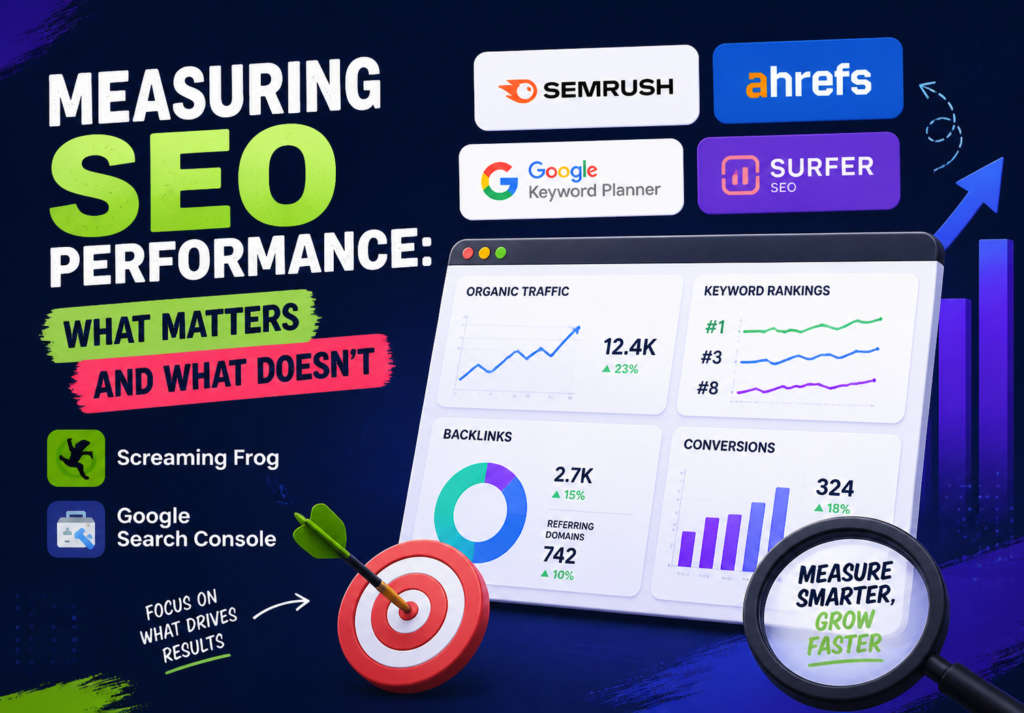
The tooling available for organic search campaign management spans a wide range of price points and capability levels. The mistake most people make when evaluating these tools is treating them as substitutes for strategic thinking rather than as instruments for gathering and processing data more efficiently than manual methods allow. A tool tells you what is happening. The practitioner’s judgment tells you what to do about it.
| Tool / Platform | Primary Use Case | Approximate Cost |
|---|---|---|
| Google Search Console | Indexation monitoring, query performance, crawl issues | Free |
| Google Analytics 4 | Traffic analysis, conversion tracking, user behavior | Free |
| Ahrefs | Backlink analysis, keyword research, competitor intelligence | $99 – $999/month |
| Semrush | Keyword research, site audit, position tracking | $120 – $450/month |
| Screaming Frog | Technical site crawl, on-page audit, redirect analysis | Free (500 URLs) / $259/year |
| Google PageSpeed Insights | Core Web Vitals assessment, speed optimization recommendations | Free |
| Google Keyword Planner | Search volume data, keyword discovery from Google’s own data | Free (Google Ads account required) |
| Rank tracking platforms | Daily position monitoring for target keyword sets | $30 – $200/month |
| Surfer SEO / Clearscope | Content optimization scoring against competing pages | $49 – $350/month |
For tracking how your site currently ranks across your target query set, the guide to how to check your website positions covers the tools and methods available at different budget levels, from free manual checks to automated rank tracking platforms that monitor hundreds of keywords daily across multiple devices and locations.
Measuring SEO Performance: What Matters and What Doesn’t
The metrics that get reported most frequently in monthly dashboards are not always the ones that most directly connect campaign activity to business outcomes. Keyword rankings are useful for understanding whether specific pages are moving in the right direction, but ranking position is a means to an end rather than the end itself. A site that improves its rankings for queries that attract browsers rather than buyers has improved a metric without improving its business. The metrics that matter are those that trace the path from organic search activity to commercial outcome.
Non-branded organic sessions — traffic from people who don’t already know your brand — is the metric that most directly reflects whether the campaign is expanding the site’s reach to new prospective customers. Organic-attributed conversion events — contact form submissions, phone clicks, purchase completions, appointment bookings — connect the organic traffic to the actions that produce revenue. Cost per organic-sourced lead, calculated monthly and compared against the campaign investment, is the metric that tells you whether the investment is producing returns that justify its continuation relative to alternatives.
The full breakdown of what different investment levels realistically produce and at what timelines is covered in the guide to how much does SEO cost — which approaches the pricing question from the standpoint of what different budgets actually buy in terms of scope and expected outcome, rather than just quoting market price ranges without context.
| Implementation Stage | Recommended Tools | Average Monthly Investment |
|---|---|---|
| Technical audit and remediation | Screaming Frog, PageSpeed Insights, Search Console | $300 – $1,500 (one-time or quarterly) |
| Keyword research and content planning | Ahrefs, Semrush, Google Keyword Planner | $150 – $600 (tool cost component) |
| On-page optimization (10–20 pages) | Surfer SEO, Screaming Frog, Search Console | $400 – $1,200 |
| Content creation (3–4 articles/month) | Clearscope, Surfer, GA4 for performance tracking | $800 – $2,500 |
| Organic link acquisition | Ahrefs (prospecting), Hunter.io (outreach) | $600 – $2,000 |
| Editorial (paid) link placements | Ahrefs (quality vetting), Semrush (domain analysis) | $1,000 – $5,000+ |
| Local SEO (Google Business + citations) | Brightlocal, Whitespark, GBP dashboard | $200 – $800 |
| Rank tracking and monitoring | Semrush, Ahrefs, SerpWatch, Nightwatch | $30 – $200 |
| Conversion rate optimization | Hotjar, GA4, Optimizely, VWO | $100 – $500 (tool) + implementation |
| Reporting and analytics | GA4, Looker Studio, Search Console, DataBox | Free – $200 |
| International SEO architecture | Ahrefs, Semrush, hreflang validator tools | $1,500 – $5,000 (setup) + ongoing |
| Schema markup implementation | Schema.org validator, Google Rich Results Test | $200 – $800 (one-time or phased) |
| Review management | Brand24, Podium, ReviewTrackers, Trustpilot | $50 – $300 |
| E-E-A-T and entity signals | Manual audit, Wikipedia, Wikidata, structured author pages | Time investment — minimal tool cost |
| AI search visibility optimization | Manual prompt testing, GA4 referral tracking, brand monitoring | $100 – $400 |
AI Search and What It Changes About Optimization Strategy
The emergence of AI-generated search responses — Google’s AI Overviews, ChatGPT with browsing, Perplexity — is changing the visibility landscape in ways that require an expansion of the traditional optimization framework rather than a replacement of it. The fundamental shift is that a meaningful proportion of informational queries that previously produced a list of blue links now produce a generated summary that answers the question without requiring the user to click anywhere. Being cited within that summary is a form of visibility that exists alongside rather than instead of traditional organic ranking.
What is good seo in an environment where AI-generated summaries intercept a portion of search traffic? It is optimization that serves both traditional ranking algorithms and the retrieval systems that generate AI responses — because the signals that make content a credible source for generated summaries are largely the same signals that produce strong traditional rankings, with some specific additions. Content that is factually grounded, clearly attributed to named experts, structured around direct answers to specific questions, and hosted on a domain with established topical authority is the content that performs well in both environments simultaneously.
The full guide to AI search optimization covers the specific content formatting requirements, structured data implementations, and entity authority signals that influence citation frequency in AI-generated responses across Google, ChatGPT, and Perplexity. The core finding is that the investment in content quality and external authority that drives traditional rankings also drives AI citation frequency — the two optimization objectives are more complementary than they are competing.
The AI search change that matters most for established sites:
AI Overviews are appearing for a growing proportion of informational queries, and they appear above organic results. For sites that rank organically for informational queries, this means the click-through rate from those rankings is being suppressed by the overview that sits above them. The strategic response is not to stop targeting informational queries — it is to get cited within the overviews rather than just ranking below them, which requires content formatting and attribution signals that traditional on-page optimization doesn’t fully address.
Why Is SEO Important — And Why the Case for It Keeps Getting Stronger
Why is seo important in an environment where paid search can produce immediate results and social media platforms can generate significant traffic through content distribution? The answer is the economics of compounding. Paid search produces traffic as long as the campaign runs and not a day longer. Social media produces traffic as long as the content is being actively promoted and the platform’s algorithm is favoring it. Organic search builds authority over time that continues producing traffic after the initial investment has been made — and that authority becomes progressively more difficult for competitors to replicate as it accumulates.
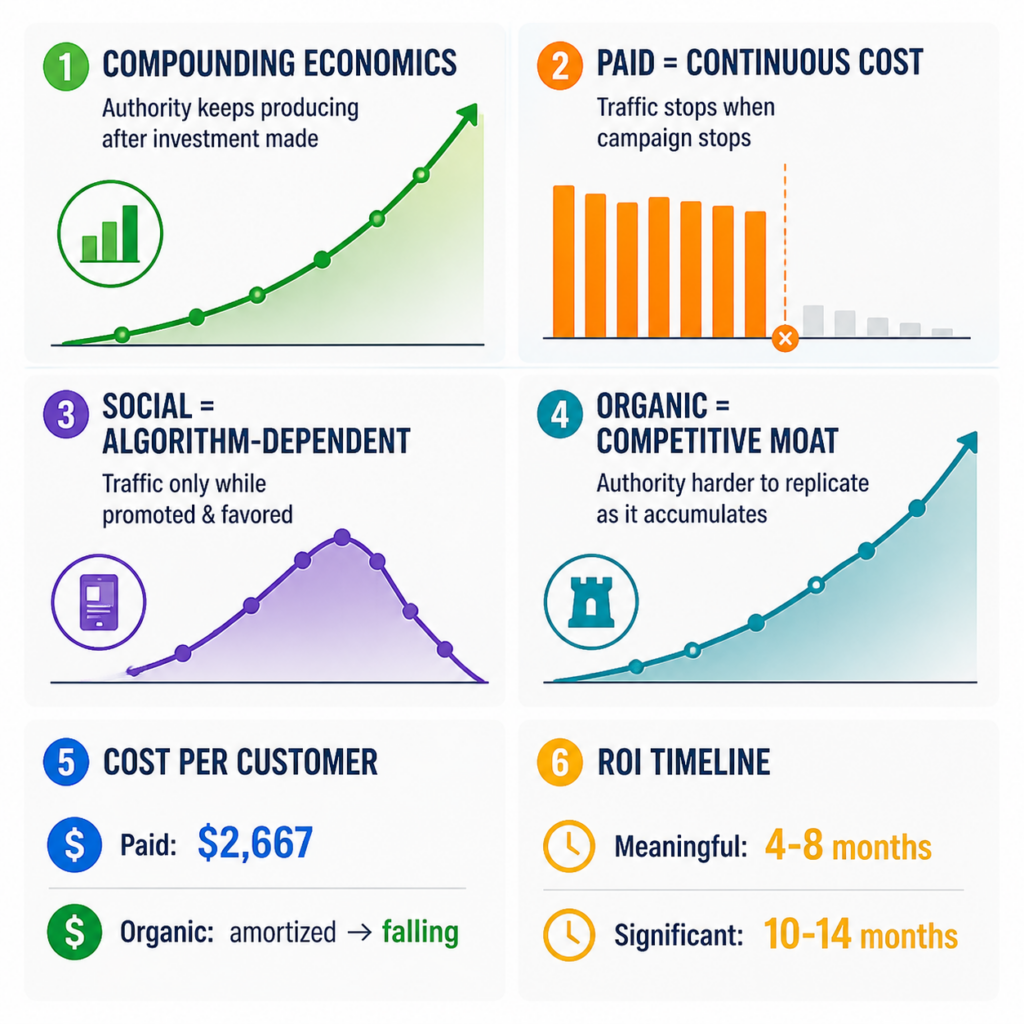
The cost per acquired customer comparison tells the story most clearly. In competitive markets, paid search cost per click for commercial intent queries can reach $30 to $150. A business paying $80 per click and converting at three percent is paying $2,667 per acquired customer in media costs alone, before accounting for management fees. A business that has invested in organic authority and is acquiring customers through unpaid search at the same conversion rate has a media cost of zero per click — the cost per acquisition is the amortized campaign investment divided by the number of customers produced, and that number continues falling as the campaign matures and the content library expands.
The timeline required to reach the positive ROI threshold — and what to expect at each stage of an organic campaign’s development — is covered in detail in the guide to how long does SEO take to show results. The honest answer is that it depends on the competitive situation, the site’s starting authority level, and the investment level of the campaign — but the typical range for meaningful results in moderately competitive markets is four to eight months, with significant ROI typically emerging in months ten through fourteen.
Reviews and Reputation as SEO Signals
Customer reviews are a factor in organic visibility that most businesses underinvest in systematically. For local businesses, review quantity, recency, and average rating are direct map pack ranking signals. For all businesses, review content that describes specific outcomes, specific service attributes, and specific expertise areas contributes to the entity authority signals that both traditional algorithms and AI retrieval systems evaluate when deciding whether a source is credible.
The tools that most effectively support review acquisition and management at scale are:
- ► Google Business Profile dashboard — primary platform for review monitoring and response management for any business with a physical location or local service area
- ► Podium — multi-platform review request automation that sends review invitations via SMS at defined points in the customer journey
- ► ReviewTrackers — multi-platform review monitoring and response management for businesses with presence across many review platforms simultaneously
- ► Trustpilot — high-domain-authority third-party review platform that contributes to entity credibility signals for businesses in categories where it is the standard reference
- ► Brand24 / Mention — brand monitoring tools that track where and how the business is mentioned across the web, which feeds the upstream signals that influence entity authority
The review content quality principle is worth stating explicitly: a review that says “great service, highly recommend” contributes minimally to entity authority. A review that says “they handled our contested estate case with a level of technical knowledge that made the outcome possible — the specific expertise in inter-state trust law was what made the difference” tells an AI retrieval system that this entity is credible in a specific domain. Encouraging clients to describe their specific experience rather than just their satisfaction level produces review content that is more useful both for prospective customers and for the algorithmic systems that evaluate entity credibility.
DIY SEO vs Hiring a Professional: An Honest Assessment
The question of whether to manage organic search campaigns internally or hire a professional is more nuanced than most coverage suggests. The honest answer depends on the specific situation: the competitive intensity of the target market, the technical complexity of the site, the availability of internal time and expertise, and the speed at which results are needed. There is no universal answer — there is only the right answer for a specific set of circumstances.
For businesses in low-competition niches with founders or team members willing to invest ten to fifteen hours per week in learning and executing the discipline, DIY organic optimization is a legitimate path. The guide to DIY SEO covers what is realistically achievable through self-managed campaigns, what the skill acquisition curve looks like, and where the limits of self-managed optimization typically appear as competitive intensity increases. For businesses in competitive markets where established competitors have years of content investment and strong authority profiles, professional management is almost always the more cost-effective path — not because internal execution is impossible but because the opportunity cost of the time required and the cost of learning through expensive trial and error typically exceeds the cost of professional management.
For businesses that want professional management but are evaluating how to identify a capable provider rather than just a well-marketed one, the guide to how to choose an SEO agency covers the evaluation framework — what questions to ask, what results evidence to request, and what contract provisions to insist on before committing budget to any provider.
The DIY ceiling that most self-managed campaigns hit:
Technical and on-page optimization are learnable by any intelligent person willing to invest the time. Content creation is learnable if you are a capable writer in the relevant subject matter. Link building — the component most directly responsible for competitive authority — is the area where self-managed campaigns most consistently hit a ceiling. Building genuine editorial relationships with publications that will link to your content requires experience, outreach skills, and an existing network that takes years to develop. This is the gap that most often justifies professional support even for businesses that prefer to manage other components internally.
What Good SEO Actually Looks Like Over Time
What is good seo in the sense of what it looks like in practice rather than in principle? It looks like a site whose organic traffic grows consistently month over month — not in a straight line, because algorithm updates and seasonal patterns create variability, but in a clear upward trend over quarters and years. It looks like an expanding portfolio of keyword rankings across commercial and informational queries, with an increasing proportion of those rankings in the top ten positions for commercially relevant terms. It looks like organic-attributed conversion events growing in proportion to the traffic growth, indicating that the traffic being acquired is genuinely relevant to the business’s customer profile.
It also looks like a campaign that adapts. Algorithm updates happen several times per year, and major updates can significantly reshuffle rankings for sites whose profiles don’t align with the updated quality signals. A campaign managed by practitioners who monitor these changes, understand their implications, and adapt strategy accordingly maintains its trajectory through update cycles. A campaign managed by practitioners applying fixed methodology regardless of the evolving environment loses ground to competitors who adapt faster.
The define SEO question — asked in its deepest form — is really asking: what separates organic search programs that produce durable business value from those that produce temporary metric improvements followed by stagnation or loss? The answer is the same across every successful campaign I have seen over fourteen years: consistent, coordinated work across all three layers — technical, content, and authority — executed by people who understand the system deeply enough to know when to push harder and when to change direction, sustained through the compounding phase long enough for the investment to produce returns that significantly exceed what any alternative acquisition channel delivers at equivalent investment levels.
What is SEO marketing when it is working correctly:
It is the most cost-effective customer acquisition channel available to most businesses in competitive markets — not immediately, but over the twelve to twenty-four months that it takes for compounding authority and content investment to produce returns that exceed alternatives. The businesses that understand this and commit to the timeline consistently outperform those that approach organic search as a quarterly experiment rather than a multi-year infrastructure investment.
Why World SEO Agency
What is seo in digital marketing without a capable execution partner? An expensive experiment. World SEO Agency was built around the operational principles described throughout this guide — technical depth, content quality, authority building through genuine editorial relationships, and complete transparency about what is being done and why. Here is what working with us actually involves.

1) 90-Day Performance Commitment
Every engagement includes documented performance milestones achievable within the first ninety days, written into the agreement with specific and verifiable targets. At the INDUSTRY LEADER tier, a financial performance commitment is tied to specific ranking targets for the agreed query set. The commitment is contractually backed — not a marketing phrase attached to a proposal that disappears before the contract is signed. For context on what performance commitments in this industry actually mean and which ones are enforceable, the guide to SEO timelines and realistic expectations provides the framework for evaluating any provider’s performance language against what the evidence actually supports.
2) Affordable Pricing
Pricing at World SEO Agency reflects the actual scope required for the specific competitive environment — assessed honestly before any commitment is made. Every proposal includes itemized deliverable quantities. The total annual cost is calculable from the first conversation. No add-ons appear at month three, no tool subscriptions are passed through as separate charges, and no content charges above the included quota appear on any monthly invoice. For businesses evaluating what a complete campaign realistically costs at different investment levels, the guide to how much does SEO cost covers the full pricing landscape with specific scope context at each tier.
3) All-Inclusive System Without Hidden Payments
Technical work, content production, link acquisition, local optimization, reporting, and account management are all included in the monthly package price. One invoice. Same amount. Every month. The structure eliminates the supplementary billing model — where agencies charge a headline retainer and then add content, links, and tools as separate line items — that inflates the effective cost of most agency relationships well above their advertised prices.
4) Working in the USA and Worldwide
World SEO Agency serves clients across the United States — with active campaigns in New York, Los Angeles, Chicago, Houston, Miami, Dallas, Phoenix, Seattle, Atlanta, and San Diego — and internationally in London, Dubai, Sydney, Toronto, and Singapore. For businesses evaluating whether international campaign management requires a provider with genuine cross-market experience rather than domestic methodology applied without adaptation, the distinction matters in both strategy and execution.
Want to order SEO services for your website? Get a consultation from a World SEO Agency expert. Send a request.
Frequently Asked Questions
Is it possible to do SEO without any paid tools, and how far can you get?
Yes — Google Search Console, Google Analytics 4, Google Keyword Planner, and Google PageSpeed Insights are all free and together cover the most critical monitoring and research functions. The limitations appear in competitive intelligence: free tools don’t give you the depth of competitor backlink analysis, keyword difficulty scoring, and content gap identification that paid platforms like Ahrefs or Semrush provide. For low-competition niches, free tools are sufficient. For competitive markets, the paid platform investment is typically recovered quickly in campaign efficiency gains.
What is the biggest misconception about how quickly SEO produces results?
That month three is a meaningful evaluation point. The most common reason organic campaigns are abandoned prematurely is that practitioners or clients evaluate performance at three months and conclude it isn’t working — right at the boundary where the compounding effect is beginning to develop but hasn’t yet produced the traffic volume that makes it visible in analytics. The businesses that maintain their campaigns through month six consistently report results that month-three evaluators never see.
Technical remediation can produce ranking improvements within weeks of implementation. Content-led authority growth operates on a multi-month timeline. External authority building compounds over quarters and years. Each layer has its own timeline, and a complete campaign produces a rolling series of improvements rather than a single moment of visible change.
Does the size of a website affect how SEO works for it?
Substantially. Large sites — e-commerce platforms with hundreds of thousands of product pages, news publishers with millions of articles — face technical challenges that small sites don’t encounter: crawl budget management, duplicate content at scale, faceted navigation issues, and internal link equity dilution across an enormous page count. The optimization priorities for large sites are heavily technical in a way that small-site campaigns are not. The content and authority building principles are the same; the technical execution is completely different.
Why do some businesses with poor websites still rank well in local search?
Because the map pack ranking algorithm weights Google Business Profile signals, review quantity and recency, and local citation consistency more heavily than website quality for many local queries. A business with a technically mediocre website but an active, well-reviewed profile and consistent citation presence can outrank a business with a technically excellent website but a neglected profile. This is why local optimization needs to be treated as a distinct workstream rather than assumed to be covered by website-level work.
What happens to organic rankings if I switch to a new website or redesign my current one?
A redesign or migration done without proper redirect management is one of the most common causes of catastrophic organic traffic loss. Every URL that changes during a redesign needs a permanent (301) redirect from the old address to the new one. Every page that exists on the old site needs to either be preserved at the same URL or redirected to a relevant equivalent. Migrations that skip this step — which happens with alarming frequency when the redesign is managed by a designer rather than by someone with search expertise — can take twelve to eighteen months of recovery work to restore pre-migration traffic levels.
How does algorithm update volatility affect long-term SEO investment decisions?
Major updates can produce significant short-term ranking volatility, but their long-term effect is consistently to favor the same characteristics: genuine content quality, demonstrated expertise and authority, and strong user experience signals. Sites that have been built on these foundations consistently recover from update volatility faster than those that have been optimized around exploiting specific ranking signals rather than genuinely serving users. The best insurance against algorithm update risk is doing the right thing consistently — which is also the approach that produces the best long-term returns regardless of update activity.
Is paying for links ever acceptable or is it always a risk?
The distinction that matters is not payment but editorial independence. A link that appears in an article because the publisher was paid to place it, without any disclosure, violates Google’s guidelines and carries penalty risk. A link that appears in a genuinely editorial piece that the publisher chose to publish because it serves their readers — and for which a placement or content creation fee was paid — occupies a gray area that is standard practice at the upper end of the market. The risk profile correlates with how clearly the placement looks like editorial content versus how clearly it looks like a paid placement. The safest position is building organic editorial relationships rather than relying primarily on paid placements regardless of how the transaction is structured.
The sequence matters here: organic link acquisition first, building a velocity pattern that looks natural, and then supplementing with paid editorial placements at a volume and rate that doesn’t create a suspicious pattern. Jumping straight to high-volume paid link acquisition without organic history is the pattern most likely to produce algorithmic flag activity.
Can a brand-new domain with no history rank in a competitive market within the first year?
For genuinely competitive commercial queries in established markets — personal injury law, insurance, financial services — a brand-new domain almost certainly cannot reach page one within twelve months regardless of campaign quality or investment level. The authority gap between a new domain and the incumbents is too large to close that quickly through any ethical methodology. The rational approach for new domains is to target lower-competition, longer-tail queries first, build rankings and traffic in those areas, develop the domain’s authority and engagement history, and progressively move toward more competitive terms as the profile supports it.
What does E-E-A-T mean and why does it keep being referenced in SEO discussions?
E-E-A-T stands for Experience, Expertise, Authoritativeness, and Trustworthiness — the framework Google uses in its quality rater guidelines to describe the characteristics of high-quality content. It is referenced frequently because it represents a shift in how quality is evaluated: from purely algorithmic signals toward assessments of whether the content is produced by someone with genuine firsthand experience and verifiable expertise in the subject matter. The practical implication is that named authorship with verifiable credentials, content that demonstrates direct experience rather than research-based summarization, and entity-level credibility signals matter more than they did when ranking algorithms weighted primarily technical and link signals.
How important is site speed as an SEO factor relative to content and links?
Site speed is a threshold factor rather than a differentiating factor. Below a certain performance threshold — pages that load in more than three seconds on mobile, or that produce poor Core Web Vitals scores — speed actively suppresses rankings because it signals a poor user experience. Above that threshold, the marginal improvement from optimizing an already-fast site has minimal ranking impact compared to the returns available from content and authority investment. The priority order is: fix critical speed issues that are actively suppressing rankings, then invest that optimization energy in content and link acquisition where the marginal return is much higher.
What does “topical authority” mean and how is it built?
Topical authority is the concept that a domain which covers a subject area deeply and consistently — publishing substantive content across the full range of questions a prospective reader might have about a topic — is treated by search algorithms as a more credible source for queries on that topic than a domain that covers it superficially or sporadically. It is built through content architecture: organizing the site’s content into clusters where a pillar page covers the broad topic and supporting pages cover specific sub-topics in depth, with internal links connecting them in a way that makes the site’s topical coverage apparent to both readers and crawlers.
How often should SEO strategy be reviewed and updated?
Monthly — based on performance data from the previous period. The keyword rankings that were priorities at campaign launch may not be the same priorities at month six if the competitive landscape has shifted or if the data shows that adjacent opportunities produce better returns. Quarterly strategy reviews should assess the full campaign scope against the business objectives to determine whether the investment mix across technical, content, and link building needs to be rebalanced. Annual strategy reviews should assess the competitive landscape from scratch — competitors change, search behavior evolves, and the strategic foundation of a campaign built three years ago may need updating regardless of how well it has been maintained.
Is there a meaningful difference between SEO for different CMS platforms?
The principles are universal but the implementation varies significantly by platform. WordPress has specific plugin ecosystems, theme performance considerations, and default behaviors that affect technical optimization in ways that don’t apply to Shopify, Webflow, or custom-built sites. Shopify has URL structure limitations and duplicate content patterns that require specific management. Headless CMS architectures present JavaScript rendering challenges that traditional server-rendered sites don’t face. Understanding the platform-specific implementation details is the difference between generic advice that sounds right and specific guidance that actually works for the site in question.
What is the single most important thing a business can do to improve its organic performance if it has no SEO investment at all currently?
For businesses with a physical location or local service area: optimize the Google Business Profile completely, implement a systematic review request process, and ensure the business’s name, address, and phone number are consistent across all major citation sources. This work costs primarily time rather than money and can produce measurable map pack improvements within weeks for businesses that have previously neglected their local presence. For businesses without a local component, the single most impactful first step is usually a technical audit to identify and fix the crawlability and indexation issues that are suppressing the performance of content and authority that already exists.