




 Get to WhatsApp

Our manager will contact you
within 15 minutesт
Google Business Profile Optimization — The Ultimate Guide
Everything That Actually Moves Your Local Rankings
OUR EXPERTS WROTE THIS GUIDE BECAUSE MOST ADVICE ON THIS TOPIC IS EITHER OUTDATED, OVERSIMPLIFIED, OR WRITTEN BY PEOPLE WHO’VE NEVER MANAGED A REAL LOCAL CAMPAIGN. THIS IS A COMPLETE, HONEST BREAKDOWN OF EVERY ELEMENT THAT INFLUENCES YOUR LOCAL SEARCH VISIBILITY — AND EXACTLY WHAT TO DO ABOUT EACH ONE.
Google Business Profile Optimization — The Ultimate Guide
What You Will Learn in This Guide
1. Why Your Business Listing Is More Powerful Than Most Websites.
2. The Setup Fundamentals Most Businesses Get Wrong.
3. Categories and Attributes: The Hidden Ranking Levers.
4. Photos, Videos, and the Visual Layer of Local Trust.
5. Reviews: The Single Most Influential Ranking and Conversion Factor.
6. How to Motivate Customers to Leave Reviews Without Being Pushy.
7. Posts and Updates: The Feature Almost Nobody Uses Properly.
8. The Q&A Section: Your Most Underused Asset.
9. What the Research Actually Says About Listing Completeness and Rankings.
10. Understanding the Local Pack and How It Decides Who Shows Up.
11. Advanced Tactics for Competitive Local Markets.
12. Tracking What’s Working and What Isn’t.
13. How World SEO Agency Approaches Local Search for Clients.
14. FAQ.
Why Your Business Listing Is More Powerful Than Most Websites
There’s a fundamental misunderstanding that many business owners carry into local marketing: that their website is the primary digital asset, and everything else is secondary. For local search, this is backwards. The listing that appears in Google’s map results — the one with your photos, hours, reviews, and phone number — is often what determines whether a potential customer calls you or your competitor. The website comes later, if it comes at all.
Consider the user journey for someone looking for a plumber, a dentist, a restaurant, or a law firm. They type a query. They see a map with three listings. They look at the photos, check the rating, scan the hours, read two or three reviews. In many cases, they pick up the phone right there. They never visit a website. The entire decision-making process happened inside the search results page, and the quality of your listing either won or lost that customer for you.
This is why the investment in optimizing your local presence properly is one of the highest-return activities available to any business with a physical location or a defined service area. It doesn’t require a large budget. It requires attention, consistency, and understanding of how the system actually works — which is what this guide covers.
The scale of the opportunity is worth naming explicitly. Searches with local intent account for a significant portion of all queries on mobile devices, and conversion rates from local search are substantially higher than most other digital channels. Someone searching for a service near them is not casually browsing — they have a specific need and they’re ready to act. Showing up prominently for those searches, with a listing that builds immediate trust, is as direct a line to new business as any marketing channel offers.
📌 The Numbers Behind Local Search:
Research consistently shows that the top three results in Google’s local map pack capture the overwhelming majority of clicks for local queries. Businesses outside those three positions receive dramatically less visibility. And of those map pack clicks, a significant proportion result in direct contact — calls, direction requests, or website visits — within hours of the search.
For a deeper grounding in how local search works as a system — beyond just the listing itself — the complete local SEO guide covers the broader context that makes individual tactics make more sense.
The Setup Fundamentals Most Businesses Get Wrong
Before you can optimize anything, the foundation needs to be correct. And a surprising number of businesses — including ones that have been operating for years — have foundational errors in their listing that silently undermine everything else they do.
The business name field is one of the most commonly mishandled. The correct approach is to use your exact legal trading name — nothing more, nothing less. No added keywords, no location modifiers, no taglines. “Smith & Co Plumbing” not “Smith & Co Plumbing Best Plumber Chicago.” Adding keywords to your business name is against the platform’s guidelines, and while it sometimes appears to provide a short-term boost, it exposes you to listing suspension — which means losing your entire local search presence until the issue is resolved. The risk is not worth it.
The address and service area configuration is the next common problem. If customers come to your physical location, you should display your address. If you go to customers — a home repair service, a mobile dog grooming business, a catering company — you should hide the address and configure a service area instead. Many businesses do this the wrong way, either displaying a home address they’d rather keep private or showing no address when they should, which confuses both the algorithm and potential customers.
Phone numbers and website URLs need to be consistent with what appears everywhere else on the web. This consistency — what the industry calls NAP consistency, for Name, Address, Phone — is a significant trust signal. If your phone number on your listing doesn’t match your website, which doesn’t match your Yelp page, which doesn’t match your Facebook page, you’re sending confused signals that reduce your ranking potential and can make customers doubt the reliability of the information.
- ● Use your exact legal business name — no keywords, no location modifiers
- ● Configure address visibility correctly based on whether customers visit you or you visit them
- ● Ensure phone number and website URL match every other online mention of your business
- ● Set your business hours accurately — and update them for holidays and special closures
- ● Verify your listing through the official process — unverified listings have severely limited visibility
- ● Write a business description that leads with what you do and who you serve — not your founding story
The business description field is worth spending real time on. You have 750 characters and most businesses waste them on generic language about being “dedicated to quality service” and “serving the community since 1987.” Your description should answer the question a potential customer is actually asking: what do you do, where do you do it, and why should I choose you over the alternatives? Lead with the most important information and make every sentence earn its place.
Categories and Attributes: The Hidden Ranking Levers
If there are two elements of a business listing that are simultaneously most important and most misunderstood, it’s categories and attributes. Most businesses set these once during initial setup and never think about them again. That’s a mistake.
Your primary category is the most significant single ranking signal within your listing. It tells the algorithm what type of business you are, and it determines which queries your listing is eligible to appear for. Choosing too broad a category — “store” instead of “hardware store” — or too narrow — “vintage clothing consignment shop” when “clothing store” would capture more relevant searches — directly affects your visibility for the searches that matter most to your business.
Secondary categories allow you to capture additional relevant search territory. A business that operates primarily as a Italian restaurant but also offers catering can add catering as a secondary category. A law firm that practices both family law and estate planning can reflect both. The key is accuracy — only add categories that genuinely reflect services you offer. Adding categories to appear in searches where you’re not actually relevant is both against guidelines and counterproductive, because even if you appear, the mismatch between the search intent and your actual offering means poor engagement and no conversion.
Attributes are the checkboxes and toggles that provide additional detail about your business — things like whether you offer outdoor seating, whether the location is wheelchair accessible, whether you accept credit cards, whether you offer delivery. These serve two purposes: they appear in your listing and help customers make decisions, and some of them function as ranking signals for specific query types. A user searching for “restaurants with outdoor seating near me” — the system needs to know whether your restaurant has outdoor seating before it can serve you as a relevant result.
🔧 The Category Research Process:
Before finalizing your primary category, search for your main service terms and look at what categories the top-ranking competitors are using. This reverse-engineering approach often reveals category options you weren’t aware of — and shows you what the algorithm is currently rewarding for your specific type of search in your specific market.
Photos, Videos, and the Visual Layer of Local Trust
Photos, Videos, and the Visual Layer of Local Trust
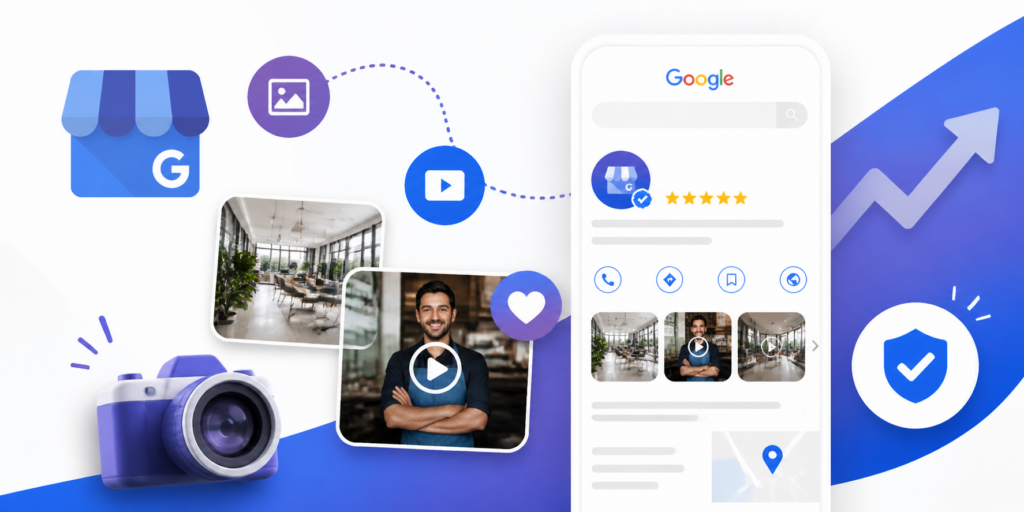
The visual content on your listing does two distinct jobs, and most businesses only think about one of them. The obvious job is making a good impression — showing potential customers what your location looks like, what your products are, who your team is. The less obvious job is signaling to the algorithm that your listing is active, maintained, and worth showing.
Listings with a higher volume of quality photos consistently show better performance metrics — more views, more click-throughs, more direction requests. This is not coincidental. The algorithm uses engagement data as a proxy for quality and relevance. A listing that attracts more interaction signals that it’s providing value to users, which reinforces its ranking position.
The types of photos that matter most vary by business type, but there are some consistent principles. Exterior photos help customers recognize your location when they arrive. Interior photos set expectations and reduce friction — someone who’s seen what your restaurant or office looks like feels more comfortable walking in for the first time. Product and service photos are the most directly conversion-relevant, because they answer the question “is this what I’m looking for?” Team photos build personal trust, especially for service businesses where the human element is central to the relationship.
Photo quality matters more than quantity up to a point. Blurry, poorly lit, or clearly outdated images create a negative impression that can outweigh having many of them. If you’re going to invest in visual content, invest in doing it properly. You don’t need professional photography for every image, but the most prominent photos — the ones that appear first in your listing — should be genuinely good.
| Photo Type | Primary Purpose | Recommended Frequency |
|---|---|---|
| Exterior / storefront | Location recognition, first impression | 3–5 images, update seasonally |
| Interior / atmosphere | Expectation setting, reduce visit anxiety | 5–10 images, refresh annually |
| Products / services | Direct conversion driver | Add new images monthly |
| Team / staff | Personal trust, humanizing the business | Update when team changes |
| Work in progress / behind the scenes | Demonstrating expertise and process | Add regularly as work is completed |
| Customer moments (with permission) | Social proof, community feel | As available |
Videos are underutilized to a significant degree. A short, well-shot video — even 30 to 60 seconds — showing your space, your process, or your team can dramatically increase time spent on your listing and the quality of the impression you make. Video content stands out in a sea of static images and creates a sense of authenticity that photography alone can’t quite achieve.
Reviews: The Single Most Influential Ranking and Conversion Factor
If you could only focus on one element of your local presence, it would be reviews. Not because everything else doesn’t matter — it does — but because reviews simultaneously influence your ranking position, your click-through rate from the results page, and your conversion rate once someone is looking at your listing. No other single element does all three.
The quantity of reviews matters, but it’s not the only dimension. Recency matters enormously — a business with 200 reviews, most of them from three years ago, is outperformed in the algorithm by a business with 80 reviews that are consistently recent. This makes intuitive sense: recent reviews reflect the current state of the business, while old reviews may reflect a version of the business that no longer exists. The algorithm is trying to serve users well, and serving them well means pointing them to businesses that are currently delivering quality.
The average rating matters, but perhaps not in the way you’d expect. The research doesn’t show that a 5.0 average dramatically outperforms a 4.7. In fact, some studies suggest that a very high volume of reviews with a slightly less-than-perfect average can be more credible than a perfect score with few reviews — because sophisticated consumers are appropriately skeptical of perfection. The goal should be a genuinely high rating earned through genuinely good service, not an artificial one manufactured through selective review solicitation.
Review content — the actual text of what people write — influences which specific searches your listing appears for. A pest control company that has reviews consistently mentioning “termite inspection” and “ant problem” sends signals to the algorithm about those specific service types. This is not gaming the system; it’s a natural reflection of what customers genuinely say when they’ve experienced your services. But it does mean that actively providing excellent experiences across your full range of services, and building a review base that reflects that breadth, has compounding search benefits.
⭐ Responding to Reviews Matters More Than Most Businesses Realize:
Every response you write to a review — positive or negative — is visible to every future visitor who looks at your listing. A thoughtful, professional response to a negative review often does more to build trust than a dozen positive reviews, because it shows how you handle problems. Businesses that respond to reviews consistently also see better ranking performance, which suggests the algorithm rewards active listing management.
How to Motivate Customers to Leave Reviews Without Being Pushy
This is the section that most guides on this topic either skip entirely or handle with platitudes. The honest reality is that asking for reviews feels awkward for many business owners, and customers who have genuinely positive experiences still don’t always think to leave one. The gap between “customer had a great experience” and “customer actually wrote a review” is where most businesses lose ground to competitors who have simply figured out how to bridge it.
The most effective approach is to make the ask feel natural, low-friction, and personally genuine — rather than automated, transactional, or guilt-inducing. Timing matters more than the specific words you use. The ideal moment to ask for a review is when the customer has just had a positive experience and the emotion is fresh. A restaurant owner who checks in on a table that’s clearly had a great meal, a contractor who has just completed a job to the client’s visible satisfaction, a consultant who has just delivered news the client is excited about — these are the moments when an ask lands naturally rather than feeling like a marketing obligation.
The friction reduction is critical. Most customers who would happily leave a review don’t do so because they’re not sure where to go or how to do it. Removing that friction — sending a direct link to your review page, having a QR code at your point of sale, including a simple line in your follow-up email — dramatically increases the conversion rate from “willing” to “actually did it.”
- ● The direct link method: Generate your unique review link and send it directly to satisfied customers via text or email — one tap to leave a review
- ● The QR code at point of sale: A small card or sign with a QR code that goes directly to your review page — works well for retail and hospitality
- ● The follow-up email: A simple, personal-feeling message sent 24 to 48 hours after service completion — not a template, an actual note
- ● The in-conversation ask: Training your team to naturally mention reviews at the end of a positive interaction — “If you ever wanted to share your experience online, we’d really appreciate it”
- ● The loyalty acknowledgment: For returning customers, acknowledging their continued relationship and gently noting that a review helps new customers find you
What doesn’t work — and what’s against platform guidelines — is incentivizing reviews with discounts, free items, or any form of compensation. Beyond the guideline violation risk, incentivized reviews tend to be generic and unconvincing to readers. The most valuable reviews come from genuinely satisfied customers who chose to share a real experience, and the systems that generate those reviews consistently are built on delivering excellent service and making the ask easy.
One mindset shift that helps: reframe the ask from “do me a favor” to “help people like you find a business they can trust.” Most customers who’ve had a genuinely good experience understand that reviews are how other people navigate their choices — and framing your request around that benefit rather than your own marketing needs changes the dynamic entirely.
Understanding how reviews fit into the broader picture of getting more online customers helps contextualize this work within your overall growth strategy rather than treating it as a standalone task.
Posts and Updates: The Feature Almost Nobody Uses Properly
The posts feature is one of the most consistently underused tools available for local search visibility — which means it’s also one of the clearest opportunities to differentiate your listing from competitors who aren’t paying attention.
Posts appear directly in your listing in search results and serve as a real-time content channel that keeps your listing current and engaging. You can use them to announce promotions, share new products or services, highlight events, publish content relevant to your audience, or simply demonstrate that your business is active and engaged. From an algorithmic standpoint, regular posting signals that the listing is actively maintained — which is a positive quality signal.
The businesses that use posts most effectively treat them similarly to a lightweight social media presence: consistent, relevant, and written for a human reader rather than for keywords. A post that says “This month we’re offering 20% off all window cleaning services — book before the end of the month” is useful. A post that says “best window cleaning services in the area click here for cheap window cleaning deals” is not.
Post timing and frequency matter. The platform favors recent content, and posts older than a few weeks begin to decay in prominence. A cadence of one to two posts per week is enough to maintain freshness without becoming a burden. Building this into your routine — even a brief weekly habit — keeps your listing consistently more active than the majority of competitors.
The Q&A Section: Your Most Underused Asset
The Q&A section of a business listing is one of the least understood features in local search, and one of the most strategically valuable when used intelligently. Here’s something most business owners don’t know: you can add questions to your own listing and answer them yourself. This is not manipulation — it’s a legitimate and recommended practice that helps potential customers find answers to the questions they’re most likely to have.
Think about what questions you get asked most often before someone becomes a customer. What are your hours on weekends? Do you offer payment plans? Is there parking nearby? Do you work with insurance? Do you require appointments or do you take walk-ins? These are questions that, if answered in the Q&A section, reduce friction for potential customers and prevent them from leaving your listing to search for the information elsewhere.
There’s an additional benefit that’s less obvious. Questions and answers appear in your listing and are indexed by the search engine. If someone searches for a specific question about a service type and your listing has an answer to that question, it can influence your visibility for that query. This is a low-effort, high-leverage opportunity that the vast majority of businesses leave completely untapped.
⚠️ Monitor This Section Actively:
Anyone can post a question in your Q&A section, and anyone can answer it — including people who have never interacted with your business. Incorrect or misleading answers can sit there indefinitely if you’re not monitoring. Set up notifications so you’re alerted when new questions appear, and respond promptly to ensure accurate information is the most visible answer.
What the Research Actually Says About Listing Completeness and Local Rankings
Most of the advice you’ll find on this topic is anecdotal. People share what worked for their business or their clients, and it gets repeated until it becomes conventional wisdom — regardless of whether it holds up at scale. So let’s look at what the structured research actually shows, because the findings are both more nuanced and more actionable than the generic “complete your profile” advice that dominates most guides.
Multiple independent studies of local search ranking factors have consistently identified listing completeness as a significant positive signal. Businesses with fully completed profiles — all fields populated, all relevant attributes set, regular photo uploads, active posting history — show substantially higher visibility in local map results compared to businesses with incomplete or minimally maintained listings. The effect is not marginal. In competitive markets, the gap in visibility between a well-maintained listing and a neglected one can mean the difference between appearing in the map pack and not appearing at all.
The research on reviews is particularly striking. One large-scale study examining thousands of local business listings found that businesses in the top three map pack positions had, on average, significantly more reviews than businesses ranking fourth through tenth for the same search terms. Crucially, it wasn’t just the quantity — businesses at the top positions also had notably higher response rates to their reviews and more recent review activity. The algorithm appears to reward businesses that actively engage with their reputation, not just those that passively accumulate it.
Photo volume and recency show a similar pattern. Listings that added new photos within the past 30 days showed measurably higher engagement — measured in profile views, website clicks, and direction requests — than listings with static photo sets that hadn’t been updated in months. The mechanism is likely a combination of algorithmic freshness signals and the simple human reality that more and better visual content creates a more compelling impression.
| Listing Element | Impact on Local Rankings | Impact on Conversion |
|---|---|---|
| Primary category accuracy | Very high — directly determines eligibility | Moderate — affects relevance perception |
| Review quantity and recency | Very high — consistent top ranking signal | Very high — primary trust factor |
| Review response rate | High — signals active management | High — shows customer care |
| Photo volume and freshness | Moderate to high — engagement signal | High — visual trust and expectation setting |
| Regular posts and updates | Moderate — freshness and activity signal | Moderate — demonstrates active business |
| Complete attributes | Moderate — enables attribute-specific queries | High — answers decision-making questions |
| Populated Q&A section | Low to moderate — content indexing benefit | Moderate — reduces pre-visit friction |
The proximity factor is worth acknowledging honestly: your physical distance from the searcher remains the single largest ranking factor for most local queries, and it’s the one thing you can’t optimize. You can’t move your location to be closer to search queries. What the research shows is that among businesses within a given proximity band, the listing quality factors above are what determine who appears at the top and who doesn’t. Listing optimization is how you win within the competitive set that proximity creates.
If you’re thinking about how this listing-level work connects to a broader strategy for ranking your website and building overall online visibility, the complete guide to ranking a website on top of Google provides the wider context within which local optimization sits.
Understanding the Local Pack and How It Decides Who Shows Up
The local pack — the map with three business listings that appears for local search queries — is governed by an algorithm that evaluates three primary dimensions: relevance, distance, and prominence. Understanding these dimensions honestly is more useful than any collection of tactics divorced from the underlying logic.
Relevance is about whether your business is an appropriate match for the search query. This is determined primarily by your categories, your business description, the content of your reviews, and your website’s content. A business that is genuinely relevant to a query will always have an advantage over one that’s trying to appear relevant through superficial optimization.
Distance is proximity — how close the searcher is to your business location. For searches that include a specific neighborhood or city, distance is calculated relative to that location. For searches without a specified location, the algorithm uses the searcher’s device location. This is why local businesses can rank well for searches in their immediate area even against larger competitors, and why a business in one neighborhood may struggle to rank for searches originating from a different part of the city.
Prominence is the accumulated authority and reputation of your business, both online and offline. It incorporates review volume and ratings, the strength of your website, the number of citations across the web, links from other websites, and the overall digital footprint of your brand. This is the dimension that’s most influenced by long-term investment in local SEO strategy rather than one-time listing optimization.
Advanced Tactics for Competitive Local Markets
Advanced Tactics for Competitive Local Markets
Once the fundamentals are solid, there are additional strategies that can meaningfully improve performance in competitive markets where the top positions are occupied by well-maintained listings and the gap between them is narrow.
Citation building — ensuring your business information is accurately listed across a wide range of directories, data aggregators, and industry-specific platforms — contributes to the prominence signal. This is less about any individual citation and more about the cumulative weight of consistent, accurate information appearing across many sources. It’s also a defensive tactic: inaccurate citations can undermine your ranking and create confusion for customers, so cleaning up existing errors is often as valuable as building new citations.
Geotagging your photos before uploading them is a tactic with a debated but potentially meaningful impact. Adding location data to image metadata before uploading provides an additional geographic signal associated with your visual content. Whether this directly influences rankings is contested, but the effort involved is minimal and the potential benefit is real.
Keyword research applied to your listing description, posts, and Q&A section — not in a stuffed or unnatural way, but by ensuring the language you use reflects how your customers actually search — helps align your listing content with the queries you want to appear for. If customers in your market search for “emergency roof repair” rather than “urgent roofing services,” using the language they use is simply good communication, and it also happens to be good for search visibility.
For businesses in genuinely difficult competitive situations, the broader signals that come from a strong website, quality backlinks, and consistent content creation become increasingly relevant. The listing and the website reinforce each other — a strong listing drives traffic to the website, and a strong website reinforces the prominence signals that the listing algorithm uses. They function as a system, not as independent assets. Understanding what you can realistically manage yourself versus where professional support adds value is an important strategic question as competition increases.
🔍 Competitor Analysis for Local Search:
Studying the top-ranked competitors for your most important search terms reveals patterns you can learn from. Look at how many reviews they have, how recently those reviews were added, how many photos they’ve uploaded, what categories they’re using, and how complete their profiles are. The gap between your listing and theirs is a roadmap of what to prioritize. Often the advantage the top-ranked business has is less mysterious than it appears — it’s simply more consistent effort applied over a longer period.
Tracking What’s Working and What Isn’t
Optimization without measurement is guesswork. The built-in insights available within the platform provide a reasonable baseline for understanding how your listing is performing and where the biggest opportunities lie.
The metrics worth tracking consistently include: search impressions broken down by query type (direct searches for your business name versus discovery searches for category or service terms), profile views, website clicks, phone calls, direction requests, and photo views. Each of these tells you something different about how customers are finding and interacting with your listing.
Discovery searches — where someone finds you by searching for a service or category rather than your specific name — are the most important growth metric. An increase in discovery search impressions means more potential customers who didn’t know you existed are now seeing your listing. Converting more of those impressions to actions — clicks, calls, directions — is the optimization challenge, and it’s driven primarily by the quality of your listing’s first impression: photos, rating, review count, and the completeness of your basic information.
Tracking your ranking position for specific search terms over time requires tools beyond the built-in insights — local rank trackers that show your position in the map pack for defined queries from defined locations. For any business operating in a competitive market, this data is essential for understanding whether your optimization efforts are producing movement and where specific improvements are having the most impact.
Connecting your listing performance to actual business outcomes — revenue, new customers, bookings — closes the measurement loop. This requires cross-referencing your listing data with your CRM or booking system, asking new customers how they found you, and treating local search as a measurable revenue channel rather than an abstract marketing activity. The businesses that treat it this way consistently outperform those that don’t, because measurement drives better decisions and better resource allocation. For a practical framework on how visibility translates to customers, the guide on getting more online customers covers the conversion side of this equation in detail.
How World SEO Agency Approaches Local Search for Clients
Everything covered in this guide represents the kind of work that genuinely moves local rankings — but knowing what to do and executing it consistently across a competitive market are different challenges. World SEO Agency works with businesses at every stage of this process: from initial setup and audit through ongoing optimization, review strategy, and the integration of listing performance with broader website SEO.
What distinguishes a professional approach from DIY maintenance isn’t access to information — most of this guide is freely available. It’s the consistency, the competitive intelligence, the technical depth when issues arise, and the strategic thinking that connects individual tactics to business outcomes. Local search is not a set-and-forget channel. It rewards businesses that show up for it consistently over time, and the compounding effect of that consistency is what separates the businesses that dominate their local market from the ones that occasionally appear and then disappear again.
If you want to understand what guaranteed SEO services with real accountability look like in a local search context, World SEO Agency’s approach ties performance commitments to defined outcomes — not vague promises about “improved visibility.”
For businesses that want to go beyond listing optimization into a comprehensive local strategy, the full picture — technical website health, content development, link acquisition, and Google Business Profile management working together as a system — is where the real competitive advantage is built. That level of integration is what produces the kind of local dominance that’s genuinely hard for competitors to replicate quickly.
Frequently Asked Questions About Local Business Listing Optimization
1️⃣ How long does it take to see ranking improvements after optimizing a business listing?
Changes to listing content — categories, description, attributes — can influence rankings within a few weeks in some cases. Review accumulation and photo additions tend to show measurable impact over one to three months of consistent effort. The timeline depends heavily on the competitiveness of your market and the gap between your current listing quality and the top-ranked competitors. Less competitive markets respond faster; highly competitive ones require sustained effort over a longer period before the ranking movement becomes consistent.
2️⃣ Can I create multiple listings for the same business to appear in more searches?
No — and attempting to do so creates significant risk. The platform’s guidelines are explicit about one listing per physical location. Creating duplicate listings triggers algorithmic and manual spam detection, and the consequences can include suspension of your primary listing — the legitimate one — in addition to the duplicates. If you have multiple genuine locations, each location gets its own listing. If you have a single location, you get a single listing, and attempting to circumvent this policy is never worth the risk.
The right approach for expanding your local search reach is to build the authority of your single legitimate listing through reviews, content quality, and website signals — not to artificially multiply your presence in a way that violates platform policies.
3️⃣ What should I do when I receive a fake or unfair negative review?
First, respond professionally and publicly — future customers will see your response, and a measured, helpful reply to an unfair review often builds more trust than the negative review loses. Second, flag the review for removal if it violates the platform’s policies — reviews that are spam, are clearly from someone who never used your business, or contain prohibited content are eligible for removal through the official reporting process. Third, accelerate your review solicitation with genuine customers to ensure the negative review represents a small fraction of your total reviews rather than a prominent data point.
4️⃣ Does the website linked from my listing affect my local ranking?
Yes, meaningfully. The website is a significant component of the prominence signal that the local ranking algorithm evaluates. A well-optimized website with relevant content, strong technical health, and quality backlinks reinforces the authority of your listing. A weak or poorly maintained website limits how high the listing can rank regardless of how well-optimized the listing itself is. The listing and the website function as a system — optimizing one without the other leaves meaningful performance on the table.
5️⃣ Is it worth paying someone to manage my local listing, or can I do it myself?
For most businesses in low to moderately competitive markets, the core listing maintenance is manageable in-house with a few hours of attention per month once the initial setup is complete. Where professional management adds clearest value is in competitive markets where the difference between top-three and top-ten in local rankings translates to significant revenue, in multi-location businesses where maintaining consistency across many listings is complex, and in situations where algorithmic or manual issues need technical diagnosis and resolution. The honest answer is that it depends on your competitive situation and the opportunity cost of your own time.
6️⃣ How important is it to respond to every single review?
Responding to every review is best practice and worth pursuing as a goal, but the most important reviews to respond to are negative ones and highly detailed positive ones. A thoughtful response to a negative review demonstrates professionalism and shows future customers how you handle problems. A personal response to a detailed positive review reinforces the relationship and encourages the reviewer to recommend you to others. Generic “thanks for your review!” responses to every one-line positive review add less value than focused, specific responses to the reviews that warrant more than acknowledgment.
7️⃣ What happens to my listing if my business moves to a new location?
You can update your address directly within the platform, which will trigger a re-verification process. Once verified, the listing retains its review history, photo library, and accumulated engagement data — you don’t lose your reputation assets when you move. The ranking implications depend on whether the new location puts you closer to or further from the geographic center of your target searches. Update your address everywhere else on the web simultaneously — website, directories, social profiles — to maintain the NAP consistency that contributes to your prominence signal.
8️⃣ Do Google posts actually help with rankings, or are they just for customer engagement?
The evidence for posts as a direct ranking signal is moderate rather than conclusive — but the engagement benefits are real and likely contribute to the behavioral signals that the algorithm uses as proxy measures of listing quality. More practically: posts keep your listing fresh, give customers a reason to engage when they find you, and demonstrate that your business is actively operated. In competitive situations where other listing factors are roughly equal, regular posting activity is one of the differentiators that can tip the balance. The effort involved is low enough that the question of whether it’s “worth it” is almost moot — it clearly is.
9️⃣ How do I know which search terms my listing is actually appearing for?
The built-in insights show a breakdown of searches that led to your profile views, including some keyword-level data. For more granular and actionable keyword visibility data, third-party local rank tracking tools allow you to input specific search terms and see exactly where your listing appears in the local pack results for those queries, from specific geographic locations. This level of visibility is important for competitive analysis and for prioritizing which elements of your listing and website to focus optimization effort on. Without it, you’re essentially optimizing in the dark and hoping the right things are improving.