




 Get to WhatsApp

Our manager will contact you
within 15 minutesт
How Long Does SEO Take to Show Results? An Honest Timeline With Real Data
The question every website owner asks — and the answer nobody wants to hear, but everybody needs
I WROTE THIS ARTICLE BECAUSE I KEPT SEEING THE SAME FRUSTRATION OVER AND OVER — PEOPLE INVEST IN SEO, WAIT A FEW WEEKS, AND GIVE UP. SO I DECIDED TO PUT TOGETHER AN HONEST, DATA-BACKED TIMELINE FOR YOU: FROM THE FIRST MONTHS TO 12+ MONTHS, WHY SOME SITES GROW FAST AND OTHERS DON’T, AND WHAT ACTUALLY DRIVES THE SPEED. NO EMPTY PROMISES — JUST THE REAL PICTURE.
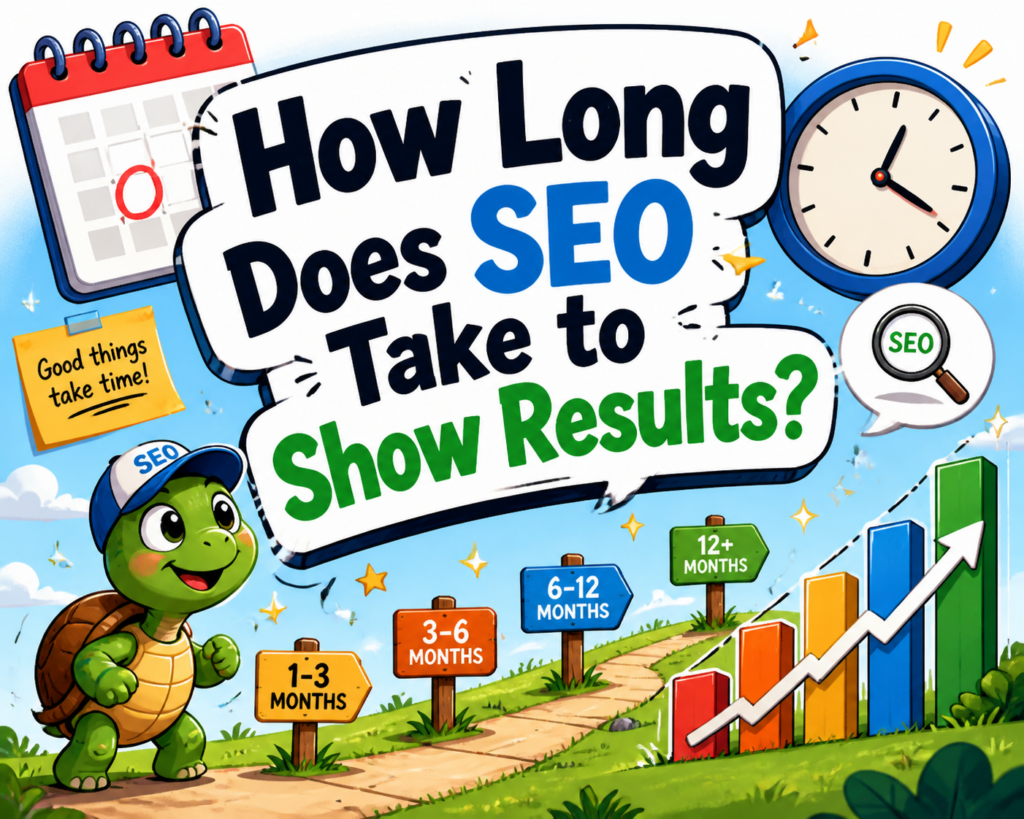
How Long Does SEO Take to Show Results? An Honest Timeline With Real Data
Table of Contents
Why SEO Takes Time: The Honest Truth Behind the Waiting
Let me be upfront with you: if you’re expecting SEO to deliver results in two weeks, you’re going to be disappointed. And if someone promised you that, they either don’t understand how search engines work or they’re not being honest with you. SEO is not a switch you flip. It’s more like planting a tree — you do the work now, and you live with the results for years.
Google doesn’t index and rank pages the moment you publish them. The search engine has to discover your content, crawl it, evaluate its quality in the context of hundreds of signals, compare it with existing pages on the same topic, and then decide where it fits in the ranking landscape. All of that takes time — and the more competitive your niche, the longer the judgment takes.
Here’s something that surprises a lot of business owners: Google engineers themselves have said publicly that it can take anywhere from four months to a full year before SEO efforts are properly reflected in rankings. That’s not a pessimistic estimate — it’s a realistic baseline. And yet, week after week, people pour money into SEO campaigns and then abandon them after six weeks because “nothing is happening.”
The reason for the delay is structural. Search engines are built on trust, and trust is earned over time. A page that was published last Tuesday doesn’t have the history, the backlinks, the engagement signals, or the track record that a page published and actively maintained two years ago has. Google knows this, and it weights accordingly. This doesn’t mean new content can’t rank quickly — it can, especially for low-competition queries — but for anything meaningful, you’re working with a longer timeline than most people expect.
📊 Real data point
According to a study by Ahrefs that analyzed over 2 million random pages, only 5.7% of all newly published pages ranked in the top 10 of Google within a year of publication.
The majority of pages that did reach the top 10 took between 61 and 182 days to get there — and those were the pages that ranked at all. Most never do.
The takeaway: early rankings are rare, but the ones that stick are worth the wait.
Understanding this isn’t about managing disappointment — it’s about making smarter decisions. If you know that real SEO traction typically starts showing up around the six-month mark, you can plan your budget, your content pipeline, and your team’s expectations accordingly. You can stop chasing vanity metrics and start building something durable.
What Happens in the First 1–3 Months
The first three months of an SEO campaign often look like nothing is happening — and from a rankings perspective, that’s often true. But it would be a mistake to interpret the silence as inactivity. This phase is foundational, and what you do here determines how fast (or slow) everything moves later.
In month one, a competent SEO team is doing the work that most people never see: technical audits, crawl analysis, identifying indexation problems, reviewing site architecture, checking for duplicate content issues, evaluating page speed, and making sure search engines can actually access and understand your content. These aren’t glamorous tasks, but they’re the difference between a site that climbs steadily and one that plateaus for no apparent reason.
By month two, keyword research and content strategy are typically being executed. This means identifying the search queries your potential customers are actually using, understanding the search intent behind those queries, and mapping them to pages that either exist already or need to be created. Good keyword research isn’t just a list of high-volume terms — it’s an understanding of where your site can realistically compete right now versus where it needs to work toward over time.
Month three is when you start seeing the first whispers of movement. Pages that were never indexed before start showing up. Some long-tail queries that you hadn’t previously ranked for begin to bring in a trickle of traffic. Your crawl coverage in Google Search Console improves. These are small signals, but they’re meaningful — they tell you the engine is starting to notice your work.
💡 Worth knowing
The technical foundation you build in months 1–3 has a compounding effect. A site with clean architecture, fast load times, and proper internal linking doesn’t just rank better — it ranks faster.
Every technical issue you fix is one less obstacle between your content and the top of Google.
If you’re working with a limited budget, investing in affordable SEO that prioritizes technical health first is often a smarter move than going straight to content or link building.
One thing to watch for in this early phase: don’t obsess over your main target keywords. They’re almost certainly not going to move in the first three months unless your domain already has strong authority. Instead, watch for improvements in your site’s overall crawlability, the growth of indexed pages, and early rankings on long-tail and informational queries. Those are the real early indicators that your campaign is on the right track.
Months 4–6: When the Ground Starts to Move
This is the phase where SEO starts to feel real. Not triumphant yet — but real. Pages that were sitting on page three or four of search results start climbing to page two. Some informational content you published early on begins bringing in meaningful traffic. Your keyword portfolio expands as Google gets a better picture of what your site is about.
The four-to-six month window is also when backlink building starts to matter more visibly. If you’ve been earning or building quality links during the first phase — from relevant industry publications, partner sites, or content that earned organic mentions — you’ll start to see their effect in this period. Links are essentially votes of trust, and trust takes time to be recognized. A backlink earned in month two might not show its full impact until month five.
Something else happens in this window that often goes unnoticed: Google starts to understand your site’s topical authority. If you’ve published a cluster of well-researched, genuinely useful content around a particular theme, the algorithm begins to associate your domain with that topic. This matters because Google increasingly ranks sites, not just pages. Establishing yourself as a reliable source on a subject — rather than publishing isolated articles — is one of the most powerful things you can do for long-term SEO performance.
For local businesses, this period can be particularly productive. If you’ve worked on your Google Business Profile, built local citations, and published location-relevant content, months four through six often bring the first real local ranking improvements. If you want to go deeper on how this works, our guide on local and international SEO breaks down the nuances for different market types.
📈 Real-world example
A SaaS company in the project management space started a structured SEO program and saw their organic sessions increase from around 800/month to just under 3,000/month between months four and six.
Nothing dramatic happened in months one through three — then suddenly the compounding effect kicked in. Their technical foundation was solid, their content was organized around clear topic clusters, and they’d earned about 14 new referring domains.
That combination created the inflection point. It almost always does.
Months 6–12: The Real Results Window
If there’s one thing I’d want any business owner or marketing manager to internalize, it’s this: months six through twelve are where real SEO stories are written. This is where the compounding nature of the work pays off. Pages that ranked on page two move to position three, four, five on page one. Traffic starts growing in a way that starts to meaningfully affect leads and revenue. The graph in your analytics tool finally looks like what you hoped it would.
By month eight or nine, sites that have followed a consistent, well-executed strategy often reach what I’d describe as “SEO momentum” — a state where existing content continues to improve in rankings, new content launches with better initial traction because of the domain’s growing authority, and the flywheel starts spinning on its own. You’re no longer pushing the boulder uphill; it’s starting to roll.
This is also the window where competitive analysis becomes especially useful. You can now look at which of your pages are performing and why, compare them against what competitors are doing, and double down on what’s working. Pages that reached position 6–10 are prime candidates for optimization — a targeted content refresh, stronger internal linking, or a few additional backlinks can often push them into the top five where click-through rates are dramatically higher.
One thing worth noting: the twelve-month mark isn’t a finish line. It’s more like the point where your SEO program matures from “building” to “compounding.” Companies that sustain their SEO investment past the first year — consistently creating content, earning links, and optimizing existing pages — see returns that continue to grow rather than plateau. This is the fundamental economic argument for SEO over paid advertising: the value you build doesn’t disappear when you stop writing checks.
🏆 The compounding advantage
A well-optimized blog post that reaches position 2 for a keyword with 1,000 searches per month might bring in 250–300 visits every month — indefinitely, without additional spend.
Run that across 20 or 30 such posts and you have a traffic asset that would cost thousands per month to replicate through paid channels.
That’s the real value proposition of SEO — and it’s why the 6–12 month investment period is worth it for most businesses.
What Actually Speeds Up (or Slows Down) Your SEO
Not all SEO timelines are equal. Two businesses in different industries, with different site histories, different budgets, and different levels of competition will have completely different experiences. Here are the factors that actually move the needle on speed — in either direction.
— Domain age and authority. An established domain with years of history, existing backlinks, and a clean record of quality content has a head start. A brand new domain is, frankly, starting from zero. Google has to build trust in that domain before it’ll push it into competitive positions. New domains often experience what SEOs call the “Google Sandbox” — a period of several months where the site struggles to rank even for terms it should theoretically be competitive for.
— Content quality and depth. This one is non-negotiable. Thin content — pages that cover a topic superficially without adding real value — simply doesn’t rank well anymore. Google’s quality evaluators are looking for content that demonstrates expertise, experience, and trustworthiness. This doesn’t mean every page needs to be 5,000 words, but it does mean that every page needs to genuinely serve the reader’s intent better than the alternatives.
— Technical health of the site. Core Web Vitals, mobile responsiveness, HTTPS, clean URL structure, proper canonicalization, efficient crawl budget management — these aren’t optional extras. They’re the infrastructure that determines how effectively Google can index and rank your content. A site with unresolved technical issues is like a car with a clogged fuel line: it might move, but not efficiently.
— Link building velocity and quality. Backlinks remain one of the most powerful ranking signals. But quality matters more than quantity. A single editorial link from a well-regarded industry publication is worth more than fifty links from low-authority directories. A well-executed link building strategy focuses on earning links that are topically relevant, contextually placed, and from domains with genuine authority.
— Competition level. This is often underestimated. Ranking for “best CRM software” is a fundamentally different challenge than ranking for “best CRM software for independent financial advisors.” The more specific and targeted your initial keyword focus, the faster you’ll see results — and those results build the authority that eventually lets you compete for broader terms.
New Website vs. Established Domain: A Different Race Entirely
If you’re launching a brand new website, you need to go into your SEO program with different expectations than someone who’s been operating an established site for years. It’s not that new sites can’t achieve great results — they absolutely can — but the timeline is typically longer, and the early work is more foundational.
A new domain starting from scratch should realistically expect to see meaningful organic traffic somewhere between months six and twelve, assuming consistent, quality work throughout. The first three to four months are almost entirely about establishing technical health, building initial content depth, and beginning the process of earning links. Don’t expect to compete with sites that have been building authority for five years on broad, competitive queries.
An established domain, on the other hand, has a different kind of challenge. Often, the problem isn’t starting from zero — it’s cleaning up years of accumulated technical debt, outdated content, or a backlink profile that includes low-quality links from past campaigns. An audit of an established site frequently reveals that a significant portion of the work is remediation rather than construction. But once that foundation is cleaned up, established domains often see faster ranking improvements because the underlying authority is already there.
For enterprise-level organizations with large, complex sites, the dynamics are different again. The sheer scale of managing SEO across thousands of pages, multiple subdomains, international versions, and competing internal content priorities requires specialized expertise. If that applies to your situation, understanding the specifics of enterprise SEO is worth exploring in depth.
🆚 New vs. established — a quick contrast
New domain (0–1 year old): Expect 6–12 months before meaningful traction. Focus on technical foundation, long-tail keywords, and local or niche terms where competition is lower. Build content consistently. Earn links patiently.
Established domain (3+ years): Often see improvements within 2–4 months of optimization. Existing authority accelerates ranking recovery. Audit first, optimize second, build content third. Watch for cannibalization and content decay.
Does Your Industry Matter? Absolutely
Yes, your industry has a significant impact on SEO timelines, and this is something that doesn’t get discussed enough. A law firm trying to rank for personal injury attorney keywords in a major city is operating in one of the most competitive SEO environments on the internet. Estimated cost-per-click for those terms in Google Ads runs into hundreds of dollars — which tells you how much money is chasing those rankings. Getting meaningful organic traction in that space can genuinely take 18–24 months.
On the other end of the spectrum, a B2B software company with a genuinely niche product might find that with three to four months of focused effort on highly specific, long-tail queries, they’re generating meaningful pipeline from organic search. The competition for those terms is lower, the search intent is crystal clear, and the audience is smaller but far more relevant.
E-commerce is its own challenge. Product pages face constant competition from Amazon, large retailers, and comparison sites that have enormous domain authority. Category pages tend to be more attainable. Content marketing — reviews, buying guides, comparison articles — often shows the fastest traction for e-commerce SEO because it targets people earlier in the buying journey where competition is less intense.
Healthcare, finance, and legal — the so-called YMYL (Your Money or Your Life) categories — face additional scrutiny from Google’s quality evaluators because errors or misinformation in these areas can cause real harm. Sites in these industries need to invest heavily in demonstrating expertise and authority, which adds to the timeline but also means that once you’ve established that authority, it’s very durable.
What to Actually Measure While You Wait
One of the biggest reasons SEO campaigns get cancelled prematurely is that people measure the wrong things. They look at their target keywords in week three, see no movement, and conclude that nothing is working. Meanwhile, meaningful progress is happening in places they’re not looking.
• Crawl coverage and indexation. Is Google crawling and indexing more of your site over time? Check Google Search Console for the number of indexed pages, any indexation errors, and how your crawl coverage is evolving. Growing indexation is a clear early signal.
• Keyword universe growth. How many keywords is your site ranking for in any position? Even position 80 is meaningful — it means Google has associated that query with your content. Over time, you want to see this number growing, and you want to see those rankings moving up. Tools like Ahrefs or Semrush track this well.
• Non-branded organic traffic. Separate your branded traffic (people searching for your company name) from non-branded traffic (people searching for topics related to your business). Non-branded organic growth is the cleanest signal that your SEO is working.
• Click-through rate improvements. As your rankings improve, your CTR should improve too. But you can also improve CTR without changing rankings — by writing better title tags and meta descriptions. Track this in Google Search Console.
• Referring domain growth. How many unique domains are linking to your site? This should grow over time as a result of your link building and content efforts. A flat or declining referring domain count is a warning sign.
For a deeper dive into the mechanics of building lasting organic visibility, our guide on how to rank a website on top of Google covers the full picture — from technical foundations to content strategy to link acquisition.
📋 Monthly SEO health checklist
✅ Check Google Search Console for new crawl errors
✅ Review indexed page count — is it growing?
✅ Track total keyword universe in your SEO tool
✅ Monitor non-branded organic sessions week over week and month over month
✅ Review referring domain count
✅ Identify any pages dropping significantly in rankings
✅ Check Core Web Vitals scores
These metrics together give you a much more accurate picture of SEO health than looking at two or three target keywords in isolation.
Red Flags: When Your SEO Is Going Nowhere
Patience is essential in SEO, but it shouldn’t be blind. There’s a difference between the normal slow burn of building organic authority and a campaign that’s genuinely not working. Knowing the difference can save you months of wasted investment.
No improvement in indexation after three months. If Google is still struggling to crawl and index your site properly after a quarter of focused technical work, something is structurally wrong. This might be a crawl budget issue, a robots.txt misconfiguration, a canonicalization problem, or something else — but it needs to be investigated and fixed.
Declining keyword universe despite new content. If you’re publishing content regularly and your total keyword footprint is actually shrinking, you may have a content quality problem, a duplicate content issue, or a penalty of some kind. This is a flag that requires investigation, not more of the same activity.
Zero growth in referring domains after six months. If your backlink profile isn’t growing at all over a six-month period, your content isn’t earning links organically and your outreach strategy isn’t working. Links are too important a ranking factor to ignore. This needs a reset and a fresh approach.
Traffic that exists but doesn’t convert. Sometimes you can build organic traffic and still see no business impact. This usually means your keyword targeting is off — you’re attracting visitors who have no purchase intent, or who aren’t your target audience. Good SEO isn’t just about traffic; it’s about the right traffic.
Promises that weren’t kept. If you were promised specific ranking results within a specific timeframe that came with a guarantee, and those results haven’t materialized, it’s worth asking hard questions. Legitimate SEO professionals don’t guarantee specific rankings because they can’t control Google’s algorithm. Guarantees are usually a warning sign, not a reassurance.
Setting Realistic Expectations With Your Team or Client
If you’re in a position where you need to communicate SEO timelines to a client, an executive team, or a board, this section is for you. Managing expectations is genuinely one of the most important skills in SEO — and one of the least discussed.
Start with a clear-eyed assessment of where you’re starting from. A brand new site in a competitive market and an established site in a niche with little competition have completely different trajectories. Don’t use the same timeline framing for both. Segment your expectations by domain authority, competitive landscape, and the realism of your target keyword set.
Build a phased narrative. The first three months are about foundation. Months three to six are early signals and momentum building. Months six to twelve are when results become visible and reportable. Beyond twelve months, the compounding effect takes over. This framing gives stakeholders a roadmap rather than a mystery — they know what “success” looks like at each stage, not just at the end.
Be specific about what you will and won’t measure at each stage. In month two, you’re not going to report on target keyword rankings — you’re going to report on indexation health, crawl coverage, and technical fixes completed. In month six, you’re reporting on keyword universe growth and early organic sessions. In month ten, you’re reporting on traffic and starting to connect it to business outcomes. This progression feels honest because it is honest.
And finally: be honest about what you don’t control. Algorithm updates can affect rankings positively or negatively regardless of the quality of your work. A competitor launching an aggressive content and link campaign can temporarily slow your growth. These aren’t excuses — they’re real variables in a complex system. The best SEO practitioners explain these dynamics upfront so that when they occur, they’re understood rather than misinterpreted as failure.
🎯 A simple framework for expectation-setting conversations
“SEO is a twelve-month investment with value that compounds over time. In the first quarter, we build the foundation — you won’t see dramatic ranking changes, but you’ll see improved technical health and early indexation growth.”
“In months four through six, we start seeing movement in the mid-funnel: more pages ranking, longer-tail traffic growing. In the second half of the year, we expect to see your target keywords climb meaningfully and organic traffic begin contributing to business goals.”
“Every month, we’ll report on the metrics that are meaningful for that stage of the campaign.”
This framing sets honest expectations, gives stakeholders something to evaluate at each stage, and positions patience as a strategy rather than a lack of results.
The reality is that SEO done right is one of the most valuable investments a business can make. But it requires something that a lot of modern marketing culture has trained people to resist: patience with a long time horizon. The businesses that understand this, commit to it, and execute consistently are the ones that end up with durable, compounding organic traffic that pays dividends for years. The ones that give up at month four end up repeating the cycle — and never seeing the return they were capable of earning.
If you’re ready to approach SEO with the kind of strategic patience it deserves, the first step is understanding your current position clearly and building a plan that’s honest about both the opportunity and the timeline. That’s the only way to do this right.

Want to order our services? Get a consultation from an SEO expert. Send a request.
Frequently Asked Questions About SEO Timelines
⏳ How long does it realistically take to see SEO results for a brand new website?
For a brand new domain, plan for at least six months before meaningful organic traffic appears. Google needs time to crawl, index, and build trust in a site it’s never seen before — and that process simply can’t be rushed.
⚡ Can SEO ever produce results faster than six months?
Yes, in certain situations. Sites targeting very specific, low-competition long-tail queries can see early ranking movement within four to eight weeks. Local businesses in markets without dominant competitors can gain visibility in the Google local pack within two to three months of a properly optimized Google Business Profile.
Sites that are fixing major technical issues — crawl blocks, duplicate content, broken redirects — often see a fast ranking recovery once those problems are resolved, because Google was simply unable to evaluate their content before. So speed is possible, but it’s circumstantial. Don’t build your business plan around best-case scenarios.
🛍️ Is there a difference between SEO timelines for e-commerce and service businesses?
Significantly. E-commerce sites compete with Amazon, large retailers, and comparison platforms on transactional keywords — that’s a tough environment, and timelines for product pages tend to be longer. Informational content like buying guides and product comparisons moves faster because competition is less intense and the content is more differentiated.
Service businesses, on the other hand, often benefit from local SEO dynamics where the competition is geographically scoped rather than global. A plumbing company in a mid-size city and an e-commerce store selling the same city’s products are playing completely different games, even if both are “doing SEO.”
The key is understanding which game you’re in before setting timeline expectations — because applying the wrong benchmark will either make you panic unnecessarily or give you false confidence.
🚧 What’s the most common mistake that slows down SEO results?
Inconsistency. Full stop. SEO compounds — like interest. A business that publishes a burst of content for six weeks and then goes quiet will almost always underperform one that publishes one solid piece per month, every month, without exception. The algorithm rewards sustained signals of relevance and authority, not one-time sprints.
🔄 How do algorithm updates affect the SEO timeline?
Google runs thousands of small updates every year that most sites never notice. But a few times a year, broad core updates roll out that can meaningfully shift rankings across entire categories and industries.
For sites that have been building genuine quality — useful content, earned links, real user engagement — core updates tend to be a net positive over time. For sites that have been relying on shortcuts or thin content to hold rankings, updates are when the bill comes due.
The honest truth is that you can’t fully control how an update affects you. What you can control is whether your site deserves its rankings in the first place. Build something Google would be embarrassed not to rank, and updates become less of a threat and more of an opportunity.
💰 Should I run paid search while waiting for SEO to kick in?
For most businesses, yes — and not just as a stopgap. Running paid search in parallel with an early-stage SEO program gives you real conversion data: which keywords actually drive leads, which landing pages perform, what message resonates. That data is gold for your SEO strategy. You stop guessing about which organic keywords to prioritize and start optimizing toward what’s already proven to convert.
Just keep the economics clear: paid traffic stops the moment you stop the spend. Organic traffic keeps coming after the investment ends. Both have a role, but only one builds a lasting asset.
🔍 How do I know if my SEO agency is actually doing good work in the early months?
Ask for reporting on leading indicators, not just rankings. In months one through three, a solid agency should be showing you: fewer crawl errors, improved Core Web Vitals, growing indexed page count, evidence of keyword research being executed, and the beginning of a link acquisition program.
If they’re sending you a monthly screenshot of three keywords at position 40 and calling it a report, that’s not transparency — it’s noise. Real early-stage SEO work is visible in Google Search Console data, not in target keyword positions that haven’t moved yet because they’re not supposed to have moved yet.
The agencies worth working with explain what they’re doing, why it matters at this stage, and how it connects to results you’ll see in months six through twelve. If that kind of clarity is missing, it’s worth asking harder questions.