




 Get to WhatsApp

Our manager will contact you
within 15 minutesт
How to Choose an SEO Agency: 12 Questions to Ask Before You Sign Any Contract
A Practical Vetting Checklist Before You Commit
I PUT THIS CHECKLIST TOGETHER BECAUSE TOO MANY BUSINESSES SIGN SEO CONTRACTS BLINDLY AND REGRET IT MONTHS LATER. ASK THESE TWELVE QUESTIONS BEFORE YOU COMMIT, AND YOU WILL SEPARATE SERIOUS AGENCIES FROM THOSE SELLING EMPTY PROMISES.
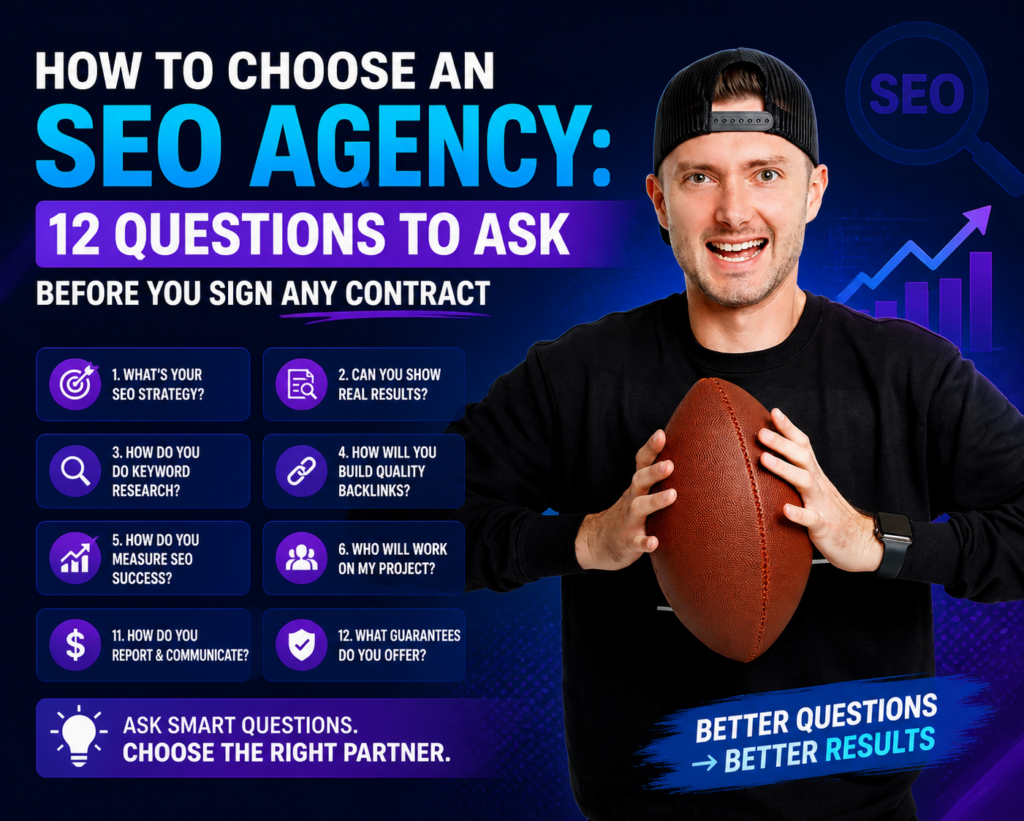
How to Choose an SEO Agency: 12 Questions to Ask Before You Sign Any Contract
Table of Contents
- Why Vetting an SEO Agency Properly Matters
- Question 1: What Industries Have You Worked In
- Question 2: What Specific Strategy Would You Use for Us
- Question 3: How Will You Report Progress and Results
- Question 4: Who Will Actually Be Working on My Account
- Question 5: Can You Walk Me Through Your Link Building Process
- Question 6: What Timeline Should I Realistically Expect
- Question 7: What Does the Contract and Exit Process Look Like
- Question 8: How Is Pricing Structured and What Is Included
- Red Flags That Should End the Conversation
1. Why Vetting an SEO Agency Properly Matters
Hiring the wrong SEO agency is not a neutral mistake — it is actively costly. Beyond the wasted monthly fee, a poorly executed campaign can leave your website in worse shape than before: thin content scattered across dozens of pages, spammy backlinks that trigger algorithmic penalties, or technical changes that quietly broke things nobody noticed for months. Untangling that damage often costs more than the original engagement ever did.
There is also the opportunity cost to consider. Every month spent with an agency that is not moving the needle is a month your competitors spend pulling further ahead in search visibility. Unlike paid advertising, where a bad campaign can be paused and corrected within days, organic search results respond slowly. A misstep discovered six months in might take another six months just to recover from, let alone make forward progress.
The good news is that distinguishing a capable agency from a mediocre one does not require you to become an SEO expert yourself. It requires asking the right questions and paying close attention to how confidently, specifically, and honestly those questions get answered. Vague, evasive, or overly polished answers are themselves useful data points.
🧭 Why This Process Is Worth the Time
Businesses that take two to three weeks to properly vet multiple agencies before signing tend to report significantly higher satisfaction twelve months later compared to those who chose the first agency that pitched them. A rushed decision in this area rarely pays off.
Treat the sales process itself as a preview of what working together will actually feel like. An agency that is hard to get clear answers from before you are a paying client is unlikely to suddenly become transparent afterward.
2. Question 1: What Industries Have You Worked In
Asking about an agency’s track record is standard practice, but the more useful version of this question goes deeper than “do you have case studies.” Ask specifically whether they have worked in your industry or a closely adjacent one, and ask what made that work successful or difficult. An agency that has spent years competing in your specific niche will already understand the competitive landscape, the typical content gaps, and the link-building opportunities unique to that space.
That said, industry-specific experience is not always essential. A skilled agency with strong fundamentals can often ramp up quickly in a new vertical, particularly for businesses operating in less specialized or less saturated markets. What matters more is whether they can articulate a clear research process for getting up to speed on an unfamiliar industry — competitor analysis, keyword gap research, and a genuine willingness to learn your business rather than applying a generic template.
If your business operates within a defined geographic area, it is worth asking directly whether the agency has experience with local SEO strategies, since the tactics involved — citation building, review management, map pack optimization — differ meaningfully from national or enterprise campaigns.
What to Listen for in Their Answer
- ●Specific client examples, not just vague references to “many clients”.
- ●Honest acknowledgment of industries where results were harder to achieve.
- ●A clear explanation of their research process for new verticals.
- ●Willingness to share actual data, not just polished success stories.
- ●Knowledge of your specific competitive landscape.
- ●Awareness of regulatory or compliance considerations relevant to your field.
3. Question 2: What Specific Strategy Would You Use for Us
Be wary of any agency that proposes a detailed strategy before they have done any real research into your business, your competitors, or your current website. A thoughtful agency will typically want to conduct at least a preliminary audit before committing to specifics — but they should be able to describe, in general terms, how they approach strategy development and what factors would shape their recommendations for a business like yours.
Push for specificity wherever you can get it. If an agency tells you they will “improve your content and build quality backlinks,” that is not a strategy — it is a description of SEO itself. Ask follow-up questions: What kind of content gaps do they expect to find based on a quick look at your site? What does their link acquisition process typically look like? How do they prioritize which pages to optimize first?
For businesses unsure of what a genuinely solid strategy even looks like, our comprehensive guide on how to rank a website on top of Google walks through the core building blocks that any credible strategy should be grounded in — useful context before you evaluate any agency’s proposed approach.
🎯 A Simple Test for Strategy Quality
Ask the agency what they would do differently for your business compared to a generic competitor in your space. If their answer could apply to literally any company in any industry, that is a sign the proposal has not been genuinely tailored to your situation.
A strong strategic answer references something specific they noticed about your website, your market position, or your competitors during the sales conversation — evidence that real thinking, not a copy-paste pitch deck, went into the proposal.
4. Question 3: How Will You Report Progress and Results
Reporting is where many agency relationships quietly break down. Some agencies send monthly reports stuffed with vanity metrics — total keywords tracked, raw traffic numbers detached from context — that look impressive but say little about actual business impact. Others provide almost no reporting at all, leaving clients guessing whether anything meaningful is happening behind the scenes.
Ask exactly what a sample report looks like before you sign anything. A genuinely useful report should connect SEO activity to outcomes that matter to your business: leads generated, conversion-relevant traffic growth, ranking improvements on commercially important terms, and a clear narrative explaining what was done and why. It should also be honest about setbacks, not just selectively highlighting wins.
Equally important is the cadence and format of communication beyond the formal report. Will you have a dedicated point of contact? Are strategy calls included, or billed separately? How quickly can you expect a response if something urgent comes up, like a sudden traffic drop? These operational details often matter more day-to-day than the headline strategy itself.
5. Question 4: Who Will Actually Be Working on My Account
One of the most common disappointments in agency relationships stems from a mismatch between who pitches the account and who actually executes the work. The senior strategist who impressed you in the sales call may have little to no involvement once the contract is signed, with day-to-day execution handed off to junior staff or, in some cases, outsourced entirely to third-party contractors or overseas content mills.
This is not inherently a problem — many excellent agencies use a tiered structure where senior staff set strategy and junior team members execute under supervision. The issue arises when there is no real oversight, or when the gap between the pitch and the actual delivery team is never disclosed. Ask directly: who will be writing my content, who will be doing my technical work, and how much senior oversight does that work receive before it ships?
It is also reasonable to ask how account team changes are handled. Staff turnover happens at every agency, but a provider with a clear onboarding and knowledge-transfer process for new team members will minimize disruption to your campaign. An agency that cannot explain how they handle this transition is signaling a lack of internal process maturity.
| Role | What They Should Do | Questions to Ask |
|---|---|---|
| Strategist | Sets direction, reviews performance | How involved will they stay post-signing? |
| Content writer | Produces optimized, original content | In-house or outsourced? |
| Technical specialist | Handles audits and site fixes | What is their review process? |
| Outreach specialist | Builds relationships, secures links | What outreach methods are used? |
| Account manager | Primary point of contact | How quickly do they respond? |
6. Question 5: Can You Walk Me Through Your Link Building Process
Link building remains one of the most consequential — and most easily mishandled — parts of any SEO campaign. Low-quality or manipulative link building can trigger manual penalties or algorithmic devaluation that takes far longer to undo than it took to create. Before signing with any agency, you want a clear, honest picture of exactly how they go about acquiring links on your behalf.
Ask whether links are purchased, exchanged, or earned through outreach and content. Ask what kinds of websites they typically secure placements on, and whether you will have visibility into where links are being built before or after the fact. An agency that is cagey about specifics, or that talks vaguely about “high authority links” without explaining the actual process, deserves closer scrutiny.
If link building is a particular priority for your campaign, it is worth exploring our dedicated link building services as a point of comparison, or as a complement to existing SEO work where link acquisition has felt thin or opaque.
⚠️ Questions That Reveal Risky Link Practices
If an agency promises a specific, guaranteed number of links per month regardless of niche or content quality, ask how that volume is achievable without resorting to low-quality or paid placements. Genuine, editorially earned links cannot be manufactured on a rigid schedule with full reliability.
Also ask what happens if Google penalizes your site due to a past link-building campaign, whether from this agency or a previous one. A responsible provider will have a disavowal and cleanup process ready, rather than treating penalty recovery as an entirely separate, additional paid service.
7. Question 6: What Timeline Should I Realistically Expect
Any agency that promises fast, dramatic ranking improvements within weeks should be approached with significant skepticism. SEO is inherently a gradual process, shaped by how search engines crawl, index, and re-evaluate content over time. An honest agency will give you a realistic range rather than an artificially compressed promise designed to win your business.
For a detailed breakdown of what to expect at each stage of a campaign — from the initial technical groundwork through to measurable ranking and traffic gains — our guide on how long SEO takes to show results offers a grounded, realistic timeline framework you can use to evaluate any agency’s claims against.
It is reasonable to expect some early indicators of progress — technical improvements, content publication, initial ranking movement on lower-competition terms — within the first three months. Meaningful, sustained traffic and conversion growth typically takes longer, often six to twelve months depending on competitiveness. Agencies that cannot articulate this distinction clearly may not fully understand the mechanics of what they are selling.
8. Question 7: What Does the Contract and Exit Process Look Like
Contract terms deserve as much scrutiny as the strategy itself. Pay close attention to contract length, cancellation terms, and what happens to the work product if you decide to leave. Some agencies require lengthy lock-in periods with steep penalties for early termination — a structure that can trap you in a relationship that is not delivering value.
Ask specifically what you retain if the relationship ends. Do you keep ownership of content that was produced? Do you receive documentation of technical changes made to your site? Is there a transition period to help a new provider or internal team pick up where things left off? An agency confident in the quality of its work generally has no problem being transparent about these terms, since they are not relying on contractual lock-in to retain clients.
It is also worth understanding how performance accountability is structured contractually. Some providers offer structured guarantees tied to specific deliverables or milestones rather than vague promises. Reading about guaranteed SEO services can help you understand what a legitimate, well-structured guarantee looks like compared to marketing language that sounds reassuring but carries no real accountability.
Key Contract Terms Worth Reviewing Closely
- ●Minimum contract length and renewal terms.
- ●Early termination penalties or notice periods.
- ●Ownership rights to content and technical documentation.
- ●Scope creep clauses — what counts as extra billable work.
- ●Performance review checkpoints built into the agreement.
- ●Data and reporting access if the relationship ends.
9. Question 8: How Is Pricing Structured and What Is Included
Pricing transparency is a strong signal of how an agency operates more broadly. Ask for a clear, itemized breakdown of what your monthly fee actually covers — content volume, technical work hours, link building activity, reporting, and strategy calls — rather than accepting a single bundled number without detail.
It is also worth understanding how pricing scales if your needs grow or shrink over time. Reviewing a transparent SEO pricing breakdown from a provider can give you a useful benchmark for comparing proposals, since it allows you to see exactly how cost correlates with scope rather than guessing based on a single quoted figure.
For smaller businesses operating with tighter budgets, it is worth explicitly asking whether a provider offers affordable SEO packages scaled appropriately to your size, rather than being pushed into an enterprise-tier engagement that exceeds what your business genuinely needs. Conversely, larger organizations with complex websites should confirm an agency has genuine experience with enterprise SEO at scale before committing.
| Question to Ask | Good Sign | Warning Sign |
|---|---|---|
| What’s included monthly? | Itemized, specific list | Vague bundled description |
| Are there hidden fees? | Clear, upfront answer | Hesitation or deflection |
| Can scope change later? | Clear adjustment process | No defined process |
| How are guarantees defined? | Specific, measurable terms | Vague ranking promises |
| Is pricing competitive? | In line with market norms | Dramatically below market rate |
| What triggers extra charges? | Clearly defined in advance | Discovered only after billing |
| Who owns produced content? | You retain full ownership | Ownership unclear or retained by agency |
10. Red Flags That Should End the Conversation
Beyond the specific questions above, certain patterns during the sales process are worth treating as immediate disqualifiers, regardless of how polished the rest of the pitch sounds. Trust your instincts here — agencies that are right for your business tend to make the vetting process feel collaborative, not adversarial.
Walk away from any provider who guarantees a specific Google ranking position, since no agency controls the algorithm closely enough to make that promise honestly. Be equally cautious of agencies unwilling to provide references or case studies relevant to your situation, or those who pressure you to sign quickly with limited time to evaluate the proposal. Genuine confidence in the value being offered does not require artificial urgency.
Watch closely for evasiveness around specific tactics. If you cannot get a straight answer about how content is produced, where links come from, or who actually does the work, that opacity tends to persist — and often worsen — once you are a paying client rather than a prospective one.
Advantages of Working With World SEO Agency
If this checklist has made you more cautious about choosing a provider, that is exactly the point. Here is how our agency stacks up against the criteria outlined throughout this guide.
All-Inclusive System With No Hidden Fees
Every detail of what your monthly investment covers is laid out clearly before you ever sign anything. There are no surprise charges buried in fine print, no separately billed strategy calls, and no ambiguity about what counts as included work versus a paid add-on. What you agree to at the outset is exactly what you are billed for throughout the engagement.
Financial Guarantees
Rather than relying on vague assurances, our engagements include structured, accountable guarantees tied to real deliverables and performance milestones. We believe a provider should be willing to put genuine commitments behind its work, not just confident language during the sales process.
High Volume of Work Delivered Every Month
Many agencies spread thin teams across too many accounts, leaving little actual output each month. Our structure is built to deliver substantial, consistent monthly work — meaningful content production, technical improvements, and active outreach — so progress remains visible and measurable rather than token and sporadic.
Affordable Price
We have built our pricing to remain genuinely accessible for small and mid-sized businesses without compromising on the depth or quality of work delivered. The result is a service level that competes with far more expensive providers, without the inflated price tag.
Curious how our referral structure benefits long-term partners and clients alike? You can explore our partner referral program, or learn more broadly about who we are on our SEO agency homepage.
Want to order our services? Get a consultation from an SEO expert. Send a request.
Frequently Asked Questions
📋 How many agencies should I realistically interview before deciding?
Three to four candidates tends to strike the right balance between having enough comparison points and avoiding decision fatigue. Interviewing too few leaves you without a real benchmark for what reasonable pricing and strategy should look like, while interviewing too many often leads to analysis paralysis without meaningfully improving the final decision.
🔄 Is it a bad sign if an agency wants to start with a smaller trial project first?
Not necessarily — in fact, it can be a reasonable way to evaluate fit on both sides before committing to a long-term retainer. A focused technical audit or a short content sprint can reveal a lot about an agency’s communication style, work quality, and reliability without either party taking on significant risk.
The distinction worth paying attention to is whether the trial project is structured to genuinely demonstrate capability, or whether it is priced and scoped in a way that makes it nearly impossible to show real value in such a short window. Ask what success would realistically look like within the trial period before agreeing to one.
💬 What should I do if an agency’s answers sound rehearsed rather than specific to my business?
Push further with follow-up questions that require genuine knowledge of your situation rather than generic talking points. Ask them to reference something specific from your website, your competitors, or your industry that came up during the conversation. A rehearsed pitch tends to fall apart quickly under that kind of specific follow-up, while a genuinely engaged team will have no trouble responding with relevant detail.
📉 How do I know if a low price is a genuine value or a red flag?
Compare the quoted price against the realistic cost of producing the deliverables being promised. If an agency is offering extensive content production, technical work, and active link building at a price point dramatically below typical market rates, it is worth asking directly how that is financially sustainable for them. Often, the answer involves outsourced, low-quality execution or unsustainable business practices that eventually affect service quality.
That said, not every lower-priced option is suspect. Smaller agencies with lower overhead, or providers specifically positioned around affordability for small businesses, can offer genuinely fair pricing without cutting corners. The key is asking specifically what is included and verifying that the scope matches what similarly priced competitors are offering.
🤝 Should I expect to speak directly with the person who will manage my account during the sales process?
Ideally, yes, though this is not always standard practice at larger agencies where sales and account management are separate functions. If you are not able to meet your actual account manager before signing, it is reasonable to ask detailed questions about their experience level and how account assignments are typically made, so you have some confidence in who you will actually be working with day to day.