




 Get to WhatsApp

Our manager will contact you
within 15 minutesт
On-Page SEO Checklist: 20 Things to Fix on Your Website Right Now
Twenty Fixes That Move the Needle on Organic Traffic
I HAVE AUDITED HUNDREDS OF WEBSITES OVER THE YEARS, AND THE SAME PROBLEMS SHOW UP AGAIN AND AGAIN REGARDLESS OF INDUSTRY OR SITE SIZE. THIS GUIDE WORKS THROUGH EACH CATEGORY OF ON-PAGE ISSUES IN ORDER OF IMPACT — SO IF YOU ONLY HAVE TIME TO ADDRESS SOME OF THEM, YOU WILL KNOW WHICH ONES TO PRIORITIZE FIRST.
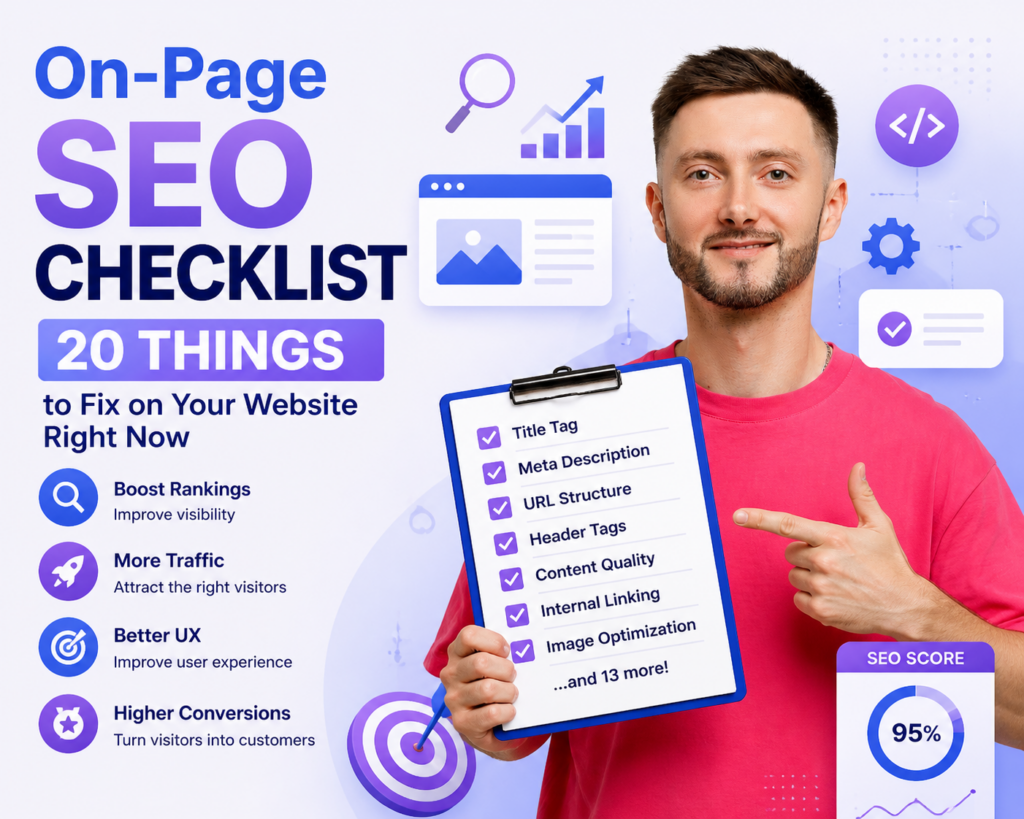
On-Page SEO Checklist: 20 Things to Fix on Your Website Right Now
Table of Contents
- Title Tags: The First Thing Google and Users See
- Meta Descriptions That Actually Drive Clicks
- Heading Structure and Content Hierarchy
- URL Structure and Slug Optimization
- Content Quality and Depth Signals
- Natural Keyword Placement Without Stuffing
- Internal Linking Architecture
- Image Optimization: Alt Text, File Size, and Format
- Page Speed and Core Web Vitals
- Mobile Experience and Responsive Design
- Structured Data and Schema Markup
- Turning This Checklist Into a Systematic Action Plan
1. Title Tags: The First Thing Google and Users See
The title tag is the single most influential on-page SEO element, and it is also one of the most frequently mishandled. It appears as the clickable headline in search results and as the tab label in a browser window, which means it does double duty: it signals relevance to search engines and it convinces humans to click. Getting both right simultaneously requires more thought than most websites invest in the process.
The most common title tag mistakes are predictable ones: titles that are too long and get truncated in results, titles that are identical across multiple pages, titles that front-load the brand name instead of the keyword, and titles that describe the page in generic terms rather than addressing user intent directly. Each of these is a missed opportunity that costs clicks you have already earned by ranking.
A well-constructed title tag puts the primary keyword or intent phrase near the front, keeps total length between 50 and 60 characters to avoid truncation on most devices, and gives the user a clear, honest reason to click through. It should describe what the page delivers rather than what the company sells. For most pages, a brand name suffix is appropriate, but it belongs at the end rather than the beginning unless brand recognition is so strong that the name itself drives clicks.
✏️ A Quick Title Tag Audit Method
Open Google Search Console, navigate to the Pages report, and sort by impressions. For your highest-impression pages, check whether the title tag matches the primary query driving impressions. If the query and the title are substantially misaligned, the title is a strong candidate for rewriting.
Also check whether Google is rewriting your titles in search results — you can compare the title you set against what actually appears by searching the page URL directly. Frequent rewrites are a signal that Google found your original title insufficiently descriptive of the page content.
2. Meta Descriptions That Actually Drive Clicks
Meta descriptions do not directly influence ranking position, but they have a measurable impact on click-through rate — which does influence ranking indirectly over time. A well-written meta description functions as a micro-advertisement for the page: it elaborates on the title, addresses the user’s likely intent, and provides a compelling reason to click through rather than choosing the result above or below yours.
Many websites either leave meta descriptions entirely blank — allowing Google to pull arbitrary excerpts from the page — or populate them with the same boilerplate text across dozens of pages. Both approaches are missed opportunities. Blank descriptions result in Google selecting whatever text it finds most relevant, which is often a poor representation of what the page actually delivers. Duplicate descriptions across multiple pages add no differentiation value and may trigger quality issues in more comprehensive audits.
Aim for descriptions between 140 and 155 characters, written in plain language that speaks directly to what the user will get from clicking. Include a natural mention of the target topic and, where appropriate, a soft call to action. Avoid keyword stuffing — meta descriptions are for human readers, not search algorithms, and overloaded descriptions tend to read as unnatural and untrustworthy.
3. Heading Structure and Content Hierarchy
Heading tags — H1 through H6 — serve both structural and semantic purposes. They organize content into a scannable hierarchy for human readers while simultaneously telling search engines which topics and subtopics a page covers and how they relate to each other. When heading structure is broken or inconsistent, it creates friction for both audiences.
Every page should have exactly one H1 tag that clearly states the primary topic of the page. This is not a technical preference — it is a fundamental signal about what the page is about. Multiple H1 tags on a single page dilute that signal. Missing H1 tags leave the page without a clear topical anchor. H2 tags should cover the major sections of the page content, with H3 tags used for subsections within those sections. Going deeper than H3 is rarely necessary for most standard content formats.
A practical audit step is to extract all heading tags from your most important pages and read them in sequence, without the surrounding body text. If that heading outline alone communicates a coherent picture of what the page covers, the structure is working. If the headings feel disconnected, repetitive, or confusing out of context, the page’s structure needs attention.
🗂️ When Headings Are Used as Design Elements Instead of Structure
A surprisingly common issue is the use of heading tags purely for visual styling — making a line of text larger or bolder — rather than for structural meaning. This creates heading hierarchies that make no semantic sense and that actively confuse search engine interpretation of the page content.
If your website uses heading tags for decorative purposes, the fix involves either replacing those tags with styled paragraph or span elements, or restructuring the heading hierarchy so that every heading reflects the actual informational structure of the page. Both approaches require careful implementation to avoid unintended visual or structural consequences.
4. URL Structure and Slug Optimization
A clean, descriptive URL structure is one of those on-page elements that is easy to get right initially and surprisingly costly to fix retroactively. URLs appear in search results, in social shares, and in the address bar — all contexts where a readable, descriptive path adds user confidence, while a string of random characters or auto-generated numbers adds nothing and occasionally triggers distrust.
The guiding principles for URL optimization are straightforward: keep slugs short and descriptive, use hyphens rather than underscores to separate words, remove stop words where doing so does not change the meaning, and avoid including dates in URLs for content that is intended to remain evergreen. A URL like yoursite.com/on-page-seo-checklist communicates the page topic clearly to both users and search engines. A URL like yoursite.com/post?id=4471&cat=3 communicates nothing useful to either.
One important caution: changing existing URLs on established pages requires proper 301 redirects from the old URL to the new one. Without redirects, you lose any ranking equity the original URL had accumulated, and any external links pointing to the old address return errors. The benefit of cleaner URLs is real, but it needs to be weighed against the implementation risk on high-traffic, well-established pages.
5. Content Quality and Depth Signals
Content quality is the most consequential variable in on-page SEO and the hardest to reduce to a simple checklist item. Google’s understanding of what constitutes helpful, high-quality content has grown substantially more sophisticated in recent years, making it increasingly difficult to rank pages that are technically correct but substantively thin. In 2026, the bar for content that earns and sustains rankings is genuinely high.
Thin content — pages with fewer than 300 words, pages that address a topic superficially without genuine depth, pages that could be summarized in a sentence without losing anything meaningful — is one of the most common causes of organic underperformance across otherwise well-structured websites. If your analytics show pages with high impressions but very low click-through rates, or pages with decent traffic but high bounce rates and minimal session depth, content quality is a likely contributing factor.
Depth means covering a topic completely enough that a user who lands on the page does not need to return to search results for additional information. It means addressing the obvious follow-up questions, acknowledging nuance and complexity, and providing genuine insight rather than surface-level summary. For a detailed framework on building the kind of content depth that drives sustained ranking growth, our guide on how to rank a website on top of Google covers the underlying principles in full.
| Content Signal | Weak Version | Strong Version |
|---|---|---|
| Word count | Under 300 words, generic | Appropriate depth for intent, no padding |
| Originality | Rephrased from top-ranking pages | Unique perspective, original examples |
| Intent match | Topic addressed but intent missed | Directly answers what the user needs |
| Author credibility | Anonymous, no expertise signals | Named author with verifiable credentials |
| Freshness | Outdated facts, old publish date | Reviewed and updated regularly |
| Supporting evidence | Claims without sources or examples | Data, case studies, or cited references |
6. Natural Keyword Placement Without Stuffing
Keyword placement in on-page SEO is not about hitting a specific density number — there is no magic percentage of keyword occurrences that unlocks better rankings. It is about ensuring that the terms and phrases a page is meant to rank for appear naturally in the locations that carry the most semantic weight, while the rest of the content reads as it would if written purely for a human audience.
The highest-signal locations for keyword inclusion are the title tag, the H1, the opening paragraph of the page, and at least one H2 subheading. Beyond those anchor placements, the target topic should appear naturally throughout the body text in the same way it would in any well-written article about that subject — alongside related terms, synonyms, and contextually relevant phrases that reinforce topical relevance without forcing repetition.
Keyword stuffing — repeating a target term unnaturally across a page in an attempt to signal relevance — is not just ineffective; it actively damages readability and can trigger quality filters in Google’s evaluation of the page. If you read a page aloud and the target phrase sounds awkward or forced, it is appearing too frequently. Trust the instinct that good writing and good SEO are not in conflict — the best-performing pages consistently read like they were written for people, not algorithms.
7. Internal Linking Architecture
Internal linking is the on-page element most businesses underinvest in relative to its impact. A well-designed internal link structure distributes authority across your website efficiently, helps search engines discover and understand the relationship between your pages, and guides users deeper into your content rather than letting them exit after a single page. Done well, it is one of the highest-leverage improvements available to most established websites.
The most impactful internal linking practice is ensuring your highest-priority pages — the ones you most want to rank for competitive terms — receive internal links from multiple other pages on your site, particularly those pages that already carry significant authority. Orphan pages — pages with no internal links pointing to them — are essentially invisible to search engines regardless of how good their content is, since crawlers discover pages by following links.
When adding internal links, use descriptive anchor text that tells both the user and the search engine what the linked page is about. Avoid generic anchors like “click here” or “learn more” in favor of specific, topic-relevant phrases. For businesses developing a broader linking and authority strategy, our dedicated link building services address both the internal architecture and the external authority signals that compound over time.
🔗 A Simple Internal Link Audit You Can Do Today
Use a crawl tool like Screaming Frog or Sitebulb to identify pages on your website with zero or very few internal links pointing to them. Cross-reference this list with your analytics to see whether any of those orphaned or under-linked pages are commercially important. The pages that appear on both lists — important but under-linked — are your highest-priority internal linking opportunities.
Also look at your homepage and your ten most authoritative pages. Count how many internal links each one contains, and where those links point. If most links point to top-level service or product pages rather than distributing authority toward mid-funnel content and deeper category pages, the internal linking structure is working less efficiently than it could.
8. Image Optimization: Alt Text, File Size, and Format
Images are one of the most consistently neglected areas of on-page SEO, particularly on websites that have grown organically over several years without a systematic content audit. Unoptimized images slow page load times, fail to contribute to topical relevance signals, and miss opportunities to appear in image search results that can drive supplementary traffic.
Alt text — the descriptive text attribute attached to each image — serves two purposes simultaneously: it makes images accessible to screen readers for visually impaired users, and it provides search engines with a text description of visual content they cannot directly interpret. Alt text should describe what the image actually shows, in plain language, with a natural inclusion of the page’s primary topic where it fits genuinely rather than being forced. Decorative images that add no informational value can use empty alt attributes rather than descriptive text.
File size optimization is equally important. An image that takes two seconds to load on its own can single-handedly push a page’s LCP score into the “needs improvement” range, directly affecting both user experience and Core Web Vitals performance. Compress all images before uploading using tools that reduce file size without perceptible quality loss, and serve images in next-generation formats like WebP or AVIF wherever your CMS and browser support allow.
9. Page Speed and Core Web Vitals
Page speed has been a ranking factor for over a decade, but the introduction of Core Web Vitals as specific, measurable signals elevated it from a general consideration to a concrete set of performance thresholds with direct ranking implications. The three primary metrics — Largest Contentful Paint, Interaction to Next Paint, and Cumulative Layout Shift — each measure a different dimension of the user experience, and each has a defined threshold separating good, needs improvement, and poor performance.
For most websites, the biggest performance gains come from a relatively small number of high-impact fixes: compressing and converting images to modern formats, enabling browser caching, minimizing render-blocking JavaScript and CSS, reducing server response time through better hosting or a content delivery network, and eliminating third-party scripts that load synchronously. None of these are simple for non-technical website owners, but all of them are addressable with the right expertise and tooling.
Google’s PageSpeed Insights tool provides a free, detailed breakdown of your current performance on both mobile and desktop, along with specific recommendations ordered by estimated impact. Running your most important pages through this tool is a productive starting point for identifying where the largest performance gains are available. Understanding how long these improvements take to affect rankings is also important context — our guide on how long SEO takes to show results addresses realistic timelines for technical improvements specifically.
| Core Web Vital | What It Measures | Good Threshold |
|---|---|---|
| LCP | Time for main content to load | Under 2.5 seconds |
| INP | Page responsiveness to user input | Under 200 milliseconds |
| CLS | Visual stability during page load | Under 0.1 |
10. Mobile Experience and Responsive Design
Google indexes and ranks websites based on their mobile version first — not desktop. This has been the case since 2019, and its implications are still underappreciated by a surprising number of website owners. If your mobile experience is meaningfully worse than your desktop experience — slower to load, harder to navigate, with content that is difficult to read on small screens — you are being evaluated primarily on that inferior version.
Responsive design, where the website layout automatically adapts to the screen size and orientation of the device being used, is the baseline expectation. But responsiveness is not a binary — a technically responsive website can still deliver a poor mobile experience if font sizes are too small, tap targets are too close together, or content that works well at desktop width becomes cramped and unreadable at mobile width.
For local businesses in particular, mobile experience is especially consequential because local search is disproportionately mobile-driven. Someone searching for a restaurant, a plumber, or a dentist is typically doing so from their phone, often with immediate intent to call or visit. A mobile experience that is slow or frustrating at the moment of highest purchase intent is a direct loss of business. Our local SEO services include mobile experience assessment as a core component precisely because of how directly it affects local conversion rates.
📱 Testing Mobile Experience Beyond Basic Responsiveness
Use Google’s Mobile-Friendly Test tool for a quick pass-fail assessment, but do not stop there. Open your website on an actual mobile device — ideally a mid-range Android phone rather than a high-end device that makes everything look better than it will for most users — and navigate through your most important pages as a first-time visitor would.
Pay attention to how long it takes each page to become usable, whether all interactive elements are easy to tap accurately, whether any content requires horizontal scrolling, and whether pop-ups or overlays are easy to dismiss. These qualitative observations often reveal friction points that automated testing tools miss entirely.
11. Structured Data and Schema Markup
Structured data is code added to a page — typically in JSON-LD format — that explicitly tells search engines what type of content the page contains and what its key properties are. It does not directly influence rankings, but it enables rich results in search — enhanced listings that include star ratings, FAQ dropdowns, event details, product prices, and other visual elements that significantly increase click-through appeal relative to standard blue-link results.
The most broadly applicable schema types for most business websites are Organization (establishing core brand information), LocalBusiness (for location-specific pages), Article (for blog content), FAQPage (for pages with question-and-answer sections), and Product or Service (for specific offering pages). Each of these is relatively straightforward to implement and can produce visible search result enhancements within days of being crawled and validated.
The fastest way to check whether your existing pages have structured data implemented is to run them through Google’s Rich Results Test tool. If a page has no structured data or has errors in its existing implementation, those are concrete, addressable fixes with a clear path to improved search appearance. For businesses thinking about the broader investment involved in a comprehensive technical SEO overhaul, our transparent SEO pricing breakdown outlines what structured data implementation typically costs as part of a complete engagement.
On-Page Elements Worth Auditing Systematically
- ●Title tags: unique, keyword-forward, under 60 characters on every page
- ●Meta descriptions: written for click-through, not duplicated across pages
- ●H1 tags: exactly one per page, aligned with the primary topic
- ●Image alt text: descriptive and present on every non-decorative image
- ●Internal links: all priority pages linked from multiple relevant sources
- ●Schema markup: implemented and error-free on key page types
12. Turning This Checklist Into a Systematic Action Plan
A checklist is only useful if it leads to action, and the risk with a twenty-item list is that the scope feels overwhelming enough to delay starting indefinitely. The way to avoid that outcome is to prioritize ruthlessly based on the specific condition of your website and the potential impact of each fix.
Begin with a content audit of your highest-traffic and highest-impression pages — the pages doing the most work in organic search right now. For each one, run through the title tag, meta description, heading structure, and content depth checks first, since those elements have the most direct impact on both ranking and click-through rate. Fix everything you find before moving to lower-traffic pages.
Next, address technical performance: run your most important pages through PageSpeed Insights and Google’s Mobile-Friendly Test. Identify the two or three highest-impact performance issues — typically large image files, render-blocking scripts, or slow server response times — and address those before working down the priority list. Then move to internal linking and structured data, which require more deliberate mapping but deliver compounding returns as the work accumulates across multiple pages.
For businesses that want a structured, professionally managed approach to working through a comprehensive on-page audit rather than tackling it internally, our SEO agency builds this kind of systematic audit and remediation work into every client engagement from the first month. And if you are considering whether the investment in ongoing professional SEO makes financial sense for your situation, our overview of guaranteed SEO services explains how accountable, results-oriented engagements are structured.
Prioritization Framework: Where to Start
- ●Fix title tags and meta descriptions on your top 10 pages by impressions first
- ●Identify and improve the five thinnest pages on your most important topic clusters
- ●Resolve any Core Web Vitals failures shown in Google Search Console
- ●Compress and convert all images over 100KB on high-traffic pages
- ●Add internal links from your five most authoritative pages to under-linked priority pages
- ●Implement FAQ schema on any page with question-and-answer content
📋 Tracking Progress Over Time
On-page SEO improvements do not produce instant results. Google needs to recrawl and reindex each updated page before any changes can affect rankings, and the full impact of substantive content improvements often takes several weeks to become visible in performance data. Building a simple tracking document that logs which pages were updated, what was changed, and when the change was made gives you a reliable way to correlate specific actions with subsequent performance movements in Search Console.
Revisit your Search Console data for updated pages approximately four to six weeks after changes are made. Compare click-through rate and average position for the target queries against the pre-change baseline. This feedback loop, applied consistently over several months, is one of the most reliable ways to develop an accurate intuition for which types of on-page changes deliver the strongest results on your specific website.
Why Work With World SEO Agency
Working through a twenty-item on-page checklist systematically takes time, specialized tools, and the experience to distinguish high-impact fixes from lower-priority noise. Here is why businesses choose to work with us rather than managing the process internally.
All-Inclusive System With No Hidden Fees
On-page audits, technical fixes, content improvements, internal linking work, and structured data implementation are all included in your monthly engagement rather than billed as separate line items. You will know exactly what is covered before you sign anything, and you will never encounter a surprise invoice for work that was not explicitly agreed upon from the start.
Financial Guarantees
We stand behind our work with structured, accountable performance commitments rather than optimistic projections that disappear once the contract is signed. Our approach to guarantees is explained in detail in our overview of guaranteed SEO services — worth reading before evaluating any agency that makes promises without accountability structures to back them up.
High Volume of Work Delivered Every Month
An on-page audit that identifies twenty issues is only valuable if those issues are actually fixed. Our delivery model is built around consistent, substantial monthly execution — real content improvements, real technical resolutions, and real structural changes — rather than diagnostic reports that leave implementation entirely to the client. Progress is visible because the work is done, not just planned.
Affordable Price
Access to professional, comprehensive on-page SEO work should not require an enterprise-level budget. Our pricing is structured to remain genuinely accessible for small and mid-sized businesses without reducing the scope or quality of what gets delivered each month. Our transparent SEO pricing page covers exactly what each tier includes, and our partner referral program offers additional benefits for businesses that refer clients to us. Learn more about our full range of services at World SEO Agency.
Want to order our services? Get a consultation from an SEO expert. Send a request.
Frequently Asked Questions
🔍 How often should I audit on-page SEO across my website?
A full on-page audit of your entire website is worth conducting once or twice per year, depending on how frequently you publish new content and how actively your competitors are updating their pages. For your highest-traffic and highest-priority pages, a lighter quarterly review — checking for outdated information, title tag performance, and content freshness — is a reasonable ongoing practice that prevents small issues from compounding into larger problems.
📊 Does fixing on-page issues actually improve rankings, or do I need more backlinks first?
It depends on where your current performance gaps are coming from. For pages that are well-linked but ranking below where their authority would predict, on-page issues are often the primary constraint — and fixing them produces visible ranking improvements relatively quickly. For pages in highly competitive niches where the top-ranking competitors have substantially more authority, on-page improvements alone may not be sufficient, and link building becomes an important complement.
In practice, on-page and off-page work are most effective together rather than treated as sequential. Getting the on-page foundation right first ensures that any authority you earn through link building is transmitted efficiently to the right pages, rather than being diluted by structural problems in the page itself.
⏱️ How long does it take for on-page changes to show up in rankings?
Google needs to recrawl and reprocess a page before any changes take effect in rankings. For frequently crawled pages on established websites, that can happen within days. For less frequently crawled pages, it may take several weeks. After recrawling, ranking changes typically become visible in Google Search Console data within two to four weeks, though the full impact of substantive content improvements often continues to develop over two to three months as Google gains confidence in the updated content.
🖼️ Is image alt text really important, or is it mostly for accessibility?
It is genuinely important for both purposes, and the two reinforce each other rather than competing. From an SEO perspective, alt text provides the only text-based description of image content that search engines receive, which means pages with images and no alt text are missing an opportunity to reinforce topical relevance signals. From an accessibility perspective, alt text is what screen readers use to describe images to visually impaired users. Treating it as an SEO checkbox rather than a content element tends to produce alt text that serves neither purpose well.
🏗️ What is the most commonly overlooked on-page SEO issue across most websites?
Internal linking, consistently. Most websites focus heavily on content creation and keyword placement while leaving internal link structures to develop organically — which typically means important pages are under-linked, authority is distributed inefficiently, and orphan pages accumulate quietly in the background. A well-planned internal linking audit and rebuild often produces meaningful ranking improvements on pages that have strong content but insufficient internal link equity pointing toward them.
📝 Should I update old content or create new pages to improve on-page SEO?
Both strategies have a role, but updating existing content is frequently undervalued relative to creating new pages. An established page with existing backlinks, crawl history, and some ranking history is often far easier to improve significantly than a brand-new page starting from zero authority. Conducting a content audit to identify pages with declining traffic or stagnant rankings — and then updating, expanding, and improving those pages systematically — typically delivers better return on effort than a pure new-content strategy for most websites with more than a year of publishing history.
⚙️ Do I need a developer to implement most of these on-page fixes?
For many of them, no — particularly on CMS platforms like WordPress, Squarespace, or Shopify where title tags, meta descriptions, headings, and content are editable without code. Image compression and alt text, internal link additions, and content updates are all manageable through standard CMS interfaces with no technical background required. Structured data implementation, Core Web Vitals fixes, and URL restructuring work typically do require developer involvement, or a professional SEO team that handles implementation as part of the engagement.
🌐 Does on-page SEO work differently for local businesses versus national ones?
The fundamentals are the same, but local businesses have some additional on-page considerations that national sites do not. Location pages need to include specific geographic signals — city name, neighborhood references, local landmarks, and address information marked up with LocalBusiness schema — that help search engines understand the geographic relevance of the page. For businesses with multiple locations, each location should have its own dedicated, substantively different page rather than a single generic location page with swapped city names. Our local SEO services address these location-specific on-page requirements as part of a complete local visibility strategy.