




 Get to WhatsApp

Our manager will contact you
within 15 minutesт
Audit Checklist: How to Know If Your SEO Agency Is Really Working
A Brutally Honest Framework for Evaluating Your Current Partner
OUR EXPERTS BUILT THIS GUIDE AFTER REVIEWING DOZENS OF FAILED SEO RELATIONSHIPS WHERE BUSINESSES PAID FOR MONTHS OR YEARS WITHOUT KNOWING WHAT THEY WERE ACTUALLY GETTING. THIS CHECKLIST EXISTS TO GIVE YOU THE TOOLS TO EVALUATE YOUR CURRENT SITUATION CLEARLY — AND MAKE AN INFORMED DECISION ABOUT WHAT TO DO NEXT.
SEO Agency Audit Checklist — How to Know If Yours Is Really Working
What You Will Learn in This Guide
— The Real Problem With Most SEO Relationships.
— The Reporting Audit: What Good Transparency Actually Looks Like.
— The Technical Checklist: Is the Foundation Actually Being Maintained.
— The Content Audit: Are They Building Real Authority or Just Publishing.
— The Link Building Audit: Quality, Velocity, and What to Watch For.
— The Results Audit: Reading the Numbers Honestly.
— The Communication Audit: How Your Agency Behaves Under Pressure.
— Red Signals and Green Signals — A Side-by-Side Comparison.
— What a High-Accountability SEO Partnership Actually Looks Like.
— FAQ.
Quick Answer
A complete audit checklist for evaluating your current SEO partner. Experts break down what good work looks like versus what agencies do to look busy without producing results.
The Real Problem With Most SEO Relationships
Here’s something the industry doesn’t talk about enough: the opacity of SEO work is a feature for bad agencies and a bug for their clients. Search engine optimization, done properly, involves months of technical work, content development, and link acquisition before results become clearly visible in traffic and rankings. That gap between action and outcome is where a significant number of agencies hide — doing the minimum, sending impressively formatted reports, and counting on the complexity of the discipline to obscure the fact that not much of value is actually happening.
The business owner on the other side of this arrangement is typically not an SEO expert. They’re running a company. They hired specialists precisely because they don’t have time to learn everything themselves. So when the monthly report arrives showing some charts and a list of completed tasks, there’s a reasonable tendency to trust it. The problem is that “tasks completed” is not the same as “value created” — and many agencies have become very skilled at documenting the former while delivering very little of the latter.
This doesn’t mean all agencies operate this way — far from it. But the only way to know which kind you’re working with is to develop enough literacy to evaluate the work directly. Not to become an SEO expert yourself, but to understand the signals that distinguish a team genuinely moving the needle from one that’s running out the clock on a retainer.
What follows is the most comprehensive evaluation framework I’ve seen in one place. It covers reporting, technical work, content, links, results, and communication. Go through it systematically. Take notes on what you find. By the end, you’ll have a clear picture — either of a partnership worth continuing and investing in further, or of a relationship that needs to change.
📌 Before You Begin This Audit:
Pull up your Google Search Console, your analytics platform, and the last three months of reports from your current partner. You’ll need them open as you work through this checklist. If you don’t have independent access to your own Search Console and analytics — if the agency controls those accounts and you see only what they choose to show you — that is itself the first and most important finding of your audit.
If you want a broader frame of reference before diving into the evaluation — understanding what a good partnership should look like from the start — the guide on how to choose an SEO agency covers the selection criteria that also serve as benchmarks for evaluating an existing one.
The Reporting Audit: What Good Transparency Actually Looks Like
Reporting is the interface between the work being done and your ability to understand it. Before you evaluate the substance of what’s in a report, evaluate the structure of how reporting is set up — because that structure reveals a great deal about how the agency thinks about accountability.
The first question in this checklist section is deceptively simple: do you have direct, independent access to your own data? This means your own login to Google Search Console, your own access to whatever analytics platform is being used, and ideally access to any rank tracking software being used on your behalf. An agency that presents you with data only through their own filtered dashboards is controlling the narrative. That may be for legitimate UX reasons — dashboards are easier to read than raw Search Console data — but it becomes a problem if that’s your only window into performance.
The second question is what the reports actually measure. There’s a consistent pattern among low-performing agencies: their reports are heavy on activity metrics and light on outcome metrics. Activity metrics are things the agency controls — number of pages optimized, number of blog posts published, number of links built. Outcome metrics are things the market controls — organic traffic, rankings for commercial queries, conversion rates from organic visitors, revenue attributed to organic search. Both matter, but if your monthly report is 80% activity and 20% outcomes, that ratio tells you something important about what the agency wants you to focus on.
- ● Checklist item 1: Do you have independent login access to Search Console and analytics?
- ● Checklist item 2: Does the monthly report show organic traffic trends over at least 6 months?
- ● Checklist item 3: Are rankings tracked for commercial keywords — not just brand terms and easy long-tails?
- ● Checklist item 4: Is organic traffic segmented by type — branded vs. non-branded, informational vs. commercial?
- ● Checklist item 5: Does the report acknowledge what didn’t go well, not just what did?
- ● Checklist item 6: Is there a forward-looking strategic section — what’s planned for next month and why?
That last item deserves emphasis. A report that only describes the past without explaining the future is a record, not a strategy document. Genuinely useful reporting tells you what was done, what it produced, and what the next phase of work is designed to accomplish. If every month’s report looks like a copy of last month’s with updated numbers, the strategic thinking isn’t there.
🔍 The Branded Traffic Trap:
One of the most common ways agencies inflate the appearance of organic growth is by including branded search traffic — visits from people searching specifically for your company name — in the overall organic traffic numbers. This traffic would come to you regardless of any SEO work. Genuine non-branded organic growth is the only number that reflects what your agency’s work has actually produced. If you’ve never seen this breakdown, ask for it explicitly.
The Technical Checklist: Is the Foundation Actually Being Maintained
Technical search engine optimization is the least visible part of the work and therefore the easiest to neglect without clients noticing. A business owner doesn’t see a crawl budget audit happening. They don’t see Core Web Vitals being monitored or internal link structure being improved. They see the report, which may or may not accurately reflect what’s actually being done at the technical level.
The way to audit technical work without becoming a developer yourself is to access the data directly. Google Search Console’s Coverage report shows you which pages are indexed, which are excluded, and what errors exist. If that report has had the same 200+ index errors for the past three months, the technical issues aren’t being addressed regardless of what the report says. The data doesn’t lie; it just requires someone looking at it who understands what they’re seeing.
Core Web Vitals — Google’s set of page experience metrics covering loading speed, interactivity, and visual stability — are verifiable through PageSpeed Insights and Search Console. If your site has been consistently failing Core Web Vitals for six months and the agency hasn’t either fixed the issues or given you a credible explanation for why they can’t, that’s a gap in the technical work that matters for ranking performance.
Site architecture and internal linking are areas where genuine expertise shows. A well-structured site has logical hierarchy, consistent internal linking that distributes authority to important pages, and URL structures that help both users and crawlers understand content relationships. If nobody has ever discussed your site’s architecture with you — if it’s never come up in a call or appeared as a deliverable in a report — it’s probably not being managed actively.
For a reference point on what thorough on-page technical work actually involves, the on-page SEO checklist covers the elements that should be addressed and maintained on an ongoing basis — not just during an initial audit.
| Technical Area | How to Check It Yourself | Warning Sign |
|---|---|---|
| Index coverage | Search Console → Coverage report | Same errors present for 2+ months |
| Core Web Vitals | PageSpeed Insights / Search Console CWV report | Consistent “Poor” or “Needs Improvement” with no action plan |
| Crawl errors | Search Console → Pages with crawl issues | 404 errors on linked pages never cleaned up |
| Mobile usability | Search Console → Mobile Usability | Mobile errors unaddressed for 60+ days |
| Sitemap status | Search Console → Sitemaps section | Sitemap not submitted or returning errors |
| Schema markup | Google’s Rich Results Test tool | No structured data on key pages despite it being industry standard |
| Duplicate content | Screaming Frog (free version) or Siteliner | High levels of duplicate or near-duplicate content never flagged |
The Content Audit: Are They Building Real Authority or Just Publishing
Content production is one of the most visible parts of an SEO engagement and one of the most commonly misunderstood. The question isn’t whether content is being produced — it’s whether the content being produced is doing anything useful for your search visibility and your business.
The first thing to evaluate is whether the content strategy is actually strategic. Does each piece target a specific search query or topical area? Is there a clear content map that connects individual pieces to your commercial goals? Or are posts being published because “regular content is good for SEO” without a clear rationale for why this particular topic was chosen this week?
The second thing to evaluate is quality. Not by reading every post and forming an aesthetic judgment, but by looking at engagement signals. What is the average time on page for organic visitors landing on blog content? What is the scroll depth? What percentage of visitors who arrive from informational content end up visiting a commercial page or converting in some way? If organic content visitors bounce immediately and never engage, the content isn’t serving its function regardless of how many pieces have been published.
Topical authority is the modern standard against which content strategy should be measured. Google’s systems increasingly favor sites that demonstrate genuine depth and expertise across a topic area — not sites that publish one post about everything. A proper content strategy builds clusters of interrelated content that collectively signal authority on specific subjects. If your content library looks like a random assortment of topics with no clear architecture, topical authority isn’t being built deliberately.
📋 The Content Volume Trap:
Publishing twelve thin, 500-word posts per month is worse for your site than publishing two genuinely excellent, deeply researched pieces. Thin content dilutes your site’s overall quality signals, and Google’s systems are increasingly effective at identifying it. If your agency is leading with content volume as a key performance indicator, ask them to show you the traffic and engagement data for the posts they’ve published in the last six months. The numbers will tell you whether volume is producing value.
The checklist items for content evaluation are: Does each piece target a specific, researched query? Is there a content calendar with clear strategic rationale? Are existing high-performing pages being updated and maintained — not just new content being added? Is there evidence of content clusters and internal linking between related pieces? And critically — is any of the content actually ranking for the terms it was intended to target?
The Link Building Audit: Quality, Velocity, and What to Watch For
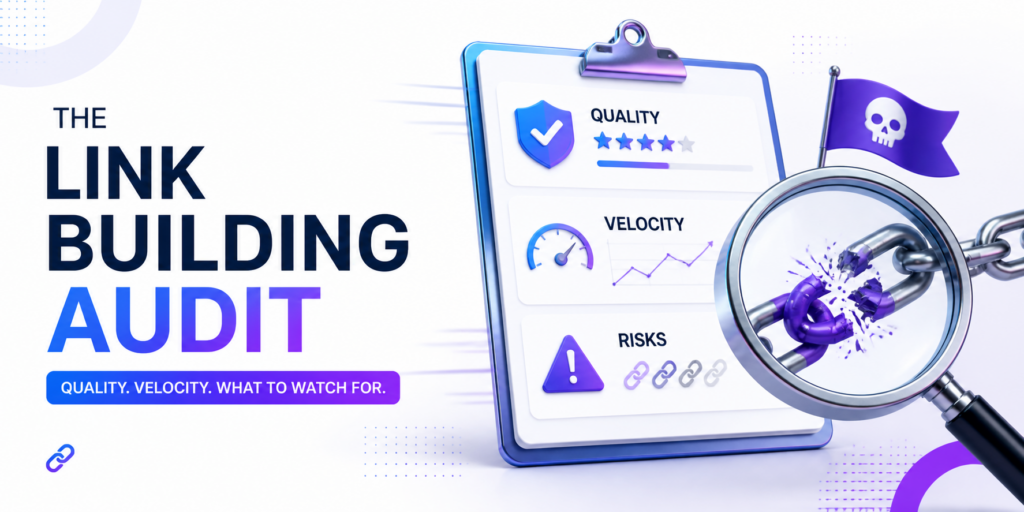
The Link Building Audit: Quality, Velocity, and What to Watch For
Link building is the area where the gap between what agencies claim and what they deliver is most consequential — because bad links don’t just fail to help; they can actively damage your site’s standing with search engines. This checklist section requires the most careful attention.
Before evaluating the links themselves, evaluate the transparency around link building. Does your agency tell you specifically where they’re building links, on which domains, and in what context? Can you see the actual pages where your links appear? If link building is included in your retainer but you’ve never seen the URLs of the pages linking to your site, that’s a critical transparency gap. Understanding what legitimate link building actually involves gives you the baseline to evaluate whether what you’re getting matches that standard.
Quality assessment requires looking at the domains where links are appearing. High-quality backlinks come from websites with genuine editorial standards, relevant topical authority, real organic traffic of their own, and content that humans actually read. Low-quality links come from private blog networks, link farms, sites that exist only to sell links, or irrelevant directories that have no connection to your industry. A single link from a respected industry publication does more for your rankings than a hundred links from low-quality sources — and those hundred low-quality links create penalties that are painful to recover from.
- ● Checklist item: Pull your backlink profile in Ahrefs, Semrush, or Moz — look at the referring domains acquired in the last 90 days
- ● Checklist item: Visit five to ten of those linking pages — do they look like real websites with real content and real audiences?
- ● Checklist item: Check the Domain Rating or Domain Authority of linking sites — a pattern of very low scores signals low-quality link building
- ● Checklist item: Look at anchor text distribution — an unnatural concentration of exact-match keyword anchors is a manipulation signal
- ● Checklist item: Check whether any links have been disavowed — a healthy disavow process means the agency is actively managing link quality
Link velocity — how quickly links are being acquired — is also worth examining. A sudden spike of dozens of links in a short period followed by months of inactivity is a pattern associated with low-quality, batch-purchased links rather than genuine editorial outreach. Sustainable link building is consistent over time, not spiky and episodic.
The Results Audit: Reading the Numbers Honestly
This is the section where most business owners either get misled or mislead themselves — because reading organic search data accurately requires understanding several important nuances that agencies sometimes use to their advantage when framing performance.
The first and most important distinction in this checklist section is between overall organic traffic and non-branded organic traffic. Brand searches — people typing your company name directly — will grow naturally as your business grows, as you run ads, as you get press coverage, as word of mouth spreads. None of that growth is attributable to SEO work. If your agency is celebrating organic traffic growth without separating branded from non-branded, they may be taking credit for your business development efforts rather than their own.
The second critical distinction is between traffic that converts and traffic that doesn’t. Rankings and traffic are intermediate metrics — they’re meaningful only insofar as they lead to business outcomes. An agency can grow your organic traffic by targeting informational queries that attract people who have no intention of becoming customers. That traffic looks good in a chart. It doesn’t pay the rent. The question to ask is: of the organic visitors your site attracted this month, what percentage converted — requested a quote, made a purchase, booked a call, submitted a form? And how does that compare to six months ago?
Understanding what realistic results look like over realistic timeframes is important for calibrating your expectations and your assessment. The detailed breakdown of how long SEO takes to show results helps contextualize whether what you’re seeing is a partner underperforming or a timeline that’s simply unfolded as expected given your starting point and competitive situation.
📈 What Genuine Progress Looks Like:
In months one through three, meaningful progress shows up as technical improvements, indexed page growth, and early ranking movement on lower-competition queries. Months four through eight should show clear non-branded traffic growth and ranking improvements on target commercial terms. By month nine to twelve, a well-executed campaign should be producing measurable business impact. If you’re past month twelve with no clear revenue or lead attribution to organic search, something is wrong.
The Communication Audit: How Your Agency Behaves Under Pressure
Communication quality is one of the strongest predictors of overall agency quality — not because good communicators necessarily do better technical work, but because an agency’s communication behavior reveals how they think about accountability and client relationships.
The most revealing test is what happens when something goes wrong. Google algorithm updates, ranking drops, traffic declines — these happen to virtually every site at some point. The question is whether your agency notifies you proactively when they see a problem, explains what happened with genuine technical clarity, and presents a plan for addressing it. Or whether they wait for you to notice, downplay the significance, or offer vague reassurances without concrete action.
Consider how access to your account team is structured. Do you have a named contact who knows your account and can answer substantive questions about your campaign? Or do you communicate through a general inbox and get different people responding each time, none of whom has deep familiarity with your situation? Account team stability and accessibility are operational indicators that correlate with quality of service, because they reflect how the agency structures its client relationships.
Also evaluate the quality of explanations you receive. When you ask why a particular piece of content was chosen, or why a specific link was built, or why a technical change was made — do you get a clear, reasoned answer that educates you? Or do you get generic statements about best practices and industry standards that don’t actually engage with your specific question? Agencies that treat client questions as a burden to be managed rather than an opportunity to demonstrate expertise are not investing in the relationship.
Red Signals and Green Signals — A Side-by-Side Comparison
After working through all the sections above, it helps to consolidate what you’ve found against a clear framework. The table below is designed to help you categorize your observations into patterns — not to make a binary judgment on a single item, but to identify whether the overall picture skews toward a functioning partnership or a problematic one.
| Area | Green Signal | Red Signal |
|---|---|---|
| Data access | You have independent login to Search Console and analytics | You see only what the agency chooses to share with you |
| Reporting substance | Reports lead with outcome metrics and forward-looking strategy | Reports are heavy on activity lists and light on results |
| Technical maintenance | Errors are identified and resolved; CWV is actively managed | Same errors persist month after month without resolution |
| Content strategy | Content is strategically mapped to search intent and commercial goals | Volume is emphasized without evidence of traffic or ranking impact |
| Link quality | Links come from real editorial sites with genuine audiences | Links come from low-DR sites with no real content or traffic |
| Results framing | Non-branded traffic and conversion data are clearly presented | Branded traffic is mixed into overall organic numbers |
| Problem handling | Issues are proactively flagged with explanation and action plan | Problems are downplayed or only acknowledged when you raise them |
No agency will score perfectly on every dimension. What you’re looking for is the overall pattern. If most of your observations fall into the green column with a few yellow areas, you likely have a partnership worth continuing and improving. If most fall into the red column, you have a decision to make — and the sooner you make it, the less time and budget you lose on a relationship that isn’t serving your business.
For context on what the market looks like and how different agencies compare, the SEO agencies ranking provides a useful external reference point for evaluating where your current partner sits relative to the broader field.
👉 One More Thing Worth Checking:
Look at your agency’s own website in search. Do they rank for competitive terms in their own industry? Are their pages well-optimized? Does their own content demonstrate the expertise they claim? An agency that can’t rank its own site credibly in a competitive space has a credibility problem when it comes to ranking yours. This is not a definitive judgment — agencies are sometimes too busy serving clients to invest in their own marketing — but it’s a data point worth noting.
Understanding what SEO should cost at different quality levels is also relevant here — because if you’re paying enterprise rates for foundational work, or foundational rates for a competitive market, the mismatch itself is part of the problem. Price and scope need to match your situation.
And if after this entire checklist your situation looks genuinely sound — your agency is producing real results, communicating clearly, maintaining the technical work, and building quality links — then the question shifts from evaluation to optimization. The guide on guaranteed SEO services covers what accountability-driven partnerships look like and how to structure agreements that align incentives for the long term.
What a High-Accountability SEO Partnership Actually Looks Like
After going through this entire audit framework, you have a clearer picture of what’s missing from many client-agency relationships. Transparency, accountability, outcome-orientation, consistent high-quality output — these aren’t luxury features of a premium service tier. They’re the baseline of what a functioning professional relationship should look like. The fact that so many agencies operate below that baseline is a market failure, not a natural law.
World SEO Agency was built around the belief that clients deserve better than the industry average — not in a vague aspiration-statement way, but in specific, contractually defined ways that put real stakes behind the partnership.
👉 All-Inclusive System With No Hidden Fees
Every service required to execute your campaign — technical work, content development, link acquisition, reporting infrastructure, strategy — is included in the agreed scope. There are no line items that appear mid-campaign. There are no “content is extra” conversations after you’ve already committed. The price agreed at the start is the price that governs the engagement. This isn’t a sales pitch for a simple service. It’s a commitment to operating with the kind of clarity that most clients have never actually experienced from an agency.
👉 Financial Guarantees
Performance commitments are written into the agreement with defined consequences if milestones aren’t met. This is the model that every business owner intuitively wants from an agency and almost never gets — because most agencies aren’t willing to bet their own revenue on their own results. The willingness to operate under financial accountability is a meaningful signal about confidence in methodology and quality of execution.
👉 Transparent Pricing
Pricing at World SEO Agency is structured around what your specific situation requires — not inflated to capture as much margin as possible, and not artificially lowered to win the contract with the intention of upselling later. You know what you’re spending, what you’re getting for it, and how each element contributes to your campaign goals. That transparency extends to reporting — you see the actual numbers, from your own analytics access, not through a filtered agency dashboard.
👉 No Hidden Fees
The all-inclusive model means that when additional work is genuinely needed — a site migration, a penalty recovery situation, a content refresh for an underperforming section — it’s discussed openly and either accommodated within scope or proposed with a clear rationale and a fair additional cost estimate. There are no surprise invoices. There are no retroactive charges. What you agreed to is what you get.

Want to order services? Get a consultation from an SEO expert. Send a request.
Frequently Asked Questions — Honest Answers to Hard Questions
👉 My agency sends great-looking reports every month. Does that mean they’re doing good work?
Not necessarily — and this is one of the most common mismatches in the industry. Report quality and work quality are different things. Some of the most impressive-looking monthly documents come from agencies doing the least substantive work, because the energy that should go into strategy and execution goes into presentation instead. The question to ask about any report is: can I independently verify these numbers? If the answer is no, the report is only as trustworthy as the agency producing it.
🔍 My organic traffic is growing. Isn’t that proof the agency is working?
It’s a positive signal, but not proof by itself. The critical follow-up questions are: what type of traffic is growing — branded or non-branded? What is that traffic doing once it arrives — converting, or bouncing? Is the growth in organic traffic producing measurable business outcomes like leads or revenue? Traffic growth that doesn’t eventually connect to business outcomes is a vanity metric, and agencies who know this sometimes deliberately target easy traffic rather than commercially relevant traffic because it’s easier to produce and easier to defend.
Non-branded organic traffic growth, paired with stable or improving conversion rates from organic visitors, is the combination that indicates genuinely valuable progress. Anything less than that deserves scrutiny.
⚠️ My agency told me it’s too early to see results and I should wait. How long is too long to wait?
Timeline expectations vary legitimately by market competitiveness, starting domain authority, and scope of work. But there should be measurable intermediate progress — improved crawlability, indexed page growth, early ranking movement on lower-competition terms — within the first three months. If six months have passed with no visible movement in any metric and your agency’s only response is “give it more time,” that’s not patience, that’s avoidance. A professional team will show you leading indicators of progress even before traffic and rankings fully materialize.
💰 I’m paying a lot every month. Does a higher price mean better work?
No — and this is worth being direct about. Some of the most expensive agencies in major markets produce mediocre results, while some mid-market firms consistently outperform their price point. Price reflects what the market will bear, the cost structure of the agency, and their brand positioning — not necessarily the quality of the work. What matters is value: the ratio of business outcomes produced to investment made. The right question is not “am I paying enough to get good work?” but “is the work being done producing outcomes proportional to what I’m spending?”
📋 My agency promised a checklist of deliverables each month. They’re completing them all. Why aren’t my rankings improving?
Because completing a checklist of tasks and producing results are not the same thing. An agency can publish four blog posts per month, make three technical fixes, and build ten links — all legitimate activities — and still produce no ranking improvement if those tasks weren’t strategically chosen and properly executed. The tasks need to be the right tasks, done well, in the right priority order for your specific situation. A checklist of completed activities without strategic context is just evidence of effort, not of progress.
😱 My agency lost access to my Search Console data and somehow fixed things without it. Is that possible?
No reputable practitioner works without Search Console access. It’s the primary diagnostic tool for understanding how Google sees your site — indexation status, manual actions, crawl errors, search performance data. An agency that claims to be doing meaningful technical SEO without Search Console access either doesn’t understand what they’re doing or is doing very little actual work. This is a significant red flag that warrants an immediate, direct conversation about what has actually been happening with your campaign.
🕐 We’ve been working together for 18 months and the agency still says we’re in the “building phase.” Is that normal?
No. Eighteen months is enough time to see clear, measurable results for virtually any legitimate campaign. The “building phase” framing is appropriate for months one through six — during which foundational work is being done and early indicators of progress are beginning to show. By month eighteen, non-branded organic traffic should be clearly growing, commercial keywords should be showing meaningful ranking movement, and there should be at least some attributable business impact from organic search. If none of those things are true after a year and a half, the campaign has failed regardless of what the agency calls the current phase.
👀 My agency said they use “proprietary methods” they can’t share. Should I trust that?
Be skeptical. Legitimate SEO methodology is not a trade secret — the principles are well-documented and any competent professional can explain them. What agencies legitimately protect is their specific operational processes, their outreach relationships, and the particular ways they apply publicly known principles. But if an agency refuses to explain in plain language what they’re doing and why — using “proprietary” as a shield against accountability — that’s a transparency problem. You should understand at a conceptual level every major tactic being used on your site. Anything less than that is not a partnership; it’s a dependency.
🤔 My agency ranks well for “cheap SEO services” in their own city. Does that mean they’re good?
It means they know how to rank for low-competition terms in a local market — which is a very different challenge from ranking for competitive commercial keywords in a national or industry-specific context. Evaluate your agency’s own digital presence relative to the difficulty of their market and the terms they claim to target, not just whether their website shows up somewhere. An agency that ranks for one easy term locally but can’t rank their own site for competitive industry terms has a portfolio problem that should inform your confidence in their ability to do the same for you.
🛠️ We switched agencies six months ago and things got worse. How do I know if this is a transition problem or a new problem?
Agency transitions routinely cause short-term ranking volatility — particularly if there was a change in domain structure, content approach, or link strategy. The first two to three months after a switch often look worse before they look better, because the new team is auditing, correcting prior mistakes, and rebuilding on a more solid foundation. The distinction between transition effects and genuine new problems usually becomes clear around the four to six month mark. If things are still declining or flat at six months post-transition with no clear explanation and no evidence of foundational work being completed, you have a new problem, not a transition one.