




 Get to WhatsApp

Our manager will contact you
within 15 minutesт
How to Build a Website That Ranks: A Complete SEO Guide
From Site Architecture to Content — Everything That Matters for Rankings
MOST BUSINESSES INVEST IN A WEBSITE AND DISCOVER MONTHS LATER THAT IT WAS BUILT IN A WAY THAT MAKES RANKING NEARLY IMPOSSIBLE WITHOUT A COMPLETE REBUILD. OUR EXPERTS WROTE THIS GUIDE TO HELP BUSINESS OWNERS, DEVELOPERS, AND MARKETERS UNDERSTAND EXACTLY WHAT AN SEO-READY WEBSITE REQUIRES — FROM THE INITIAL ARCHITECTURE DECISIONS THROUGH CONTENT STRATEGY, TECHNICAL INFRASTRUCTURE, AND THE ONGOING WORK THAT CONVERTS VISIBILITY INTO REAL CUSTOMERS.
How to Build a Website That Ranks on Google: A Complete SEO Guide
What’s Inside This Guide
1. Why Development Quality Determines Your Ranking Potential
2. Site Structure: The Architecture Google Needs to See
3. Mobile-First Design — Not a Feature, a Requirement
4. Site Speed and Core Web Vitals
5. On-Page Elements: What Every Page Must Have
6. The Complete Page SEO Element Checklist
7. Content That Earns Rankings and Keeps Visitors
8. Technical SEO: What Happens Behind the Scenes
9. Local Visibility — Ranking in Your Geographic Market
10. User Experience as a Ranking Signal
11. Building Authority Through External Signals
12. Tracking, Measurement, and Ongoing Improvement
13. The Mistakes That Kill Rankings Before They Start
14. Good Website vs. Bad Website: The SEO Difference
15. How World SEO Agency Approaches Website Builds
16. FAQ
Why Development Quality Determines Your Ranking Potential
There is a conversation that happens in almost every agency-client relationship at some point, and it is an uncomfortable one: “Your website needs to be rebuilt.” Not redesigned. Rebuilt. The client invested real money — often tens of thousands of dollars — in a website that looks professional and functions adequately as a brochure. But when it comes to competing in search results, the foundation is structurally wrong in ways that no amount of content, links, or paid promotion can compensate for.
The problem is that website development and search visibility are treated as separate disciplines when they are actually deeply interdependent. A developer hired to build a visually appealing, technically functional website will succeed on those terms without ever considering how Google’s crawlers will navigate the architecture, whether page titles are unique and relevant, whether the URL structure creates logical hierarchy, or whether JavaScript rendering prevents key content from being indexed at all. None of these failures are visible to a human visitor. All of them are visible to Google — and all of them have direct consequences for ranking potential.
The downstream costs of this disconnect are significant. When a business finally realizes that its website is not performing in search, the remediation process typically involves restructuring URLs — which creates 404 errors unless every old URL is properly redirected. It involves rewriting title tags and meta descriptions across potentially hundreds of pages. It involves fixing internal linking architecture, consolidating duplicate content, rewriting navigation structure, and in some cases rebuilding page templates entirely. Every one of these interventions introduces risk: a missed redirect, a canonical tag error, or a robots.txt misconfiguration during remediation can produce ranking drops that take months to recover from.
The correct approach is to resolve all of this before the site is built — or at minimum before it is launched. A website built with search visibility as a core requirement from the first planning conversation is a fundamentally different project from one that treats visibility as a post-launch concern. The decisions made during architecture planning, during URL structure design, during template development, and during content organization determine whether the site will be an effective search marketing asset or an expensive obstacle to it. This guide covers each of those decisions in the order they need to be made.
📌 The Rebuild Reality:
When a website requires structural remediation after launch — URL restructuring, architecture changes, template rebuilds — the average time to recover any rankings that existed before the intervention is three to six months, even when the remediation is executed correctly. When it’s executed with errors, the recovery timeline extends to twelve months or more. Building correctly from the start costs a fraction of what rebuilding after the fact costs in both direct fees and lost revenue during recovery.
Site Structure: The Architecture Google Needs to See
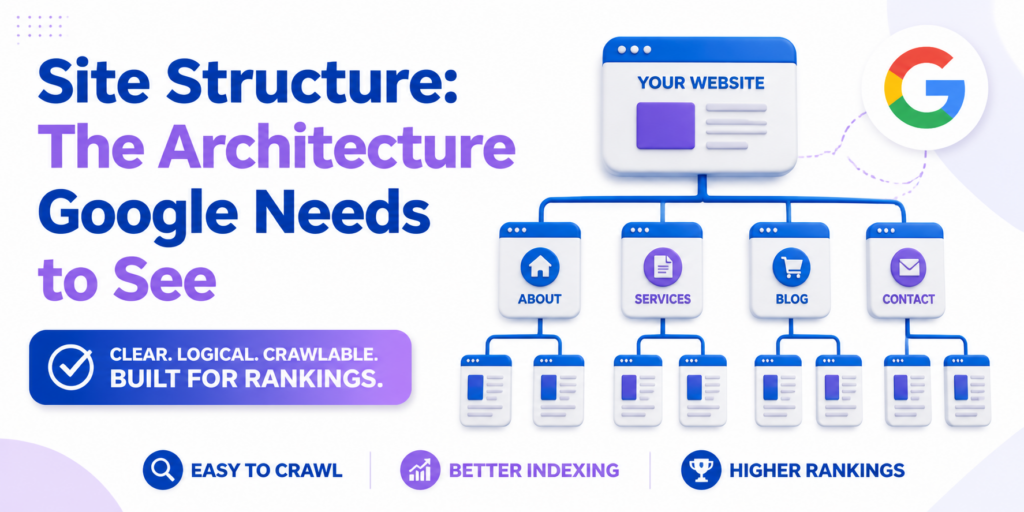
Site Structure: The Architecture Google Needs to See
Site architecture is the organizational logic of how a website’s pages relate to each other — which pages link to which, how deeply nested individual pages are, what the URL structure communicates about content hierarchy, and how authority flows through the internal linking system. Google’s crawlers navigate websites the same way a visitor would — following links from page to page — which means the architecture determines what gets discovered, how efficiently it gets crawled, and how much authority each page receives from the site’s overall link equity.
The hierarchy model that works best for most business websites is a pyramid structure: the homepage sits at the top as the most authoritative page, main service or category pages sit at the second level and receive significant internal link equity from the homepage, and individual pages for specific services, locations, or topics sit at the third level and receive their authority from the category pages above them. This structure ensures that no page is completely isolated from the site’s authority flow, that crawlers can reach every page efficiently, and that the logical relationship between pages is communicated clearly through the navigation and linking architecture.
URL structure is the part of site architecture that most developers and clients overlook because it seems cosmetic. It isn’t. A URL like /services/commercial-roofing/chicago/ communicates three things to Google simultaneously: the page is a service page, it’s about commercial roofing, and it serves Chicago. That hierarchical clarity contributes to how the page is categorized and ranked for relevant queries. A URL like /page?id=4523&cat=services communicates nothing about content — it’s just a database pointer. Building URLs that reflect content hierarchy from the beginning is significantly easier than migrating to a clean URL structure later.
- ► Every important page should be reachable within three clicks from the homepage
- ► Use hyphens to separate words in URLs — never underscores or spaces
- ► Keep URLs lowercase and free of special characters or session parameters
- ► Plan the full URL map before development begins — retrofitting URL structure is costly
- ► Include primary keywords in URLs naturally — not stuffed, but genuinely descriptive of the page content
- ► Avoid creating orphan pages — every page should be linked to from at least one other page in the same hierarchy level
Navigation design is the human-visible expression of site architecture, and it serves both users and crawlers simultaneously. A navigation structure that gives users clear, logical access to the site’s main sections also gives crawlers a reliable map to follow. Dropdown menus are fine structurally, but they should not be the only way to access important pages — footer links and contextual in-content links create additional crawl paths that reinforce the architecture and distribute authority more effectively.
Mobile-First Design — Not a Feature, a Requirement
Google indexes the mobile version of websites first. This has been true for several years now, and it has a specific implication that many website builds still fail to account for: the content visible on the mobile version of a page is the content Google primarily uses to evaluate and rank that page. If your desktop site has more detailed content than your mobile version — a common outcome of responsive designs that collapse or hide content on smaller screens — the content that matters for ranking is the truncated mobile version, not the complete desktop version.
This means that mobile-first design is not about making sure the site looks acceptable on a phone. It’s about ensuring that the complete content of every important page is accessible, indexable, and well-presented on mobile. Content hidden behind “read more” toggles or collapsed sections on mobile may not be indexed with the same weight as fully visible content. Content that requires horizontal scrolling or uses font sizes too small to read without zooming provides a poor experience that Google’s user experience signals reflect in rankings.
The technical implementation of mobile-first design has standardized around responsive design — a single HTML codebase that adapts its presentation to different screen sizes through CSS. Separate mobile subdomains (m.website.com) are technically functional but introduce complications around canonical tags and duplicate content that responsive design avoids entirely. For a new build, responsive design is the correct default. The responsive implementation should be tested against Google’s actual mobile indexing standards using the URL Inspection tool in Search Console before launch, not assumed to be correct based on how it looks in a browser developer tools preview.
📲 Mobile Content Parity Check:
Before launching any new website, load the mobile version on an actual device and compare the content visible on each key page against the desktop version. Specifically check: Are all heading tags present? Is all body content visible without interaction? Are all internal links accessible? Is the contact information and call-to-action as prominent as on desktop? Any discrepancy between mobile and desktop content is a ranking liability that needs to be resolved before the site goes live.
Site Speed and Core Web Vitals
Site speed has been a ranking factor for over a decade, but Google’s Core Web Vitals framework — which measures specific, quantified aspects of loading performance, interactivity, and visual stability — made speed a more precise and more consequential ranking consideration. These three metrics provide specific targets rather than a general “be faster” directive, which makes them actionable in a way that general speed guidance never was.
Largest Contentful Paint measures how quickly the main visual content of a page becomes visible to the user. The target is under 2.5 seconds. The primary causes of poor LCP are unoptimized images — particularly large hero images that load before anything else — slow server response times from inadequate hosting, and render-blocking resources like JavaScript files that prevent the browser from rendering content until they finish loading. Optimizing images to appropriate file sizes and formats, upgrading hosting to a server with fast time-to-first-byte, and deferring non-critical JavaScript are the three highest-impact LCP improvements for most websites.
Cumulative Layout Shift measures how much the page’s visual content moves unexpectedly as it loads. A page that shifts its layout while loading — because images don’t have defined dimensions, because web fonts swap visually after initial render, or because late-loading ad scripts push content down — creates a disorienting user experience and a poor CLS score. The fix is primarily a development discipline issue: defining explicit width and height attributes on all images and iframes, using font-display settings that prevent layout shift during font loading, and reserving space for dynamically loaded elements before they load.
Interaction to Next Paint measures how responsive the page is to user input. Poor INP scores are almost always caused by excessive JavaScript execution — particularly third-party scripts like chat widgets, analytics tools, and marketing pixels that run on the main thread and block the browser from processing user interactions. Auditing third-party script load and deferring or lazy-loading non-critical scripts is typically the most effective INP improvement available without architectural changes.
On-Page Elements: What Every Page Must Have
On-page optimization is the practice of ensuring that each individual page communicates its topic, relevance, and purpose clearly to both human visitors and search engine crawlers. The elements involved are not optional extras to consider after the page is built — they are structural components that need to be planned as part of the page template design and populated with genuinely relevant content as part of the content creation process.
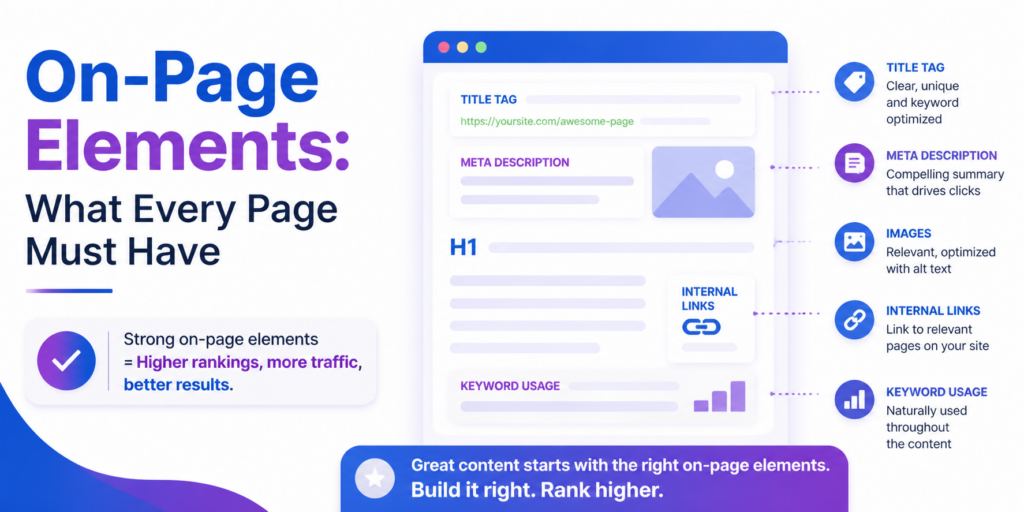
On-Page Elements: What Every Page Must Have
The title tag is the most important on-page element for communicating a page’s topic to search engines. It appears in search results as the blue clickable headline and in browser tabs, and it is one of the most heavily weighted signals in Google’s relevance assessment. Each page needs a unique title tag that includes the primary topic or keyword the page is targeting, keeps the total character count under approximately 60 characters to avoid truncation in search results, and reads naturally rather than as a keyword list. Template title tags that use the same format across all pages — “Home | Company Name,” “Services | Company Name” — are a common development default that fails to communicate anything specific about the content of individual pages.
Meta descriptions don’t directly influence rankings but significantly influence click-through rate — which indirectly influences rankings through engagement signals. A well-written meta description that communicates specifically what a visitor will find on the page and gives them a reason to click is a conversion optimization element for your search listings. Generic descriptions like “Learn more about our services” or auto-generated excerpts from page content are missed opportunities to earn the click from users who are evaluating their options in the search results page before deciding which result to visit.
The Complete Page SEO Element Checklist
Every page on a well-built website should contain a specific set of structural and content elements that signal relevance, improve usability, and facilitate crawling and indexing. The table below defines what each element is, its function, and the priority level for implementation on service and content pages.
| Page Element | Function and Purpose | Priority Level |
|---|---|---|
| Unique H1 heading | Signals primary page topic — one per page, includes target keyword | Critical — non-negotiable |
| H2 subheadings | Organizes content into logical sections, supports secondary keyword relevance | Critical |
| Title tag | Primary ranking signal — appears as headline in search results | Critical |
| Meta description | Influences click-through rate from search results — not a direct ranking factor | High |
| Canonical tag | Prevents duplicate content issues by defining the preferred URL version | Critical for sites with URL parameters |
| Internal links with descriptive anchor text | Distributes authority through the site and signals content relationships | High |
| Image alt text | Enables image indexing and provides accessibility compliance | High |
| Schema markup (structured data) | Enables rich results in search — reviews, FAQs, breadcrumbs, business info | High — significant CTR impact |
| Open Graph tags | Controls how pages appear when shared on social platforms | Medium |
| Breadcrumb navigation | Reinforces site hierarchy for both users and crawlers | High for multi-level sites |
| FAQ section with schema | Targets question-based queries and can generate rich result expansion in search | High for service and content pages |
| Clear call-to-action | Reduces bounce rate by guiding users toward conversion — affects engagement signals | High — conversion critical |
| Author or trust signal section | Supports E-E-A-T signals — indicates the expertise behind the content | High for content pages |
| Last updated date | Signals content freshness — important for queries where recency affects rankings | Medium |
| Social proof elements | Reviews, testimonials, case study links — reduce bounce rate and increase conversion | High for commercial pages |
Content That Earns Rankings and Keeps Visitors
The relationship between content quality and search rankings has become more nuanced over successive algorithm updates, and the nuance matters for how website content should be planned and written. The era of content that ranked through keyword density and volume has passed. What ranks consistently now is content that demonstrates genuine expertise, answers the specific question a searcher had when they typed their query, and provides enough depth and accuracy that a reader who arrived with real uncertainty leaves with genuine understanding.
Google’s E-E-A-T framework — Experience, Expertise, Authoritativeness, and Trustworthiness — is the evaluative lens through which content quality is increasingly assessed. Experience means the content reflects firsthand knowledge of the subject, not recycled generic advice. Expertise means the author has actual knowledge of the topic area beyond what a generalist could write from aggregating other sources. Authoritativeness means the page and site have demonstrated credibility in the topic area over time, supported by external signals like links from relevant sources. Trustworthiness means the content is accurate, the claims are supportable, and the site doesn’t manipulate users or make unverifiable assertions.
Content planning should be driven by keyword research that maps to actual customer intent — not by keyword volume metrics alone. A page targeting a query that 200 people search per month with strong commercial intent is worth more than a page targeting a 20,000-search-per-month query with informational intent from an audience that was never going to buy. Understanding the intent behind each query — what the searcher is actually trying to accomplish — determines whether ranking for that query produces business value or just traffic. For a full examination of how organic content connects to lead generation and business outcomes, the guide on how to generate leads from your website covers the conversion dimension that content planning needs to account for.
📈 The Content Compounding Effect — How a Website Grows Over Time:
Month 1–3: Foundation content published — service pages, location pages, core FAQs. Minimal traffic but crawl coverage established.
↓
Month 4–6: First rankings appear for lower-competition queries. Blog content begins generating impressions. Internal linking architecture strengthens page authority distribution.
↓
Month 7–12: Multiple pages ranking. Organic traffic measurable and growing. Content published in early months accumulates links and engagement signals.
↓
Month 13–24: Compounding effect visible. Each new content piece benefits from established site authority. Cost per organic lead declining month over month.
The most effective content types for business websites combine informational value with commercial relevance. Detailed service pages that explain not just what a service is but who it’s for, what the process involves, what outcomes clients can expect, and what distinguishes this provider from alternatives — these pages serve both the ranking function and the conversion function simultaneously. Supporting blog content that answers the questions potential customers ask during their research phase builds authority for the service pages it links to, extends the keyword footprint of the site, and captures research-mode visitors who may not be ready to buy today but are building the consideration set that leads to future conversions.
Technical SEO: What Happens Behind the Scenes
Technical optimization covers everything that affects how search engine crawlers access, process, and index a website — without touching the visible content. These factors don’t directly produce rankings by themselves, but their absence creates ceilings that prevent content quality and authority from translating into actual ranking performance. A technically broken website with excellent content will underperform a technically sound website with equivalent content, because the crawlers can’t efficiently process what they can’t properly access.
HTTPS is the baseline. Any website not served over a secure connection in the current environment is displaying a browser security warning to visitors and signaling to Google’s systems that the site doesn’t meet basic security standards. SSL certificate installation is a solved technical problem that every hosting environment supports — there is no legitimate reason for a new website to launch without it.
XML sitemaps tell crawlers which pages exist and should be indexed. For any website beyond the simplest single-page structure, submitting an XML sitemap through Google Search Console is a fundamental setup step that accelerates discovery and indexing of new pages. The sitemap should include only canonical URLs, only indexable pages, and should be updated automatically when new content is published rather than requiring manual maintenance.
The robots.txt file controls which sections of the site crawlers are permitted to access. This is a file that can produce catastrophic ranking consequences if misconfigured — a single line that accidentally blocks the entire site from crawling has caused complete search visibility loss for businesses that didn’t catch the error quickly. Every robots.txt file should be reviewed explicitly before launch and after any significant site changes.
- ► Implement canonical tags on all pages to define the preferred URL version and prevent duplicate content fragmentation
- ► Set up 301 redirects for any old URLs that change during the build or migration process
- ► Configure custom 404 error pages that help users find relevant content rather than displaying a dead end
- ► Implement structured data markup for business type, reviews, FAQs, and breadcrumbs to enable rich result eligibility
- ► Verify Search Console property before launch and submit sitemap within the first week of the site going live
Local Visibility — Ranking in Your Geographic Market
For businesses that serve customers in specific geographic areas — whether a single city, a region, or multiple locations — local search visibility operates through a distinct set of signals that supplement the general organic ranking factors. The local search results that appear in map packs and location-specific queries are determined by a combination of proximity, relevance, and prominence — and all three can be actively influenced through the right structural decisions during website development and the right operational practices after launch.
The foundational local signal is consistent NAP data — name, address, and phone number — that appears identically across the website, the Google Business Profile, and all third-party directory listings. Inconsistency in NAP data across these sources — different phone number formats, abbreviated versus spelled-out address components, slightly different business name variations — dilutes the local authority signal that consistency builds. This is a setup discipline issue that is most efficiently resolved before the website launches and before business listings are created, rather than audited and corrected after the fact.
Location-specific landing pages serve both the ranking function for geographic queries and the conversion function for visitors who arrived through those queries. A single generic “Service Areas” page listing cities does not serve either function well. Individual pages for each primary service area — with genuine, location-specific content that reflects real knowledge of that area’s context, customer base, and local conditions — perform significantly better for both rankings and conversion. The full framework for building this kind of geographic visibility is covered in the organic SEO approach that treats local and broader visibility as an integrated system rather than separate disciplines.
User Experience as a Ranking Signal
Google’s ranking systems incorporate behavioral signals — patterns in how users interact with search results and with the pages they visit — that reflect the actual quality of the user experience in ways that technical metrics cannot fully capture. A page that loads quickly but fails to answer the question that brought the visitor there will see users return to the search results immediately. That return-to-search behavior, measured across many users over time, provides Google with evidence that the page isn’t satisfying the intent it ranks for — and rankings reflect that evidence.
Navigation clarity is the user experience factor with the most direct impact on bounce behavior. A visitor who lands on a page and can’t immediately understand what the site offers and how to find what they need will leave. Clear, logical navigation that reflects how users think about the site’s categories — not how the company’s internal departments are organized — reduces this abandonment. The calls to action on each page need to be present, visible, and relevant to the page’s content. A service page without a clear contact mechanism is a missed conversion every time a qualified visitor reaches it.
Trust signals — the elements of a page that help a first-time visitor decide whether the business is credible — affect engagement metrics significantly. Reviews and testimonials, professional photography, team credentials, service area specificity, and visible contact information all contribute to the decision a new visitor makes in the first twenty seconds about whether to continue reading or leave. Pages that invest in these trust elements consistently produce longer session times and lower bounce rates than equivalent pages without them — both of which feed into the behavioral signals that inform rankings over time.
💬 The First-Visit Decision Window:
Eye-tracking and session recording research consistently shows that visitors make a stay-or-leave decision within the first fifteen to twenty seconds of arriving on a page. During that window, they’re not reading — they’re scanning for signals that tell them whether the page is worth reading. A compelling above-the-fold headline that directly addresses their search intent, a clear visual hierarchy that shows the page is organized and professional, and visible trust indicators are the three elements that determine whether the next twenty seconds produce a conversion opportunity or a bounce.
Building Authority Through External Signals
Authority in search is not self-declared. It is conferred through signals from external sources — primarily links from other websites, but also brand mentions, citations in relevant contexts, and the behavioral engagement signals described in the previous section. A website can be technically perfect, architecturally sound, and packed with excellent content, and still rank below a less-polished competitor that has accumulated more genuine external authority over a longer period. Understanding how authority is built — and how to accelerate it — is the piece of the ranking puzzle that no amount of internal optimization can substitute for.
Editorial links — links that appear in genuinely published content on real websites because the linking site’s editors decided the linked resource was worth referencing — are the authority signals with the highest weight in Google’s assessment. They are difficult to acquire because they require either creating content worth linking to or building relationships with publications and sites in relevant categories. The shortcuts — buying links, using link exchange schemes, building private blog networks — have progressively declining effectiveness as Google’s systems become better at identifying patterns that distinguish earned editorial links from manufactured ones.
Local authority signals operate somewhat differently. Citations in local business directories, mentions in local media, and links from locally relevant organizations — chambers of commerce, local industry associations, community publications — carry geographic relevance signals that general authority links don’t provide. Building a comprehensive local citation profile and earning coverage from locally relevant sources produces local authority gains that accelerate ranking improvement in geographic queries more efficiently than pursuing general authority links at the same investment level.
Tracking, Measurement, and Ongoing Improvement
A website that is not being actively monitored is a website that can develop significant problems invisibly. A robots.txt change that accidentally blocks crawling, a template update that removes canonical tags from hundreds of pages, a redirect chain that develops after a site migration, or a structured data error introduced by a CMS update — all of these can produce significant ranking impacts that go undetected for weeks or months without active monitoring. By the time the traffic decline becomes visible in revenue data, the underlying cause has been compounding its damage for an extended period.
Google Search Console is the non-negotiable monitoring tool for any website that cares about search visibility. It surfaces indexing issues, coverage errors, Core Web Vitals problems, manual actions, security issues, and performance data — all from Google’s own systems, not inferred from third-party tools. Setting it up is free and takes minutes. Not having it set up is the equivalent of operating a business without checking whether orders are being received. The specific monitoring workflow that extracts maximum value from the data available is covered in the guide on realistic timelines and what to track during them.
Beyond monitoring for problems, measurement of progress requires tracking the metrics that reflect actual business outcomes rather than proxy metrics that look like progress without necessarily producing it. Organic traffic growth is meaningful. Keyword rankings for vanity terms are not. Conversion rate from organic visitors — the percentage who take a contact action — is the metric that connects search visibility to business revenue. Understanding why a website with growing traffic might still produce disappointing lead volumes is addressed in detail in the guide on generating leads from web traffic.
The Mistakes That Kill Rankings Before They Start
The most consequential mistakes in website development for search visibility are not obscure technical errors — they are predictable, common decisions made during the development process by teams that weren’t thinking about search implications. Knowing what they are means they can be avoided rather than expensively corrected after the fact.
The Mistakes That Kill Rankings Before They Start
Choosing hosting based on price rather than performance is the single most common mistake. Shared hosting environments that save money on server costs produce slow time-to-first-byte — the server response time that determines how quickly a page begins loading. A page that takes 1.2 seconds just for the server to respond cannot achieve good Core Web Vitals regardless of any other optimization applied. Server performance is the floor below which no other speed optimization can compensate.
Building the site without keyword research is a structural problem that compounds over time. When page titles, URL slugs, heading structures, and content topics are decided without reference to what actual customers search for, the resulting website may be internally coherent but externally misaligned with the search landscape it needs to compete in. Retrofitting keyword alignment after the site is built requires rewriting content across potentially many pages — a project that is both more expensive and more disruptive than building the keyword alignment in from the start.
Duplicate content is another development default that creates ranking problems. When the same or substantially similar content appears under multiple URLs — www and non-www versions without a redirect, HTTP and HTTPS without consolidation, session parameter variants, printer-friendly page versions — the ranking authority that should concentrate in a single canonical URL gets split across multiple versions. Search Console’s coverage report reveals this problem, but by the time it’s discovered, the site has typically been live for months without the authority concentration it should have been accumulating.
Good Website vs. Bad Website: The SEO Difference
The distinction between a website built with search visibility as a core requirement and one built without it is visible in measurable outcomes within the first year of operation. The table below illustrates the specific differences across the dimensions that determine search performance and business impact.
| Dimension | Website Built for Search Visibility | Website Built Without SEO Consideration |
|---|---|---|
| URL structure | Hierarchical, descriptive, keyword-relevant | Database-generated parameters or generic slugs |
| Page title uniqueness | Every page has a unique, relevant title tag | Template titles duplicated across page types |
| Mobile content | Full content parity between mobile and desktop | Content collapsed or hidden on mobile version |
| Page speed | Core Web Vitals in “Good” range across key pages | Unoptimized images, render-blocking scripts, slow server |
| Internal linking | Deliberate architecture with descriptive anchor text | Minimal internal links, orphan pages, generic anchors |
| Structured data | Schema markup implemented for business, reviews, FAQs | No structured data — rich results not achievable |
| Indexing control | Canonical tags, sitemap, robots.txt all correctly configured | Default configuration — duplicate content, crawl waste |
| Content specificity | Dedicated pages per service and location | Generic combined pages with little query relevance |
| Scalability | Architecture supports adding pages without structural disruption | Adding pages creates URL conflicts, duplicate content, navigation bloat |
The scalability dimension in this table deserves special attention. A website built with a clear, logical architecture can be expanded — new service pages, new location pages, new content — without disrupting existing rankings or creating structural problems. A website built without architectural planning becomes harder to expand cleanly as it grows: new pages create URL conflicts with existing ones, navigation becomes cluttered, internal linking becomes inconsistent, and every expansion risks introducing the kind of technical problems that require remediation. The investment in architectural planning at the build stage is, in significant part, an investment in the ability to grow the site effectively over the following years without rebuilding it.
🔗 Further Reading — Before You Build or Rebuild:
▶ Does search visibility investment actually work at your business scale?
▶ What does professional optimization work actually cost?
▶ What does a performance guarantee actually mean in contract terms?
How World SEO Agency Approaches Website Builds
Most agencies either build websites or optimize them — treating development and search visibility as separate services delivered by separate teams at separate times. The result is the exact problem described at the opening of this guide: websites that require remediation before they can perform. World SEO Agency integrates both disciplines into a single coordinated process, ensuring that the decisions made during development reflect the search visibility requirements that will determine the site’s performance for years after launch.
1. Full Technical Brief for Developers and Designers
Before a single line of code is written or a single design mockup is created, World SEO Agency produces a comprehensive technical and strategic brief that covers every dimension of the build from both an SEO and marketing perspective. This document defines the complete URL architecture, page hierarchy, template requirements, structured data specifications, performance targets, content structure for every page type, internal linking map, and the technical requirements for hosting, SSL, sitemap configuration, and canonical tag implementation. Developers and designers receive everything they need to build correctly the first time — eliminating the discovery-and-fix cycle that makes post-launch remediation so expensive. The brief also covers the marketing and conversion architecture: how each page serves both the ranking function and the customer acquisition function simultaneously.
2. Financial Guarantees
World SEO Agency’s performance commitments are contractually defined with financial accountability. Agreed milestones — organic traffic growth targets, ranking position benchmarks for defined query sets, indexing coverage targets — are written into the engagement with consequences if they aren’t reached on the agreed timeline. This accountability structure reflects genuine confidence in the methodology and aligns the agency’s financial interests with the client’s outcomes. In an industry where vague promises are standard practice, financial performance guarantees are a meaningful differentiator.
3. Transparent Pricing
Every engagement begins with a clearly itemized scope of work at a stated price. What is included, what the timeline looks like, and what outcomes are being worked toward are all defined before any commitment is made. There are no ambiguous “ongoing optimization” line items that obscure what work is actually being done. Clients know exactly what they’re paying, what’s being delivered, and what success looks like — before the engagement begins.
4. No Hidden Fees
All-inclusive means all-inclusive. When a campaign requires additional technical work, additional content, or additional link acquisition to deliver the agreed results — those needs are addressed within the agreed engagement framework. There are no retroactive scope expansions, no surprise invoices for work that was always going to be necessary, and no “that’s outside our standard package” conversations about activities that should have been included from the start.
5. All-Inclusive System
Technical optimization, content development, link acquisition, structured data implementation, Search Console monitoring, and ongoing strategy are all included in a single coordinated engagement. For businesses that have experienced the fragmented approach of managing separate development, design, and marketing vendors whose work doesn’t align, the integrated system produces significantly better outcomes — because every component is working toward the same defined goal rather than each team optimizing for its own deliverables independently.
6. Working Across the US and Worldwide
World SEO Agency works with businesses across US markets and internationally — from local service businesses competing for city-level search terms to multi-location brands building national and international visibility. The methodology scales across competitive environments and geographic markets, and the performance accountability model applies regardless of location or business scale. Whether the goal is to dominate local search in a specific metro area or to build sustainable organic visibility across a national market, the approach is built on the same foundation: technically sound websites, genuinely competitive content, and authority built through methods that produce durable results.
Want to order services? Get a consultation from an SEO expert. Send a request.
Frequently Asked Questions — Straight Answers
→ We already have a website. Does it need to be rebuilt or can it be optimized as-is?
It depends on the severity of the structural problems. Many existing websites can be significantly improved through optimization work without a full rebuild — fixing title tags, improving internal linking, adding structured data, creating missing service pages, and resolving technical issues that limit crawl efficiency. A rebuild becomes necessary when the URL structure is fundamentally wrong and changing it would require migrating hundreds of URLs, when the CMS doesn’t support the technical requirements for proper optimization, or when the architecture is so fragmented that incremental improvements can’t address the root cause. An honest technical audit distinguishes between these situations — and should produce a clear recommendation rather than a default recommendation to rebuild.
→ How much does site architecture actually matter compared to content and links?
Architecture, content, and authority are interdependent rather than ranked. Architecture determines the ceiling — a structurally broken site limits how far content and authority can take rankings regardless of quality. Content determines relevance — excellent architecture with poor content produces no rankings. Authority determines competitive position — excellent architecture and content still won’t outrank established competitors without authority signals. The order of operations matters: architecture is addressed first because it’s the foundation everything else depends on, but it isn’t more important than content and authority in isolation. All three need to be present for rankings to develop and sustain.
The businesses that underinvest in architecture typically discover its importance during a site migration or redesign, when changing a URL structure they built years ago without proper redirects produces ranking losses that take months to recover from. The architecture investment pays for itself most visibly when it’s absent.
→ Our developer says the site is already optimized because they used a popular SEO plugin. Is that enough?
SEO plugins handle a narrow subset of optimization requirements — primarily title tag templates, sitemap generation, and basic meta tag management. They don’t address site architecture decisions, internal linking strategy, content quality, page speed optimization, structured data implementation, link acquisition, or the strategic alignment between what the site contains and what potential customers actually search for. A site with a well-configured SEO plugin and no other optimization work is a site with better-labeled pages pointing at the same structural and content problems. The plugin is a useful tool; it is not a strategy.
→ We’re rebuilding our website. What’s the single most important thing to get right?
If forced to name one thing: URL architecture and the redirect plan for any URLs that are changing. This is the decision that is most expensive to get wrong and most commonly overlooked during rebuilds. Every URL that changes and isn’t properly redirected to its new equivalent becomes a 404 error — a dead link that loses whatever authority the old URL had accumulated and generates a poor user experience for anyone who follows an old link. On a large site, a migration without comprehensive redirect mapping can eliminate years of accumulated authority almost instantly. Map every existing URL to its new equivalent before development begins, implement 301 redirects before the new site goes live, and verify them all after launch.
→ How long does it take for a new website to start ranking after launch?
For a brand-new domain with no previous authority history, the realistic timeline for meaningful organic traffic begins at four to six months for lower-competition local queries and extends to nine to eighteen months for more competitive national terms. This timeline reflects how long it takes for Google to crawl and evaluate a new site, for the authority signals to accumulate through legitimate means, and for content to develop the engagement history that influences rankings. The timeline can be compressed somewhat through aggressive content publication and link acquisition in the early months, but it cannot be shortcut to weeks regardless of investment level. For a detailed breakdown of what drives timeline variation, the guide on how long search results take to appear covers the specific variables.
→ We have a beautiful website but it gets almost no organic traffic. What’s usually wrong?
Visual quality and search performance are independent dimensions — a site can be both beautiful and invisible in search. The most common causes of organic traffic absence on visually polished sites are: no keyword research informed the content, so the pages don’t align with what anyone actually searches for; the site has thin or generic content that doesn’t differentiate the pages from thousands of similar sites; the site has accumulated no external authority signals because no link acquisition work has been done; or there are technical issues preventing proper indexing that no one has checked. A Search Console audit almost always identifies which of these is the primary cause within the first thirty minutes of investigation.