




 Get to WhatsApp

Our manager will contact you
within 15 minutesт
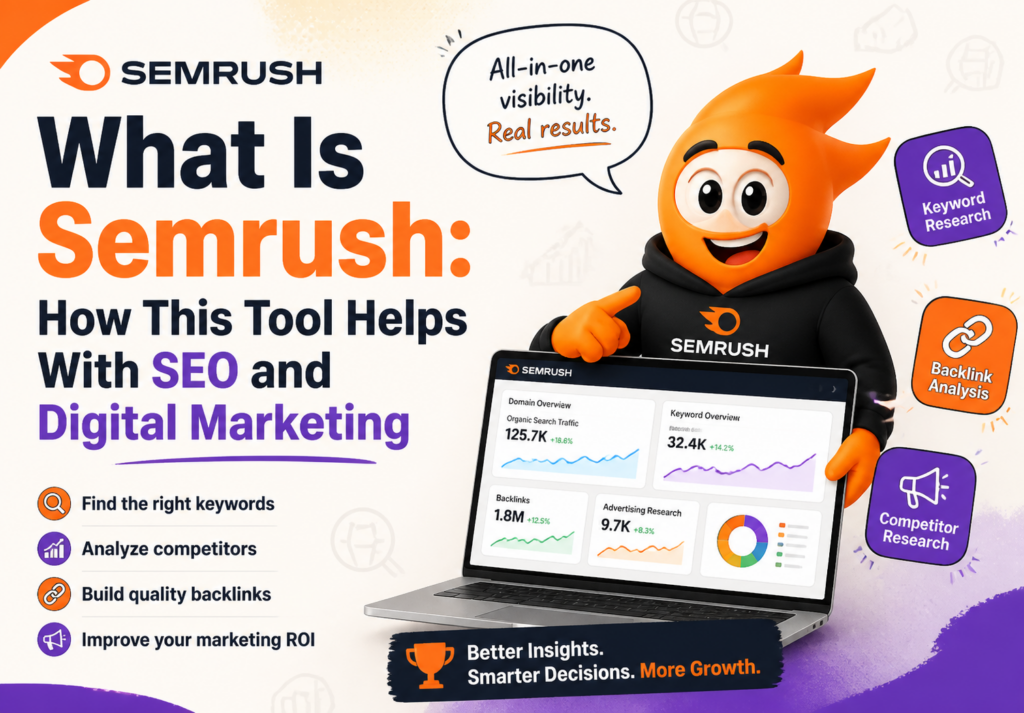
What Is Semrush: How This Tool Helps With SEO and Digital Marketing
A Practical Breakdown of Features That Actually Move Rankings
What Is Semrush: How This Tool Helps With SEO and Digital Marketing
MOST MARKETERS HAVE HEARD OF SEMRUSH BUT FEW USE MORE THAN A FRACTION OF WHAT THE PLATFORM OFFERS. OUR EXPERTS WROTE THIS BREAKDOWN TO HELP BUSINESS OWNERS, IN-HOUSE TEAMS, AND GROWING BRANDS UNDERSTAND WHAT THE TOOL ACTUALLY DOES, WHICH FEATURES PRODUCE REAL RESULTS, AND HOW PROFESSIONALS INTEGRATE IT INTO A SEARCH VISIBILITY WORKFLOW THAT COMPOUNDS OVER TIME.
What’s Inside This Article
1. What Semrush Actually Is — Beyond the Marketing Description
2. Keyword Research: Finding What Your Customers Actually Search For
3. Competitive Intelligence — Seeing Through Your Competitors’ Strategy
4. Site Audit: Finding Technical Problems Before They Kill Rankings
5. Backlink Analysis and Link Building Workflow
6. Content Tools — From Idea to Publication
7. Rank Tracking and Performance Monitoring
8. What Semrush Cannot Do — and What That Means for Your Strategy
9. FAQ
What Semrush Actually Is — Beyond the Marketing Description
Semrush is a research and analytics platform built around a large proprietary database of search data — keyword metrics, domain performance estimates, backlink records, and competitive visibility information — that it makes accessible through a collection of specialized tools. It does not have direct access to Google’s systems. It crawls the web independently, aggregates data from multiple sources, and produces estimates that are directionally accurate rather than precisely authoritative. This distinction matters for how the tool’s outputs should be interpreted and acted on.
The platform started as a competitive research tool and has expanded over years into something considerably broader — covering keyword research, technical site auditing, rank tracking, content planning, social media management, paid advertising analysis, and more. The breadth creates a risk of using it as everything and mastering nothing. The teams that get the most value from the platform do so by understanding which specific features solve which specific problems and building deliberate workflows around those features rather than treating the dashboard as a reporting interface to check occasionally.
At its core, what makes this platform genuinely useful for search visibility work is the same thing that makes any research tool useful: it surfaces information that would be difficult or impossible to gather manually at scale. Knowing which keywords your competitors rank for, which pages on your site have technical problems preventing proper indexing, where your backlink profile has gaps relative to the sites outranking you, and which content topics are generating increasing search interest in your category — all of this can be assembled from first-party data and manual research, but doing so takes significantly more time than the platform requires. The value proposition is efficiency, not magic.
📌 The Data Accuracy Reality:
Semrush’s keyword volume and traffic estimates are approximations based on clickstream data, panel data, and search engine samples — not direct access to Google’s search data. For high-volume head terms, the estimates are reasonably close to actual search volume. For long-tail queries with lower volume, the estimates become less reliable. Professional users treat Semrush data as directional intelligence — useful for comparing relative opportunity between keywords and identifying trends — rather than as precise figures for financial projections.
Keyword Research: Finding What Your Customers Actually Search For
The keyword research functionality is where most users begin and where the platform’s database depth creates genuine competitive advantage. The Keyword Magic Tool — despite the slightly overwrought name — provides access to a keyword database that, when queried intelligently, surfaces the full semantic landscape around any topic: the high-volume head terms, the specific long-tail variations with clearer commercial intent, the question-format queries that indicate research behavior, and the related terms that reveal how searchers conceptualize adjacent topics.
The raw data the tool provides — search volume, keyword difficulty score, cost-per-click from paid search, search intent classification — becomes strategically useful only when interpreted in context. Keyword difficulty scores tell you how competitive a ranking position is likely to be, but they don’t tell you whether your specific site has the authority to compete for that position on any particular timeline. A keyword with a difficulty score of 65 might be achievable for a site with significant established authority and might be completely out of reach for a new site with minimal authority, regardless of how good the content is. Using difficulty scores as absolute filters rather than contextual signals is one of the more common strategic errors in keyword selection.
The Keyword Gap tool — which allows you to compare your domain’s keyword rankings against multiple competitors simultaneously — is arguably more strategically valuable than the keyword discovery tools. It shows you specifically where competitors have ranking positions that you don’t, which is the most direct possible identification of organic search opportunities. A competitor ranking in position four for a high-commercial-intent query that you don’t rank for at all is a prioritized target — you already know the query is commercially valuable (your competitor is investing in ranking for it) and you have a benchmark to understand what ranking requires.
- ► Filter keyword results by search intent — commercial and transactional queries serve different content needs than informational ones
- ► Use the SERP features column to identify queries where rich results — featured snippets, People Also Ask boxes — are present and targetable
- ► Sort by CPC to identify queries with high commercial intent — advertisers paying significant CPCs are signaling genuine conversion value
- ► Export keyword clusters to a spreadsheet and group by topic before assigning to page targets — prevents keyword cannibalization
- ► Use the Keyword Overview tool to check monthly volume trend — a keyword with declining trend is less valuable than flat volume suggests
💡 The Long-Tail Priority Rule:
Head terms with high search volume attract attention in keyword research but rarely represent the best ranking opportunity for most businesses. Long-tail queries — three to five words, more specific intent, lower search volume — are where ranking is achievable sooner, conversion rates are typically higher, and competition from established domains is lower. A portfolio of well-ranked long-tail pages produces more commercial traffic than a single optimistic attempt at a head term that requires years of authority building to reach competitive positions.
Competitive Intelligence — Seeing Through Your Competitors’ Strategy
The competitive analysis capabilities within the platform are what distinguishes it most clearly from simpler keyword tools. The Domain Overview report provides a summary of any domain’s estimated organic traffic, keyword portfolio, traffic value, and backlink profile. Running this report on your primary competitors produces a surprisingly complete picture of their search visibility strategy — which keywords they’re prioritizing, which pages are driving the most traffic, which external sites are linking to them most frequently, and whether their organic visibility has been growing, declining, or staying flat over time.
Traffic trend data is particularly revealing when interpreted over a sufficiently long time horizon. A competitor whose organic traffic has been declining for eighteen months despite appearing strong in absolute terms is a competitor whose position is weakening — which changes the calculus of how aggressively to target the queries they currently hold. A competitor whose traffic has been growing consistently is doing something worth understanding in more detail, and the same tools that reveal their keyword portfolio also reveal the content types and topics driving that growth.
The Organic Research tool, applied to competitor domains, shows which specific pages are generating the most organic traffic and which keywords each page ranks for. This page-level competitive intelligence is one of the most actionable outputs the platform produces. When a competitor’s single guide on a specific topic is generating an estimated 15,000 monthly visits, that’s a direct signal that the topic has genuine search demand and that a superior treatment of the same subject is worth creating. The platform shows you the opportunity; the execution is what determines whether you capture it.
Site Audit: Finding Technical Problems Before They Kill Rankings
The Site Audit tool crawls a website and produces a categorized report of technical issues affecting crawlability, indexing, page experience, and on-page optimization. It covers a wide range of checks — from critical issues like pages blocked by robots.txt that shouldn’t be, duplicate title tags across multiple pages, missing canonical tags, broken internal links, and redirect chains, through to warnings and informational items that represent optimization opportunities rather than outright problems.
The value of this tool is not the issue list it produces — it’s the prioritization it enables. A website of any significant size will have technical issues. The question is which ones are actually limiting performance and which are cosmetic concerns. The audit categorizes issues by severity and provides specific explanations of why each issue matters, which allows teams to direct remediation effort toward the problems most likely to produce measurable improvements rather than working through a list alphabetically.
One use case that’s worth building into a regular workflow is running site audits after any significant website change — a template update, a CMS migration, a new section launch, a URL restructuring. Changes that seem contained to one area of a site frequently produce unintended technical consequences elsewhere: a robots.txt modification that accidentally blocks a subfolder, a canonical tag template that stops functioning correctly after a CMS update, a redirect that introduces a chain where there was previously a direct path. Catching these issues within days of the causative change is exponentially easier than diagnosing them weeks later when the ranking impact has become visible.
| Semrush Feature | Primary Use Case | How Experts Apply It |
|---|---|---|
| Keyword Magic Tool | Discovering keyword opportunities and semantic topic clusters | Filtered by intent and difficulty to build page-level keyword maps |
| Keyword Gap | Identifying queries competitors rank for that you don’t | Prioritized content creation list based on validated competitor demand |
| Organic Research | Analyzing competitor traffic sources and top-performing pages | Content gap analysis and topic opportunity identification |
| Site Audit | Technical issue detection and crawl health monitoring | Post-launch verification and ongoing monthly health checks |
| Backlink Analytics | Analyzing link profile quality and competitor link sources | Identifying outreach targets and toxic link patterns |
| Position Tracking | Monitoring keyword ranking positions over time | Campaign progress reporting and algorithm update impact assessment |
| On-Page SEO Checker | Page-level optimization recommendations against ranking competitors | Content refresh prioritization and thin page identification |
| Domain Overview | Quick competitive landscape assessment for any domain | New client onboarding, market entry analysis, link prospect vetting |
| Traffic Analytics | Estimating competitor traffic volume and channel distribution | Benchmarking own performance against market share estimates |
Backlink Analysis and Link Building Workflow
The Backlink Analytics tool provides one of the largest independent backlink databases available in any commercial platform, and it enables two distinct types of analysis: understanding your own link profile, and understanding where your competitors’ authority comes from. Both types of analysis produce actionable intelligence when applied to a real link building strategy rather than used as a vanity metric dashboard.
Analyzing your own backlink profile reveals the diversity and quality distribution of the sites linking to you, which pages on your site attract the most external links, and whether any links in the profile have characteristics associated with manipulative link schemes — low-authority sites with no real audience, irrelevant topic categories, or patterns that suggest they were built rather than earned. This quality assessment is relevant both for understanding your current authority position and for identifying links that might create risk if Google’s systems flag them as manipulative.
The more immediately actionable use of backlink analysis is competitor link prospecting. When you identify the specific domains linking to your competitors — particularly those linking to multiple competitors but not to you — you have a list of sites that have already demonstrated willingness to link to content in your category. These are higher-probability outreach targets than cold prospecting, because you’re not introducing them to a new topic category. They’ve already made the editorial decision that this topic is worth linking to. The question is whether your content gives them a reason to add a link.
📈 The Link Gap Analysis Workflow:
Step 1: Run Backlink Gap tool comparing your domain against 3–4 primary competitors
↓
Step 2: Filter for domains linking to 2+ competitors but not to you
↓
Step 3: Assess each domain’s authority and editorial relevance
↓
Step 4: Identify which of your content is the most appropriate link target for each prospect
↓
Step 5: Build outreach sequence — this is a prioritized, validated prospect list, not a cold list
The Link Building Tool within the platform attempts to systematize the outreach process by managing prospect lists, tracking outreach status, and monitoring acquired links. It is functional as an organizational system, though the actual outreach quality depends entirely on the messages being sent and the content being pitched — the tool can organize the workflow but cannot improve the quality of the relationship-building work that determines whether outreach succeeds. For a comprehensive understanding of how link acquisition fits into a broader strategy and why it affects the timeline for visible results, the guide on how long search results take to appear provides the strategic context.
Content Tools — From Idea to Publication
The content marketing toolkit within the platform has expanded significantly and now covers the full content development cycle from topic discovery through to optimization review. The Topic Research tool generates content ideas based on a seed topic by analyzing what’s performing well in search for related subjects, surfacing headline patterns, question formats, and subtopics that indicate genuine audience interest. This is more useful as an ideation starting point than as a definitive content brief — the ideas it surfaces reflect what exists and performs in search, which is useful context but not a substitute for the original thinking that makes content distinctive.
The SEO Writing Assistant is a plugin that integrates with Google Docs and WordPress, providing real-time feedback on content as it’s written — readability scores, keyword usage recommendations, recommendations for related terms to include, and a basic plagiarism check. For teams producing content at scale, it provides a consistent quality check that catches common optimization gaps before content is published.
For experienced writers working on individually crafted pieces, it can be safely used as a secondary check rather than a primary guide — the tool’s recommendations are based on patterns in existing content rather than on an understanding of what will make a specific piece genuinely better.
The On-Page SEO Checker produces page-level recommendations by comparing a specific URL’s current content and optimization against the pages currently ranking in the top positions for its target keyword. The recommendations it generates — add this related term, expand this section, improve the internal linking to this page — are directionally useful, particularly for identifying pages that are thin relative to what’s ranking. As with all the tool’s outputs, the recommendations should be evaluated for whether they make the content genuinely better for a real reader, not implemented mechanically because the tool flagged an absence. Understanding how this kind of ongoing optimization connects to generating actual leads from web traffic requires thinking about content quality and conversion together rather than separately.
✏️ The Content Brief Problem:
Semrush’s content tools help identify what to write about and provide optimization guidance, but they cannot produce the genuinely distinctive perspective, original data, or firsthand expertise that separates content that ranks long-term from content that ranks briefly before being displaced by better alternatives. The platform is a research and optimization aid, not a content strategy. The creative and strategic thinking that makes content worth reading still comes from the people behind the keyboard.
Rank Tracking and Performance Monitoring
Position Tracking is the platform’s rank monitoring tool, which tracks a defined set of keywords across one or more domains and reports daily position changes. Setting this up correctly — with a thoughtfully selected keyword set that reflects actual commercial and informational targets rather than vanity terms, and with competitors configured for comparative visibility — produces a monitoring system that makes campaign progress visible and makes algorithm update impacts immediately identifiable.
The keyword selection for position tracking deserves more attention than it usually receives. The instinct is to track the highest-volume keywords in a category. But high-volume head terms may be in positions 40–60 for months before any movement becomes relevant, while mid-funnel and long-tail terms where real commercial impact happens might reach top-10 positions and start generating traffic within the first few months of a campaign. Tracking a balanced set that includes quick-win targets alongside longer-horizon goals provides a more accurate and motivating picture of campaign progress than a keyword set dominated by head terms that move imperceptibly.
The Sensor feature, which tracks overall SERP volatility on a daily basis, provides useful context for interpreting position changes. When multiple keywords show simultaneous movement — both up and down, across multiple sites — on the same day, the cause is almost certainly a broad algorithm update rather than anything specific to the monitored site or campaign. Without this context, individual keyword fluctuations can produce unnecessary alarm or unwarranted celebration. Understanding that a position change reflects a broad update rather than a site-specific event changes how the appropriate response should be framed. For the broader strategic picture of how to evaluate whether a campaign is genuinely working, the guide on guaranteed search optimization services covers the accountability frameworks that separate real performance from activity theater.
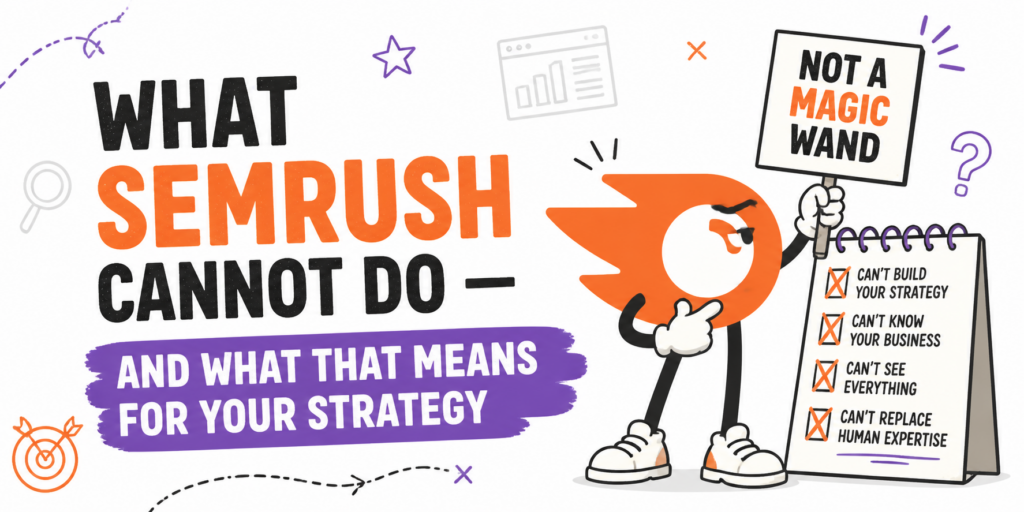
What Semrush Cannot Do — and What That Means for Your Strategy
What Semrush Cannot Do — and What That Means for Your Strategy
Understanding the limitations of any tool is as important as understanding its capabilities — possibly more important, because the limitations determine where you need to supplement the tool’s outputs with different data sources, professional judgment, or first-party information that the platform doesn’t have access to.
The most significant limitation is that all of the platform’s traffic, ranking, and keyword data are estimates derived from third-party data sources rather than direct measurement. Google does not share search data with Semrush. The traffic estimates for competitor domains, the keyword volume figures, and even the ranking positions (which are crawled from specific locations rather than representing the full geographic distribution of actual search results) are approximations. They are useful approximations — useful enough to drive strategic decisions — but they should not be treated as auditable figures or used to make financial projections that require precision.
The platform also cannot tell you what your audience actually wants, what makes your business different from competitors, or what content will resonate with the specific humans who are your best customers. These are strategic and creative questions that no amount of data aggregation can answer. The most common misuse of research platforms is using their outputs as a substitute for this strategic thinking rather than as an input into it. A keyword research report that tells you what people search for does not tell you what you should say to them — the content strategy that converts search intent into business relationships requires understanding your audience at a level the platform cannot provide.
There is also no substitute for Google’s own first-party data for understanding what’s happening with your specific website. Search Console data — which comes directly from Google’s systems — is more authoritative than anything Semrush can produce about your own site’s performance. The correct professional workflow uses Semrush for competitive intelligence and research, and Google Search Console for authoritative data about what’s actually happening with a specific site in search. For teams that want expert guidance on integrating these tools into a coherent optimization workflow, SEO consulting provides the strategic layer that connects tool outputs to decisions that actually improve business outcomes.
- ► Always cross-reference Semrush keyword volume data against Google Search Console impression data for your own site’s queries
- ► Treat competitor traffic estimates as directional benchmarks rather than precise figures for reporting
- ► Use the platform’s research outputs as inputs to strategic thinking — not as strategic conclusions in themselves
- ► Supplement technical site audit data with manual review of pages flagged as having issues — the tool identifies problems, human judgment determines severity
- ► Don’t let the platform’s content recommendations override editorial judgment about what makes writing genuinely valuable to real readers
🔗 How Semrush Fits Into a Professional SEO Workflow:
▶ Research phase: Keyword research, competitive analysis, topic gap identification
▶ Pre-launch: Site audit baseline, competitor backlink prospecting, position tracking setup
▶ Ongoing monitoring: Weekly position tracking review, monthly site audit re-run, quarterly competitor landscape update
▶ Content production: Topic research, brief development, on-page optimization check pre-publication
▶ Link building: Backlink gap analysis, prospect qualification, link monitoring post-acquisition
The platform is best understood as a research accelerator and monitoring infrastructure rather than a strategy generator. It makes good strategy faster to execute and easier to track. It does not generate good strategy on its own. The teams that extract the most value from it are those that bring clear strategic objectives to the platform’s capabilities rather than those that open the dashboard and look for direction. For businesses evaluating whether the investment in professional search visibility work — with or without platform access — is right for their situation, the guide on what guaranteed optimization services actually deliver provides a realistic framework for evaluating ROI.
Frequently Asked Questions — Honest Answers
👉 Is Semrush worth the subscription cost for a small business owner managing their own website?
For a small business owner doing their own search visibility work, the platform’s value depends heavily on how actively it’s used. The monthly subscription cost is significant relative to the budgets of many small businesses, and the tool’s full capability requires genuine expertise to extract value from. For someone who will use the keyword research and basic site audit features regularly, it can pay for itself. For someone who will log in occasionally to check ranking positions, cheaper and simpler tools produce the same outcome. The platform is most cost-effective when used systematically as part of an active workflow rather than as an occasional reference.
🔍 Semrush says my competitor gets 50,000 visitors per month. Can I trust that number?
Treat it as a directional estimate rather than a precise figure. Semrush’s traffic estimates are derived from keyword ranking data and estimated click-through rates rather than from actual analytics access. For large sites with many high-volume rankings, the estimates tend to be reasonably close to actual traffic. For smaller sites with traffic coming predominantly from long-tail queries — where Semrush’s keyword database has less coverage — the estimates can be significantly lower than actual traffic. A competitor showing 50,000 estimated visitors might actually receive anywhere from 30,000 to 80,000 real sessions. Use the number to understand relative scale, not absolute volume.
More useful than the absolute traffic estimate is the trend direction — whether estimated traffic has been growing, declining, or staying flat over twelve to twenty-four months. Trend direction is more reliably represented by the platform’s data than point-in-time absolute numbers, because the methodological factors that cause inaccuracy tend to be consistent over time.
⚠️ Can Semrush replace the need for a professional SEO consultant or agency?
No — and understanding why clarifies what the tool is actually for. A professional search visibility expert uses platforms like this as research and monitoring infrastructure, in the same way that a surgeon uses diagnostic imaging equipment. The equipment doesn’t perform the surgery; it informs the surgeon’s judgment. Semrush surfaces information. The strategic interpretation of that information, the prioritization of actions, the quality judgment about what content will actually outcompete what’s currently ranking, and the relationship-building required for genuine link acquisition all require human expertise that no software platform provides. For businesses that need expert strategy rather than tool access, professional SEO consulting addresses the gap between data and decisions.
💰 We’re paying an agency that sends us Semrush reports every month. Is that enough to demonstrate they’re doing real work?
No. Semrush reports can be generated in minutes by anyone with a subscription and a client’s domain entered. A monthly report showing keyword rankings, domain authority trends, and backlink counts is a data summary, not evidence of work being done. The relevant question is what specific work was performed in the month — what content was created, what links were acquired and from where, what technical issues were identified and resolved — and how that work connects to the metrics in the report. Agencies that use platform reports as their primary deliverable are often using them as a substitute for the work that would actually produce results, not as documentation of it.
📌 How accurate is the keyword difficulty score for evaluating whether I can rank for a given term?
Keyword difficulty scores are useful as relative benchmarks — a score of 30 is meaningfully less competitive than a score of 75 — but they don’t account for your specific site’s authority level. The score reflects how hard it is to rank given the current competitive landscape, but “hard” is contextual: what’s achievable for a site with five years of established authority in a category is not achievable in the same timeframe for a new site regardless of content quality. Use difficulty scores to prioritize across keyword opportunities relative to each other, not as absolute predictions of what your specific site can rank for. Cross-referencing with your site’s current average ranking positions for similar-difficulty terms gives you a better sense of your realistic competitive range.
🔹 I ran a site audit and got 847 issues. Where do I even start?
Start with the errors category — not the warnings or notices — and within errors, prioritize by volume of affected pages and by issue type. A single broken canonical tag template affecting 300 pages is more important than 50 individual missing alt text attributes. The critical issues to address first are anything preventing proper crawling and indexing: robots.txt blocks on important pages, noindex tags applied incorrectly, server errors returning to crawlers, redirect chains longer than two hops. After those are resolved, work through on-page issues — duplicate title tags, missing H1 tags, thin content flags — before moving to warning-level items. The notices category can often be deprioritized entirely until higher-priority issues are addressed.