




 Get to WhatsApp

Our manager will contact you
within 15 minutesт
SEO Packages & Pricing in Chicago: How Much Does SEO Cost
Finding the Right Balance Between Price and Real Results
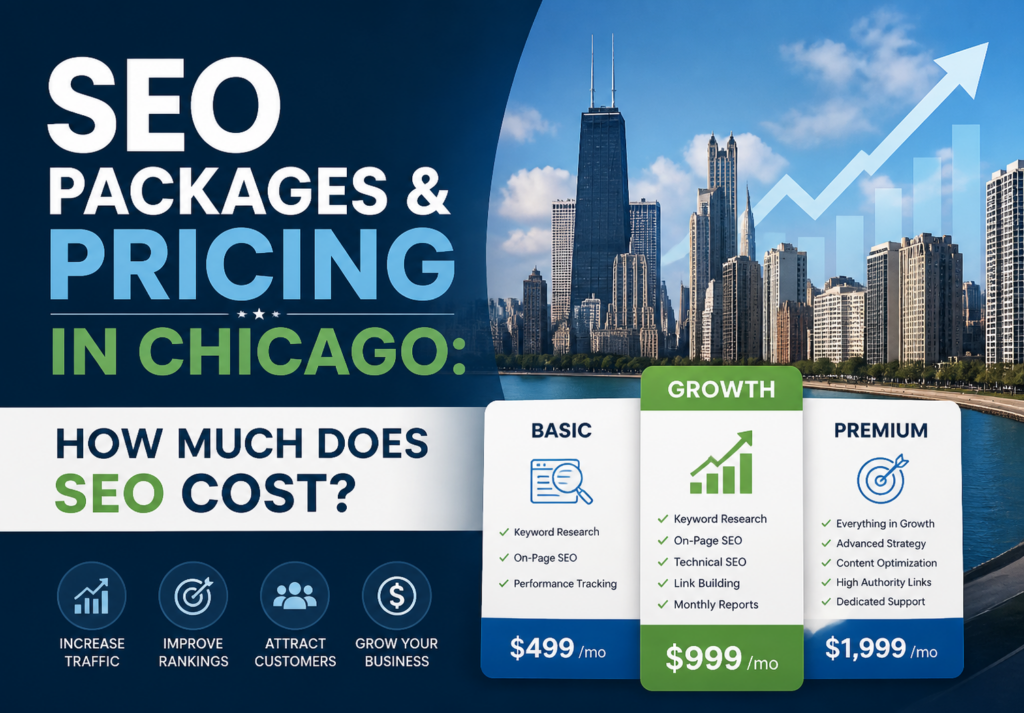
SEO Packages & Pricing in Chicago: How Much Does SEO Cost
I’VE EVALUATED HUNDREDS OF PROPOSALS FROM CHICAGO AGENCIES AND WATCHED CLIENTS MAKE COSTLY MISTAKES AT BOTH ENDS OF THE PRICE SPECTRUM. THIS GUIDE IS MY HONEST ATTEMPT TO GIVE YOU THE CLARITY THAT MOST PROVIDERS DELIBERATELY WITHHOLD.
What This Guide Covers
— What Actually Determines the Price of a Search Optimization Campaign in Chicago.
— What to Expect at Each Investment Level — and What You Won’t Get.
— How Individual Service Components Are Priced in the Chicago Market.
— What’s Included in Our SEO Packages.
— Why World SEO Agency for Your Chicago Campaign.
What Actually Determines the Price of a Search Optimization Campaign in Chicago
Before comparing any two proposals side by side, you need to understand the factors that legitimately cause price differences in this market — because not all price variation reflects quality variation, and understanding the distinction is what separates businesses that make smart decisions from those that overpay for mediocrity or underpay and get nothing.
The competitive intensity of the target market is the first and most significant driver of legitimate cost variation. A financial services firm targeting high-value commercial keywords in downtown Chicago is competing against pages built by organizations that have been investing in authority development for a decade or more. The link profile depth required to rank competitively in that environment is orders of magnitude greater than what a neighborhood bakery needs to appear for local dessert queries. A provider who quotes both businesses the same monthly fee is either overcharging the bakery or undercommitting to the financial services firm — and both outcomes are problematic. Honest SEO pricing in Chicago accounts for this competitive threshold difference explicitly, not as a footnote in the proposal but as a central input to the scope definition.
The starting condition of the website is the second major driver that most buyers don’t fully account for when evaluating proposals. A technically sound site with clean URL structure, proper indexation, no accumulated redirect debt, and some existing domain authority requires significantly less remediation investment than a site with years of accumulated technical problems, a history of plugin conflicts that created crawl errors, and zero referring domains. Two businesses in the same industry and geographic market may need very different investment levels simply because their sites are at different starting points — and a provider who doesn’t assess this before quoting is either not doing the work required to price accurately or planning to discover scope complications after the contract is signed and present them as add-ons.
📌 The Four Factors That Legitimately Drive Price Differences:
Competitive intensity: How authoritative are the current top-ranking pages, and how much authority gap needs to be closed to reach competitive positions?
Site starting point: How much technical remediation, content architecture work, and authority building is required from the current state?
Campaign scope: How many pages, how many keywords, how many content pieces, how many links per month?
Market specificity: Does the provider understand the specific competitive dynamics of your industry in Chicago, or are they applying generic national methodology to a local context?
The third factor — campaign scope — is where most pricing confusion originates. Two proposals that both say “comprehensive monthly search optimization” can represent wildly different actual work volumes. One might include four links per month, two blog posts, and monthly on-page checks for a single primary service page. The other might include twelve links per month from high-authority referring domains, four in-depth content pieces, technical audit monitoring with remediation, and optimization across twenty commercial pages simultaneously. Both are described as “comprehensive” in the proposal language. Neither the work volume nor the quality standard is visible in the category description — which is why demanding specific deliverable quantities and quality standards before any comparison is meaningful is the foundational discipline of evaluating any proposal honestly.
What to Expect at Each Investment Level — and What You Won’t Get
The honest version of the investment tier conversation acknowledges something that most agencies avoid saying directly: the monthly investment level determines how much work can be done each month, and the amount of work required to produce results in a given market is determined by the competitive environment — not by what the business can afford. These two numbers are often different, and when they are, the outcome is consistent: the campaign runs for six to twelve months, reports look busy, and positions don’t move meaningfully. Understanding this before engaging any provider is the most important piece of financial literacy available in this space.
At the entry level — roughly $500 to $1,200 per month in the Chicago market — the economics of the investment support a foundational scope: basic technical audit findings, on-page optimization for a small number of primary pages, and perhaps a single content piece per month. For businesses in genuinely low-competition categories — a specialized niche with few local competitors and modest search volume — this investment level is appropriate and the results it produces will be proportionate to the investment. For businesses in any of Chicago’s competitive commercial categories — legal, medical, real estate, financial services, home services — this investment level is structurally insufficient regardless of provider quality, because the competitive threshold for meaningful positions requires more sustained, higher-volume work than the economics of this tier can support.
At the growth tier — $1,500 to $3,500 per month — the investment supports a genuinely complete campaign when properly scoped: full technical remediation, on-page optimization across primary commercial pages, regular content production, and a defined link acquisition program running simultaneously. This is the investment range where most Chicago businesses in competitive local and regional categories should be operating if organic lead generation is a meaningful priority. The differentiation between providers at this tier is not primarily price — it’s what’s included without add-on billing, how specifically the deliverables are defined, and whether the provider has demonstrated results in comparable markets and verticals. When evaluating providers at this level, reviewing the Top 15 Best SEO Companies in Chicago provides useful context for what distinguishes genuine capability from effective self-marketing at comparable investment levels.
⚠️ The Hidden Cost Trap in Standard Retainer Pricing:
A $1,000/month retainer that excludes link building, content production, and technical remediation frequently costs $1,800–$2,400/month once those components are billed separately in months three through six.
An all-inclusive package at $1,500/month that covers all components is often less expensive over twelve months than a “cheaper” entry retainer with accumulated add-ons — and provides the scope certainty that allows realistic planning.
Always request: what is the estimated total twelve-month cost including all anticipated additional charges? A responsible provider can answer this before you commit.
At the premium tier — $4,000 to $10,000 per month and above — the investment supports enterprise-scale campaigns: large site architecture, multilingual content production at scale, aggressive authority building programs targeting high-domain-authority placements, and the reporting infrastructure that enterprise marketing teams require for cross-channel attribution. This range is appropriate for multi-location businesses with complex site structures, highly competitive categories in major metropolitan markets, and businesses with revenue volume that justifies premium investment for maximum market share capture. For most local Chicago businesses, the growth tier provides better return on investment than the premium tier — because the marginal value of additional work diminishes once foundational positions are established and maintained.
- ➤ Ask every provider to itemize the monthly investment by deliverable category — time, tools, content volume, link acquisition quantity — before any proposal discussion
- ➤ Confirm whether link building is included at a specified monthly quantity with minimum quality standards — it is the most frequently excluded high-impact component in standard retainers
- ➤ Ask what triggers a change order — any scenario the provider cannot absorb within the monthly scope is a future add-on invoice waiting to appear
- ➤ Confirm that tool subscription costs are absorbed by the provider rather than passed through as separate monthly charges
- ➤ Request the estimated total annual cost including all anticipated add-ons — this is the number that matters for budget planning, not the headline monthly fee
How Individual Service Components Are Priced in the Chicago Market
Understanding component-level pricing gives you the analytical framework to evaluate whether any retainer proposal is realistically complete at the quoted price. The pattern that emerges consistently across the market is that standard retainer pricing covers a subset of the components required for a functional campaign — typically on-page optimization and reporting — while the highest-cost components appear as add-ons after the client has committed to the engagement. This is not always deliberate — some providers genuinely underscope initially and discover the gap as the campaign progresses — but the financial outcome for the client is identical regardless of intent: a total annual cost substantially above the proposal’s headline figure.
Link building is the component most frequently excluded or underrepresented in standard Chicago retainers. It is also the component that most directly determines ranking ability in competitive categories — the authority threshold for top positions in legal, medical, real estate, and financial services queries cannot be reached through on-page optimization alone regardless of how thoroughly it’s executed. A retainer that doesn’t specify a monthly link acquisition quantity with defined quality minimums is, in practice, a partial service that generates activity reports without generating the authority signals required to compete. When evaluating any proposal, the specific link building component — how many links, from what quality sources, verified how — is the most revealing single element of the scope.
For businesses researching how much does SEO cost in Chicago relative to what the investment actually produces, the most useful comparison framework is total annual cost against a complete, specified scope — not monthly headline numbers against category descriptions. The guide on SEO guarantees covers what legitimate performance accountability looks like contractually, which is equally important context before evaluating any provider’s commitment language at face value. It’s also worth considering that for many businesses, particularly those just building their online presence, we recommend paying attention to affordable SEO options that deliver genuine value without inflated pricing.
Chicago Market — Service Component Pricing Reference
| Service Component | Typical Chicago Market Price | Expected Timeline to Impact |
|---|---|---|
| Full technical audit (initial) | $800 – $2,500 one-time | Findings deliverable within 1–2 weeks |
| On-page optimization (per page) | $150 – $400 per page | Ranking signal improvement within 4–8 weeks per page |
| Content production (per article) | $300 – $800 per piece | Indexing within 1–3 weeks; ranking traction within 60–90 days |
| Editorial link building (per link) | $150 – $600 per placement | Authority signal impact visible within 60–90 days |
| Local citation management | $200 – $500/month | Map pack improvement within 4–8 weeks |
| Google Business Profile management | $300 – $700/month or one-time setup | Visibility improvement within 3–6 weeks of active management |
| Rank tracking and reporting | $100 – $300/month (often a pass-through) | Data visible from campaign launch — ongoing |
| Structured data implementation | $400 – $1,200 one-time | Rich result eligibility within 2–4 weeks of implementation |
| Entry-level all-in retainer (low competition) | $500 – $1,200/month | Suitable for minimal competition only; results in 3–6 months |
| Growth all-inclusive retainer (competitive local) | $1,500 – $3,500/month | First movements in 1–2 months; sustainable positions in 6–9 months |
| Premium / enterprise retainer | $4,000 – $10,000+/month | Aggressive markets; first signals in weeks, top positions in 6–12 months |
| Penalty recovery (manual or algorithmic) | $1,500 – $5,000 project fee | 2–6 months depending on severity and history |
📄 How to Use This Pricing Reference When Evaluating Proposals:
Step 1: Identify which components your campaign genuinely requires based on your competitive category and site starting point.
Step 2: Calculate the component-level cost of a complete campaign using the ranges above — technical, content, links, tracking, and reporting.
Step 3: Compare any retainer proposal against this component total. If the quoted retainer is significantly below the calculated complete cost, identify which components are excluded or will appear as add-ons.
Step 4: Request a twelve-month total cost commitment from every provider before making any comparison — only total annual cost allows accurate comparison, not monthly headline figures.
The SEO agency in Chicago market is competitive enough that pricing transparency has become a meaningful differentiator — providers who publish their pricing and itemize what each tier includes before any consultation are demonstrating a structural confidence that providers who withhold pricing until the discovery call are not. The withholding of pricing before contact is typically not a sign of bespoke customization — it is a sign that pricing is calibrated to perceived client budget rather than to actual work scope, which is the practice that produces the accumulated add-on billing pattern described above.
What’s Included in Our SEO Packages?
| Package | Monthly Price | What’s Included |
|---|---|---|
| START A Profitable Start Get Started → |
from $1,500 / month First result: 2 months |
Website optimization. Top 10 Google rankings. AI (GEO) under Google search. Local SEO with new page creation. Promoted pages: 10. Keywords: 30. |
| BUSINESS Customer Selection ★ Get Started → |
from $2,500 / month First result: 1 month |
Everything in START. Top 5 Google rankings. AI (GEO) optimization. Local SEO with new pages. Promoted pages: 20. Keywords: 100. Regular blog development. Organic backlinks. |
| INDUSTRY LEADER Everything Is Included Get Started → |
from $3,500 / month First result: 2 weeks |
Full-service SEO. Top 3 Google rankings. AI (GEO) optimization. Local SEO. Unlimited pages and keywords. Regular blog. Organic backlinks. Technical improvements. Paid link building included. Financial guarantee applies to this plan. |
Every World SEO Agency package is built on the same foundational principle: the monthly price covers everything required to run a genuinely functional campaign without supplementary invoicing. No link building add-ons at month three. No content sprint charges when the editorial calendar requires additional pieces. No tool subscription pass-throughs. No change orders for technical work that falls within reasonable campaign scope. The invoice the client receives each month is the only invoice — every month, for the full duration of the engagement. For Chicago businesses that have previously experienced the frustration of a “comprehensive” retainer that generated a steady stream of unanticipated additional charges, this structure is immediately recognizable as a departure from how most providers in this market operate.
📌 What Separates Our Packages From Standard Chicago Market Retainers:
Link building included: Specified monthly quantity with defined quality minimums — not a separate billing category or an optional add-on.
Content production included: Defined monthly article quota written to brief — no additional charge for the content the campaign requires to build topical authority.
Tool subscriptions absorbed: Research, rank tracking, and audit platform costs are operational expenses — not pass-through charges billed to clients separately.
Technical work included: Issues identified through ongoing monitoring are remediated within scope — no developer billing for fixes that should reasonably be part of running a complete campaign.
Reporting included: Monthly performance report with full deliverable verification data — not a separately billed reporting module or a dashboard login that substitutes for actual analysis.
Why World SEO Agency for Your Chicago Campaign
The SEO pricing in Chicago market is competitive enough to include providers at every quality level — from freelancers charging a few hundred dollars per month to enterprise agencies billing five figures. World SEO Agency sits at the growth tier with a structural advantage that most providers at any price point can’t match: every deliverable is specified before commitment, the price is fixed for the engagement, and performance accountability is written into the contract as a specific, enforceable obligation rather than used as marketing language in the proposal. For the full context on what our Chicago campaigns cover and who they’re best suited for, the Chicago SEO agency page provides the most complete overview of our approach and process.
1) All-Inclusive System Without Hidden Payments
Technical audit and remediation, on-page optimization, content production, link acquisition, rank tracking, and monthly reporting are all included in the monthly package price. The invoice the client receives each month is the only invoice. No add-ons, no pass-throughs, no change orders for work that should reasonably be considered part of running a complete campaign. The total cost of a twelve-month World SEO Agency engagement is exactly what was quoted at the proposal stage — not what was quoted plus the accumulated additions that appear throughout the year in a standard retainer relationship.
2) Financial Guarantees
The INDUSTRY LEADER package includes a financial performance guarantee tied to specific ranking milestones for the agreed query set within the agreed timeline. The guarantee is contractual — written into the engagement agreement with documented financial consequences if milestones are not delivered — not rhetorical marketing language without legal backing. This structure is possible because the methodology has been validated across a sufficient volume of comparable engagements to make milestone targets predictable rather than aspirational. A campaign that includes all four components simultaneously — technical, content, links, and local signals — simply performs more reliably than a partial campaign that the client expected to be complete.
3) Large Volume of Work Every Month
The deliverable volumes at each World SEO Agency tier reflect what competitive environments actually require to produce results — not the minimum viable scope that the economics of a low-priced retainer can support. Technical work, content production, and link acquisition run simultaneously as coordinated parallel workstreams rather than sequentially or at reduced volume in months where other components are absorbing the budget. The monthly output is defined, documented, and verifiable — every link placed has a live URL, every content piece is findable in Search Console, every technical fix has a before-and-after crawl comparison to demonstrate it was completed.
4) Transparent Price
SEO pricing at World SEO Agency is published and explained before any consultation. Every proposal is itemized with specific deliverable quantities and quality standards. There is no pricing-on-request approach that allows quotes to be calibrated to perceived client budget rather than actual work scope. The price reflects what the campaign requires — determined by an honest assessment of the site’s starting point and the competitive environment, not by what the proposal presentation can justify as premium value.
5) 90-Day Performance Commitment
Every engagement includes contractual performance milestones achievable within the first ninety days of a well-executed campaign. If those foundational milestones are not delivered on the agreed timeline, the contract specifies the accountability mechanism. This commitment is specific and verifiable — not a satisfaction clause or a “we’ll work until you’re happy” provision that creates no actual financial accountability. It is a defined outcome commitment that gives clients meaningful protection during the investment period before results become fully visible.
Want to discuss your campaign? Get a consultation from a World SEO Agency expert. Send a request.
Frequently Asked Questions
👉 Why is SEO pricing in Chicago generally higher than in smaller US markets?
The Chicago market combines a large and economically active business population, an established digital marketing ecosystem that has been investing in organic visibility for years, and high competitive thresholds in major commercial categories. The competitive threshold for top positions in legal, medical, real estate, and financial services queries is genuinely higher here than in secondary markets, and the cost of the link acquisition and content production required to reach those thresholds reflects the market’s competitive intensity rather than arbitrary premium pricing.
📈 What is the minimum investment level where a Chicago business in a competitive category can realistically expect results?
For most competitive service categories in the Chicago market — legal, medical, home services, real estate — the realistic minimum for a complete campaign that can actually move positions is $1,500 per month. Below that level, the investment cannot economically support simultaneous content production and link acquisition at the volumes required to compete. Entry-level retainers below $1,200 per month are appropriate only for genuinely minimal competition situations, which are uncommon in Chicago’s most commercially active categories.
The more useful question is not “what’s the minimum” but “what does my specific competitive environment require” — and the honest answer to that is based on a site audit and competitive analysis, not a general price list.
⚡ Can I get faster results by spending significantly more per month?
Up to a point. More investment allows more link acquisition, more content production, and more comprehensive technical remediation running simultaneously — which compresses the authority-building timeline. But the relationship is not linear: doubling the monthly investment does not halve the time to results, because the limiting factor is often the time required for authority signals to be recognized and weighted by search systems, not the volume of work being done. At higher investment levels, the primary benefit is more thorough competitive coverage and better positioning by the end of the campaign timeline, not proportionally faster results.
📌 How do we verify that the link building included in a package is actually happening?
Ask for live URLs of every link placed in the most recent month’s reporting cycle. Each link should be on a page that is indexed in Google, has genuine organic traffic (verifiable through any traffic estimation tool), and surrounds the link with topically relevant content. Providers who have done the work have this verification data readily available. Providers who haven’t will offer screenshots, spreadsheets without URLs, or aggregate domain authority metrics that don’t allow independent verification.
📄 Is there a meaningful difference between paying $1,500 and $2,500 per month in the Chicago market?
Yes — primarily in the volume of work and the breadth of coverage. The $1,500 tier supports a foundational campaign covering primary commercial pages with baseline link acquisition. The $2,500 tier supports a significantly expanded keyword and page coverage with a more active link acquisition program and regular content production. For businesses in low-to-moderate competition categories, the $1,500 tier produces results. For businesses in highly competitive categories, the $2,500 tier is where the work volume required to reach competitive positions becomes sustainable.
🎯 Should we evaluate a Chicago agency based on their own search rankings?
Their own rankings provide some signal but less than most people assume. An agency that ranks well for competitive terms in a major market demonstrates that its methodology works for that specific context. But their own ranking is a single data point from a site with years of accumulated authority — it doesn’t predict how well they’ll perform for a client starting from a weaker position in a different competitive category. Client results in comparable categories, verified through Search Console data or live link review, are more predictive than the agency’s own rankings.
🔎 What does “guaranteed results” actually mean in a search optimization contract, and how do we evaluate these claims?
The phrase “guaranteed results” means almost nothing without the specific contractual terms that define it. The questions that reveal whether a result commitment is genuine: what specific outcome is committed to, by what specific date, and what financial consequence occurs if that outcome is not delivered? A contractual financial remedy — partial refund, extended service at no cost, or another documented remedy — indicates genuine risk-sharing. A “satisfaction guarantee” or “we’ll keep working” provision creates no financial accountability and provides no actual protection if the campaign underperforms.
💵 Why do some Chicago agencies charge $8,000 or more per month? Is that ever justified?
Yes — for specific campaigns where the competitive environment, site complexity, and business scale genuinely require that investment level. Enterprise sites with hundreds of thousands of indexed pages, multi-location businesses competing simultaneously in multiple geographic markets, and companies in nationally competitive categories where the top-ranking pages have decade-long authority profiles all represent situations where the work genuinely costs more to execute at a competitive standard.
The test is whether the provider can itemize the investment by actual work components at that price point. If they can, the price may be justified. If the answer is vague reference to their expertise and track record, the price reflects brand positioning rather than work complexity.