




 Get to WhatsApp

Our manager will contact you
within 15 minutesт
Local SEO Pricing Guide 2026: How Much Does a Local SEO Package Cost
A Transparent Breakdown of Costs, Packages, and What You Actually Get
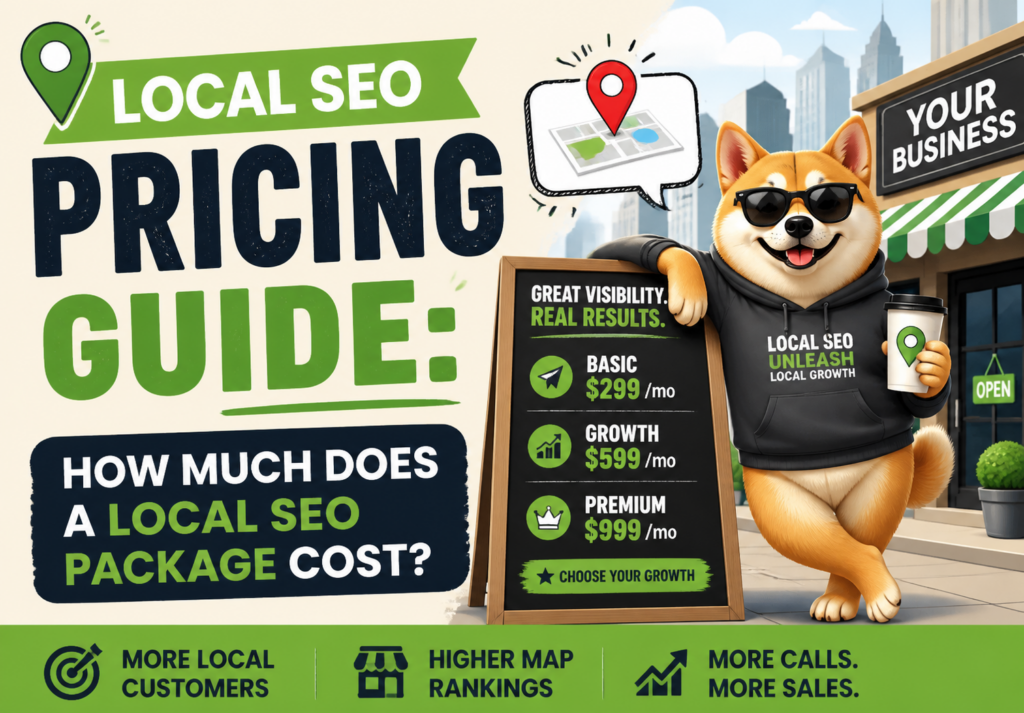
Local SEO Pricing Guide: How Much Does a Local SEO Package Cost
THE MARKET FOR LOCAL SEARCH OPTIMIZATION SERVICES IS ONE OF THE MOST CONFUSING BUYING DECISIONS A SMALL BUSINESS OWNER FACES — QUOTES RANGE FROM $150 TO $5,000 PER MONTH FOR WHAT APPEARS TO BE THE SAME SERVICE. OUR EXPERTS WROTE THIS GUIDE BECAUSE THE PRICE DISPARITY IN THIS MARKET IS REAL AND CONSEQUENTIAL: CHOOSING THE WRONG PROVIDER AT THE WRONG INVESTMENT LEVEL IS ONE OF THE COSTLIEST MARKETING MISTAKES A LOCAL BUSINESS CAN MAKE, AND MOST OWNERS DON’T HAVE THE FRAMEWORK TO EVALUATE WHAT THEY’RE BEING QUOTED.
What’s Inside This Guide
1. Why the Price Range Is So Dramatic — and What It Actually Means
2. The Specific Factors That Drive Your Quote Up or Down
3. What Different Investment Levels Actually Include
4. Pricing by Market — US, UK, Europe, Australia, and Beyond
5. The Tools and Tactics That Make Up a Local Campaign
6. Red Flags in a Quote — What Cheap Really Costs You
7. Calculating Whether the Investment Makes Financial Sense
8. How to Evaluate and Choose the Right Provider
9. Why World SEO Agency — and What We Offer
10. FAQ
Why the Price Range Is So Dramatic — and What It Actually Means
If you have spent any time getting quotes for search optimization services for your local business, you have almost certainly experienced the confusion of receiving proposals that range from $200 to $3,000 per month for what appears, on paper, to be the same service. Both proposals might say “Google Business Profile optimization,” “citation building,” “monthly reporting,” and “on-page optimization.” The deliverable list looks similar. The price difference is enormous. And nobody on the agency side explains why.
The explanation is not primarily about profit margin. It’s about economics. Genuine, effective local search work — the kind that actually moves a business from invisible in its market to prominent in map pack results and near-the-top organic positions — requires meaningful human time every month. Auditing the competitive landscape, identifying citation inconsistencies and fixing them across dozens of directories, creating location-specific content that genuinely answers what local customers search for, building the kind of external links that signal neighborhood authority to Google’s systems, optimizing and actively managing the Google Business Profile with posts, Q&A responses, and review strategy — all of this takes hours. At $200 per month, after software costs and overhead, there are perhaps two to three hours of human attention available for a client account. Two to three hours is enough to generate an automated report. It is not enough to do any of the work that actually produces results.
The businesses that understand this economics-of-time reality make fundamentally better purchasing decisions than those who evaluate proposals purely on deliverable bullet points. A high deliverable count in a cheap proposal is almost always a list of things that will be done superficially or automatically — not a list of things that will be done well enough to move rankings. Understanding local SEO pricing as a reflection of the actual human work hours that can be applied to your campaign at a given budget level is the starting framework for evaluating any quote you receive.
📌 The Time Economics of Local Search Work:
A thorough Google Business Profile audit and optimization takes 3–4 hours. A proper citation audit across 50+ directories takes 4–6 hours. A single location-specific landing page written to competitive standard takes 3–5 hours. One quality editorial link takes 2–4 hours of outreach. Monthly review management and response takes 1–2 hours. Add these together and a genuinely effective month of local campaign work requires 15–25 hours minimum. At industry-standard agency billing rates, that alone justifies a $900–$2,000 monthly engagement before any overhead.
The Specific Factors That Drive Your Quote Up or Down
Local search campaign costs are not arbitrary — they reflect a set of specific variables that any competent agency should be able to articulate when explaining their proposal. If a provider cannot clearly explain what is driving the cost of their quote, that inability is itself diagnostic information about the quality of thinking behind the proposal.
The single biggest cost driver is competitive intensity. A plumber trying to rank in a small market with limited competition requires fundamentally different work — and therefore different budget — than a personal injury attorney trying to rank in a major metropolitan market against dozens of established competitors with years of authority and thousands of reviews. The competitive environment determines how much authority work (content and links) is required to reach and hold top positions, which is the most time-intensive part of any campaign. Competitive analysis at the start of an engagement should explicitly quantify this — how many links do the top-ranking competitors have, how many reviews, how long have they been indexed — and the campaign scope should reflect those specific requirements.
The number of locations is the second major cost driver. A single-location business requires building authority signals for one geographic target. A business with five locations across a metro area requires the same work done five times — five sets of location pages, five Google Business Profile strategies, five citation profiles, five review management workflows. Multi-location businesses should expect per-location costs to be somewhat lower than five times the single-location cost due to efficiencies, but the total investment still scales significantly with location count. The guide on how much SEO costs across different business types covers this scaling dynamic in detail for both local and national campaigns.
- ► Market competitiveness — the number and strength of established competitors in your specific geographic market
- ► Number of locations — each physical location requires its own citation profile, landing page, and profile management
- ► Starting point — a business with zero citations and a neglected profile requires remediation work before growth work can begin
- ► Industry category — some categories (legal, medical, home services) have more aggressive competition and require more authority investment
- ► Service radius — businesses serving a wide geographic area around a single location require content and authority work for a larger territory than hyper-local operators
- ► Timeline pressure — faster results require more intensive early-stage investment in citation cleanup, profile optimization, and link acquisition
What Different Investment Levels Actually Include
The question of how much does a local SEO package cost is best answered by understanding what each investment tier can realistically fund in terms of actual work — not by comparing bullet point lists on agency websites. The following breakdown reflects what competent, honest providers can deliver at each budget level in the current market, and what should realistically be expected in terms of outcomes.
At the entry level — roughly $300 to $600 per month — the economics support a narrow scope of genuinely useful work: Google Business Profile optimization and monthly post management, basic citation consistency audit and correction, and reporting from Google Search Console and the profile dashboard. This tier is appropriate for businesses in low-competition markets where the profile optimization alone is sufficient to produce top map pack results. It is not appropriate for businesses in competitive markets, businesses that need significant authority work, or businesses with multiple locations requiring individual attention. The question is not whether this price point is cheap or expensive — it’s whether the work it funds is sufficient for the competitive environment the business operates in.
The mid-tier range of $800 to $1,800 per month is where most single-location businesses in moderate-competition markets find the right balance between cost and scope. At this level, the work expands to include active citation building (not just cleanup), regular content production for location-specific pages, review acquisition strategy with response management, and some link building activity — typically three to five local editorial links per month. This is the range where campaigns produce measurable ranking improvements within four to six months for most businesses, assuming the work is genuinely being done rather than automated and reported. The honest breakdown of what cheap versus expensive search optimization actually delivers covers the quality difference at each price point in detail.
📈 Package Tier Summary — What Each Level Realistically Funds:
$300–$600/month: Profile management, citation audit, basic reporting. Works in very low competition only.
$600–$1,200/month: Profile + citations + one location page per month + review management. Works in moderate competition.
$1,200–$2,500/month: Full local campaign with content, links, and active profile management. Works in competitive markets.
$2,500–$5,000/month: Aggressive multi-area or multi-location campaigns with significant authority building. Required for high-competition industries.
$5,000+/month: Enterprise multi-location operations, highly competitive legal/medical/finance categories in major metros.
The premium range — $2,500 to $5,000 per month — is required for businesses competing in genuinely difficult markets: personal injury law in major cities, dental practices in dense urban markets, home service businesses in markets with dozens of well-established competitors. At this investment level, the scope includes aggressive content production (four to six pieces per month), consistent link acquisition from locally relevant publications and organizations, structured review campaigns, and active management of the full citation ecosystem across niche and general directories. The timeline for competitive results at this level is typically four to nine months, depending on where the business starts and how strong the top competitors are. Understanding the full timeline dynamic is covered in the guide on how long it takes to see results.
Pricing by Market — US, UK, Europe, Australia, and Beyond
Local search optimization service costs vary significantly by geographic market — not primarily because the work is different, but because agency labor costs, competitive market dynamics, and client expectations differ meaningfully across countries. A campaign that costs $1,500 per month in the United States might cost £800 in the United Kingdom, €900 in Germany, or $700 AUD in Australia for equivalent work quality. Understanding these market-specific benchmarks prevents businesses from either overpaying when working with overseas providers or undervaluing the work when comparing domestic and international quotes.
| Market / Region | Typical Monthly Range | Notes on Market Specifics |
|---|---|---|
| United States (major cities) | $1,000 – $5,000+ | Highest competition markets globally; NYC, LA, Chicago at premium end |
| United States (small/mid markets) | $500 – $2,000 | Lower competition allows effective work at moderate investment |
| United Kingdom | £600 – £3,000 | London at premium; regional UK cities more accessible |
| Australia | $800 – $3,500 AUD | Sydney and Melbourne most competitive; strong ROI for service businesses |
| Canada | $700 – $3,000 CAD | Toronto and Vancouver competitive; similar structure to US market |
| Western Europe (Germany, France, Netherlands) | €700 – €3,000 | Growing market; multilingual requirements add complexity and cost |
| Eastern Europe | €300 – €1,200 | Lower labor costs; quality varies significantly between providers |
| Southeast Asia (Singapore, Philippines) | $300 – $1,500 USD | English-language markets growing; local map competition varies widely |
| India | $150 – $800 USD | Very low cost; output quality and strategic depth highly variable |
The US market deserves particular attention because it combines the highest competition levels with the most sophisticated buyer expectations and the highest ROI potential for local businesses. A restaurant or medical practice in New York City or Los Angeles is competing for visibility in one of the most contested local search environments in the world — and the investment required to compete effectively reflects that reality. The dedicated breakdown of search optimization pricing across the United States, as well as the specific guides for Los Angeles and New York, provide market-specific benchmarks for the two most competitive metro markets in the country.
The Tools and Tactics That Make Up a Local Campaign
Understanding what goes into a local search campaign — the specific tools, platforms, and activities involved — makes it significantly easier to evaluate any proposal against its claimed scope. When a provider says they “optimize your Google Business Profile” as part of a package, that phrase can mean anything from a fifteen-minute setup session to an ongoing monthly program of posts, Q&A management, photo updates, service list refinement, and competitive monitoring. The specificity of what each deliverable actually involves is the detail that separates meaningful proposals from vague marketing language.
| Tool / Tactic | What It Does for the Campaign | Included at Which Tier |
|---|---|---|
| Google Business Profile management | Controls map pack appearance, review visibility, and local authority signals | All tiers — foundation of every local campaign |
| Citation audit and cleanup | Corrects inconsistent NAP data across directories that dilutes local ranking signals | Entry and mid tier — one-time remediation plus ongoing |
| New citation building | Expands directory presence to build consistent local authority footprint | Mid tier and above |
| Location landing page creation | Targets geographic queries with dedicated, optimized content for each service area | Mid tier and above |
| Review acquisition strategy | Systematic process for generating authentic customer reviews — a top ranking signal | All tiers — strategy only at entry; active management at mid+ |
| Review response management | Responding to reviews signals engagement and affects both ranking and conversion | Mid tier and above |
| Local link building | Earns editorial links from local publications, chambers, and community organizations | Mid to premium tier — most impactful authority signal |
| Schema markup (LocalBusiness) | Structured data that helps Google understand business type, location, and hours | Mid tier and above — technical requirement often missed at entry level |
| Competitor gap analysis | Identifies exactly what top-ranking competitors have that the client lacks | Mid and premium — drives strategic prioritization |
| Local rank tracking | Monitors position changes for target geographic queries from specific locations | All tiers — basic at entry, granular location grid at premium |
| Google Business Profile Q&A management | Proactively populates and monitors the Q&A section to control brand messaging | Mid tier and above |
| BrightLocal or Whitespark local grid tracking | Visualizes map pack ranking from multiple geographic points within the service area | Premium tier — provides granular local visibility intelligence |
Red Flags in a Quote — What Cheap Really Costs You
The most dangerous outcome in this category is not overpaying for good work — it’s underpaying for bad work and then paying again to fix the damage. This cycle is far more common than the industry admits: a business invests $250 per month for a year in a low-cost provider, sees minimal results, and then hires a competent agency that charges significantly more and spends the first three months of the engagement cleaning up the citation mess, disavowing the low-quality links, and rebuilding the profile optimization that was done incorrectly. The total cost of that cycle is substantially higher than a quality mid-tier engagement from the start.
The warning signs in a proposal that indicate likely underdelivery are consistent and recognizable once you know what to look for. Vague deliverable language — “ongoing optimization,” “regular reporting,” “monthly link building” — without specific quantities or quality standards attached is the most common indicator. An agency that cannot tell you how many citations they will build, from which categories of sources, or what their monthly link acquisition target is in terms of referring domain authority range, is describing work that will be done to an undefined standard. That undefined standard almost always resolves to “whatever the software automates” rather than “whatever produces results.”
Guaranteed first-page rankings quoted within thirty days of a new engagement are another reliable red flag. Legitimate local search work takes time — profile authority builds over months, citation consistency is assessed by Google’s systems on a crawl schedule that takes weeks, and editorial links require genuine outreach and relationship building. Any provider promising dramatic results within weeks is either describing a competitive environment with no real competition (in which case the work is trivial) or describing tactics — like PBN links and fake reviews — that produce short-term movement followed by penalties and recovery costs. The guide on what guaranteed SEO services actually mean covers the legitimate versus illegitimate versions of performance guarantees in this industry.
⚠️ The True Cost of a Bad Local Campaign:
A year of ineffective low-cost work at $300/month = $3,600 spent with no results. Add 3 months of remediation work at $1,500/month = $4,500. Add lost revenue during the 15-month period where the business had minimal local visibility. The total cost of the “cheap” decision routinely exceeds $15,000–$25,000 when lost revenue opportunity is included. The same $3,600 invested in a quality mid-tier provider from the start would have produced measurable ranking improvements within 4–6 months.
Calculating Whether the Investment Makes Financial Sense
The question of how much does a local SEO package cost only makes sense in the context of what that investment returns. A campaign that costs $1,500 per month and produces four additional customers per month for a business with a $3,000 average customer value has a 700% monthly ROI. A campaign that costs $500 per month and produces zero additional customers has a negative ROI regardless of how many rankings improved or how many citations were built. Framing the investment decision in terms of expected return rather than in terms of cost is the correct analytical approach.
The calculation requires three inputs: the expected monthly customer value generated by new organic customers, the realistic conversion rate from local search traffic to paying customers, and the expected increase in qualified local traffic from the campaign. A dental practice with a $2,500 average new patient value, a 15% conversion rate from inquiry to appointment, and a campaign that generates 30 additional local search inquiries per month is looking at approximately 4–5 new patients per month worth $10,000–$12,500 in monthly revenue from a $1,800 investment. Those numbers make the investment decision straightforward regardless of what the monthly cost feels like in isolation.
For businesses uncertain whether the numbers work for their specific situation, the local SEO services consultation process at World SEO Agency includes an ROI projection based on the business’s existing conversion rates and average customer value — so the decision is made with data rather than with hope. The broader framework for evaluating whether search optimization investment makes sense for different business types is covered in the guide on SEO pricing in the USA, which includes industry-specific ROI benchmarks across major service categories.
How to Evaluate and Choose the Right Provider
The due diligence process for selecting a local search optimization provider is simpler than most business owners expect — but it requires asking specific questions rather than reviewing marketing materials. The questions that separate competent providers from incompetent ones are not about credentials or case study volume. They are about the specifics of the work proposed for the specific account.
The first question to ask any provider is: “What specifically will be done in the first ninety days of this engagement, and by whom?” A competent provider can answer this with specific activities, specific timelines, and a clear description of who on their team will do each type of work. A provider that responds with general language about “strategy development” and “ongoing optimization” without specific activities attached is describing a work program that has not been defined. That absence of definition is almost always a sign that the work will be reactive and generic rather than strategic and specific.
The second question is: “Can I speak with a current client in a similar business category?” Not a testimonial on the website — a current client who can describe in real terms what the experience of working with the agency has been, what results they’ve seen, and how the team communicates. Agencies that do genuinely good work have clients who are happy to speak with prospective clients. Agencies that don’t do genuinely good work find reasons why client references aren’t available. For a complete framework on what to ask, the guide at our SEO company resource covers the full evaluation process with specific due diligence criteria.
- ► Ask for an itemized scope of work — not a category list, but specific deliverables with quantities and quality standards
- ► Request at least one verifiable client reference in your industry or a closely adjacent category
- ► Ask who specifically will manage your account — name, experience level, and how many other accounts they simultaneously manage
- ► Confirm that you retain ownership of all content, listings, and links built during the engagement if you ever end the contract
- ► Ask what the performance milestone structure looks like — what happens if agreed deliverables are not completed within the contract period
- ► Verify that reporting will include access to your own Search Console and analytics data — not just a proprietary dashboard that disappears if you leave
🔗 Additional Resources for This Decision:
▶ Cheap or expensive SEO — what the price difference actually means
▶ How long does it take to see results from local search work?
▶ What guaranteed SEO services actually mean in contract terms
Why World SEO Agency — and What We Offer
Most agencies in this space make it difficult to understand what you’re paying for, what you own at the end of a contract, and what accountability exists if results don’t materialize. We’ve built our engagement model around the opposite of that approach — because we’re confident enough in our methodology to be transparent about it.
→ Financial Guarantees
World SEO Agency operates with contractual performance milestones built into every engagement. Agreed deliverables — specific ranking improvements, traffic growth benchmarks, citation coverage targets — are written into the contract with financial consequences if they are not achieved on the agreed timeline. This is not a marketing claim. It is a contractual commitment that reflects genuine confidence in the work we do. Businesses that have spent money on agencies that delivered reports without results understand immediately why this distinction matters.
→ Transparent Pricing
Every proposal we produce is itemized by activity type, time allocation, and expected outcome. You see exactly what is being done, by whom, with what frequency, and toward what specific goals before signing anything. There are no vague “ongoing optimization” line items that could mean anything. The scope is specific, the timeline is specific, and the success criteria are specific. We publish benchmark pricing ranges for our core service tiers because we believe informed clients make better long-term partners than clients who discover the real scope of work after the contract is signed.
→ No Hidden Fees
The investment quoted at the start of an engagement is the investment. Additional technical work required to achieve the agreed results — because the site has issues that affect performance, because the competitive environment requires more link acquisition than initially scoped, because a new location requires additional setup — is addressed within the agreed engagement framework, not invoiced as surprise additions. What we quote is what you pay. The distinction between what is included and what is not is made explicit before any commitment is made.
→ All-Inclusive System Without Hidden Payments
Our engagements cover the complete scope of local search work — technical audit and remediation, citation management, content development, link acquisition, profile management, review strategy, rank tracking, and monthly reporting — in a single coordinated program. We do not separate these into optional add-on tiers that inflate the real cost of a functional campaign. The work that produces results is the work that is included, because separating strategy from execution and charging for each component separately is a practice designed to make the initial quote look competitive, not to produce results for the client.
→ Working Across the USA and Worldwide
World SEO Agency works with local and regional businesses across all major US markets — including the most competitive metro areas where local search visibility requires the most sophisticated and well-resourced campaigns — as well as with businesses in the UK, Australia, Canada, and European markets. The methodology is consistent across markets; the competitive research and strategy that defines each campaign’s scope reflects the specific market conditions the business operates in, not a template applied uniformly regardless of context.
Want to discuss your campaign? Get a consultation from a local search expert. Send a request.
Frequently Asked Questions — Straight Answers
1. Is $200 per month worth anything at all for local search optimization?
💡 At $200 per month, the economics of what can realistically be done with that budget leave very little room for meaningful human work. After software costs, account management overhead, and basic reporting, you are left with perhaps an hour or two of actual specialist time applied to your account per month.
That is enough to manage a Google Business Profile at a surface level — publishing occasional posts, responding to reviews — in a market where you face virtually no competition. In any market where other businesses are actively investing in their search visibility, $200 per month will produce no measurable improvement in rankings, traffic, or leads. The money is not wasted in the sense that some minimal maintenance happens, but it is not producing a return that justifies treating it as a marketing investment.
2. Why do some agencies charge $5,000 a month and others charge $300 for the same deliverable list?
💡 Because deliverable lists are not the same as deliverable quality. An agency charging $300 per month for “citation building” might be submitting your business information to fifty low-quality generic directories using automated software in under an hour. An agency charging $1,500 per month for citation building is manually researching the most relevant industry-specific and location-specific directories for your business category, verifying each listing for accuracy, and monitoring them for changes over time. The deliverable name is identical. The work behind it, and therefore the impact on your local search rankings, is fundamentally different. This is why asking “what specifically does this involve?” is more valuable than comparing deliverable lists between proposals.
3. How much does a local SEO package cost for a multi-location business compared to a single location?
💡 Multi-location businesses should expect per-location costs to be lower than a single-location campaign multiplied by the number of locations — typically 40 to 60 percent of the single-location rate per additional location, due to shared strategy and infrastructure. A single-location campaign at $1,200 per month might expand to three locations at $2,500 to $3,000 per month total rather than $3,600.
The key variables are whether the locations are in the same metro area (shared content and authority work) or in different markets (separate competitive research and strategy required for each), and whether the profile and citation infrastructure for additional locations is being built from scratch or already exists in some form.
4. Our business has been around for 20 years. Shouldn’t that count for something and reduce the cost?
💡 It can — but not automatically. A twenty-year-old business with a well-maintained Google Business Profile, consistent citation data across directories, hundreds of authentic reviews, and established authority in the local market genuinely does require less remediation work and can achieve results faster with less initial investment. A twenty-year-old business that has ignored its digital presence, has inconsistent NAP data across dozens of outdated directory listings, has few reviews, and has no optimized content for its service areas may require more foundational work than a newer business that started with correct setup. Age of the business matters less than the current state of the digital presence. A proper audit before pricing any engagement is what reveals the actual starting point.
5. Can we pause or reduce the campaign after the first few months to save money?
💡 Pausing or significantly reducing investment after the first few months is one of the most common mistakes in local search campaigns — and it consistently produces worse outcomes than either committing fully or not starting. The reason is compounding: the ranking improvements achieved in months three through six are built on the foundation work done in months one and two. Removing the ongoing work that sustains and builds on that foundation — link acquisition, content production, profile management — typically results in rankings plateauing and then gradually declining as competitors who continue investing overtake the positions that were earned.
The correct approach if budget is constrained is to choose a lower monthly scope from the start and commit to it consistently, rather than starting at a higher level and cutting back.
6. We got a quote that includes “500 citations” for $150. Is that a good deal?
💡 Five hundred citations for $150 almost certainly means automated submission to five hundred low-quality, generic directories using a tool that costs the provider a fraction of that amount. The result is typically a large number of low-quality directory listings that Google’s systems largely ignore, mixed with a smaller number of higher-quality directories where the information may not be formatted correctly for the category. The value of citations is not in volume — it’s in the quality, relevance, and accuracy of the specific directories where the business appears. A carefully built set of fifty highly relevant, accurately maintained citations in industry-specific and location-specific directories produces substantially more local authority signal than five hundred generic directory listings that nobody visits and Google doesn’t weight significantly.
7. Is local search optimization worth the investment for a business that already gets most clients through referrals?
💡 The referral-dependent business is actually one of the most compelling cases for investing in local search visibility — for two reasons. First, referrals are not a scalable or controllable acquisition channel. When referral volume drops — and it will at some point — a business with no organic search presence has no alternative pipeline to fill the gap. Second, the research consistently shows that even customers who arrive through referrals use local search to validate the recommendation before contacting the business.
A business with poor search visibility, few reviews, or a sparse Google Business Profile loses a significant percentage of referred customers who check online before calling. Search visibility is as much a trust validation tool as it is a discovery tool, which makes it relevant even for businesses that aren’t primarily reliant on search for new customer acquisition.
8. How much does a local SEO package cost when comparing agencies in the US vs. overseas providers?
💡 Overseas providers — primarily based in India, the Philippines, and Eastern Europe — typically charge 30 to 60 percent less than US-based agencies for nominally equivalent packages. Whether this represents a genuine cost saving or false economy depends on the specific work being done. For technical tasks that follow clear processes — citation submission, basic profile setup, structured data implementation — overseas execution at lower cost can represent genuine value.
For work that requires nuanced understanding of local market context, industry-specific content quality, and relationship-based link acquisition — the activities that produce the most significant ranking improvements in competitive markets — the quality gap between low-cost overseas execution and experienced domestic specialists typically outweighs the cost saving when evaluated in terms of actual results produced per dollar invested.
9. What’s the minimum realistic monthly investment for a service business trying to rank in a competitive US city?
💡 For a single-location service business trying to achieve consistent top-five map pack and organic visibility in a competitive US metropolitan market — plumbing, HVAC, electrical, dental, legal, or similar categories in markets like Phoenix, Denver, Atlanta, or comparable cities — the minimum realistic investment that can produce measurable results within a twelve-month timeframe is approximately $900 to $1,200 per month. Below this level, the campaign scope is insufficient to compete against established competitors who are investing more aggressively. In the most competitive markets — New York, Los Angeles, Chicago, Miami — the minimum investment for genuinely competitive results rises to $1,500 to $2,500 per month reflecting the significantly higher authority requirements of those markets.
10. We tried local search optimization before and saw no results. Does that mean it doesn’t work for our business?
💡 Before concluding the channel doesn’t work, it’s worth diagnosing specifically why the previous campaign failed. The most common causes of local campaign failure are: investment level below what the competitive environment requires; work done to an insufficient quality standard (automated citations, generic content, no genuine link building); poor targeting of the specific queries most relevant to the business’s actual customer acquisition; and expectations set on an unrealistic timeline relative to the campaign scope. In the majority of cases where “we tried this before and it didn’t work,” an honest audit of what was actually done during that previous engagement reveals that the channel was never genuinely tested — a template approach was applied at a budget level that couldn’t fund meaningful work in a competitive market.
The channel itself works for most local service businesses; what fails is under-resourced execution applied to it.
11. How do I know if an agency is actually doing the work they claim each month?
💡 Three verification mechanisms work reliably. First, insist on direct access to your own Google Search Console, Google Business Profile Insights, and analytics data from day one — not a proprietary dashboard that filters what you see. The raw data from these sources is available to anyone with access to the accounts, and an agency that objects to giving you direct access is obscuring something. Second, ask for the specific URLs of every piece of content published and every citation or link built in each month’s reporting cycle. These are verifiable — you can check that the content exists, that the citation is live, and that the link appears in your backlink profile.
Third, compare the ranking position changes reported against the actual data in Search Console — position trends should be directionally consistent across both data sources.