




 Get to WhatsApp

Our manager will contact you
within 15 minutesт
Affordable SEO Pricing & Packages in Los Angeles: A Complete Guide to How Much SEO Actually Costs
What LA Businesses Actually Pay — and What They Should
OUR EXPERTS WROTE THIS GUIDE BECAUSE LA BUSINESSES CONSTANTLY OVERPAY FOR UNDERWHELMING SEO WORK. WE BREAK DOWN REAL PRICING ACROSS ALL BUDGET LEVELS, EXPLAIN WHAT EACH TIER SHOULD INCLUDE, AND HELP YOU UNDERSTAND WHAT SEPARATES GENUINE VALUE FROM EXPENSIVE MEDIOCRITY IN ONE OF THE MOST COMPETITIVE SEARCH MARKETS IN THE COUNTRY.
SEO Pricing & Packages in Los Angeles: A Complete Guide to How Much SEO Actually Costs
What You Will Learn in This Guide
1. Why the LA Market Changes Everything About SEO Pricing
2. How SEO Agencies Structure Their Fees
3. The Real Variables Behind Every Quote You Receive
4. Package Tiers: What Each Investment Level Gets You
5. Proposals That Should Make You Walk Away
6. When the Investment Starts Paying for Itself
7. Why World SEO Agency Offers a Smarter Deal
8. FAQ: Straight Answers to Common Pricing Questions
WE HAVE SPENT YEARS WORKING IN THIS MARKET AND WATCHED BUSINESSES BURN THROUGH BUDGETS ON VAGUE PROPOSALS THAT DELIVERED NOTHING. THIS IS WHAT WE WISH SOMEONE HAD PUT IN WRITING SOONER.
Why the LA Market Changes Everything About SEO Pricing
Los Angeles is not a single market — it’s dozens of overlapping markets stacked on top of each other. Entertainment, tech, real estate, law, healthcare, hospitality, e-commerce, professional services — every one of these industries is represented here at scale, and every one of them is competing for digital visibility against well-funded players who have been investing in organic search for years. The baseline level of competition is simply higher here than in most American cities, and that affects everything about what search optimization costs and what it requires.
The talent dimension matters too. Experienced SEO professionals who understand competitive commercial markets — who can build real editorial links, develop content that ranks in saturated niches, and navigate technical complexity — command significantly higher rates in this city than in smaller markets. Agencies that want to attract and retain those people have to pay them. That labor cost gets reflected in what they charge clients. Any agency offering rates that feel implausibly low is making a corresponding cut somewhere in the quality of the people and the work.
There’s also the geographic diversity of LA itself. A business targeting customers in Santa Monica is operating in a different competitive context than one targeting Downtown or the Valley or Long Beach. Some neighborhoods have intense local competition; others are genuinely underserved digitally. Where your business sits within that landscape shapes what a realistic investment needs to look like — and an agency that quotes you the same package regardless of your specific situation hasn’t thought carefully about your business at all.
The vertical matters just as much as the location. A personal injury attorney competing for the most valuable legal search terms in the country faces a categorically different challenge than a boutique interior designer building local visibility for the first time. Treating them the same way — with the same scope, the same timeline expectations, the same budget — produces the same poor outcome for both. Understanding your competitive position before committing to any investment is the starting point of making smart decisions here.
📌 The LA Competitive Reality:
In markets like legal, real estate, and healthcare in Los Angeles, the top-ranking organic competitors have domain authority scores in the 50 to 70+ range, thousands of quality backlinks, and years of consistent content investment behind them. Entering those markets requires a meaningful, sustained budget — not because agencies are inflating prices, but because building competitive authority genuinely requires that level of input.
For businesses that want a thorough grounding in how to evaluate and select a partner before focusing on price, the guide on how to choose an SEO agency walks through the criteria that matter most — many of which are more important than the headline monthly number.
How SEO Agencies Structure Their Fees
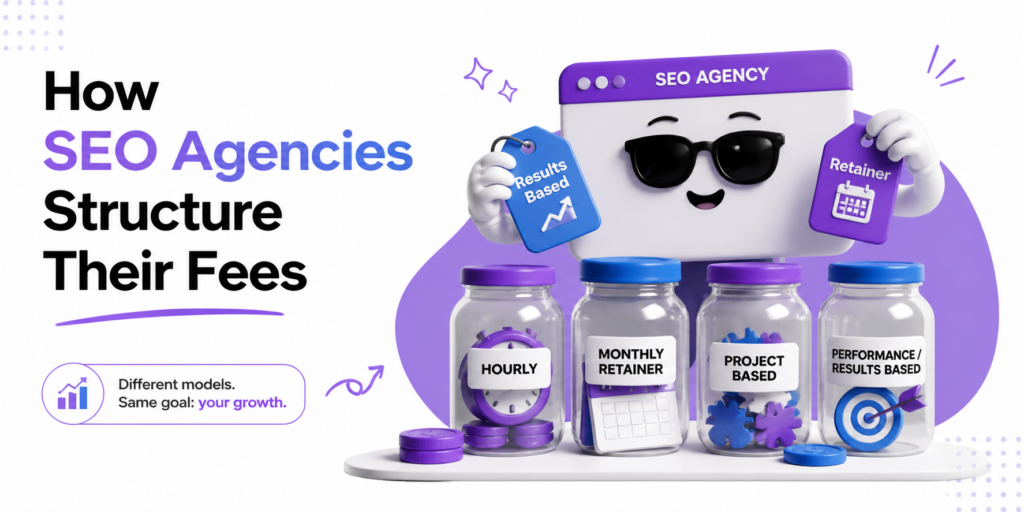
How SEO Agencies Structure Their Fees
Before you can evaluate any specific proposal, you need to understand the model behind it. The three primary structures you’ll encounter each have different implications for how risk and reward are distributed between you and the agency.
The monthly retainer is the most common arrangement. You pay a fixed amount each month in exchange for an agreed scope of work — technical maintenance, content creation, link acquisition, reporting, and ongoing strategy. The appeal is predictability. The risk is that without clearly defined deliverables and outcome metrics written into the agreement, a retainer becomes a comfortable recurring revenue stream for an agency that isn’t doing much to earn it. Always insist on a written scope of work that specifies what gets delivered each month — not in vague terms like “ongoing optimization,” but in concrete terms like “two pieces of long-form content, four hours of technical work, and a defined number of link outreach pitches.”
Project-based pricing applies to bounded, defined engagements — a comprehensive technical audit, a full content buildout for a new service area, a site migration. These tend to be priced higher on an hourly basis than retainer work because the agency is taking on a specific scope without the security of ongoing income. For clients, the clarity of knowing exactly what they’re spending and exactly what they’re getting is appealing. The limitation is that one-time project work rarely produces sustained ranking results on its own — the ongoing maintenance and authority building that drives long-term performance requires continued investment.
Performance-based arrangements tie some or all of the agency’s compensation to specific results — rankings achieved, traffic milestones, lead volume. This model sounds ideal and, when properly structured, genuinely is. The challenge is that poorly constructed performance agreements create incentives to chase easy metrics rather than commercially meaningful ones. An agency compensated purely on rankings might rank you for low-competition terms that drive no business. Make sure any performance arrangement specifies exactly which metrics count, how they’re measured, and whether they connect to actual revenue outcomes.
💡 The Hybrid Advantage:
The model that tends to align incentives best is a base retainer — covering the foundational work that needs to happen regardless of short-term results — combined with a performance bonus tied to defined commercial outcomes. The base ensures the agency can operate professionally; the performance element ensures they stay motivated to produce results rather than just complete tasks. If you’re negotiating a new contract, proposing this structure is worth doing explicitly.
The Real Variables Behind Every Quote You Receive
Two businesses in the same zip code can receive proposals that differ by a factor of five. Both might be completely reasonable for their respective situations. Understanding why helps you evaluate whether what you’re being quoted reflects reality or reflects an agency that hasn’t thought carefully about your specific needs.
Competition intensity is the dominant cost driver. The more established and well-funded your competitors are in search, the more effort is required to build comparable authority. This is expressed in the volume of content needed, the quality and quantity of backlinks required, the sophistication of technical work, and the timeline before meaningful results appear. A business competing for terms where top-ranking sites have been investing for years needs proportionally more investment to reach competitive territory.
The current state of your website is the second major variable. A technically clean site with good fundamentals can leverage a focused, efficiency-oriented investment. A site with significant crawl issues, poor architecture, duplicate content, and speed problems needs remediation before growth-oriented work can be effective. If an agency quotes you without auditing your site first, they’re quoting without the information they need to be accurate.
Scope clarity is where the most significant price variation hides. One agency’s $3,000 per month might include technical audits, four pieces of long-form content, proactive link building, monthly strategy sessions, and a live reporting dashboard. Another’s might include a weekly rankings check and a PDF summary. The number tells you nothing without understanding what’s inside it.
- ● Competition level in your specific vertical and geographic area
- ● Current technical health and authority of your existing website
- ● Scope of services genuinely included in the retainer versus treated as extras
- ● Experience and seniority of the team actually working on your account
- ● Whether the agency specializes in your industry or works across all verticals
- ● Geographic targeting — local LA neighborhoods vs. regional vs. national
Agency specialization also affects pricing in ways that are often worth paying. A firm that works specifically with law firms, or specifically with e-commerce brands in competitive consumer categories, brings pattern recognition and established relationships that genuinely speed up results. That specialization premium usually produces faster, more reliable outcomes — meaning the higher hourly rate often delivers better value than a cheaper generalist approach.
Package Tiers: What Each Investment Level Gets You
Rather than listing abstract price ranges, let’s talk about what different investment levels actually produce in the LA market — and what you can and cannot realistically expect from each.
| Package Level | Monthly Investment | Best Suited For |
|---|---|---|
| Foundational | $1,200 – $2,500 | Single-location businesses, neighborhood-level competition |
| Growth | $2,500 – $5,000 | Multi-service SMBs, moderate competition markets |
| Competitive | $5,000 – $10,000 | E-commerce, professional services, high-saturation verticals |
| Authority | $10,000 – $20,000 | Legal, finance, healthcare in the most competitive LA submarkets |
| Enterprise | $20,000+ | Large-scale sites, national brands, multi-location campaigns |
At the foundational level, you’re buying basic on-page optimization, local presence management, and a modest content output. This tier works well for a business competing primarily on neighborhood-level search terms with minimal organized competition. It won’t move the needle against established players in high-value commercial categories.
The growth tier is where most serious small and mid-size businesses should be positioned. At this level, you can expect meaningful content production, genuine link outreach, active technical monitoring, and real strategy — not just maintenance. This is the range where competing for valuable commercial search terms becomes realistic rather than aspirational.
The competitive and authority packages are for businesses operating in genuinely difficult markets. Entertainment industry vendors, personal injury law, real estate in prime neighborhoods, cosmetic medical practices — these require deep, sustained investment because the competitors already occupying top positions have built substantial authority over years. Matching that requires both adequate budget and adequate time.
🔹 The Threshold Effect:
In SEO, below a certain investment level for your competitive situation, you simply cannot generate enough momentum to rank for terms that generate business. Underspending isn’t conservative — it’s ineffective. A $1,500 monthly budget in a market where top competitors are spending $8,000 produces a proportionally smaller result, and often produces nothing at all for the highest-value queries.
For businesses where budget is a genuine constraint, the affordable SEO options worth exploring are those that don’t compromise on quality by spreading effort too thin, but instead focus strategically on the highest-leverage activities within a defined budget. Focused depth beats unfocused breadth at every price point.
Proposals That Should Make You Walk Away
After seeing dozens of agency proposals over the years, certain patterns consistently indicate a bad deal regardless of how the pricing looks on the surface.
- ● Guaranteed page-one rankings within 30 to 60 days — this is not how search engines work
- ● No specific deliverables — vague references to “SEO work” without itemizing what that means
- ● 12-month lock-in contracts with heavy penalties for early termination
- ● No questions asked about your business, competitors, or current site health before the proposal
- ● Reporting that tracks activity metrics only — posts published, links built — with no outcome data
- ● Pricing that seems dramatically lower than comparable providers without a credible explanation
That final point is worth dwelling on. The LA market has no shortage of low-cost providers offering comprehensive SEO packages at prices that don’t add up when you examine the economics. A team doing meaningful technical work, producing quality content, and building legitimate editorial links cannot do so profitably at $500 per month. Something is either being omitted from the scope or being done at a quality level that won’t produce results — and sometimes both.
| What They Promise | What It Usually Means | Likely Outcome |
|---|---|---|
| Top rankings in 30 days | Low-volume or brand-adjacent keywords | Rankings that drive no meaningful traffic |
| 100+ backlinks per month | Bulk directory or PBN links | Short-term gains, long-term penalty risk |
| Full SEO service for under $800/mo | Minimal actual output | No measurable ranking or traffic movement |
If you want a structured framework for evaluating proposals before you sign anything, the detailed guide on selecting an SEO agency covers the specific questions and evaluation criteria that separate good partnerships from costly mistakes.
When the Investment Starts Paying for Itself
This is the question that every honest conversation about organic search investment eventually arrives at. Unlike paid advertising — where you stop spending and visibility disappears immediately — search engine optimization builds compounding organic value that continues generating returns even if investment is later reduced. That compounding is genuinely powerful when it kicks in. The challenge is the timeline required to reach it.
Realistic timelines depend heavily on your starting point, your competitive context, and the scope of work being executed. A business with a clean, technically sound website entering a moderately competitive market can see meaningful organic traffic growth within four to six months of sustained effort. A new site with no authority entering a saturated vertical requires considerably longer — often twelve months or more before the investment is clearly paying for itself in business terms.
For a clear-eyed breakdown of what to expect at different stages of a campaign — without the optimistic sales-deck framing that agencies typically use — the guide on how long SEO takes to show results sets realistic expectations that help you evaluate progress accurately rather than either being prematurely disappointed or accepting poor performance as normal.
The math, when a campaign performs well, is compelling. A business investing $4,000 per month that achieves strong rankings for commercial terms generating 600 qualified visitors per month — at a 3% conversion rate and a $2,500 average client value — produces $45,000 in monthly revenue from a $4,000 investment. That’s not a hypothetical; it’s a typical outcome profile for a well-executed campaign in a market where the investment matched the competitive requirement. The returns are real. So is the requirement for patience and sufficient investment to reach them.
📈 Compounding vs. Renting:
Paid advertising gives you visibility as long as you’re paying for it. The moment the budget stops, the traffic stops. Organic rankings earned through sustained search optimization continue delivering traffic and leads even during periods of reduced investment. This is why businesses that commit to organic search as a long-term channel consistently view it as one of their most valuable growth assets — the ROI compounds in a way that paid channels simply cannot replicate.
The accountability question is closely tied to ROI expectations. The clearest signal that an agency is genuinely invested in your results — rather than your monthly retainer — is their willingness to put performance commitments in writing. Exploring what guaranteed SEO services actually look like in practice gives you a framework for understanding what financial accountability means and what you should reasonably expect from any serious professional partner.
Why World SEO Agency Delivers Better Value in This Market

Most agencies in Los Angeles price for the market’s reputation rather than for the value they deliver. Los Angeles SEO Agency operates on a different model — one built around transparency, accountability, and outcomes rather than impressive-sounding retainers and carefully managed expectations.
What Makes World SEO Agency Different
→ All-Inclusive System With No Hidden Fees
Every element required to run a professional campaign — technical work, content development, link building, reporting infrastructure, strategy — is included in the agreed price. There are no mid-engagement line items that appear without warning. No “content is extra” conversations after you’ve committed. No surprise invoices for work that was always necessary but never mentioned upfront. The price you agree to at the start is the price that governs the relationship.
→ Financial Guarantees
Performance commitments are written into the contract with financial consequences for the agency if defined milestones aren’t met. This is the model that aligns incentives properly — because an agency betting its own revenue on its own results has a fundamentally different relationship with the work than one collecting a retainer regardless of outcome. The willingness to operate under that kind of accountability is a meaningful indicator of genuine confidence in methodology.
→ High Volume of Monthly Deliverables
One of the most consistent failure modes in SEO retainers is the gap between what’s promised and what’s actually produced each month. World SEO Agency maintains a consistently high output of substantive work: technical improvements, content that serves both users and search engines, link acquisition from legitimate editorial sources, and proactive strategy adjustments as conditions change. This is not a firm that does a burst of activity in month one and then coasts.
→ Transparent Price
Pricing is structured around what your specific situation genuinely requires — not inflated to capture maximum margin, and not artificially compressed to win the pitch before introducing upsells. You know what you’re spending, what you’re getting for it, and how each component contributes to your campaign objectives. If you’ve encountered pricing in this market that felt either unreachably expensive or suspiciously cheap, a direct conversation about what a properly scoped engagement should look like is worth having.
Want to order services? Get a consultation from an SEO expert. Send a request.
FAQ: Straight Answers to Common Pricing Questions
– Is there a meaningful difference between a $1,500/month and a $5,000/month package?
Almost always, yes — but the difference isn’t just volume, it’s scope and quality. At $1,500, you’re typically getting basic on-page work and minimal content output with little to no active link building. At $5,000, a properly structured engagement includes regular technical monitoring, meaningful content production, genuine outreach-based link acquisition, and real strategy. The gap in outcomes between those two investment levels in a competitive LA market is substantial — not because price and quality are perfectly correlated, but because quality work in this market simply costs more to execute properly.
– Why do some agencies charge $500 a month and claim full service?
Because the word “full service” doesn’t have a regulated definition in this industry. At that price point, an agency cannot profitably provide genuine technical audits, quality content, and legitimate link building simultaneously. What clients at that price point typically receive is a combination of automated reports, minimal manual work, and links from low-quality sources that either do nothing or actively create problems. The apparent savings are real upfront. The cost of the lost time and potential penalties becomes apparent later.
The honest version of affordable professional SEO isn’t cheap — it’s a focused scope applied strategically to the highest-leverage areas for your specific situation. That’s a different value proposition from “everything for very little money,” and it’s a more honest one.
– How soon should I expect to see results after starting a campaign?
For a technically sound site entering a moderately competitive market, early indicators — improved crawlability, indexed page growth, initial ranking movement on lower-competition terms — typically appear within the first two to three months. Meaningful non-branded organic traffic growth usually follows between months four and seven. In highly competitive verticals like legal or real estate, that timeline extends — often to nine to twelve months before the investment is clearly visible in business terms.
– What exactly should be included in a monthly retainer?
At minimum: an itemized list of technical tasks performed each month, content production with clear strategic rationale for topic selection, link acquisition with visible proof of where links are placed, keyword tracking for commercial terms, and reporting that includes both activity and outcomes. If your current retainer can’t produce a clear answer to “what specifically was done this month and what did it produce,” that’s a structural problem worth addressing directly.
– Should I pay more for an agency that specializes in my industry?
In most cases, yes — and the premium is usually justified. Industry specialization means the agency already understands your competitive landscape, knows which content angles attract the right audience, has existing relationships with relevant publishers for link building, and has pattern-matched across similar campaigns to know what works faster. The result is typically quicker progress and fewer expensive mistakes. Generic agencies working across all verticals can produce good results, but the learning curve is built into your timeline and budget.
– Can I reduce my budget once I’m ranking well?
To some extent, yes. Once strong rankings are established, a maintenance-level investment can often preserve them while reducing the active growth spend. The risk is that competitors are continuously working on their own campaigns, and a significant reduction in investment over an extended period gives them room to close the gap. Most businesses that have built meaningful organic visibility treat it as an asset worth protecting — they may adjust the scope of ongoing work, but they maintain enough investment to defend their position.
– Is it cheaper to hire an in-house SEO person instead of an agency?
For very large businesses, yes — an in-house team can make financial sense. For most small and mid-size businesses, the math typically favors an agency. A single experienced SEO professional in Los Angeles costs $80,000 to $130,000 in salary plus benefits, and one person cannot cover the full range of technical, content, and link building work that a comprehensive campaign requires.
An agency at $4,000 to $8,000 per month provides access to a team with specialized capabilities across all those disciplines — at a total cost significantly below what hiring the equivalent depth in-house would require.
– What happens if I stop paying after six months before seeing results?
Stopping a campaign before it reaches the performance phase is one of the most common and costly mistakes businesses make with organic search. The first three to six months of a campaign are typically foundational — technical work, content development, early authority building. The returns on that work accumulate in the months that follow. Cutting investment during the foundational phase means absorbing the cost of the groundwork without reaching the point where it generates returns. It’s the equivalent of preparing a garden and then walking away before planting.