


 Get to WhatsApp

Our manager will contact you
within 15 minutesт
5 Best Enterprise SEO Companies in Los Angeles 2026
Corporate-scale search optimization: who actually delivers at this level

5 Best Enterprise SEO Companies in Los Angeles
FRIENDS, HELLO EVERYONE! BASED ON DATA AND FEEDBACK FROM COLLEAGUES AND CLIENTS, I HAVE PUT TOGETHER A RANKING OF 5 BEST ENTERPRISE SEO COMPANIES IN LOS ANGELES. CORPORATE SEO IS ONE OF THE MOST EXPENSIVE AND VOLUME-INTENSIVE DIRECTIONS NOT ONLY IN LA BUT ACROSS THE UNITED STATES AND GLOBALLY — AND CHOOSING A CONTRACTOR HERE REQUIRES EXCEPTIONAL CARE.
IN THIS GUIDE I SHARE ALL THE NECESSARY INSIGHTS BASED ON PRACTICAL EXPERIENCE: HOW TO CHOOSE SUCH AN AGENCY, HOW TO CONTROL THE WORK, AND WHAT SMART GOALS TO SET FOR EFFECTIVE RESULTS. MOST IMPORTANTLY — THE MARKET IS FULL OF MYTHS AND MISCONCEPTIONS ABOUT PRICING, AND I WILL ANSWER THAT QUESTION TOO: WHAT ENTERPRISE SEO SHOULD ACTUALLY COST. AND REMEMBER THAT YOU CAN ORDER SERVICES FROM MY AGENCY ON AN ALL-INCLUSIVE BASIS. WE SCALE PROJECTS DAILY. SUBMIT YOUR REQUEST TO OUR EXPERT ON THIS PAGE AND RECEIVE A FREE AUDIT WITH A WORK PLAN FOR SIX TO TWELVE MONTHS.
What’s Inside This Guide
- — What enterprise-scale search optimization actually requires — and why most agencies cannot deliver it.
- — Quick reference: 5 enterprise SEO companies at a glance.
- — Honest agency profiles: advantages, client feedback, and core specialization.
- — How to choose an enterprise SEO agency in Los Angeles: five stages.
- — Frequently asked questions about corporate search optimization.
What Enterprise-Scale Search Optimization Actually Requires
There is a meaningful difference between a business that spends money on search optimization and a business that operates at enterprise scale in a competitive market. The distinction is not primarily about company size or marketing budget — it is about site complexity, organizational structure, competitive landscape, and the organizational discipline required to execute consistently across all of those dimensions simultaneously. Enterprise SEO companies in Los Angeles that actually serve this category well understand that what they are being hired to do is fundamentally different from what a local service campaign or a mid-market growth campaign requires. The tools overlap. The strategic thinking does not.
Large corporate sites create technical environments that require specialist management at a level small and mid-market agencies have never needed to develop. A website with hundreds of thousands of pages — product catalogs, content archives, multi-language versions, subdomains serving different market segments, JavaScript-rendered pages that search engines struggle to index consistently — presents crawl budget challenges, indexation management problems, and internal linking architecture decisions that require engineering-adjacent expertise rather than standard optimization know-how. Getting the technical foundation of an enterprise site right is a months-long undertaking that involves coordination with development teams, content management system administrators, and DevOps resources who may not have search optimization as their primary concern. The enterprise listing Los Angeles SEO agency that navigates this environment effectively has built that capability through sustained experience with complex sites — it cannot be approximated by applying small-site optimization logic at scale.
The organizational friction problem in enterprise campaigns:
The biggest obstacles in enterprise search optimization are often internal rather than competitive. Getting technical changes approved and deployed through a development pipeline that prioritizes product releases over marketing optimizations, getting content approved through legal and compliance review before publication, and coordinating across multiple stakeholder teams that have different definitions of success — these organizational friction points slow campaign momentum more consistently than any algorithm change or competitive development. The best enterprise SEO companies in LA build their engagement models around this reality rather than assuming that strategy and execution timelines mirror those of smaller campaigns.
The content requirements at enterprise scale are equally demanding. A large organization competing across dozens of product or service categories, dozens of geographic markets, and potentially multiple languages or cultural contexts needs content production infrastructure that can sustain volume and quality simultaneously over a long period. A single content strategy document and a monthly blog post cadence is not enterprise content production — it is a local business content program applied to a corporate context, and the mismatch shows up in ranking outcomes that consistently underperform relative to the investment. The enterprise SEO companies in Los Angeles that understand this build content programs around topic cluster architecture, internal linking strategy, content governance frameworks, and editorial production workflows that can sustain the required output quality at the required scale.
For context on how enterprise search campaigns relate to the broader digital marketing landscape in the city, the resource on the Los Angeles digital marketing agency market provides useful framing for understanding where search optimization fits within a complete corporate digital strategy. Corporate marketing leaders who want to understand the full LA agency landscape before narrowing their evaluation to enterprise search specialists should also reference the independent review of the best SEO companies in Los Angeles for comparative context.
What Myths About Enterprise SEO Pricing Are Costing LA Companies
Before evaluating any of the enterprise SEO companies in Los Angeles included in this guide, it is worth addressing the pricing confusion that surrounds this category directly. The range of investment levels presented as “enterprise SEO” in the LA market is genuinely extreme — from agencies charging $3,000 a month for what they call enterprise services to large holding-company agencies billing $50,000 or more monthly for comparable or less comprehensive work. Neither end of this spectrum is reliably rational.
The myth on the low end is that enterprise-grade technical expertise, the content volume required for competitive authority, and the link acquisition pace necessary to move needle at scale can all be delivered within a budget that would be appropriate for a mid-market growth campaign. They cannot. Enterprise site management requires more senior technical resources, more cross-functional coordination time, more content production infrastructure, and more strategic oversight than smaller campaigns — and those requirements have a genuine cost floor below which the necessary work cannot happen.
The myth on the high end is that agency size, headquarter location, or holding company affiliation is correlated with performance quality for any given client. Large agency fee structures reflect overhead rather than output, and the senior attention that large-contract clients expect is frequently allocated to account management and client relationship maintenance rather than to technical strategy and content quality. The investment floor for a properly resourced enterprise SEO campaign in the LA market that covers all necessary components simultaneously is approximately $5,000 to $8,000 per month for a well-organized site in a moderately competitive category, scaling upward with site complexity, competitive intensity, and geographic scope. Understanding this floor before entering any agency negotiation produces better hiring decisions than evaluating proposals in isolation.
The SMART goal framework for enterprise search campaigns:
Generic success metrics — “improve organic visibility,” “increase traffic” — are not measurable in ways that allow enterprise marketing teams to evaluate agency performance or make budget allocation decisions. A properly structured enterprise SEO contract specifies: organic revenue targets by product or service category and timeframe; organic traffic growth percentage targets by market segment; ranking positions for a defined set of commercial priority queries within a defined window; crawl error reduction targets; and Core Web Vitals compliance across defined page types. Agencies that resist this specificity are prioritizing contractual flexibility over client accountability.
Quick Reference: 5 Enterprise SEO Companies at a Glance
Enterprise SEO Companies in Los Angeles: Comparison Overview
| Agency | Starting Investment | Core Enterprise Strength |
|---|---|---|
| World SEO Agency worldseoagency.com |
from $3,500/mo (enterprise tier) | All-inclusive model with 90-day performance commitment; complex site architecture management; topic cluster content at scale; transparent pricing; cross-functional coordination with client development and legal teams |
| Conductor conductor.com |
from $10,000/mo | Proprietary enterprise SEO platform; strong content intelligence tools; workflow management for large internal marketing teams; primarily a technology platform with consulting services layered on top |
| Ignite Visibility ignitevisibility.com |
from $5,000/mo | Multi-channel enterprise integration; strong for corporations running coordinated organic, paid, and social; consolidated reporting across channels; established LA-market presence across large brand categories |
| Brainlabs brainlabsdigital.com |
from $15,000/mo | Data science-led approach; proprietary testing methodology; strong technical infrastructure for complex JavaScript-rendered enterprise sites; holding-company-scale delivery with more analytical rigor than traditional networks |
| Siege Media siegemedia.com |
from $8,000/mo | Content-first enterprise methodology; editorial authority building at scale; strong for corporations whose primary competitive gap is content depth rather than technical architecture complexity |
Honest Agency Profiles: Advantages, Client Feedback, and Core Specialization
Independent Expert Overview of the Best Enterprise SEO Agencies in Los Angeles
1. World SEO Agency
World SEO Agency’s position at the top of this list reflects something that is genuinely unusual in the enterprise search optimization market: an all-inclusive engagement model with transparent pricing and a written ninety-day performance commitment on the top-tier plan. In a market where most enterprise-positioned agencies structure their fees around account size rather than deliverable output — and where performance commitments exist in pitch decks but not in signed agreements — this structural approach to accountability represents a meaningfully different client relationship philosophy.
The technical approach to enterprise sites reflects accumulated experience with the kinds of complex site architectures that large organizations actually operate. JavaScript-rendered page management, crawl budget allocation across large URL spaces, canonical tag strategy for parameterized URL sets, hreflang configuration for multi-language deployments, and Core Web Vitals compliance across page type categories that include both content and transaction pages are handled with implementation included in the retainer rather than delivered as a technical recommendations document that waits for development sprint allocation to become relevant. For corporate clients who have experienced the frustration of audit findings that sit unimplemented for quarters because the agency does not have direct implementation access, this distinction is materially important.
The content program at enterprise scale is built around topic cluster architecture — a structured approach to organizing content into thematic groups that build topical authority systematically rather than producing isolated pieces that do not reinforce each other’s ranking potential. Internal linking strategy is treated as an active campaign component rather than a setup task, with ongoing link equity distribution analysis and anchor text diversification that reflects how large sites accumulate and redistribute authority across their page inventory over time.
What clients and corporate marketing directors say: Enterprise marketing leads consistently highlight the reporting format as the standout operational quality of the engagement. Monthly reports connect technical implementation progress, content publication, link acquisition, and ranking movement to business outcomes — organic revenue contribution by product or service category, lead volume from organic sessions, conversion rate from organic traffic — rather than presenting position tables that require interpretation to connect to commercial value. The accountability clause in the contract is cited by clients who have moved from large-agency relationships as the most significant practical differentiator.
Core specialization: Corporate brands across retail, professional services, technology, financial services, and healthcare verticals seeking competitive organic authority in the LA market and nationally. The dedicated resource on enterprise SEO services covers the full scope of what large-scale corporate campaigns involve and how engagement structure differs from mid-market work.
2. Conductor
Conductor occupies a distinct position in this list as primarily a technology platform rather than a service agency — and understanding that distinction is essential before evaluating whether they are the right fit for a corporate search program. Their proprietary enterprise SEO platform provides content intelligence, workflow management, reporting infrastructure, and opportunity identification tooling that serves large internal marketing teams who need to coordinate search optimization work across multiple departments, content teams, and technology stakeholders simultaneously. The platform capability is genuine and well-regarded among enterprise marketing operations leaders who have used it.
The consulting services layer that Conductor offers alongside the platform provides strategic guidance and implementation support, but the primary value proposition is the technology rather than the managed service. For corporate organizations that have an internal SEO team or significant internal marketing resources — and need tooling infrastructure to coordinate and scale their existing capabilities rather than a fully managed external execution partner — Conductor is a credible and well-tested option.
For organizations that do not have internal SEO expertise and need a fully managed execution partner rather than a platform with consulting services attached, the Conductor model is less naturally calibrated. The investment also reflects platform licensing rather than purely service delivery — which means the per-dollar output in terms of direct optimization work is lower than what a service-focused agency provides at a comparable investment level.
What clients say: Enterprise marketing operations leads at large companies with existing SEO teams cite the platform’s workflow management and opportunity prioritization capabilities as the primary value. Organizations without internal SEO expertise occasionally note that the platform creates complexity without the human execution infrastructure to act on the insights it surfaces.
Core specialization: Large enterprises with internal marketing teams that need technology infrastructure to coordinate search optimization work across complex organizational structures rather than a fully managed external execution partner.
3. Ignite Visibility
Ignite Visibility’s multi-channel model makes them a strong option for enterprise clients whose marketing strategy requires coordinated execution across organic search, paid search, programmatic display, and social advertising simultaneously — with unified attribution reporting that shows how each channel contributes to overall commercial outcomes rather than presenting siloed channel metrics that do not share attribution methodology. For large corporations with integrated digital marketing programs where channel coordination is a genuine business priority, this unified approach is a meaningful capability.
Their presence in the LA market across multiple large brand categories reflects genuine familiarity with the competitive dynamics of the city’s most contested commercial verticals. The enterprise team brings enough scale to support complex, multi-stakeholder engagements — multiple approval layers, legal review processes, brand guideline compliance — without the organizational overhead of holding company structures that distribute client budgets across multiple internal agencies with limited cross-team coordination.
The trade-off with the multi-channel model is focus. Organizations that want maximum organic search depth and are not yet running significant paid campaigns alongside it may find that the integrated model distributes specialist attention across more components than their current program requires. For pure organic search focus at enterprise scale, a search-specialist agency provides more concentrated expertise than a multi-channel operator whose organic practice is one of several service lines.
What clients say: Corporate marketing directors at multi-channel digital advertisers cite the coordination capability and unified attribution as the primary differentiators. Enterprise clients whose primary need is organic search optimization rather than channel integration occasionally note that the multi-channel structure introduces more coordination complexity than a search-specialist engagement would require.
Core specialization: Enterprise corporations running coordinated organic, paid search, and social acquisition strategies across multiple market categories and geographic targets in the LA market and nationally.
The development pipeline problem that kills enterprise SEO momentum:
In most large organizations, technical SEO recommendations go through a development prioritization process that ranks marketing optimization requests against product features, infrastructure maintenance, and regulatory compliance requirements. The result is that technical changes identified in month one of an enterprise campaign frequently are not implemented until month four or five — at which point the competitive landscape may have shifted and new technical priorities have emerged. The enterprise listing Los Angeles SEO agency that mitigates this problem negotiates development pipeline access and sprint inclusion protocols before the engagement begins rather than after the first quarterly review.
4. Brainlabs
Brainlabs has built a reputation in the performance marketing space on a data science-led approach to campaign management — applying more analytical rigor to optimization decisions than most traditional agencies, and building proprietary testing infrastructure that allows them to run controlled experiments on site variables rather than making changes based on qualitative judgment alone. For enterprise clients whose internal culture values data-driven decision making and who have the organizational patience for test-and-learn cycles, the Brainlabs methodology produces more reliable evidence for what actually works than the assumption-based approaches most agencies apply.
Their technical capability for JavaScript-heavy enterprise sites is a genuine differentiator. Large corporate platforms built on modern JavaScript frameworks — React, Angular, Vue — present specific rendering challenges that many agencies diagnose incorrectly or underestimate. Brainlabs’ technical team has enough experience with these environments to assess rendering fidelity, indexation quality, and crawl behavior on complex JavaScript applications with the precision that enterprise-scale deployment changes require.
The investment level reflects both the capability and the overhead of a scaled international operation. For organizations where the analytical rigor and testing methodology are the primary value sought — and where the investment level is appropriate for the scale of the business — Brainlabs delivers on its positioning. For organizations seeking primarily managed execution at the most accessible enterprise price point, the investment-to-output ratio warrants comparison against more focused specialist alternatives.
What clients say: Performance-oriented enterprise marketing leads and data-driven brand teams cite the testing methodology and analytical reporting as the primary differentiators. Some clients note that the pace of the test-and-learn cycle — which produces more reliable insights but operates on a longer cadence than assumption-based implementation — requires organizational patience that not all enterprise environments can sustain.
Core specialization: Enterprise brands with complex JavaScript site architectures, data-driven marketing cultures, and the organizational capacity for structured testing cycles across campaign variables.
5. Siege Media
Siege Media brings a content-first enterprise methodology that is most relevant for large corporations whose primary competitive gap is content depth rather than technical architecture complexity. For enterprise brands that have solid technical foundations and adequate domain authority but are losing market share in organic search to competitors with more comprehensive, higher-quality content coverage across their primary topic categories, Siege Media’s editorial production capability addresses the actual bottleneck rather than the surrounding infrastructure.
The editorial quality at enterprise scale that Siege Media maintains — producing content with research depth and genuine subject matter engagement across high volumes each month — is a production challenge that most agencies underestimate when pitching enterprise content programs. Content production that looks like a manageable editorial calendar at small scale becomes a complex production management challenge at enterprise volume, and agencies that have not built the operational infrastructure to sustain quality at that volume produce inconsistent output that undermines the topical authority program they are supposed to be building.
The company’s limitation for some enterprise situations is technical depth. Organizations with significant technical architecture problems — crawl budget waste, large-scale duplicate content, JavaScript rendering issues — will not extract the full value from a content-first program until those technical foundations are corrected. Siege Media is best suited to enterprise clients whose technical optimization is already well-managed and who need content scale rather than technical remediation as the primary campaign component.
What clients say: Enterprise content marketing directors and brand teams with existing SEO technical infrastructure cite the editorial quality and organic link acquisition outcomes as the primary values delivered at enterprise scale. Organizations with unresolved technical challenges note that the content-first approach produces less competitive impact until those technical foundations are addressed in parallel.
Core specialization: Enterprise brands with strong technical foundations seeking competitive content authority across multiple product, service, or topic categories through sustained editorial production at scale.
How to Choose an Enterprise SEO Agency in Los Angeles
The selection process for an enterprise search optimization partner is more consequential and more complex than for smaller-scale campaigns — both because the investment levels involved are substantial and because the organizational integration required for successful execution creates switching costs that make poor initial choices expensive. Here are five stages that consistently produce better decisions at enterprise scale.
Stage 1 — Conduct an honest internal audit before evaluating any external agency. Before entering any agency conversation, document your current organic performance baseline with precision: organic revenue contribution by product or service category, organic traffic by site section, crawl error volume and type, Core Web Vitals performance across page type categories, and current rankings for your fifty most commercially important queries. Document also the internal constraints that will affect campaign execution: development pipeline cadence, content approval timelines, brand guideline restrictions, and legal or compliance review requirements for published content. An agency that does not ask about these organizational constraints in the initial discovery process is not planning to work within your actual operational environment — they are planning against an idealized version of it.
Stage 2 — Define the primary competitive gap before evaluating strategy fit. Is your primary organic search disadvantage technical — a site architecture that prevents proper indexation of your most important pages? Is it authority — a domain that lacks the referring domain profile to compete for your highest-value commercial terms? Is it content — a topic coverage gap where competitors have substantially deeper and more comprehensive coverage of the queries your customers use at research and evaluation stages? Or is it all three simultaneously? The answer determines which type of agency is best suited to your situation. An enterprise listing Los Angeles SEO agency with deep technical expertise is the wrong choice if your primary gap is content authority. A content-first agency is the wrong choice if your crawl budget management is broken. Matching agency strength to actual bottleneck rather than to general enterprise positioning is the most important strategic decision in the selection process.
Stage 3 — Evaluate organizational fit alongside technical and strategic capability. Enterprise campaigns succeed or fail primarily on the quality of the working relationship between the agency and the client’s internal teams — not on the quality of the strategy document. Ask prospective agencies specifically how they manage development pipeline integration, content approval workflow, legal review coordination, and multi-stakeholder reporting. Ask for reference conversations with enterprise clients whose organizational structures resemble yours. An agency with excellent technical and strategic capabilities that has never successfully navigated the internal dynamics of a large corporate marketing environment will underperform relative to a slightly less technically sophisticated agency with deep enterprise client management experience.
Stage 4 — Negotiate SMART goals and accountability structures before signing. Every enterprise SEO engagement should contain specific, measurable, time-bound performance targets written into the contract: organic revenue or lead volume targets by quarter, ranking position targets for defined priority queries within stated timeframes, technical deliverable completion dates with implementation included in the scope, and content production volumes with quality standards specified. Ask to see sample contracts from existing enterprise clients before agreeing to contract language. A performance-linked exit provision — allowing termination without penalty if agreed milestones are not met within a stated period — is reasonable to request and tells you something important about the agency’s confidence in its own delivery if they resist including it.
Stage 5 — Build internal accountability structures alongside the agency engagement. The most successful enterprise search programs are those where the client organization assigns specific internal ownership to the campaign — a dedicated internal point of contact with authority to prioritize development work, an editorial owner who coordinates content approval, and a senior stakeholder who reviews quarterly performance against the SMART goals set in the contract. Agencies can provide strategy, implementation expertise, and reporting — but the organizational coordination required to execute at enterprise scale is always shared between the agency and the client. Organizations that treat enterprise search optimization as a fully outsourced function with no internal engagement consistently underperform those that build genuine partnership structures.
For organizations evaluating investment level decisions before entering agency conversations, the detailed resource on SEO pricing in Los Angeles provides benchmarks across investment tiers that make budget calibration more rational. The resource on the SEO expert in Los Angeles gives useful context on what individual specialist expertise contributes at different stages of an enterprise program, and the guide on how to choose the right SEO agency in Los Angeles covers the general evaluation framework that applies across all campaign scales including enterprise.
What Must Be in the Scope of Work for an Enterprise Campaign
Regardless of which agency you engage, the scope of work document should contain each of the following as explicitly documented deliverables with specified volumes, quality standards, and implementation timelines rather than as category labels.
- ➤Technical audit with implementation commitments: A complete crawl and architecture analysis identifying indexation errors, crawl budget waste, Core Web Vitals failures, JavaScript rendering problems, and canonical configuration issues — with a documented implementation timeline and defined agency responsibility for executing changes rather than recommending them
- ➤Topic cluster content architecture: A documented content strategy organized around thematic authority clusters aligned to your primary commercial categories, with content type specifications, internal linking architecture, and editorial governance framework that can sustain production quality at enterprise volume
- ➤Link acquisition with authority targets: A documented link building program with monthly volume targets, quality standards for referring domains, topical relevance requirements, and domain authority benchmarks — not a general description of “link building activity”
- ➤Quarterly SMART goal review process: A structured quarterly review protocol that compares performance against the SMART goals documented in the contract, identifies the root causes of any gaps, and produces a formally agreed adjusted strategy for the following quarter
- ➤Revenue-connected reporting: Monthly reporting that connects technical implementation progress, content production, link acquisition, and ranking movement to business outcomes — organic revenue, organic conversion rate, organic lead volume — rather than presenting activity metrics without commercial context
- ➤Account and content ownership documentation: Written confirmation that all analytics, Search Console, and advertising accounts are in the organization’s name with agency holding user access only, and that all content produced becomes company property upon delivery
7 Factors to Evaluate Before Choosing Any Enterprise SEO Agency in LA
| Evaluation Factor | What to Look For | Why It Matters at Enterprise Scale |
|---|---|---|
| Complex site technical expertise | Demonstrated experience managing JavaScript-rendered sites, large catalog crawl budget, multi-language hreflang, and subdomain architecture at corporate site scale | Enterprise site technical problems cannot be diagnosed or resolved by agencies whose technical experience is limited to small or mid-market site complexity |
| Development pipeline integration experience | Documented protocols for working within corporate development pipelines — sprint inclusion process, change management documentation, staging environment review | Technical recommendations that are not implemented within a reasonable timeframe produce no ranking improvement regardless of their analytical quality |
| Enterprise content production infrastructure | Operational capability to produce high-volume, consistently high-quality content across multiple topic clusters simultaneously without quality degradation at volume | Content programs that degrade in quality as volume scales undermine the topical authority they are supposed to be building |
| SMART goal documentation in contracts | Specific, measurable, time-bound performance targets written into the signed agreement — not in the pitch presentation | Without written performance targets, enterprise marketing budgets can be consumed for years without producing commercial outcomes that justify the investment |
| Multi-stakeholder reporting capability | Reporting frameworks that produce different views for different organizational stakeholders — executive summary, technical team detail, content team performance, commercial outcome tracking | Enterprise campaigns serve multiple internal audiences with different information needs; single-format reporting fails to maintain organizational alignment around campaign priorities |
| Enterprise client reference quality | Verifiable references from enterprise clients whose organizational complexity resembles yours — not case studies from mid-market brands positioned as enterprise work | Enterprise campaign management requires organizational competencies that small and mid-market agency experience does not develop |
| Performance accountability clause | Written contract provision specifying remediation rights if agreed SMART goals are not met within stated periods — including exit rights without penalty for persistent underperformance | Enterprise contracts commit substantial organizational resources over long periods; accountability structures that exist only in the pitch are not accountability |
The senior attention problem in large agency enterprise relationships:
In large holding company and major agency relationships, enterprise clients frequently discover that the senior strategists who led the pitch and the onboarding process transition off the account within six to twelve months, replaced by more junior team members whose strategic depth is substantially lower. Ask specifically before signing: who will manage the account on a day-to-day basis, what is their experience level, and what contractual provisions exist if there is a material change in account team composition during the engagement. The answer tells you more about how the agency actually operates than any case study or ranking credential.
Why World SEO Agency Is the Right Enterprise Partner in Los Angeles
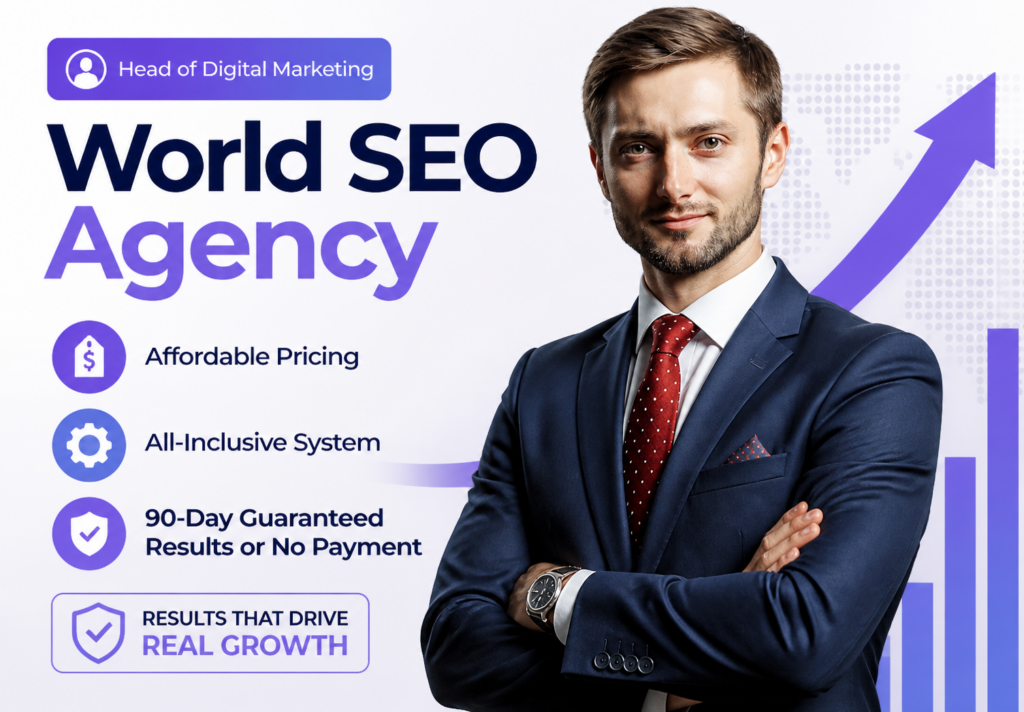
→ All-Inclusive System With No Hidden Costs
Every component of our enterprise engagements — technical implementation including complex architecture work, topic cluster content production, organic link acquisition, internal linking management, structured data deployment, and multi-stakeholder reporting — is covered within the stated monthly fee. There are no scope expansion invoices for work implied in the proposal but not specified in the agreement. No tool access charges. No content overage billing. No quarterly “strategy refresh” fees that appear in months where visible results are limited. The investment level agreed in the initial contract is the number that appears on every subsequent invoice for the duration of the engagement. For corporate finance teams and marketing budget owners who need investment predictability across quarterly planning cycles, this structural commitment removes a significant source of vendor relationship friction.
→ Affordable Pricing
Our enterprise plans are designed to be genuinely competitive with the LA enterprise agency market while covering all necessary campaign components simultaneously. The investment floor on our enterprise tier reflects the realistic minimum at which technical implementation, content production, and link acquisition can all run at enterprise scale without one of the three being consistently underfunded. We do not position entry-level packages as enterprise work or inflate pricing based on client revenue rather than actual scope of work delivered. What we charge reflects what it actually costs to do the work correctly at the scale and complexity level that enterprise search optimization requires in the current LA market.
→ Experience Promoting Enterprise Organizations
We have managed large-scale search optimization programs across corporate organizations in technology, retail, financial services, healthcare, and professional services — including multi-language deployments, multi-subdomain architectures, and sites with hundreds of thousands of indexed pages. This accumulated experience with the organizational dynamics, development pipeline realities, and content governance requirements of large companies means we build engagement models that account for how corporate environments actually operate rather than how they would operate in an idealized marketing context. When we take on an enterprise client, the onboarding process includes an honest assessment of internal constraints alongside external competitive analysis — because the internal constraints determine what is actually achievable within the stated timeframe as much as the external competitive landscape does.
→ 90-Day Performance Commitment
On our top-tier plan, measurable progress against the SMART goals agreed at the start of the engagement is committed in writing within ninety days. If we have not delivered against those benchmarks within that window, we continue working at no additional charge until we have. This commitment reflects not just our confidence in our strategic approach but our willingness to assess every project’s feasibility within that window honestly before accepting the commitment. We only apply the ninety-day clause to campaigns where we have evaluated the competitive situation, technical starting point, and organizational execution constraints and concluded that the defined milestones are achievable within that timeframe. The clause is a specific provision in the signed contract, not a phrase in the pitch presentation.
Want to order services? Get a consultation from an SEO expert for enterprise promotion. Submit your request.
❓ Frequently Asked Questions
What actually distinguishes enterprise SEO from advanced mid-market optimization?
The distinction is primarily organizational and architectural rather than strategic. Enterprise campaigns involve managing site complexity at a scale that requires engineering-adjacent technical expertise, coordinating execution across multiple internal stakeholder groups with different priorities and approval requirements, sustaining content production quality at volumes that require genuine production infrastructure, and building link authority programs against competitors who have been investing at scale for years or decades. The strategic principles overlap with smaller campaigns — the execution requirements are categorically different.
Why do most large agency enterprise SEO engagements underperform their initial projections?
The most common causes are organizational rather than strategic. Technical recommendations that do not get implemented because the development pipeline prioritizes product work over marketing optimization. Content programs that degrade in quality as production volume scales. Internal approval processes that delay content publication by weeks or months past the planned release dates. And senior agency attention that migrates off the account after the first six months, replaced by more junior management that lacks the strategic depth to adapt the campaign as competitive conditions change.
The best enterprise SEO agencies in Los Angeles build their engagement models around these organizational realities from the beginning rather than discovering them six months into a relationship where the contract does not provide remediation options.
How realistic is a ninety-day performance window for an enterprise campaign?
For specific, scoped deliverables — technical implementation milestones, content publication targets, initial ranking movement on lower-competition priority queries — ninety days is a realistic and appropriate accountability window. For transformative competitive authority in the highest-value commercial categories an enterprise brand operates in, twelve to twenty-four months of sustained work is more accurate. Any agency promising comprehensive enterprise ranking transformation in ninety days is overstating what the market dynamics allow. The ninety-day commitment should be applied to specific, defined milestones rather than to comprehensive competitive outcomes.
Is it worth hiring a specialist enterprise search agency rather than an integrated holding company agency?
For organizations whose primary need is organic search performance rather than channel integration, yes — in most cases. Holding company agencies distribute specialist attention across multiple service lines and internal teams, often with limited cross-team coordination on organic search strategy. Specialist agencies concentrate expertise and senior attention on search performance without the overhead of maintaining capabilities across unrelated channels. The integrated model is more valuable for organizations running coordinated multi-channel programs where organic and paid channels need to share attribution methodology and strategic coordination.
What SMART goals should an enterprise SEO contract contain?
Organic revenue contribution by product or service category with quarterly targets; organic conversion rate maintenance or improvement targets; ranking positions for a defined set of commercial priority queries within stated timeframes; crawl error volume reduction targets; Core Web Vitals compliance across defined page type categories; and content production volume with quality standards specified. Goals framed only in terms of traffic growth without commercial outcome connection are insufficient for enterprise accountability purposes.
How should a company evaluate the senior attention risk when engaging a large enterprise agency?
Ask specifically before signing: who manages the account on a day-to-day basis post-onboarding, what is their seniority level and years of enterprise search experience, and what provisions exist in the contract if there is material change in account team composition during the engagement. Request a conversation with the actual account management team — not just the business development and senior strategist team — before signing. If the agency cannot facilitate this conversation, the senior attention question has been answered implicitly.
What is the realistic investment floor for a properly resourced enterprise SEO campaign in Los Angeles?
For a well-organized corporate site in a moderately competitive commercial category, the realistic floor at which technical implementation, content production at adequate volume, and link acquisition can all run simultaneously without one being consistently underfunded is approximately $5,000 to $8,000 per month. For large catalog sites with significant technical complexity, or for brands competing in the most contested enterprise commercial categories, the investment required to produce competitive results scales upward from that floor. Below it, the campaign cannot deliver all necessary components simultaneously and will plateau before reaching competitive authority positions.
Can an enterprise organization run any part of the search optimization program in-house while using an agency for other components?
Yes, and for many large organizations this is the most rational model. Internal teams are often better positioned to produce certain content types — particularly technical documentation, product descriptions, and brand-specific thought leadership — while agencies provide the technical audit expertise, link acquisition infrastructure, and strategic oversight that internal teams rarely have the specialist depth to deliver. The key is ensuring clear ownership boundaries are documented so that each component has a defined responsible party and there are no execution gaps between internal and agency responsibility areas.