




 Get to WhatsApp

Our manager will contact you
within 15 minutesт
Google Ads & Organic Search (SEO): Which Is Better for Your Business?
Two Channels, Two Completely Different Business Bets
BUSINESSES FACE THIS QUESTION EVERY TIME THEY EVALUATE THEIR MARKETING BUDGET: SHOULD THE MONEY GO INTO PAID SEARCH OR INTO BUILDING ORGANIC VISIBILITY? OUR EXPERTS WROTE THIS COMPARISON TO CUT THROUGH THE AGENCY BIAS ON BOTH SIDES AND GIVE YOU AN HONEST FRAMEWORK FOR DECIDING WHICH CHANNEL — OR WHICH COMBINATION — ACTUALLY MAKES SENSE FOR WHERE YOUR BUSINESS IS RIGHT NOW AND WHERE IT NEEDS TO GO.
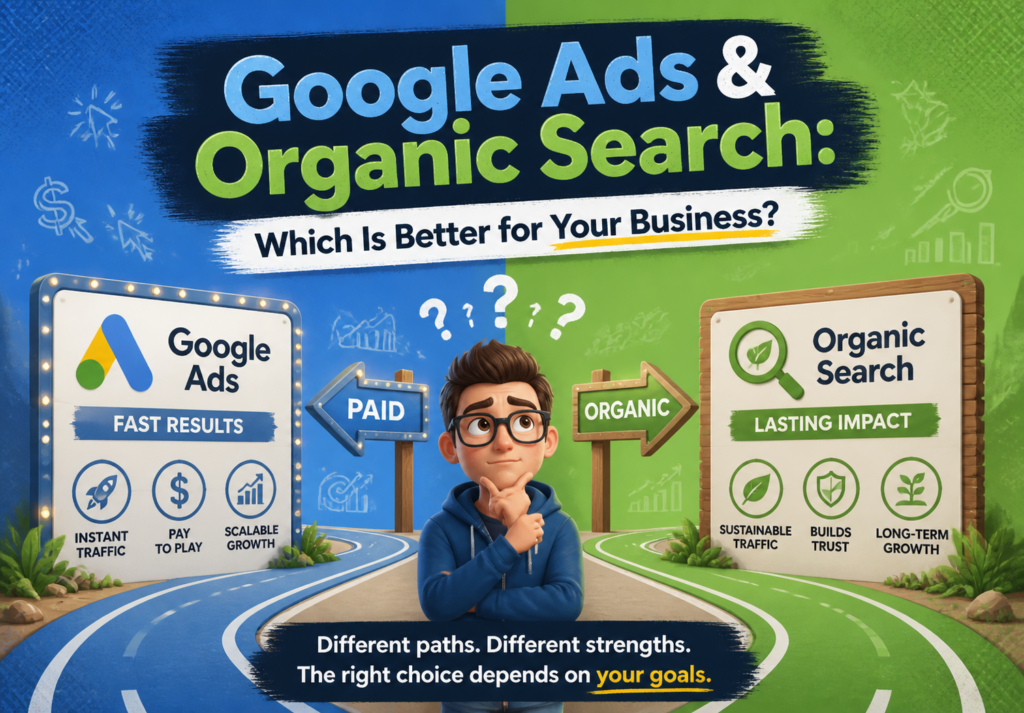
Google Ads & Organic Search: Which Is Better for Your Business?
What’s Inside This Article
1. The Fundamental Difference Nobody Explains Clearly
2. How Paid Search Actually Works — and What It Costs
3. How Organic Visibility Works — and What It Really Takes
4. Side-by-Side: Key Differences and Advantages
5. Which Channel Fits Which Business Situation
6. Running Both Channels Together — When and How
7. Making the Decision With Your Actual Numbers
8. FAQ
The Fundamental Difference Nobody Explains Clearly
Most comparisons of these two channels frame the question as speed versus sustainability — paid search is fast, organic is slow. That framing is accurate as far as it goes, but it misses the more important structural distinction: the difference between renting visibility and owning it. When you run paid campaigns, you are renting space on the search results page. The moment you stop paying, that space disappears completely and immediately. When you build organic search presence, you are investing in an asset that continues to generate traffic regardless of whether you make any payment in a given month.
This distinction has profound implications for how each channel affects a business’s economics over time. A company that has relied exclusively on paid search for five years and then faces a budget cut loses its entire search visibility overnight. A company that has built organic rankings over the same five years retains that visibility through budget cuts, market changes, and competitive pressure — because the rankings are the result of accumulated content quality and authority signals, not an ongoing payment arrangement. Understanding which side of this ownership dynamic your current marketing investment is building toward is the most important strategic question the paid versus organic comparison raises.
Neither channel is universally superior. They serve different business needs at different stages of development, and the businesses that manage them most intelligently treat them as complementary rather than competitive. But the comparison only becomes genuinely useful once you understand the structural difference in what each one is actually buying — and what happens to that investment when circumstances change.
How Paid Search Actually Works — and What It Costs
Google Ads operates on an auction model where advertisers bid for placement on specific search queries. The position an ad receives isn’t determined solely by the bid amount — Google’s system also factors in quality score, which reflects the relevance of the ad and the landing page to the query being searched. Higher quality scores mean lower effective cost-per-click and better position at the same bid level. This quality score mechanism rewards advertisers who invest in relevant, well-structured campaigns over those who simply bid more aggressively.
The cost dynamics of paid search vary dramatically by industry, query competition, and geographic market. In highly competitive verticals — legal services, insurance, home renovation, financial products — cost-per-click for high-intent queries can range from $15 to $80 or more per click. In less competitive local markets, the same click might cost $2 to $8. These numbers matter because they determine the economics of the channel: if your average conversion rate from paid search traffic is 3% and your average customer value is $500, the maximum sustainable cost-per-click at a 20% marketing cost ratio is $3. Understanding these numbers before investing in paid campaigns is the difference between a profitable channel and an expensive one.
📈 The Paid Search Economics Check:
Formula: Maximum CPC = (Average Order Value × Target Marketing Cost %) ÷ Conversion Rate
Example: $800 average value × 15% target cost = $120 ÷ 4% conversion rate = $3.00 maximum sustainable CPC
If your industry’s actual CPCs are above this number, paid search will consistently operate at a loss at your current conversion rate. Fix the conversion rate or the campaign economics don’t work — regardless of how well the ads are managed.
The practical setup of effective paid campaigns — campaign structure, keyword match types, negative keyword management, ad copy testing, and landing page alignment — requires genuine expertise to execute profitably. The full operational picture of how to set up a Google Ads campaign covers the technical requirements in detail. What’s worth noting here is that even a well-structured campaign requires ongoing management and continuous optimization — the cost of that management adds to the total investment required to make the channel work at a professional level.
- ► Campaigns can be live and generating traffic within days of setup
- ► Budget can be scaled up or down immediately in response to business needs
- ► Precise targeting by location, device, time of day, and audience demographics
- ► Performance data is immediate — conversion tracking provides rapid feedback on what’s working
- ► No visibility the moment the budget is paused or exhausted
How Organic Visibility Works — and What It Really Takes
Organic search rankings are determined by Google’s assessment of which pages best answer a given query — based on relevance, authority, technical quality, and user experience signals. Unlike paid placement, there is no direct payment for position. Rankings are earned through the quality of the website’s content, the authority signals it has accumulated from other websites linking to it, and the technical architecture that allows Google’s systems to access and understand the content efficiently.
The timeline for organic search results is the most frequently misrepresented aspect of the channel. Realistic timelines for a new or previously unoptimized website to reach meaningful organic traffic range from four to twelve months, depending on the competitive environment, the quality of work being done, and the starting point. This isn’t a limitation unique to this channel — it’s the nature of building a credible presence in a competitive information environment. The businesses that understand and accept this timeline benefit from compounding returns that paid search cannot replicate. Those that expect paid search speed from organic channels consistently misallocate their budgets and underinvest at exactly the wrong time. The honest breakdown of how long organic results take to appear covers the specific variables that affect this timeline.
The cost structure of organic search work is fundamentally different from paid search. Rather than paying per click, the investment goes into the activities that earn rankings: technical optimization, content development, and link acquisition. These are largely one-time or periodic investments rather than ongoing per-click costs — which is why the cost-per-acquisition from organic search typically decreases over time as the asset base grows, while paid search cost-per-acquisition tends to stay flat or increase. For a complete picture of what professional organic search investment actually costs at different competitive levels, the breakdown of how much SEO costs provides realistic benchmarks across business types and markets.
💡 The Compounding Returns Model:
A piece of content published and optimized in month three of an organic campaign continues generating traffic in month thirty-six — at no additional cost. Each additional piece of content adds to the cumulative traffic base rather than replacing it. This compounding effect means that the cost-per-visit from organic search decreases every month as the asset base grows, while the cost-per-click from paid search remains constant. Over a three-year horizon, this compounding difference typically produces dramatically lower cost-per-acquisition from organic channels for businesses that invest consistently.
The research on whether organic search works for small businesses addresses the ROI question with specific data — which is worth reviewing before deciding that the channel is either a guaranteed win or not suitable for a particular business type. The honest answer is that it works for most businesses in most markets when executed correctly, but the definition of “correctly” varies significantly depending on competitive environment and business objectives.
Side-by-Side: Key Differences and Advantages
The table below cuts through the generalizations and shows the specific functional differences between the two channels across the dimensions that matter most for business decision-making. Neither column is uniformly superior — the advantage depends on which dimension matters most for your specific situation.
| Dimension | Google Ads | Organic Search |
|---|---|---|
| Time to first traffic | Days — campaigns go live immediately | Months — rankings build over time |
| Cost structure | Pay per click — ongoing cost per visit | Investment in assets — cost per visit decreases over time |
| Visibility when budget stops | Disappears immediately | Maintained — rankings persist without payment |
| Audience trust level | Lower — ads are labeled and discounted by some users | Higher — organic results carry implicit editorial credibility |
| Targeting precision | Very high — location, device, time, demographics, retargeting | Query-based — you rank for what you’ve created content for |
| Scalability | Immediate — increase budget, increase volume | Gradual — more content and authority over time |
| Long-term ROI trajectory | Flat or declining as competition increases CPC | Improving — cost per acquisition decreases as asset base grows |
| Asset ownership | None — traffic rented from Google | Content and rankings are owned assets that add business value |
| Competitive intelligence | Excellent — Auction Insights reveals competitive landscape | Good — Search Console data shows query performance clearly |
Which Channel Fits Which Business Situation
The question of which channel to prioritize is not one-size-fits-all — it depends on where a business is in its development, what its competitive environment looks like, and what its financial structure can support. There are situations where paid search is clearly the right primary investment, situations where organic is clearly the right primary investment, and situations where the honest answer is that both need to run in parallel.
Paid search makes most sense as a primary channel when a business needs immediate revenue generation — at launch, after a product update, or during a seasonal peak where organic rankings don’t yet exist for the relevant queries. It also makes sense for high-value, time-sensitive conversions where the economics support the cost-per-click even in competitive markets. Service businesses with high average transaction values — lawyers, financial advisors, dental practices in high-value treatment categories — can sustain profitable paid search campaigns even at significant CPCs because the value of a converted customer justifies the acquisition cost.
📍 Channel Selection by Business Situation:
New business, no existing visibility: Paid search for immediate leads while organic foundation is built in parallel
Established business, competitive market: Organic as primary channel, paid for high-value queries where rankings are not yet in top positions
Seasonal business: Organic year-round for brand presence, paid to amplify during peak seasons
High-ticket service business: Both channels — organic for trust building, paid for immediate high-intent capture
E-commerce with tight margins: Organic primary — paid search economics often don’t work at low average order values
Organic search makes most sense as a primary investment when a business has a medium to long-term growth horizon, when the competitive environment makes paid CPCs economically challenging, or when the business model benefits from the trust signals that organic rankings carry. Businesses selling complex or high-consideration products — where the customer does significant research before buying — benefit disproportionately from organic visibility because their target customers are in research mode when they’re searching, and organic results carry more credibility during research than paid placements do.
The full strategic picture of how organic visibility connects to customer acquisition at different business scales is covered in the guide on organic SEO — which addresses both the methodology and the business case across different industry contexts.
Running Both Channels Together — When and How
The most sophisticated approach to search marketing isn’t choosing one channel over the other — it’s understanding how they interact and using each for what it does best within a coordinated strategy. Paid search and organic visibility address different parts of the customer acquisition funnel and different moments in the customer journey, which means running them in parallel produces better outcomes than either channel achieves alone.
The interaction effect between the two channels is real and measurable. Businesses that appear in both paid and organic results for the same query generate significantly higher click-through rates than those appearing only in one. The combined presence reinforces brand credibility — a business that appears in ads and in the top organic results for the same search term signals authority and relevance that neither placement alone communicates as strongly. This dual presence is particularly valuable for branded queries and high-intent commercial queries where competitors are also running paid campaigns.
The practical coordination between the two channels involves using paid search data to inform organic strategy. The queries that convert well in paid campaigns are the same queries worth targeting in organic content — because the conversion performance in paid provides validated evidence of commercial intent that organic keyword research can only approximate. Running paid campaigns while building organic presence serves double duty: generating immediate leads and producing validated conversion data that makes the organic strategy more precise.
⚡ The Data Transfer Strategy:
Export your Google Ads search terms report monthly and filter for queries with at least five conversions. These are your highest-validated organic targets — real queries that real customers used when they were ready to buy. Build dedicated content or landing pages around these terms for your organic strategy. This approach eliminates the guesswork from organic keyword targeting by replacing estimated intent signals with actual conversion data from your own campaigns.
Budget allocation between the two channels should shift over time as organic presence develops. A business starting with zero organic visibility might allocate 80% of search marketing budget to paid and 20% to organic foundation-building. As organic rankings develop and begin generating consistent traffic, that ratio can shift — moving budget from paid toward organic as the organic channel becomes increasingly self-sustaining. This migration from rented to owned visibility is the long-term strategic goal of running both channels in parallel.
- ► Use paid search data to validate which queries are worth investing in organically
- ► Reduce paid bids on queries where organic rankings reach top-three positions
- ► Maintain paid presence on high-competition queries where organic rankings are not yet achievable
- ► Use retargeting campaigns to re-engage organic visitors who didn’t convert on first visit
- ► Monitor total search impression share across both channels to identify gaps in coverage
Making the Decision With Your Actual Numbers
Abstract comparisons only get a business so far. The decision between channels — or the decision about how to allocate budget between both — becomes genuinely clear when you work through the numbers specific to your own business. The variables that matter are: your average customer value, your current conversion rate from search traffic, the cost-per-click in your competitive market for the queries you need to rank for, and the timeline pressure you’re operating under.
If your average customer value is high and your timeline pressure is significant — you need leads in the next sixty days — paid search is the pragmatic starting point regardless of its long-term economics. If your average customer value is moderate, your margins are tight, and you have a twelve-month or longer horizon, organic search is likely the higher-return investment. If you have budget for both and the business economics support it, running both in parallel with a coordinated strategy produces the best long-term outcome.
The conversion question is the often-overlooked variable in this calculation. Many businesses discover that more traffic — from either channel — doesn’t solve their lead generation problem because the conversion rate on their existing website is the actual bottleneck. The guide on how to generate leads from your website addresses the conversion layer in detail — because investing in traffic acquisition without addressing conversion rate is one of the most common and expensive mistakes in search marketing.
For businesses specifically evaluating whether organic search delivers results at their size and budget level, the guaranteed SEO model — where performance commitments are backed by contractual accountability — provides a lower-risk entry point into organic investment than standard retainer arrangements. Understanding what accountability structures look like and what they signal about a provider’s confidence in their methodology is worth factoring into any investment decision in this space.
🔗 Additional Resources for This Decision:
▶ How much does organic search optimization actually cost?
▶ What timeline should you realistically expect from organic search?
▶ Does organic search work for businesses at your scale?
▶ Is your website actually converting the traffic it receives?
Frequently Asked Questions — Straight Answers
→ We’ve been running Google Ads for two years and it’s profitable. Why would we also invest in organic?
Because profitable paid campaigns are not a permanent state. CPC costs in most industries have risen consistently year over year as more advertisers compete for the same queries. What’s profitable today at a $4 CPC may not be profitable in three years at a $9 CPC. Building organic presence while your paid campaigns are profitable is the time to do it — because you’re not dependent on organic to generate revenue while it develops. Businesses that wait until paid campaigns become unprofitable to start building organic presence have to survive the development timeline on reduced revenue.
→ Our industry has very high CPCs. Does that mean paid search won’t work for us?
High CPCs don’t automatically make paid search unprofitable — they make it unforgiving of inefficiency. In high-CPC environments, the businesses that run profitable campaigns are those with excellent quality scores, highly specific negative keyword lists, tightly structured ad groups, and landing pages that convert at significantly above-average rates. If your campaigns are structured broadly with generic ad copy and generic landing pages, high CPCs will make unprofitability almost guaranteed. The same budget, restructured precisely, can produce very different economics. Before concluding the channel doesn’t work, audit the campaign structure and landing page conversion rate rather than the CPC alone.
It’s also worth noting that high CPCs in your industry are a signal that the queries are commercially valuable — which makes them equally worth targeting organically. The same queries that cost $40 per click in paid search are worth significant investment in organic content because the traffic they deliver has demonstrated commercial intent at a level the market has priced accordingly.
→ We tried organic search for eight months and saw almost no results. Is the channel just too slow?
Eight months is enough time to see meaningful progress in most competitive environments if the work being done is genuinely effective. If you saw almost nothing after eight months, the most likely explanation is that the work wasn’t genuinely effective — not that the channel is too slow. Common causes of flat organic results after eight months include targeting queries that are too competitive for the site’s current authority level, content that doesn’t genuinely compete with what’s already ranking, technical issues preventing proper indexing, or an absence of genuine link acquisition. Before abandoning the channel, audit what was actually done versus what was supposed to be done.
→ If I pause my Google Ads tomorrow, what actually happens to my business?
Your paid search traffic stops immediately — within hours. If paid search is your primary or only search acquisition channel, your lead volume drops proportionally to your paid search share of total traffic. This is not a hypothetical risk — it’s a structural dependency that many businesses don’t recognize until they face a budget constraint or a platform issue that forces a pause. The severity of the impact depends on how much of your total leads currently come from paid search versus other channels. Running a controlled pause — temporarily reducing budget on specific campaigns to measure the true organic and direct contribution — is a useful diagnostic that reveals how dependent your business currently is on continued paid spend.
→ Can I rank organically for the same queries my Google Ads are targeting?
Yes — and this dual presence is one of the strongest positions in search marketing. Appearing in both paid and organic results for the same high-intent query communicates authority and relevance that competitors who appear in only one placement cannot match. The additional organic click-through from queries where you already have paid presence is essentially free incremental traffic — the same customer intent captured twice at the cost of one paid click. Building organic rankings for your top-converting paid search queries should be among the highest priorities in any integrated search strategy.
→ Our competitor dominates both paid and organic results. Is there any point in competing?
Yes — because “dominates” rarely means “owns every relevant query.” Competitors that appear dominant in search typically have strong positions on high-volume head terms while leaving significant gaps in the long-tail query space where search intent is more specific and conversion rates are often higher.
A legal firm that dominates “personal injury lawyer” might have minimal presence for “motorcycle accident attorney in [specific city]” — a query with lower volume but identical or higher conversion intent. Competitive dominance in search is always more partial than it appears from the outside. Query gap analysis almost always reveals exploitable opportunities that direct competitors have overlooked.