




 Get to WhatsApp

Our manager will contact you
within 15 minutesт
How to Market a Crypto Project: Top Cryptocurrency Marketing Strategies to Promote Your Token
What Separates Projects That Build Lasting Audiences From Those That Don’t
MOST BLOCKCHAIN PROJECTS INVEST HEAVILY IN DEVELOPMENT AND ALMOST NOTHING IN SUSTAINABLE VISIBILITY STRATEGY — THEN WONDER WHY ADOPTION STALLS AFTER LAUNCH. THIS GUIDE WAS ASSEMBLED TO GIVE FOUNDERS, TOKEN TEAMS, AND GROWTH LEADS A CLEAR-EYED BREAKDOWN OF WHAT PROMOTIONAL CHANNELS ACTUALLY PRODUCE RESULTS IN THIS INDUSTRY, WHY COMMUNITY TRUST IS THE ONLY DURABLE ASSET, AND HOW TO BUILD BOTH WITHOUT BURNING BUDGET ON TACTICS THAT DON’T COMPOUND.

How to Market a Crypto Project: Top Cryptocurrency Marketing Strategies to Promote Your Token
What’s Inside This Guide
1. Why Most Blockchain Project Marketing Fails Before It Starts
2. Positioning: The Foundation Every Channel Depends On
3. Organic Search as a Long-Term Acquisition Channel
4. Community Building That Creates Real Advocates
5. Content Strategy for Technical and Non-Technical Audiences
6. Influencer and KOL Strategy — What Works and What Wastes Budget
7. PR and Media Placement in the Blockchain Space
8. Social Channels: Where to Focus and How
9. Crypto, DeFi, and Blockchain — Different Audiences, Different Approaches
10. Paid Promotion: When It Makes Sense and When It Doesn’t
11. Exchange Listings as a Marketing Event
12. Retention: Keeping the Community Engaged After Launch
13. Building In-House vs. Working With a Specialized Agency
14. Why World SEO Agency
15. FAQ
Why Most Blockchain Project Marketing Fails Before It Starts
The pattern repeats itself across hundreds of projects every cycle: a technically capable team builds a product they believe in, launches with a burst of paid promotions and influencer mentions, sees a spike in wallet connections or token purchases, and then watches engagement collapse within six to eight weeks. Post-mortem analyses consistently point to the same structural problem — the marketing was designed to generate a moment rather than build a movement.
Hype is a renewable resource in this industry. New projects appear constantly, each one promising to solve a problem the previous generation couldn’t. The audience for this hype is large but increasingly sophisticated. Retail participants who’ve been through multiple market cycles have watched enough projects pump and fade to recognize promotional patterns. Institutional observers evaluate projects on fundamentals. Developer communities evaluate on technical credibility. Getting any of these audiences to genuinely care about your project — as opposed to speculating on it briefly — requires something that paid reach alone cannot manufacture: a coherent narrative that earns attention rather than buying it.
The projects that build lasting communities and sustainable token economies share a characteristic that looks obvious in retrospect but is rarely prioritized at launch: they treat their marketing infrastructure — their content, their organic search presence, their community channels, their media relationships — as long-term assets that compound in value over time, not as promotional expenses to deploy in the weeks around a token generation event. This framing change determines everything about which tactics get prioritized and how success gets measured.
📌 The Hype Trap:
Projects that rely primarily on paid influencer mentions and community airdrop incentives typically see user retention rates below 15% at the ninety-day mark. Users acquired through genuine educational content, organic search, and authentic community engagement retain at rates three to five times higher. The cost difference between these acquisition channels is significant upfront — but the lifetime value difference makes the organic approach dramatically more efficient when measured over a full year.
Positioning: The Foundation Every Channel Depends On
Before any channel strategy makes sense, the positioning question has to be answered honestly: what does this project do that nothing else does, and for whom? This sounds elementary, and most teams believe they’ve answered it. But “we’re building a decentralized protocol for cross-chain asset transfer with lower gas fees” is not positioning — it’s a feature description. Positioning is the answer to why someone who has seen fifty projects with similar feature sets should care about this one specifically.
The positioning work that precedes all channel strategy involves three components. The first is identifying the specific problem the project solves and for whom — not in the broadest possible terms, but as specifically as the actual intended user can be described. The second is mapping the competitive alternatives, including non-blockchain alternatives, and articulating why this project is the right choice for its intended user relative to all of them. The third is finding the narrative frame that makes the technical work legible and emotionally resonant to an audience that may not share the founding team’s technical background.
This positioning work then becomes the organizing principle for everything else: the language used in community channels, the topics covered in content, the story told in media pitches, the framing used in exchange listing applications. Projects that skip this work end up with fragmented messaging across channels — different things being said to different audiences without a coherent underlying story. That incoherence is detectable, and it erodes trust faster than almost any other mistake a project can make in its early stages.
Organic Search as a Long-Term Acquisition Channel
The blockchain and digital asset space has a paradox at its center when it comes to organic search: the audience is enormous and growing, the questions they’re asking are specific and high-intent, and yet most projects invest almost nothing in building the kind of content infrastructure that answers those questions and earns search visibility. This creates an unusual competitive environment where well-executed organic search strategy can produce disproportionate returns relative to what the same investment would achieve in a more mature industry.
People researching specific blockchain use cases, comparing token utilities, trying to understand protocol mechanics, or evaluating whether to participate in a particular ecosystem are using search to find answers. These are not passive audiences scrolling past an ad — they’re active research sessions with genuine information needs. A project that has built content addressing those specific research needs, and built the technical and authority signals that cause that content to rank well, is placing itself directly in front of this audience at the moment of maximum receptivity. That is the most valuable position in any marketing system.
The full operational picture of how organic search works specifically for blockchain and exchange projects — including technical architecture, content strategy, and the link signals that matter most in this vertical — is covered in detail in the guide on how to increase organic traffic to a crypto exchange. The strategic layer is worth understanding before investing in any of the channel-specific tactics that follow.
- ► Build dedicated pages for each core protocol feature — not a single “how it works” overview page
- ► Target comparison queries — users searching “X vs Y” are in active decision-making mode
- ► Create technical documentation that serves both users and search engines — well-structured docs rank reliably for specific protocol queries
- ► Build links through genuine editorial placements in crypto-native media rather than mass directory submissions
- ► Monitor search visibility in Search Console weekly — blockchain search trends move faster than most industries
The vertical also has specific challenges that general organic search strategy doesn’t fully address. Regulatory language requirements, restrictions on financial promotion in certain jurisdictions, and the need to maintain compliance while still producing compelling content all require specialized knowledge. Working with teams that have specific experience in SEO services for crypto projects avoids the compliance missteps that generalist agencies regularly make when entering this space without sufficient industry context.
Community Building That Creates Real Advocates
Community is the word most overused and least understood in blockchain project marketing. Every project launches a Telegram group and a Discord server and calls it community building. What they’ve actually built is a distribution channel — a place to broadcast announcements to people who joined because they were airdropped tokens or because they were briefly excited about a price movement. That’s not a community. A community is a group of people who would continue engaging with the project even if the token price dropped 70% — because they believe in what’s being built and feel genuine ownership over its direction.
The distinction between an audience and a community is measurable. An audience consumes. A community contributes. The projects with genuine communities have members who answer questions from newcomers without being asked, who report bugs they encounter in testing, who create educational content about the protocol unprompted, who defend the project’s reputation when FUD spreads. None of that behavior can be incentivized with token rewards — it emerges from genuine belief, which comes from genuine understanding, which comes from genuine communication between the project team and its most engaged participants.
Building that kind of community requires a specific set of practices that most projects underinvest in: regular transparent communication including when things go wrong, accessible technical explanations for non-developer audiences, meaningful governance participation that gives community members actual influence over protocol decisions, and team members who show up consistently in community channels not to announce things but to listen and engage. These practices take more time than scheduling a Twitter Spaces session or posting weekly price commentary. But the compound value of a community that genuinely advocates for a project exceeds any paid distribution channel available.
👥 The Governance Engagement Signal:
Projects that implement meaningful on-chain governance and report genuine participation rates — not just token-weighted voting dominated by large holders — consistently show higher community retention metrics. When community members have real decisions to make about protocol direction, they develop genuine stakes in the outcome that go beyond token price. That psychological ownership is the most durable form of community loyalty available, and it costs nothing beyond the operational overhead of running governance processes transparently.
Content Strategy for Technical and Non-Technical Audiences
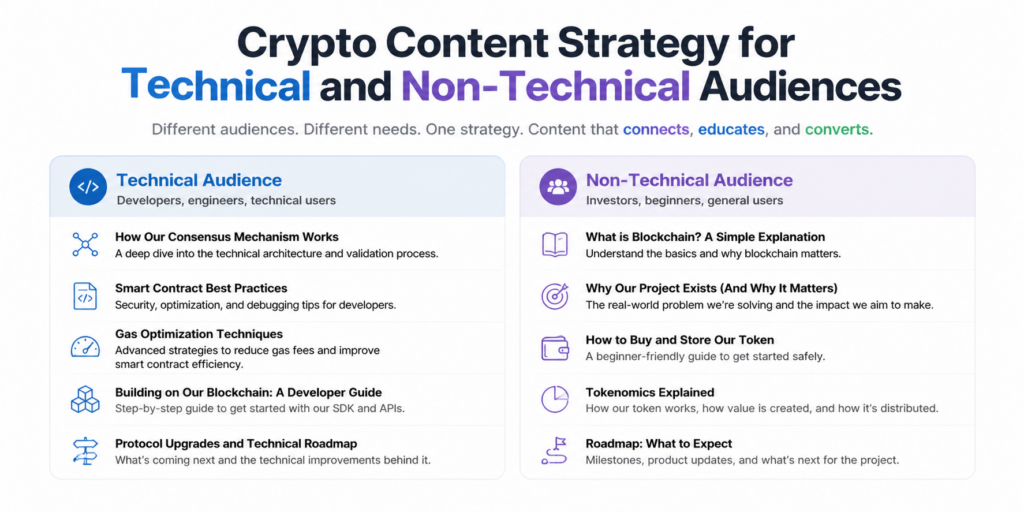
Content Strategy for Technical and Non-Technical Audiences
Blockchain projects have a content challenge that most other industries don’t face: they need to communicate meaningfully with audiences that range from highly technical developers who want protocol-level specifics to retail participants who are still learning the basics of wallet management. A content strategy that serves one group optimally will alienate the other if it doesn’t account for this range explicitly.
The solution isn’t to write everything at two different reading levels simultaneously — it’s to build separate content tracks that serve each audience deliberately. Technical documentation, developer guides, whitepaper deep-dives, and protocol update analyses serve the builder and advanced user audience. Explainer content, use case stories, comparison guides, and getting-started resources serve the broader audience that the project needs to grow beyond its initial technical community. Both tracks need to exist and be maintained — neglecting either leaves a significant portion of the potential audience underserved.
The content that consistently performs best in this industry shares a characteristic that’s worth naming explicitly: it takes a genuine position. Opinion-free, balanced, “on one hand, on the other hand” content is abundant and forgettable. Content that asserts something specific, argues for it with evidence, and acknowledges the counterarguments honestly is rare and memorable. The projects that establish genuine thought leadership — that become the source serious researchers cite when discussing a particular category of blockchain problem — do so through consistent, specific, opinionated content rather than through balanced coverage of an ecosystem they happen to be part of.
For projects specifically in the education space or for teams building educational content as a core marketing channel, the SEO for crypto education framework addresses the specific content architecture and search optimization approach that performs best for educational positioning in this vertical.
Influencer and KOL Strategy — What Works and What Wastes Budget
The influencer economy in the blockchain space has matured — and not entirely in a positive direction. The period between 2020 and 2023 produced enough high-profile examples of paid promotional content for projects that subsequently failed or turned out to be fraudulent that the audience for crypto influencer content has developed a well-calibrated skepticism about sponsored mentions. This doesn’t mean influencer partnerships don’t work. It means the ones that work look fundamentally different from the ones that don’t.
Paid promotional content from a KOL with a large following who has no genuine relationship with the project produces reach — impressions, video views, follower counts on new social profiles. It produces very little in the way of actual conviction or long-term community participation. The audience for this content has learned to discount it heavily because they’ve watched too many projects disappear after their influencer marketing push ended. The conversion rate from this type of exposure to genuine holder or user is significantly lower than it was several cycles ago.
What continues to produce results is the opposite approach: identifying a smaller number of genuinely respected voices in specific subcategories — DeFi analysis, Layer 2 infrastructure, GameFi mechanics, real-world asset tokenization — who have established credibility with precisely the audience the project needs to reach, and building a real relationship with them rather than a transactional paid placement. When a respected technical analyst with 50,000 followers writes a genuine analysis of a protocol because they find it interesting, the engagement and conversion rate from those 50,000 followers vastly exceeds what a million-follower promotional post produces. Credibility transfer is the mechanism that makes influencer partnerships valuable. It only transfers when the influencer’s endorsement is believed — and it’s only believed when it appears genuine.
| Influencer Type | Typical Audience Size | Best Use Case |
|---|---|---|
| Macro crypto generalist | 500K – 5M+ followers | Broad awareness at launch — low conversion, high reach |
| Niche DeFi analyst | 20K – 150K followers | Credibility building with technical audience — high conversion |
| Developer educator | 5K – 50K followers | Builder community recruitment — highest quality audience |
| Regional language KOL | 10K – 200K followers | Geographic market expansion — CIS, Southeast Asia, LATAM |
| Podcast host | 5K – 100K listeners | Deep narrative storytelling — best for complex protocol positioning |
| Twitter/X thread writer | 10K – 300K followers | Technical breakdowns that earn organic sharing and bookmarks |
PR and Media Placement in the Blockchain Space

PR and Media Placement in the Blockchain Space
The media landscape for blockchain and digital asset coverage has consolidated significantly. A handful of publications command the attention of serious industry participants: CoinDesk, The Block, Decrypt, Cointelegraph, and a smaller set of more technically-focused outlets like Bankless and various subcategory newsletters. Getting coverage in these publications requires understanding what their editorial teams actually consider newsworthy — which is a narrower category than most project teams assume.
An announcement that a protocol has launched its mainnet is not inherently news in an industry where dozens of projects launch every week. What is news is a genuinely novel technical approach to a problem the industry has been struggling with, a meaningful data milestone that demonstrates adoption at scale, a credible institutional partnership with implications for the broader ecosystem, or a transparent account of a problem the team encountered and how they solved it. Editors at serious publications have seen thousands of project pitches and have developed acute sensitivity to substance versus noise. The pitches that get coverage make a specific claim that is both true and interesting, supported by evidence that can be independently verified.
Press release distribution services have minimal value in this space. Articles placed through wire distribution that get republished across dozens of low-authority sites produce neither genuine readership nor meaningful search authority. The editorial link from CoinDesk or The Block that comes from a journalist choosing to cover a story because it’s genuinely newsworthy is worth more than a hundred press release placements — both for the credibility signal it carries and for the organic search authority it passes to the project’s website.
Social Channels: Where to Focus and How
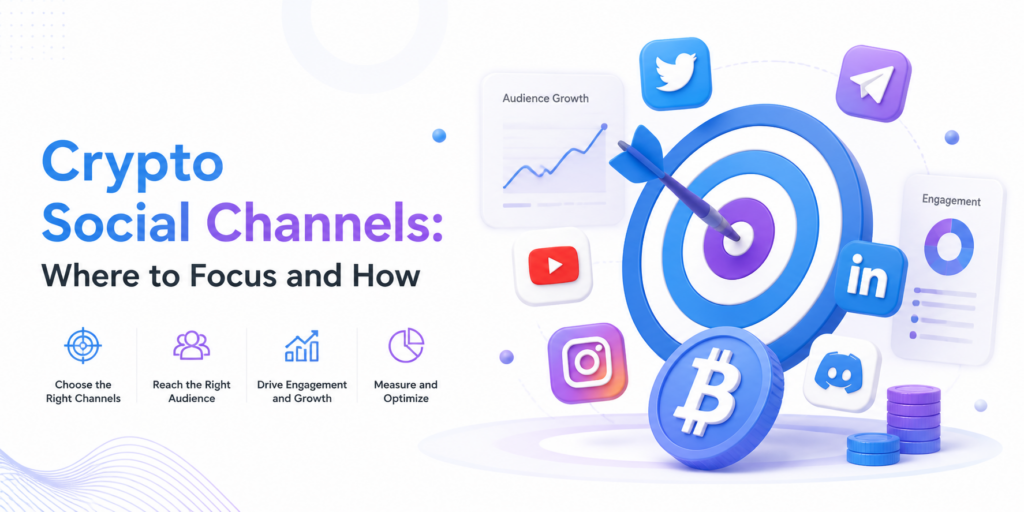
Social Channels: Where to Focus and How
The distribution of where blockchain audiences spend their attention has shifted meaningfully over the past three years. Twitter — now X — remains the primary real-time conversation hub for token trading, project announcements, and industry discourse. Its value is highest for projects that use it as a genuine communication channel rather than a broadcast mechanism. Teams whose founders and core contributors post authentic, opinionated, sometimes vulnerable content about what they’re building consistently outperform those that run scheduled announcement-only accounts.
Discord has become the standard for developer community infrastructure. The distinction between a well-run Discord and a poorly run one is visible immediately: well-run servers have active moderators, clear channel organization, genuine developer support threads, and regular team participation. Poorly run ones are announcement channels with a farming-focused chat section that generates bot-level engagement. The former builds real community. The latter inflates member counts while contributing nothing to retention or advocacy.
LinkedIn has emerged as a genuinely underutilized channel in this space, particularly for projects targeting institutional audiences, enterprise use cases, or the professional developer market. The signal-to-noise ratio on LinkedIn is higher than on most other platforms because the audience is there in a professional context. A well-executed LinkedIn presence that publishes genuine industry analysis and team thought leadership reaches decision-makers and institutional researchers who are either not present on or actively avoiding the noise of more speculative channels.
- ► Post founder and team content on X as individuals — personal accounts consistently outperform project accounts for engagement and credibility
- ► Maintain Discord as a genuine developer resource, not as an announcement broadcast channel
- ► Use LinkedIn for institutional and enterprise positioning — publish technical analysis rather than token price commentary
- ► Telegram works best for regional communities — particularly CIS, Southeast Asia, and LATAM markets where it remains the primary communication platform
- ► YouTube for long-form technical content — protocol deep dives, developer tutorials, and AMA recordings that rank in search for specific query types
Crypto, DeFi, and Blockchain — Different Audiences, Different Approaches
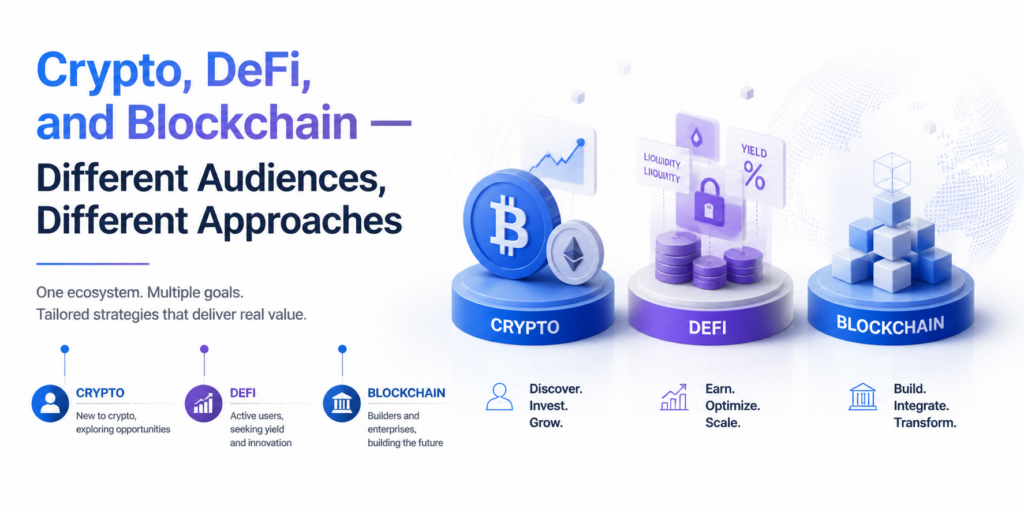
Crypto, DeFi, and Blockchain — Different Audiences, Different Approaches
One of the most common strategic mistakes in this industry is treating “crypto,” “DeFi,” and “blockchain” as interchangeable audience descriptors. They’re not. Each represents a meaningfully different audience with different motivations, different technical sophistication levels, different preferred communication channels, and different purchasing or participation behaviors. A marketing approach calibrated for one will underperform significantly with the others.
The table below provides a practical reference for understanding how content strategy, posting frequency, and community approach should differ across these three primary audience categories. This is a starting point for calibration, not a rigid rulebook — the right approach for any specific project depends on where exactly it sits relative to each category.
| Audience Segment | Crypto (Retail / Trading) | DeFi (Protocol Users) |
|---|---|---|
| Primary motivation | Price appreciation, portfolio growth | Yield, protocol efficiency, financial autonomy |
| Technical literacy | Low to moderate — prefers accessible content | High — expects precise protocol-level detail |
| Preferred channel | X (Twitter), Telegram, YouTube | Discord, Snapshot governance, Mirror.xyz |
| Posting frequency | Daily — price action commentary drives engagement | 3–4x per week — quality over volume |
| Content format | Short-form, visual, narrative-driven | Technical threads, audit summaries, TVL analysis |
| Trust signals | Exchange listings, influencer mentions, community size | Audit reports, on-chain data, team doxxing |
| Community size vs. quality | Size matters — follower count is a credibility proxy | Quality matters — active wallets and governance participation |
| Blockchain / enterprise audience | Use case documentation, compliance framing | Integration guides, SDK quality, developer support |
| Optimal content length | Short — 280 chars to 3-min video | Long — detailed research posts and deep dives |
| Response to bad news | Sell first, ask questions later | Evaluate technical response — transparency recovers trust |
For projects spanning multiple audience categories — a Layer 2 protocol serving both retail users and DeFi builders, for example — the communication architecture needs to reflect that range deliberately rather than defaulting to a single tone and format. The projects that do this well maintain distinct content tracks without creating a fragmented brand identity, which requires more editorial discipline but produces significantly better results across both audiences. Specialized support for this multi-audience challenge is available through SEO for cryptocurrency services designed specifically for the complexity of this vertical.
Paid Promotion: When It Makes Sense and When It Doesn’t
Paid promotion has a defined and limited role in a well-structured project marketing system. That role is amplification — taking content or community momentum that already exists and accelerating its reach. Paid promotion as a substitute for organic credibility doesn’t work in this market, and attempting it produces predictable outcomes: short-term visibility spikes followed by disengagement when the promotional content fails to deliver the genuine value it implied.
The contexts where paid promotion makes genuine sense are relatively specific. Retargeting campaigns reaching people who have already visited the project’s website or documentation — who have demonstrated genuine interest — convert at meaningfully higher rates than cold audience targeting. Sponsored content in publications where the editorial quality creates a credibility transfer effect — where being featured implies a standard the publication maintains — can drive genuine traffic and qualified leads. Search advertising targeting specific comparison queries or technical questions, where the intent of the searcher is active research rather than passive browsing, can produce cost-effective user acquisition when the landing pages are built to convert that specific intent.
The paid channels that consistently underperform expectations in this space are broad awareness campaigns on general social platforms targeting large crypto-adjacent audiences, banner advertising across crypto media networks with low CPM but high bot traffic ratios, and paid listing services that promise inclusion in “top project” directories without transparent editorial criteria. The budgets spent on these channels almost always produce better returns when redirected to content development, genuine media relationships, or community development activities.
Exchange Listings as a Marketing Event
An exchange listing — particularly on a tier-one centralized exchange — is simultaneously a distribution milestone and a marketing moment that requires deliberate preparation to capitalize on fully. Most projects treat the listing announcement as the marketing work itself. The teams that extract the most value from listings treat the announcement as the beginning of a prepared campaign rather than the campaign itself.
The preparation that maximizes a listing’s marketing impact begins weeks before the announcement. This includes a refreshed website with clear value proposition language accessible to an audience encountering the project for the first time, updated documentation and getting-started resources for new participants, a content publication schedule that provides genuine context for why the project is worth attention beyond the listing itself, and community channels that are active and welcoming to newcomers rather than dominated by existing holders discussing price.
Post-listing retention is where most projects fail to follow through. The spike in attention that follows a major listing brings a large number of new participants who know almost nothing about the project. Whether they become genuine community members and long-term participants — or whether they trade out within a few weeks — depends almost entirely on what they encounter in the first two to three weeks after joining. A structured onboarding experience, accessible educational content, and active community channels that answer questions and provide genuine value determine the retention rate of this new cohort more than any other factor.
📈 The Listing Amplification Flow — What High-Retention Projects Do:
6 weeks before listing: Refresh website, update documentation, prepare educational content series
↓
2 weeks before: Brief media contacts, prepare community moderators for volume increase, finalize onboarding materials
↓
Listing day: Coordinated announcement across all channels, team AMA scheduled within 48 hours, FAQ pinned in all community spaces
↓
Weeks 1–4 post-listing: Daily educational content, founder participation in community channels, weekly progress updates, systematic onboarding of new participants
↓
Month 2+: Retention measured by wallet activity and governance participation rather than token price. Community depth built during this period becomes durable asset.
Retention: Keeping the Community Engaged After Launch
Retention is the least glamorous component of blockchain project marketing and the one that determines whether a project builds a durable ecosystem or a declining community waiting for its next hype cycle. The attention economy works against retention by design — there is always a newer project making bolder promises to compete for the same audience’s attention. Keeping community members genuinely engaged over months and years requires giving them ongoing reasons to care that aren’t purely tied to token price performance.
The retention mechanisms that work consistently share a common characteristic: they give community members genuine agency and genuine information. Governance with real stakes, where community votes actually influence protocol decisions, creates participants with ongoing reasons to stay engaged. Transparent reporting — including honest accounts of challenges, delays, and course corrections — builds the kind of trust that survives market downturns. Development updates that explain what the team is building and why give technically-engaged community members content worth engaging with and sharing. None of this is expensive. All of it requires consistent execution.
The projects that build the most resilient communities also tend to be the most generous with knowledge. Publishing research that is genuinely useful to the broader ecosystem — not just promotional content about the project’s own features — establishes the kind of industry credibility that makes a project’s community a destination rather than just a communication channel. When respected researchers and builders choose to spend time in a community because it’s intellectually valuable, that reputation compounds in ways that paid promotion cannot replicate.
Building In-House vs. Working With a Specialized Agency
Most project teams reach a point where the question of whether to build an internal marketing function or work with external specialists becomes pressing. The answer depends heavily on the project’s stage, budget, and the specific capabilities most needed at that moment. Early-stage projects often benefit most from a lean internal lead who understands the product deeply combined with specialized external support for the channels requiring the most technical expertise — organic search architecture, link building, and technical PR being the most common.
The risk of building entirely in-house too early is hiring generalists who can execute across channels but don’t have the depth in any single channel to produce the results that specialist expertise enables. The risk of outsourcing everything is losing the authentic voice that comes from people who genuinely understand and believe in what’s being built. The best configurations typically involve an internal team responsible for community voice, founder communications, and product narrative — combined with specialized agencies for search visibility, content production at scale, and media relationships.
For projects evaluating specialized support specifically for search visibility and organic traffic growth, the overview of the best available options in best crypto SEO companies for blockchain projects provides a useful framework for evaluating which providers have the specific expertise this vertical requires. The full-service picture of what specialized crypto marketing agency support looks like — and how to evaluate providers in this space — covers the decision criteria worth applying before committing to any external engagement.
Why World SEO Agency
Building organic visibility for a blockchain project requires a combination of technical depth, industry-specific content knowledge, and an understanding of the compliance landscape that most generalist agencies don’t possess. World SEO Agency works specifically with crypto, DeFi, and blockchain projects — which means the strategic recommendations, the content produced, and the link acquisition approach all reflect deep familiarity with how this vertical works rather than general digital marketing principles applied to a specialized context.
→ Financial Guarantees
World SEO Agency ties its performance commitments to contractually defined milestones with financial consequences if those milestones aren’t reached. In an industry where performance promises are routinely made and rarely backed by anything enforceable, this accountability structure is genuinely unusual. It reflects confidence in the methodology and aligns the agency’s financial interests directly with the client’s outcomes. Projects that have been burned by agencies collecting retainers while delivering activity reports rather than results will recognize immediately why this structure matters.
→ Transparent Pricing
Every engagement begins with a clearly defined scope of work at a stated price. There is no ambiguity about what is included, no add-on charges that appear mid-campaign, and no retroactive billing for work that was always going to be necessary. The pricing structure is visible before any commitment is made, and it reflects the actual cost of doing genuine work rather than a low entry price designed to get a signature followed by scope expansion conversations.
→ No Hidden Fees
The all-inclusive commitment means that when a campaign requires additional content, additional technical work, or additional link acquisition beyond what was initially scoped — those needs are addressed transparently and handled within the agreed framework. Clients do not encounter invoice surprises. What is agreed at the start of the engagement governs the entire relationship, without the hidden fee structures that are endemic to agency retainer models in this industry.
→ All-Inclusive System
Technical optimization, content development, link acquisition, search visibility monitoring, and ongoing strategy — every component of a complete organic search campaign is included in the engagement rather than priced separately. For blockchain projects that need to manage marketing spend carefully while maintaining quality across multiple channels, an all-inclusive model that eliminates variable cost uncertainty is a structural advantage over a la carte arrangements where every deliverable requires a separate negotiation.
→ Working Across the US and Worldwide
Blockchain projects are global by nature, and their marketing infrastructure needs to reflect that. World SEO Agency runs campaigns across English-language markets globally and has the capacity to support projects targeting multiple geographic regions simultaneously. Whether the priority is North American visibility, European institutional audiences, or Southeast Asian retail communities, the approach scales to the geographic scope the project requires without the inconsistency that comes from managing multiple regional vendors independently.

Want to order services? Get a consultation from an SEO expert. Send a request.
Frequently Asked Questions — Direct Answers
👉 Our token launched six months ago and community engagement has dropped 80%. Is there a way back?
Yes — but it requires honest diagnosis before any tactical response. Engagement collapse six months post-launch almost always traces to one of three causes: the project failed to deliver on commitments made during the launch period; the content and communication dropped off after the initial push; or the community was built around price speculation rather than genuine interest in the product. Each requires a different fix.
The first requires transparent communication about what happened and a credible path forward. The second is operationally solvable with consistent effort. The third is the most difficult — it may require rebuilding the community with a different core audience rather than re-engaging the original one.
🔍 We have a strong technical product but our founders don’t want to be public figures. Can we still build a visible community?
It is harder without identifiable public figures, but it is not impossible. Projects that have successfully built credible public presences without doxxed founders have done so by developing other trust signals aggressively: rigorous third-party security audits, strong governance participation data, verifiable on-chain metrics, and genuine community contributors who become recognizable voices over time. The tradeoff is that the credibility-building process takes longer and requires more consistent investment in verifiable data than projects with identifiable teams. For certain categories of project — particularly those serving privacy-conscious user bases — pseudonymous founding teams are actually a feature rather than a liability if positioned correctly.
The governance dimension is particularly important in this context. When community members can see real on-chain governance participation, meaningful treasury decisions, and protocol changes driven by community input — the project demonstrates accountability through mechanism rather than identity. That mechanical accountability can substitute for much of the trust that a public founder face typically provides.
⚠️ Is it worth building organic search visibility if we’re primarily targeting non-English speaking markets?
Absolutely — but the approach needs to reflect the specific linguistic market rather than being an English-language strategy with translation applied. Search behavior, query construction, and the competitive landscape for organic visibility vary significantly across languages. A project targeting Korean or Japanese audiences is operating in markets where different platforms, different content formats, and different authority signals matter. The underlying principles — creating genuinely useful content, building real authority signals, optimizing technical architecture — apply across languages. The execution needs to be built natively for each target market rather than adapted from an English-language template.
💰 We have a $50,000 marketing budget for the next six months. How should we allocate it?
Rough allocation that produces durable results over that timeframe: approximately 40% toward content production and organic search infrastructure — this builds the compounding asset base that continues generating returns after the budget period ends. Approximately 25% toward genuine media and PR relationships — not wire distribution, but actual editorial placements in publications the target audience reads. Approximately 20% toward community management and growth — the people and tools required to maintain active, quality community channels. The remaining 15% toward targeted paid amplification of content that is already performing organically. The specific allocation should shift based on what’s working at the 90-day mark — the framework above provides a starting point, not a fixed formula.
📌 Our competitors are running aggressive airdrop campaigns and growing their communities faster than us. Should we match them?
Only if you want the same outcome they’ll get: a large community with low retention, dominated by airdrop farmers who leave the moment the rewards stop. Airdrop-driven growth produces impressive headline numbers that collapse quickly when measured against any engagement metric beyond wallet count. The projects that match aggressive airdrop campaigns typically accelerate a race to the bottom on retention quality. A better response is to let competitors grow their farming communities while you build a smaller, more engaged community of genuine users — and then let the retention data make the argument for you over the following six to twelve months.
🔹 Can organic search actually compete with paid traffic for token discovery?
For different purposes, yes — and in several important ways, organic search outperforms paid traffic for discovery. Paid traffic can be turned off, blocked by ad platforms citing compliance concerns, or rendered ineffective by banner blindness in a market that sees constant promotional content. Organic search visibility compounds over time, continues generating traffic without ongoing ad spend, and reaches users in an active research state rather than a passive browsing state.
The user who finds a project through organic search because they were researching a specific protocol problem is significantly more likely to engage genuinely than the user who saw a sponsored post while scrolling. Both channels have roles — but organic search builds an asset that paid traffic never does.