Get to WhatsApp

Our manager will contact you
within 15 minutesт
Yacht Charter & Boat Dealer Marketing: A Los Angeles SEO Guide
Water-based business visibility starts here
Yacht Charter & Boat Dealer Marketing: A Los Angeles SEO Guide
An expert guide on such an important and niche subject as SEO for yacht charter & boat dealer marketing in LA. We have put together a complete instruction: from choosing tools to selecting contractors. The most effective marketing and SEO combinations, timelines for achieving results broken down by budget. You can also order services from our agency. To do so, send a proposal request on this page.
Sharing the Secrets of How We Promote Yacht Charter and Boat Dealer Websites in Los Angeles
⚡ Quick Answer
For yacht charter companies and boat dealers in Los Angeles, the most reliable path to consistent bookings and showroom visits is a layered marketing approach: organic search as the foundation, Google Ads for high-intent seasonal peaks, a website structured around specific vessel categories and charter types, a blog that answers real buyer and renter questions, and an active Google Business Profile for local visibility. Social media on Instagram and Facebook warms the audience, YouTube walkthroughs prove the experience, and outreach plus link building compound the authority over time. Expect first measurable signals in two to three months and meaningful revenue-linked results after six to nine.
What’s Inside This Guide
— Why this niche behaves nothing like general local marketing.
— Organic search: the channel that earns its keep month after month.
— Google Ads and remarketing for seasonal and high-ticket buyers.
— Site architecture: vessel categories, charter types, and FAQ blocks.
— The blog that earns traffic and trust at the same time.
— Google Business Profile for marina-area and showroom visibility.
— Instagram, Facebook, and LinkedIn for different audience layers.
— YouTube walkthroughs that do the selling before the call.
— Marketing packaging: offers, hooks, and seasonal incentives.
— Outreach, organic mentions, and free link sources.
— Paid link building done without risk.
— Tools we use and our clients appreciate.
— Our six-stage promotion method for this niche.
— Our packages for yacht and marine businesses.
— FAQ: questions from business owners in this sector.
Why This Niche Behaves Nothing Like General Local Marketing
Selling or chartering a boat is not like selling a service. The buyer or renter is not in a hurry. They are dreaming first, planning second, and deciding third, often over a period of weeks or months. Someone who finds your site while researching a birthday sailing trip in Marina del Rey will return multiple times before they ever pick up the phone. Someone interested in purchasing a center console fishing boat is comparing dealers across the entire Southern California coast, reading forums late at night, watching YouTube reviews, and noting which companies respond to inquiry emails in under an hour. If your site is only visible to people who already know your name, you are outside the conversation during the most important part of the journey.
Los Angeles adds its own competitive texture. This is a city with an enormous waterfront, multiple marinas, and a buyer base that runs from young professionals renting a pontoon for a weekend to wealth management clients shopping for vessels above seven figures. The marketing challenges are not uniform across those segments. A party barge charter company near Long Beach operates in a different search environment from a brokerage specializing in sailing yachts in the South Bay. What works for one can be almost irrelevant for the other, which is why campaigns that treat the entire marine category as one audience tend to underperform in this market.
The long research phase problem
Most marine buyers and charter customers conduct research over three to twelve weeks before making contact. During that period, they visit four to eight websites, read reviews on multiple platforms, and form strong impressions about which companies feel professional and trustworthy. A site that cannot be found during those early research visits is not in consideration when the decision is made.
Seasonality is the other major variable. Charter demand in Los Angeles peaks in spring and early summer, then again around holidays. Boat sales correlate with boat show timing, tax season, and weather patterns that bring people back to the water after winter. Marketing that runs at the same level year-round wastes budget in slow periods and misses volume in the peaks. The right approach synchronizes content publishing, advertising intensity, and offer timing with the actual decision calendar of the buyer rather than the fiscal calendar of the business.
Trust is unusually important in this category. A buyer considering spending $40,000 on a boat, or a group planning a corporate charter event for sixty people, is making a decision that involves real financial and social risk. They want to see evidence that the company they are considering is real, experienced, properly insured, and staffed by people who know what they are doing. A website that answers every question they might be embarrassed to ask, shows real photos of real vessels, names and photographs the team, and displays licensing and insurance prominently does something no advertising can replicate: it removes doubt before the first conversation happens.
For a broader view of how search marketing works in this city, our overview of our Los Angeles SEO agency and its approach gives useful context before narrowing in on the marine sector specifically.
Organic Search: The Channel That Earns Its Keep Month After Month
The honest case for organic search in this niche is not traffic volume. It is lead quality. Someone who finds a charter company by reading a well-written page about sunset sailings in Santa Monica Bay already understands what they are looking for and roughly what it costs. They have not been interrupted by an ad. They made a decision to read. That pre-qualification is worth more than any click that was purchased.
The technical foundation is where most marine websites underperform. Many are built on platforms designed for general tourism or hospitality, without consideration for how a search engine processes availability calendars, vessel specification pages, or photo-heavy fleet galleries. A gallery page that loads sixteen high-resolution photos without any compression, lazy loading, or modern image format is a performance problem that affects both visitor experience and crawler efficiency. A booking calendar built in JavaScript that cannot be rendered without an API call is invisible to any search engine that does not render JavaScript fully.
Fix the foundation before anything else. Crawl the site and find pages that return errors, redirect chains that add unnecessary steps, duplicate fleet pages that share identical descriptions, and mobile layouts that require pinching and scrolling on a standard phone screen. These are not design preferences. They are ranking disadvantages that no amount of content work can overcome while they persist.
After the technical layer, the keyword map is the second structural decision. For yacht charter marketing Los Angeles, the map should cover several distinct intent layers: event-specific searches such as birthday boat parties and corporate yacht charters, vessel-type searches such as sailboat rentals and catamaran charters, activity-based searches such as fishing charters and sunset cruises, location-specific searches around Marina del Rey, Long Beach, and San Pedro, and buyer-research searches such as how much does it cost to rent a yacht. Each of these is a different audience with a different question, and trying to serve all of them from a single homepage is how sites end up visible to no one specific.
The hidden traffic segment
Boat dealer SEO often ignores service and repair queries entirely, even though service customers are frequently the same people who eventually buy their next vessel from the same dealer. Pages for outboard service, winterization, detailing, and warranty work capture a steady stream of existing boat owners and keep the brand visible between purchase cycles.
Authority, in this category, comes from places that actual boating communities respect. Marina newsletters, sailing club websites, fishing forum threads, marine industry publications, and local travel blogs covering the Southern California coast. These are the sources that earn links with real value, and they are built through relationships and genuine helpfulness rather than through bulk outreach programs. Patience is required. So is a team that knows the difference between a marina and a harbor and can write about marine subjects without sounding like someone who has never been on the water.
Boat dealership SEO specifically requires attention to inventory management that parallels the automotive world: each vessel for sale should have a unique page with its own specifications, history, photos, and pricing. When a vessel sells, the page should redirect rather than 404. When new inventory arrives, the page should be published with real, specific content rather than a placeholder with manufacturer copy that appears on dozens of other dealer sites across the country. The dealers who win on organic search are the ones whose inventory pages are worth reading, not just worth crawling.
For a practical look at how to significantly grow site traffic over time, our guide on how to get 1000 visitors a day to your website is honest about the effort that requires, which makes it more useful than most traffic growth content in this sector. And for businesses in adjacent parts of the marine industry, our page on SEO for Yacht Clubs covers the club membership and event search landscape in similar practical detail.
Google Ads and Remarketing for Seasonal and High-Ticket Buyers
Paid search and organic search are not competitors. In this niche, they work in a sequence. Ads produce data quickly, covering the period while organic authority builds and generating immediate bookings for time-sensitive events. Organic work builds the lasting asset that continues producing after the ad spend ends. The relationship between the two is more like a relay than a rivalry, and treating it that way produces better results at every budget level.
Charter businesses should concentrate paid budgets on the high-intent, event-driven queries where urgency and specificity combine: a person searching for a yacht for a corporate event in Marina del Rey next month is worth many times a person searching for general boat rentals. The match type discipline is the same as in any market: exact and phrase match on bottom-funnel terms, a living negative keyword list maintained weekly, and a search terms report reviewed every seven days without exception. Generic broad match for yacht and boat queries in a market like Los Angeles will produce a remarkable variety of irrelevant searches that spend money without producing inquiries.
For dealers, paid search functions differently. The buyer is often in a long research cycle, which makes branded campaigns and model-specific ad groups more productive than generic inventory terms. Someone who visited the inventory page for a specific vessel three times without submitting a contact form is a remarketing candidate who already knows what they want. A reminder ad with a price or availability detail, delivered to that specific audience segment rather than the general visitor pool, costs less per conversion than any broad awareness campaign and requires no creative genius.
The question of when to run ads versus when organic investment is the right call is covered in depth in our analysis of Google Ads or organic search. The short version for this category: run ads for seasonal peaks and specific event queries immediately, and build organic as the year-round system underneath them.
The form abandonment audience
Charter and dealer booking forms frequently see abandonment at the step that asks for dates or deposit information. Build a specific remarketing audience for people who reached that step but did not complete it, and serve them an ad that answers the most common hesitation: flexible cancellation, payment security, or a specific promotion. This audience converts at several times the rate of cold traffic.
Luxury yacht marketing through paid channels requires a different creative and bidding approach than consumer charter advertising. The buyer is not moved by urgency tactics or countdown timers. They respond to quality signals: professional photography, specific vessel capabilities, crew credentials, and exclusive access language. Bid on terms that reflect the buyer’s research language, not what the seller calls the product. “Private yacht charter with crew” performs differently from “yacht rental,” and the difference matters at the budget levels these clients represent.
Site Architecture: Vessel Categories, Charter Types, and FAQ Blocks
Site Architecture: Vessel Categories, Charter Types, and FAQ Blocks
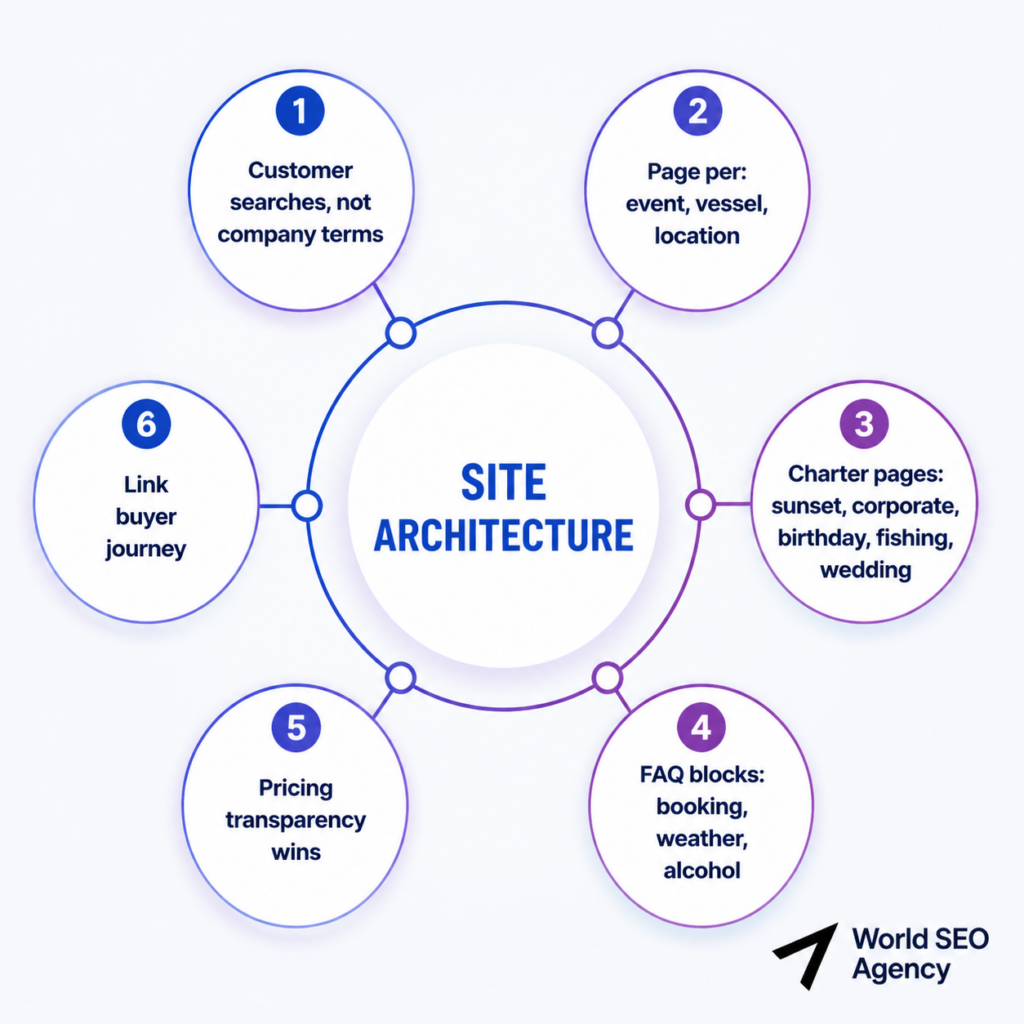
A site organized around how the company describes its own business will be less visible than one organized around how potential customers search. These are rarely the same thing. The company might call it “fleet” or “services.” The customer types “fishing boat rental near Marina del Rey” or “sailing yacht Los Angeles birthday.”
The correct structural decision is to map every distinct product and service to its own page, organized around buyer intent. For a charter company, this means separate pages for each type of event, each vessel category, and each departure location. For a boat dealer, this means separate pages for each category of vessel (fishing boats, pontoons, center consoles, sailboats, catamarans, personal watercraft), each major brand carried, and the services department. Each of these pages can be found independently by a searcher who typed the right combination of words, and each one links to the pages that naturally follow it in the buyer journey.
Charter category pages to build for a typical Los Angeles operation:
- ➜Sunset sailing charters with capacity, duration, catering options, and departure point
- ➜Corporate event yacht charters with group capacity, AV capability, and catering partners
- ➜Birthday and bachelorette boat rentals with group size options and add-on packages
- ➜Deep sea and inshore fishing charters with target species, season, and equipment information
- ➜Whale watching and wildlife excursions with timing, duration, and sighting probability
- ➜Wedding and proposal boat charters with photography packages and ceremony arrangements
The FAQ blocks on each of these pages are not an afterthought. They are one of the most effective structural choices in this niche, because the questions buyers have about a charter or a vessel purchase are specific, predictable, and rarely answered on most competitor sites. How far in advance should I book? What happens in bad weather? Is alcohol permitted? Can we bring our own food? How much does the captain need in gratuity? What is the cancellation policy in detail? Every one of these questions, answered plainly on the page that attracted the visitor, removes a barrier to contact. And they also capture the long-tail searches that the main copy never touches.
Pricing transparency as a trust signal
Charter and marine businesses are often reluctant to show prices online, worried about scaring off buyers before the conversation happens. The reality is the opposite: a visitor who arrives at a page without any pricing information will frequently leave rather than call, because finding out the price first feels less awkward online than on the phone. A price range with the factors that affect it converts better than a “contact us for pricing” placeholder.
The Blog That Earns Traffic and Trust at the Same Time
A blog in this category earns its keep when it answers the questions that buyers ask before they know who to call. Not press releases about the company. Not generic articles about the history of sailing. Specific, honest answers to the questions that actual customers type into search engines during the research phase of their journey.
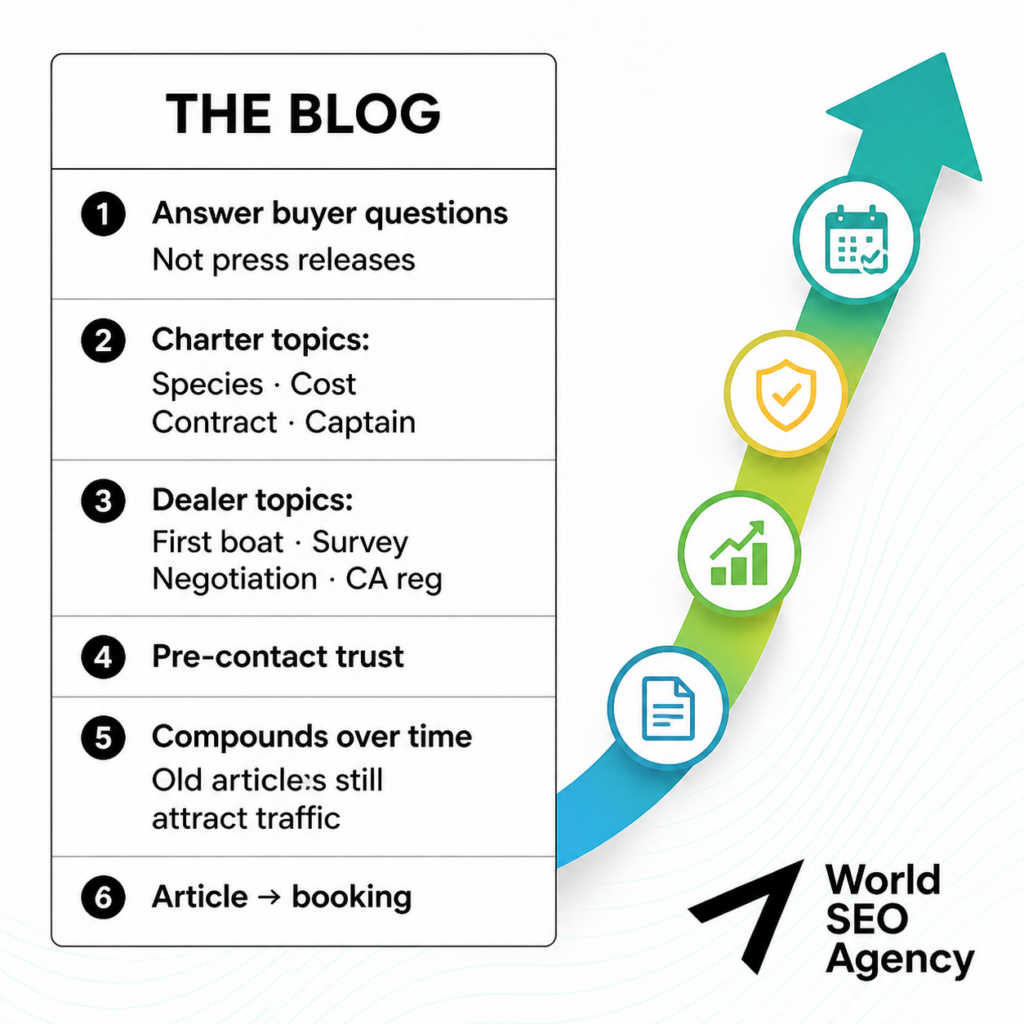
What does a good fishing charter topic library look like? Articles about the difference between nearshore and offshore fishing in Southern California. The best months for each target species in the waters off Los Angeles. What to bring on a full-day charter versus a half-day trip. How to read a charter booking contract. What captain credentials you should ask about. What the realistic cost of a private fishing charter is versus a shared one. Each of these articles attracts a reader who is planning a trip, establishes the author’s expertise, and leads naturally to the booking page for the relevant charter service.
For a boat dealer, the blog serves a slightly different audience. Articles about how to choose a first fishing boat. The difference between a center console and a bay boat for a specific use case. What to look for in a pre-owned outboard motor. How to negotiate a boat purchase. How to register a vessel in California. What marine survey actually covers. These are the questions buyers research before visiting a dealer, and a dealership whose blog contains honest answers to them builds a relationship with the buyer before the in-person conversation begins. That relationship translates into an appointment rather than a cold inquiry.
Boat dealership marketing that relies entirely on paid traffic, inventory listings, and walk-ins is renting attention. A blog that earns regular organic visitors is building ownership of a part of the market. The arithmetic of compounding content is straightforward: a well-written article from two years ago still attracts visitors today and will continue to do so as long as the information remains accurate. For more on what drives sustained traffic growth, our guide on how to get 1000 visitors a day to your website explains the method in practical terms.
Google Business Profile for Marina-Area and Showroom Visibility
A well-maintained Google Business Profile does quiet trust work that the website alone cannot. When someone searches for charter companies or boat dealers near a specific marina, the map panel they see first shows them the company name, rating, photo count, hours, and review summary before they have read a single word of website copy. A profile with fresh photos, correct hours, and recent review responses looks like a business that is active, responsive, and confident in its reputation. A neglected profile, common in this industry, looks like a company that does not pay attention to details, which is not the signal anyone wants to send about a business that involves water safety and expensive vessels.
Charter companies should claim and optimize separate profiles for each physical departure location if applicable. A company operating from both Marina del Rey and Long Beach should have both locations represented, with specific categories, service areas, and photos for each. The category selection matters. “Yacht charter service” and “boat rental service” are different categories in Google’s index and attract different search queries. Use the one that reflects the primary business accurately and add secondary categories where the platform allows it.
Review management in this niche requires more thought than in most. Charter reviews are event-based: a customer who had a birthday party on a boat three months ago has specific, detailed memories about what made it good or disappointing. Asking for a review shortly after the experience, while the memory is fresh and the emotional association is positive, produces reviews with the kind of specific detail that influences future customers far more than generic five-star ratings. Responding to every review, including the critical ones, in a calm and specific voice shows potential clients how the company handles things when they go wrong, which is exactly the information a first-time charter customer is looking for before committing.
Our local SEO services page explains the full scope of neighborhood-level search visibility work, including the profile, citation, and review components that apply to marine businesses with physical locations.
Instagram, Facebook, and LinkedIn for Different Audience Layers
Social media for a charter company or boat dealer is not a primary lead source. That is the first honest thing to say about it. What it does reliably is keep the brand visible during the extended consideration period between first awareness and first contact, and it creates the emotional connection that moves a buyer from “I should look into this” to “I need to call these people.”
Instagram is the most naturally suited platform for this category. Water, vessels, sunsets, and smiling people having experiences are exactly the content that performs on a visual platform. Short reels showing a charter in progress, a fishing trip at sunrise, or a couple celebrating an anniversary on the water reach people who were not actively looking but are emotionally receptive. The tone should be direct and experiential rather than branded. A clip of a captain explaining what the Santa Catalina crossing looks like on a perfect July morning is more persuasive than a produced commercial for the same trip.
Facebook serves a slightly different purpose. The audience skews older than Instagram, which often aligns better with the buyer demographics for vessel purchases and corporate charter events. Community engagement in boating groups, marina-area neighborhood pages, and local fishing forums builds visibility and trust in the specific communities where the target customer already spends time. For dealers, Facebook Marketplace has become a legitimate channel for pre-owned vessel listings and deserves integration into the inventory management process.
LinkedIn is relevant for charter companies competing for corporate event business, where the decision-maker is an event planner, executive assistant, or HR manager who researches vendors through professional channels. A well-maintained company page with case studies of successful corporate events, captain credentials, and safety certifications speaks to that buyer in the language they trust.
YouTube Walkthroughs That Do the Selling Before the Call
Video removes doubt in this category more effectively than any other format. A buyer considering renting a 50-foot sailing yacht for a weekend wants to see the interior layout, the cockpit, the sleeping berths, and the galley. Reading about them is useful. Watching a four-minute tour with someone who clearly knows the vessel answering the most common questions is decisive. The same applies to a customer considering purchasing a boat they found in an online listing. A thorough walkthrough video of that specific vessel, covering the engine hours, hull condition, electronics, and any notable quirks, is the difference between a speculative inquiry and a motivated appointment.
The formats that work for this category are unhurried and specific. A fleet tour for each type of vessel in the charter inventory. An honest fishing trip recap showing actual catches, weather conditions, and what the experience felt like. A boat care guide for new owners that positions the dealer as a resource beyond the sale. Captain Q&A sessions answering the questions first-time charterers ask most. These are not expensive productions. They require a steady camera, decent audio, and someone in front of it who knows what they are talking about.
YouTube also functions as a search engine in its own right, particularly for educational and research content. Someone searching for how to buy a used outboard motor in Los Angeles is as likely to find a helpful dealer video as a blog post. Titles should be written in the language the buyer uses, not in marketing language. Descriptions should include accurate chapters, relevant links to the corresponding service or inventory pages, and enough detail to make the page useful without watching the video. Embedding each video on the matching website page, together with VideoObject structured data, improves the chance that it surfaces in both YouTube and Google results for the subject it covers.
The safety credentials moment
Video is the best place to show captain licenses, vessel safety certifications, life raft demonstrations, and crew introductions. These are not exciting topics, but they are the ones that convert a hesitant buyer into a confirmed booking. A thirty-second clip of the captain walking through the safety briefing procedure answers the unspoken question every first-time charter customer has but rarely asks directly.
Marketing Packaging: Offers, Hooks, and Seasonal Incentives
The offer wrapped around a service is often what turns a browser into a buyer. In marine charter and sales, the standard offer is a price. The effective offer adds something that changes the perceived value of the experience: a complimentary fishing guide included with a half-day charter, a captain’s cocktail hour during a sunset cruise, a boat show pricing event with a specific end date, a first-service included with a new purchase, or a referral program that gives existing customers a reason to introduce the company to their circle.
Seasonal timing matters enormously here. The right offer for Memorial Day weekend is not the right offer for October. A winter maintenance special for existing customers keeps the relationship active during the slow season and produces service revenue that covers overhead until charter demand returns. A spring launch promotion with favorable pricing for early bookings moves inventory decisions forward on the buyer’s timeline rather than waiting for the peak when competitors are equally busy.
Trust-based packaging is specific to high-ticket categories. A flexible cancellation policy, clearly stated, removes one of the most common purchase hesitations. A deposit structure that staggers payments over time reduces the barrier to commitment. A test charter option, where the buyer can experience a vessel before committing to a sale, is not a give-away. It is a confident demonstration that the product delivers on its promise. These offers cost less than advertising and produce more committed buyers than any clever headline.
If your site attracts healthy traffic but contacts are not following, our analysis of why your website gets traffic but no calls identifies the most common causes by page type, which in this niche usually comes down to unclear pricing, a contact form that asks for too much information, or a booking process that requires a phone call at a stage the visitor was not ready for yet.
Outreach, Organic Mentions, and Free Link Sources
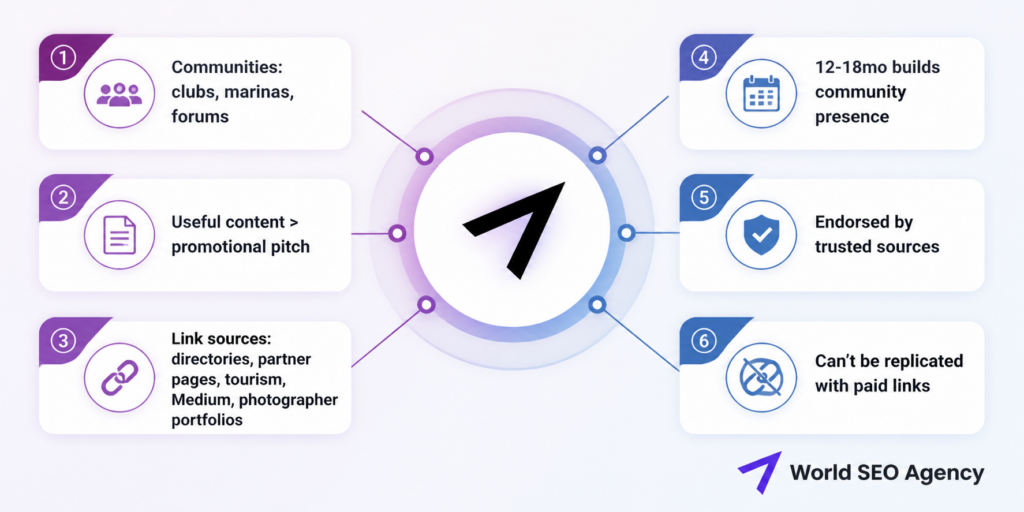
Outreach marketing for a yacht charter or boat dealer in Los Angeles begins with the communities that already care about the subject. Sailing clubs, fishing associations, marina tenants’ associations, recreational boating publications, and the growing ecosystem of boating content on YouTube and Instagram all represent audiences that overlap with the target customer. Reaching them with something genuinely useful, rather than a promotional pitch, is what distinguishes outreach from advertising.
A charter company that provides a local sailing blog with an honest guide to anchoring spots in Santa Catalina earns a link, builds a relationship, and creates content that readers of that blog may share with their own networks. A boat dealer that contributes a buyer’s guide to a recreational fishing forum earns both authority signals and the trust of an audience that is actively considering a purchase. These contributions take time and require the company to have something real to say, but they produce results that paid links cannot replicate because they come with the endorsement of a source the target audience already trusts.
Organic link sources specific to this niche include the following types worth exploring systematically:
- ➜Marina directory listings and the websites of marinas where the company operates
- ➜Fishing and sailing club partner pages and event sponsor sections
- ➜Los Angeles tourism and event planning resources and directories
- ➜Marine brand and manufacturer partner pages for authorized dealers
- ➜Medium, Substack, or LinkedIn articles on boating topics that link back to relevant service pages
- ➜Event photography partnerships where the photographer’s portfolio links to the charter that hosted the session
None of these individually moves rankings dramatically. Consistently building from them over twelve to eighteen months creates a backlink profile that reflects genuine community presence, which is exactly what search engines are designed to reward in local niche markets.
Paid Link Building Done Without Risk
Paid link building sits at the end of the sequenced work plan for good reason. It amplifies an existing foundation. Applied to a site with no organic authority, no content worth linking to, and no technical health, it produces temporary metrics and eventual risk. Applied to a site with established content, real traffic, and a clean technical profile, it accelerates the authority that organic work has already begun to build.
In the marine niche, the highest-value paid placements come from real publications that actual buyers and industry professionals read: recreational boating magazines, travel and experience publications covering Southern California, lifestyle publications aimed at affluent urban readers, and regional business journals that cover tourism and leisure industries. A link from one of these sources is worth significantly more than ten links from generic directories that exist primarily to distribute placements, and it carries none of the risk that bulk link packages introduce.
Documentation is non-negotiable. Every placement should be reported to the client with the source URL, the page URL, the anchor text, and the date of publication. Any provider that is reluctant to supply this information should be asked directly why, and the answer should be evaluated carefully before continuing. For the full context on how responsible link acquisition works and what to avoid, our guide on link building covers both the method and the common pitfalls in plain terms.
The authority and cost relationship
A single link from a genuinely authoritative marine publication typically costs more than a package of twenty links from generic sites. It is also worth more in every measurable way: ranking impact, referral traffic quality, and the duration of its effect. The budget comparison that matters is cost per lasting ranking improvement, not cost per link.
Tools We Use and That Our Clients Appreciate When Working With Us
Our clients do not pay for tools they cannot see working. Here is the stack we use in every marine and charter campaign, and the reason each item earns its place in the monthly budget.
Organic search management using Google Search Console as the daily reference for query performance, URL status, and indexing health. Combined with Ahrefs for backlink tracking, content gap analysis, and competitor page research, this pairing covers both the site’s own behavior and what the competitive landscape looks like in real time.
Google Ads management using Google Ads Editor for bulk campaign changes, negative keyword management, and match type discipline. Combined with CallRail for phone call attribution, so the client can see which keywords and pages produced actual inquiries rather than simply measuring click and form data.
Blog and content program management using Semrush for topic research and position tracking, Surfer or Clearscope for content brief development, and a structured editorial calendar built from the buyer questions we extract from support emails, sales calls, and search query reports in the first weeks of each engagement.
Beyond those three main service lines, the specific tools that add value in this niche include the following:
Screaming Frog for technical crawling, with JavaScript rendering enabled to catch content that only appears after page load. Essential for fleet and inventory pages built on modern frameworks.
Google Analytics 4 with BigQuery export for joining visit data with actual inquiry and booking records from the reservation system or CRM, so the reporting connects web activity to revenue rather than stopping at session counts.
Microsoft Clarity for session recording and heatmap analysis, particularly useful for understanding where potential charter customers abandon the booking form or which sections of a vessel listing page hold attention longest.
Looker Studio for building client-facing dashboards that join Search Console, GA4, Google Ads, and CRM data into a single view organized by the business goals, not by tool categories.
PageSpeed Insights and Lighthouse for monitoring performance on fleet photo pages and booking calendars, which are the two most performance-sensitive page types in this category and the ones most often neglected.
Core Marketing and SEO Tools Ranked by Priority for a New Campaign
| Tool or Channel | Primary Purpose | Why It Goes First and What It Requires to Work |
|---|---|---|
| Google Search Console | Indexing and search performance | Start day one. Shows what is indexed, what queries arrive, and what technical problems prevent visibility. Free. |
| Technical site audit | Foundation health | Start week one. Finds the structural problems that prevent all other work from compounding. Required before any content investment. |
| Google Business Profile | Local map visibility | Start week one. Fastest visibility improvement for marina-area and location searches. Requires accurate information and regular photo updates. |
| Category and vessel landing pages | Intent-matched content | Build in months one and two. Each page targets a specific buyer question. Produces first rankings in three to five months. |
| Google Ads search campaigns | Immediate high-intent visibility | Run from week two onward, particularly ahead of seasonal peaks. Requires dedicated landing pages, not the homepage. |
| Blog content program | Research-phase buyer traffic | Begin in month two. Articles from buyer questions generate traffic from month four onward and compound over twelve months. |
| Instagram and Facebook | Awareness and consideration | Begin in month one with real, non-produced content. Results build over three to six months as audience grows. |
| YouTube walkthroughs | Decision-stage trust | Publish two per month from month one. First search visibility in four to six months. Strongest impact on luxury and high-ticket buyer conversion. |
| Outreach and organic links | Authority accumulation | Begin in month two. First measurable authority impact in four to eight months. Requires real community engagement, not bulk outreach. |
| Paid link placements | Authority amplification | Begin only after organic foundation is established, typically month four or later. High-value placements from marine and lifestyle publications. |
Our Six-Stage Promotion Method for Yacht Charter and Boat Dealer Businesses
The sequence of work matters as much as the work itself. A campaign that publishes blog content before fixing crawling errors wastes money on pages that may not be indexed. A campaign that buys links before the site has real content worth linking to creates a risk it did not need. Our method is built around the idea that each stage creates the conditions the next one needs.
Stage 1: Technical audit and repair. Every campaign begins here. We crawl the site in full, review indexing coverage in Search Console, check mobile performance on fleet galleries and booking pages, test structured data on vessel and service pages, and map all redirect chains and URL structures. The result is a prioritized repair list with specific items and timelines. For marine sites specifically, we pay particular attention to how the inventory management system handles sold listings, how photo-heavy pages perform on a mid-range phone, and whether booking calendars are accessible to search crawlers. Most businesses are surprised by how many invisible problems have accumulated without anyone noticing them.
Stage 2: Conversion readiness and product page build-out. Before scaling any traffic, we examine the most important pages from the perspective of a first-time visitor who found the site through a search result. Does the charter category page answer the five questions that visitor is most likely to have? Is the contact path visible within one scroll? Is there a price range or pricing guide, or does the page deflect to “contact us for rates” without any context? We also build any missing category pages during this stage, ensuring every type of charter and vessel category the business offers has a dedicated, properly written home.
Stage 3: Blog and content program launch. With the site technically sound and conversion-ready, we begin the content program. Topics are drawn from search query data, sales call recordings, and the most common questions the booking team handles. Each article serves a reader at a specific stage of their decision process and links naturally to the relevant service or inventory page. Two to three articles per month is the rhythm that produces compound traffic growth without exhausting the editorial team or the budget.
Stage 4: Organic link growth. With content published and indexed, we begin the quiet work of earning mentions from outside the site. Marina partner pages, sailing and fishing clubs, local travel publications, and marine industry directories are the first tier. Guest contributions on relevant blogs and expert quotes in regional travel and lifestyle media follow. This work is slow and durable. A link from a trusted marine community source that has been in place for a year does more for authority than ten links from anonymous directories.
Stage 5: Traffic scaling through new pages. As authority builds, we expand the site with additional pages: new departure location pages, seasonal offer landing pages, comparison guides between vessel types, and deeper FAQ coverage. Each new page captures a different set of queries and links to the pages around it. This is also the stage where we refine existing pages based on what Search Console shows about which queries are almost, but not quite, earning clicks.
Stage 6: Paid link building. Only after the organic foundation is established do we introduce vetted paid placements on real, relevant sites. At this stage, the domain has sufficient natural signals that quality additions amplify rather than distort. We document every placement and share the full report with the client. For more detail on what responsible link building looks like in practice, our guide on link building covers the approach in straightforward terms.
Marketing Budget Checklist: Tools, Spend, and Time to First Results
| Activity | Tools and Typical Budget | Time to First Measurable Results |
|---|---|---|
| Technical site audit and repair | Screaming Frog, Search Console; from $1,000 to $4,000 one-time | 2 to 5 weeks |
| Charter and vessel category pages | Writers with marine knowledge; from $200 to $600 per page | 3 to 6 months to rank |
| Google Business Profile setup and management | Native tools, review software; from $150 to $400 per month | 2 to 6 weeks |
| Google Ads search and remarketing | Ad spend from $1,500 per month plus 10 to 20 percent management fee | 2 to 5 weeks for first usable data |
| Blog publishing, two to three articles per month | Writers and editors; from $700 to $2,500 per month | 4 to 8 months |
| Instagram and Facebook content | Scheduling tool, designer; from $700 to $2,500 per month | 2 to 4 months for brand awareness |
| YouTube walkthrough videos, two per month | Screen or on-water recorder, editor; from $300 to $1,500 per video | 3 to 6 months |
| Outreach and organic mentions | Ahrefs, outreach tool; from $600 to $2,500 per month | 3 to 8 months |
| Paid link placements from vetted marine and lifestyle sources | Placement database; from $800 to $3,500 per month | 4 to 9 months for ranking impact |
| Call tracking and attribution setup | CallRail; from $50 to $200 per month | Active from week one |
| Reporting and analytics maintenance | Looker Studio, GA4; from $200 to $600 per month or included | Active from month one |
What’s Included in Our SEO Packages for Yacht Charter & Boat Dealer in Los Angeles? More Profitable and Durable Than Google Ads Alone
| Package | Monthly Price | What’s Included |
|---|---|---|
| START A Profitable Start Get Started → |
from $1,500 / month First result: 3 months |
Website optimization. Top 10 Google rankings. AI (GEO) under Google search. Local SEO with new page creation. Promoted pages: 10. Keywords: 30. |
| BUSINESS Customer Selection ★ Get Started → |
from $2,500 / month First result: 2 months |
Everything in START. Top 5 Google rankings. AI (GEO) optimization. Local SEO with new pages. Promoted pages: 20. Keywords: 100. Regular blog development. Organic backlinks. |
| INDUSTRY LEADER Everything Is Included Get Started → |
from $3,500 / month First result: 1 month |
Full-service SEO. Top 3 Google rankings. AI (GEO) optimization. Local SEO. Unlimited pages and keywords. Regular blog. Organic backlinks. Technical improvements. Paid link building included. Financial commitment applies to this plan. |
How to compare quotes for this niche
When three providers give different monthly numbers, compare the deliverables, not the totals. Ask each one how they handle seasonal content updates, what happens to your pages if the engagement ends, and whether the report shows bookings or just sessions. The most useful question is: which of your current clients in marine or charter can I speak with? The answer tells you whether the marine expertise is real or repositioned from another sector.
For businesses evaluating their options across the broader Los Angeles market, our guide on affordable SEO services explains how scope, timeline, and budget relate at different investment levels, which helps set realistic expectations before any proposal is evaluated.
Advantages of Our SEO Agency: Why Marine and Charter Businesses in Los Angeles Choose World SEO Agency

1. 90-Day Performance Commitment
Every engagement begins with a defined plan: which technical issues will be repaired, which category pages will be published, which tracking will be active, and what the first ninety days should produce in measurable terms. We review this plan together at the checkpoint and adjust based on what the data shows, rather than extending a plan that is not working without acknowledgment. This structure keeps both sides honest and aligns the relationship around results rather than activity.
2. Affordable Pricing
A single-vessel charter operation and a multi-marina dealer group do not need the same program, and they should not pay the same monthly fee. Our packages begin from $1,500 per month and scale with the number of vessel categories, departure locations, and competitive conditions around the business. The price in the proposal matches the scope in the document, and the invoice matches both. For businesses comparing costs, our overview of affordable SEO services shows how scope and investment relate at different levels of ambition.
3. All-Inclusive System With No Hidden Charges
Technical repairs, vessel category pages, blog content, local profile management, link acquisition, call tracking, and monthly reporting are inside the scope. There are no separate invoices for the tools the team uses. There are no surprise charges for additional articles when the season requires extra content. The number in the proposal is the number on every invoice until we agree together to change the scope.
4. We Work in Los Angeles
Our team understands the specific competitive conditions, marina geography, and buyer behavior patterns in this market. We know which directories matter for a charter company departing from Marina del Rey versus one operating out of Long Beach. We know how seasonal demand moves in the Southern California boating calendar and how to synchronize content publishing with the actual decision timeline of buyers in this city. This market knowledge comes from running campaigns here, not from applying a national template to a local situation.
5. We Bring Industry Expertise in Your Niche
Yacht charter marketing, boat dealership marketing, and marine SEO are specific disciplines, not variations on general local search. The vocabulary is different, the trust requirements are different, and the buyer psychology is different from most consumer categories. We have worked across this niche and in adjacent categories including marinas, yacht clubs, and water sports businesses. The experience informs every page we write, every category structure we build, and every link source we evaluate.
Want to order SEO promotion services for your yacht charter or marine business in Los Angeles? Get an expert consultation. Submit a request.
❓ FAQ
How long before organic traffic produces actual bookings?
Most charter and dealer businesses see first organic bookings traceable to specific pages between months five and eight. Sites with clean technical foundations, specific category pages, and consistent blog publishing from the start of the engagement tend toward the shorter end of that range. The key variable is how well the booking process is set up to capture the visitor who arrives through search.
Should I advertise year-round or only during peak charter season?
Both approaches have logic, but the most efficient use of paid budget concentrates spend in the six to eight weeks before each seasonal peak, when buyers are actively planning rather than just dreaming. A lower-budget awareness campaign in the off-season maintains visibility and captures early planners. The mistake is spending at peak intensity year-round, which distributes budget across periods where conversion probability is significantly lower.
Charter SEO, by contrast, produces value year-round because the articles and pages published in January still attract traffic in July without additional spend.
Can a small charter company with two boats compete organically against larger operators?
Yes, particularly for specific event types and departure locations. A smaller operator that owns one specific category of experience deeply, such as private fishing charters from a specific marina with a specific captain’s specialty, can outrank larger operators for that specific query because the content and trust signals are more precisely matched to the searcher’s intent. Narrow and deep usually beats broad and thin in long-tail marine searches.
Is Instagram worth the time for a boat dealer rather than a charter company?
Yes, though the content format differs. For dealers, the most effective Instagram content is real inventory walkthroughs, on-the-water test drive clips, and before-and-after service transformations. These attract both buyers and potential service customers. The audience response to genuine on-water content is significantly stronger than to produced commercial footage, and the production cost is lower when the vessel is already on the water and the person filming knows what matters to a buyer.
What happens to my content and rankings if I stop working with the agency?
The pages and blog articles published to your website belong to your website. The rankings they have earned do not disappear immediately when a campaign pauses. What stops is the ongoing activity that maintains and improves the position. In competitive categories, rankings tend to soften over six to twelve months without active maintenance, because competitors continue their own campaigns while yours pauses. This is why the more useful question is not about exit but about what a maintenance-level engagement looks like after the initial growth phase is complete.
How do we measure whether the campaign is producing revenue rather than just traffic?
By tracking the events that actually matter to the business: charter booking form completions, test drive appointments scheduled, vessel inquiry calls, and direct messages from social platforms. Call tracking connects inbound calls to the page and keyword that produced them. GA4 events connect form completions to the article the visitor read before converting. Without this layer of attribution in place from month one, the campaign can produce impressive traffic data and unclear commercial results, which is a situation we specifically design our reporting to avoid.
Should we show prices on the website or require customers to contact us first?
Showing a price range, with a clear explanation of the factors that affect it, almost always outperforms the contact-for-pricing approach for charter bookings. The reason is that most visitors are comparing multiple operators before contacting any of them. A site that shows no pricing sends the visitor to a competitor who does. A site that shows honest price ranges, with the factors that move them up or down, keeps the visitor engaged and positions the company as transparent rather than evasive.
For high-value vessel purchases, the full price may appropriately live behind a request, but a price bracket with financing example calculations is more useful than nothing.
What is the single most neglected marketing activity in this niche?
Review management. Most charter companies and marine dealers collect reviews sporadically and reply to them even less regularly. A systematic review request process, initiated within twenty-four hours of a charter completion or a purchase delivery, with a direct link to the review form and a brief personalized message, produces three to five times the review volume of a passive approach. And responding to every review, including the critical ones, within forty-eight hours is a trust signal that potential customers read and evaluate before making contact.