


 Get to WhatsApp

Our manager will contact you
within 15 minutesт
SEO Outsourcing: Complete Guide to Services, Pricing & Choosing the Right Company
Your practical roadmap to smarter search

SEO Outsourcing: Complete Guide to Services, Pricing & Choosing the Right Company
In my experience working with dozens of businesses, SEO outsourcing is one of the most financially sound decisions a growing business can make. Instead of hiring and maintaining a full internal team, you invest roughly the equivalent of one specialist’s salary — and get access to ten or more experienced people who already know your industry, already have the tools, and can start moving immediately. No sick days left uncovered. No knowledge gaps when someone quits. No months of onboarding before anything actually happens. Below, I’ll walk through everything: what’s really included in a proper engagement, how pricing actually works across different budget tiers, how to separate trustworthy partners from those who’ll waste your time, and how to structure a contract that protects your interests. You can also order outsource SEO services through our team on a fully all-inclusive basis.
Table of Contents
- — Five signs it’s time to delegate your search presence.
- — What a full-service search engagement actually includes.
- — Honest numbers: budgets, tiers, and billing models.
- — In-house, external team, or freelancer: a side-by-side comparison.
- — Choosing the right external partner: a real checklist.
- — KPIs worth setting and how to write them into the agreement.
- — Realistic timelines: what to expect at 3, 6, and 12 months.
- — Frequently asked questions.
Five Signs It’s Time to Delegate Your Search Presence
There’s a pattern I’ve noticed with most business owners who eventually reach out to an external team. They waited too long. Not because they were naive — usually because the signals were subtle at first. Here’s what those signals look like before they become expensive problems.
The first and most telling sign is that your in-house person is stretched beyond reasonable capacity. This is rarely about skill. It’s about bandwidth. One marketing generalist cannot realistically keep up with technical audits, content pipelines, link outreach, schema markup, Core Web Vitals monitoring, and monthly reporting — all at once, all properly. When you notice that tasks keep moving to “next week” and next week never comes, the role has simply outgrown the resource.
The second sign is stagnating organic traffic despite genuine effort. If rankings plateau or slide for three or more months and no one on your team can clearly explain why — that’s a meaningful signal. Not a crisis yet, but a clear sign that fresh perspective and deeper tooling are needed. An external team sees patterns that internal people often miss, simply because they’re too close to the project and too familiar with the existing narrative about it.
Quick note on bandwidth:
A single in-house specialist typically handles around 30–40% of the workload that a properly structured external team manages — because agencies run parallel workflows, use shared toolsets, and assign dedicated roles to each discipline rather than expecting one person to own everything.
Third: you need link building done at real scale, but you don’t have the relationships or the established processes for it. Link acquisition is effectively a full-time job on its own. You need outreach specialists, editors, content writers, and ongoing relationship management — not one person toggling between that and a dozen other responsibilities simultaneously.
Fourth: international or multilingual expansion is on the table. This requires hreflang strategy, market-specific keyword research, localized content, and often entirely separate link profiles for each target region. These are specific, experience-heavy skills that most generalist hires simply haven’t encountered at any meaningful depth.
Fifth: technical needs are escalating beyond the team’s comfort zone. Crawl budget optimization, JavaScript rendering issues, log file analysis, large-scale redirect architectures — these are niche disciplines. If your developer is handling them reluctantly and your marketer is looking up every second term, the project needs dedicated specialists.
- ➤Organic traffic has been flat or declining for 3+ months with no clear internal explanation
- ➤Your content pipeline is inconsistent — posts go live whenever someone has a spare hour
- ➤Technical issues sit in the backlog for weeks because the development queue is perpetually full
- ➤Link acquisition has never been properly launched — only half-attempted and quickly abandoned
- ➤You’re planning to enter new markets but have no localization or international search strategy
Recognizing yourself in even two of these points is usually enough to start a serious conversation. The cost of inaction in organic search compounds quietly — and then suddenly, competitors appear above you on queries that used to be reliably yours.
What a Full-Service Search Engagement Actually Includes
This is where a lot of business owners get burned. They sign an agreement, pay the first month, and then wonder what exactly happened during those four weeks. The problem isn’t always the provider — sometimes it’s a genuine mismatch in expectations about what “outsource SEO services” actually means in practice. Let me break this down properly.
A well-scoped engagement covers several interconnected layers. Understanding each one helps you ask the right questions before committing to anything.
→ Technical audit and ongoing maintenance. This is the foundation. Without it, everything else — content, links, on-page work — sits on an unstable base. A real technical audit examines site speed, indexation logic, crawl errors, structured data, canonical tag usage, mobile usability, Core Web Vitals, and internal linking architecture. In a proper engagement, this isn’t a one-time deliverable — it’s a continuous process that evolves as the site does.
→ Keyword research and semantic architecture. Not a list of 50 keywords in a spreadsheet. Real semantic work maps the entire topical landscape of a niche — intent clusters, long-tail opportunities, cannibalization risks, priority pages — and connects that map to a coherent content plan over 6 to 12 months.
→ On-page optimization. Title tags, meta descriptions, header structures, content depth and intent alignment, internal links, entity optimization. This work should be handled systematically across all target pages — not just the homepage and the contact form.
→ Content production and blog management. Either handled directly by the external team or coordinated in close collaboration with yours. The defining characteristic of good content output isn’t quality alone — it’s consistency. One article per quarter is not a content strategy.
→ Link building. This is the area that demands the most scrutiny. Responsible link building means acquiring contextually relevant placements from real editorial sources. It does not mean buying bulk links from private networks. Ask any prospective partner to show you actual examples of placements they’ve secured for other clients in the past 90 days.
What many providers quietly leave out of scope:
Conversion rate optimization on organic landing pages, A/B testing of meta snippets, and ongoing competitive monitoring are regularly sold as premium add-ons — even though they directly affect whether your traffic translates into revenue.
If a provider cannot give you a clear written scope before you sign, that alone is your first warning. Vague agreements almost always resolve in the provider’s favor.
→ Analytics setup and monthly reporting. Not a PDF with position screenshots. Meaningful reporting tracks organic sessions, conversion rates by landing page, goal completions, crawl health status, backlink profile changes, and competitive movement. You should receive this monthly, with a team member available to walk through it with you.
Now, here’s a practical table that distinguishes what belongs in every core agreement versus what’s often upsold as optional:
| Scope area | Should be in the core agreement | Often sold as a paid extra |
|---|---|---|
| Technical SEO | Full audit, issue prioritization, implementation oversight | Log file analysis, JavaScript rendering fixes, migration support |
| On-page optimization | Title and meta revisions, header structure, internal links | Schema markup implementation, advanced entity optimization |
| Keyword research | Semantic map, intent clustering, priority ranking | Competitor gap analysis, international keyword expansion |
| Content | Content plan, briefs, editorial calendar | Full article writing, translation, content refresh campaigns |
| Link building | Strategy, outreach, placement tracking | Paid editorial placements, PR-based link campaigns |
| Reporting | Monthly analytics, traffic, conversions, health summary | Custom dashboards, call tracking integration |
| Competitive analysis | Baseline competitor landscape at project start | Monthly competitive monitoring, SERP shift alerts |
| Local visibility | Google Business Profile optimization | Citation building, local link acquisition, review strategy |
| Analytics setup | GA4 and Search Console configuration, goal tracking | Server-side tagging, advanced event tracking architecture |
If you want a closer look at what’s realistically included at various budget levels, our breakdown of affordable SEO services walks through scope, pricing, and which type of business each tier is suited for.
The table below gives you a quick visual overview of what falls under each core delivery pillar:
| Pillar | Core activities | Expected output |
|---|---|---|
| Technical optimization | Site crawl, speed optimization, indexing control, structured data, Core Web Vitals | Healthy crawl budget, faster page load, clean and accurate index |
| On-page optimization | Title tags, headers, meta descriptions, content depth, keyword placement, internal linking | Better click-through rates, stronger topical relevance signals |
| Off-page optimization | Brand mention monitoring, editorial outreach, backlink profile audits | Improved authority, broader referral traffic streams |
| Link building | Prospect research, outreach campaigns, placement management, anchor text strategy | High-quality backlinks from contextually relevant editorial sources |
| Blog management | Topic ideation, brief creation, writing, editing, publishing schedule | Consistent content output, measurable topical authority growth |
Honest Numbers: Budgets, Tiers, and Billing Models
This is the question almost everyone has, and almost no one answers directly. The reason most providers dance around it is that pricing genuinely varies — but there are real ranges, and pretending they don’t exist serves no one trying to make an informed decision. So let me address how much does SEO outsourcing cost in practical terms, broken down by business type and billing model.
There are four main pricing structures you’ll encounter in this space. Each has its place, and understanding the difference matters before you enter any negotiation.
→ Fixed monthly retainer. The most common model. You pay a set amount each month in exchange for a clearly defined scope of work. Works well when the workload is predictable and both sides have agreed on deliverables in writing.
→ Fixed retainer with performance bonus. A hybrid model that aligns external incentives with your business outcomes. The base retainer covers core delivery; the bonus activates when specific benchmarks are hit — traffic thresholds, lead volume, or ranking targets connected to conversion data. This structure builds in meaningful accountability and is worth pushing for in mid-size engagements.
→ Hourly billing. More common with freelancers and boutique consultants. Can be cost-effective for narrow, well-defined tasks — a one-time technical audit, for instance. Problematic for ongoing work, because hourly billing doesn’t naturally encourage efficiency or strategic thinking.
→ Project-based pricing. A fixed fee for a specific deliverable — a full site audit, a migration plan, an initial link campaign. Useful for isolated needs but poorly suited to the ongoing, compound-return nature of organic search work.
Here’s what the market looks like by budget tier. These figures reflect real SEO outsourcing pricing across agencies of varying sizes in competitive English-speaking markets:
| Budget tier | Monthly investment | Typical scope and business fit |
|---|---|---|
| Entry level | From $800 – $1,500 | Local businesses, low-competition niches, basic on-page work plus monthly reporting |
| Growth | From $1,500 – $3,500 | Regional or niche national businesses; content production and link building included |
| Competitive | From $3,500 – $7,000 | National markets, e-commerce, professional firms with active competition |
| Enterprise | From $7,000 – $20,000 | Large websites, multi-location brands, complex technical environments |
| Global / custom | From $20,000+ | International campaigns, multi-market strategy, brand-level search programs |
One thing worth saying plainly: SEO outsourcing packages priced below $500 per month are almost universally either too narrow to move any meaningful needle, or built around tactics that will cause real damage in 12 to 18 months. There are exceptions for tightly scoped local projects — but treat anything in that range with serious skepticism and ask very specific questions about what, exactly, happens during each month.
The real cost of low-quality optimization:
It’s not the monthly fee. It’s the penalty recovery, the content cleanup, the disavow file submissions, and the six to twelve months of lost momentum that follow. That math almost never favors the bargain option, regardless of how much it saves in the first three months.
What’s Included in Our Search Optimization Packages?
| Package | Monthly Price | What’s Included |
|---|---|---|
| START A Profitable Start Get Started → |
From $1,500 / month First result: 2 months |
Website optimization. Top 10 Google rankings. AI (GEO) under Google search. Local SEO with new page creation. Promoted pages: 10. Keywords: 30. |
| BUSINESS Customer Selection Get Started → |
From $2,500 / month First result: 1 month |
Everything in START. Top 5 Google rankings. AI (GEO) optimization. Local SEO with new pages. Promoted pages: 20. Keywords: 100. Regular blog development. Organic backlinks. |
| INDUSTRY LEADER Everything Is Included Get Started → |
From $3,500 / month First result: 2 weeks |
Full-service search optimization. Top 3 Google rankings. AI (GEO) optimization. Local SEO. Unlimited pages and keywords. Regular blog. Organic backlinks. Technical improvements. Paid link building included. 90-day performance milestone applies to this plan. |
In-House, External Team, or Freelancer: A Side-by-Side Comparison
The debate around SEO outsourcing vs in-house rarely gets a fully honest treatment. Most of the content on this topic is written either by agencies with an obvious incentive to recommend external partners, or by in-house marketers with an equally obvious incentive the other way. I’ll try to be as fair as the situation allows, because the right answer genuinely depends on your circumstances.
Here’s a comparison across eight criteria that actually matter when making this decision:
| Criteria | In-house specialist | External team / outsource SEO agency |
|---|---|---|
| Monthly cost (all-in) | $4,000 – $9,000 (salary + benefits + tools + training) | $1,500 – $7,000+ depending on scope |
| Speed to launch | 6–12 weeks (hiring, onboarding, learning curve) | 1–2 weeks (systems and processes already exist) |
| Depth of expertise | One person’s knowledge set, limited specializations | Full team: technical, content, link building, analytics |
| Risk of key person leaving | High — knowledge and context walk out with them | Low — team-based delivery, institutional knowledge stays in place |
| Brand and business context | Deep — embedded in the organization’s culture and daily decisions | Requires onboarding; depth builds over time with a good partner |
| Transparency of work | Full visibility — everything happens in-house | Varies; responsible providers give full access to all accounts and dashboards |
| Scalability | Limited — adding capacity means new hires, new onboarding | High — scope can be expanded without additional recruitment |
| Accountability structure | Internal management hierarchy | Contractual — deliverables and benchmarks formally agreed upon |
Freelancers sit somewhere between these two poles. They can offer genuine specialist depth at a lower cost than a full-service firm, but they carry the key-person dependency risk of an in-house hire without the institutional loyalty. They’re often excellent for specific, bounded tasks — a technical audit, a batch of content briefs, a competitive analysis report — but for ongoing multi-disciplinary work, they’re rarely the right long-term answer.
For most businesses under $50M in annual revenue that are serious about organic growth, partnering with a specialist external team delivers the strongest combination of value, speed, and risk distribution. For larger organizations with complex internal processes and sufficient budget to build a real team, a hybrid approach — internal strategy lead paired with outsourced execution — often works exceptionally well.
If you’re thinking about building your own internal team alongside external support, this practical guide on how to build a digital marketing team walks through the exact structure and roles you’d realistically need.
Choosing the Right External Partner: A Real Checklist
Finding a reliable outsource SEO company is harder than it should be — and that’s not an accident. The market is crowded with providers who are demonstrably better at selling search optimization than doing it. This checklist is built from years of watching partnerships succeed and fail. Use it as your filter before you sign anything.
If you haven’t yet found a reliable outsource SEO company through referrals or verified case studies, the checklist below is your most practical starting point. Here’s what to look for — and what should send you in the opposite direction:
| Evaluation point | What a trustworthy partner looks like | What to be wary of |
|---|---|---|
| Case studies and results | Real traffic and revenue data, verifiable or named clients | Only ranking screenshots with no traffic or conversion context |
| Access to your own accounts | You own all platforms — Google Analytics, Search Console, hosting — always | Provider creates accounts in their name “for convenience” |
| Scope clarity | Written deliverables list, defined timelines, clear task ownership | Vague “full-service” language with no specifics on what happens each month |
| Reporting format | Monthly reports covering traffic, conversions, technical health, backlink changes | Position-only reports with nothing connected to actual business outcomes |
| Communication rhythm | Named contact, regular check-ins, response time commitment in the contract | Generic support inbox, slow or unpredictable responses |
| Transparency on tactics | Can explain what they’re doing and why; shares link prospects and content plans openly | “Trust our proprietary process” — unwilling to explain methods in plain language |
| Contract terms | Reasonable notice period, clear IP and data ownership clauses | 12-month lock-in with no performance conditions or exit provisions |
| Team structure | Named team members with defined roles across technical, content, links, and analytics | One person described as handling “everything” at a suspiciously low rate |
| Industry knowledge | Asks detailed questions about your business, competitors, and goals before proposing anything | Sends a generic proposal within hours of the first contact |
| References | Willing to connect you with past or current clients on request | Deflects reference requests or offers only unverifiable written testimonials |
Now let’s talk about the SEO outsourcing red flags — the ones that should end any conversation immediately, regardless of how polished the deck looks or how persuasive the sales call was.
- ➤Position 1 promises without any prior site analysis. Rankings depend on factors no external team fully controls — algorithm updates, competitor behavior, your own site’s technical history. Any provider who commits to specific positions in writing before doing a proper audit either doesn’t understand the discipline or is being deliberately misleading.
- ➤Reporting consists only of keyword positions. Rankings are a lagging, incomplete metric. A page can hold a top-five position and drive zero qualified traffic if the intent alignment is wrong. Any provider who leads every conversation with position changes — without connecting them to sessions, leads, or revenue — is either hiding something or doesn’t understand what they’re measuring.
- ➤No admin access to your own tools. Your analytics account, your Search Console property, your content management system — these belong to you. Any provider that holds access to your own infrastructure as leverage is a liability, not a partner.
- ➤They refuse to name any past clients whatsoever. Confidentiality is understandable and sometimes appropriate. But a complete refusal to share any references — even anonymized case studies with verifiable metrics — should make you wonder what they’re concealing.
- ➤They describe link acquisition as “proprietary.” This language typically signals link schemes, private blog networks, or bulk-purchased placements — all known violations of Google’s guidelines with real and lasting penalty risk.
- ➤Pricing is suspiciously low with no defined scope. Comprehensive search optimization for $299/month isn’t a business offer. It’s a warning sign dressed in professional language.
- ➤The agreement locks you in unconditionally for 12 months. A responsible formal agreement includes documented performance benchmarks and reasonable exit provisions. Any agreement that takes your money regardless of outcomes, for a full year, is a risk not worth accepting.
Before signing any agreement, ask this question directly:
“Who owns the content, the backlinks, the Google accounts, and the analytics data if we part ways?”
The answer should always be: you do. If there’s any hesitation, qualification, or deflection, read every line of the contract before proceeding. This clause is not negotiable under any circumstances.
KPIs Worth Setting and How to Write Them Into the Agreement
The single most common mistake businesses make when partnering with an external search team is accepting position-based KPIs. “We’ll move you from position 12 to position 5 on these 20 keywords” sounds like a meaningful commitment. In practice, it often isn’t. Position 5 on a keyword that attracts zero buying intent earns you nothing tangible. Here’s how to frame benchmarks that actually reflect what your business needs.
The metrics worth measuring — and writing into the agreement — fall into three tiers:
1) Business-level KPIs (primary): These are the numbers your leadership team cares about. Qualified organic leads per month, revenue attributed to the organic channel, customer acquisition cost through search. These are the north star that everything else should connect to.
2) Channel-level KPIs (secondary): Organic sessions, new users from search, engagement rate on organic landing pages, conversion rate from search traffic. These connect the tactical work to business outcomes and give you a meaningful mid-layer view of what’s actually happening.
3) Technical and operational KPIs (tertiary): Core Web Vitals scores, crawl error rate, indexed page count, referring domain growth, content output volume. These are the indicators your team monitors frequently, but they should not be the primary basis for evaluating whether the engagement is working.
Here’s what solid contractual language looks like — and what vague language looks like by comparison:
- ➤Vague: “Improve search engine rankings for agreed keywords.” — No timeline, no baseline, no connection to business impact.
- ➤Better: “Increase organic sessions to the /solutions/ section of the website by 40% over 6 months, measured month-over-month versus the same period in the prior year.”
- ➤Vague: “Build high-quality backlinks.” — Unmeasurable, unverifiable, open to any interpretation.
- ➤Better: “Acquire a minimum of 8 referring domains per month with Domain Rating above 40, from relevant industry publications. Monthly link report delivered by the 5th of each month.”
- ➤Vague: “Produce content regularly.” — What does “regularly” mean to the provider versus to you?
- ➤Better: “Publish 4 long-form articles per month (minimum 1,200 words each), based on approved briefs, by the 25th of each month.”
Clarity on ownership is one area where the structure of SEO outsourcing differs most sharply from an in-house hire. Your agreement should also specify clearly who owns what. Content published to your site belongs to you. Backlinks, once acquired, point to your domain and remain there when the engagement ends. Analytics accounts, Search Console access, and tag manager configurations should all be in your name from day one. Any provider positioning itself as the custodian of your data rather than a trusted steward is not someone to build a long-term relationship with.
Realistic Timelines: What to Expect at 3, 6, and 12 Months
The most persistent objection I hear from business owners considering an external search team is some version of: “But SEO takes forever, and I need results this quarter.” This is partly rooted in reality and partly in bad expectations set by providers who overpromised and underdelivered. Let me give you a framework grounded in what actually tends to happen — and when.
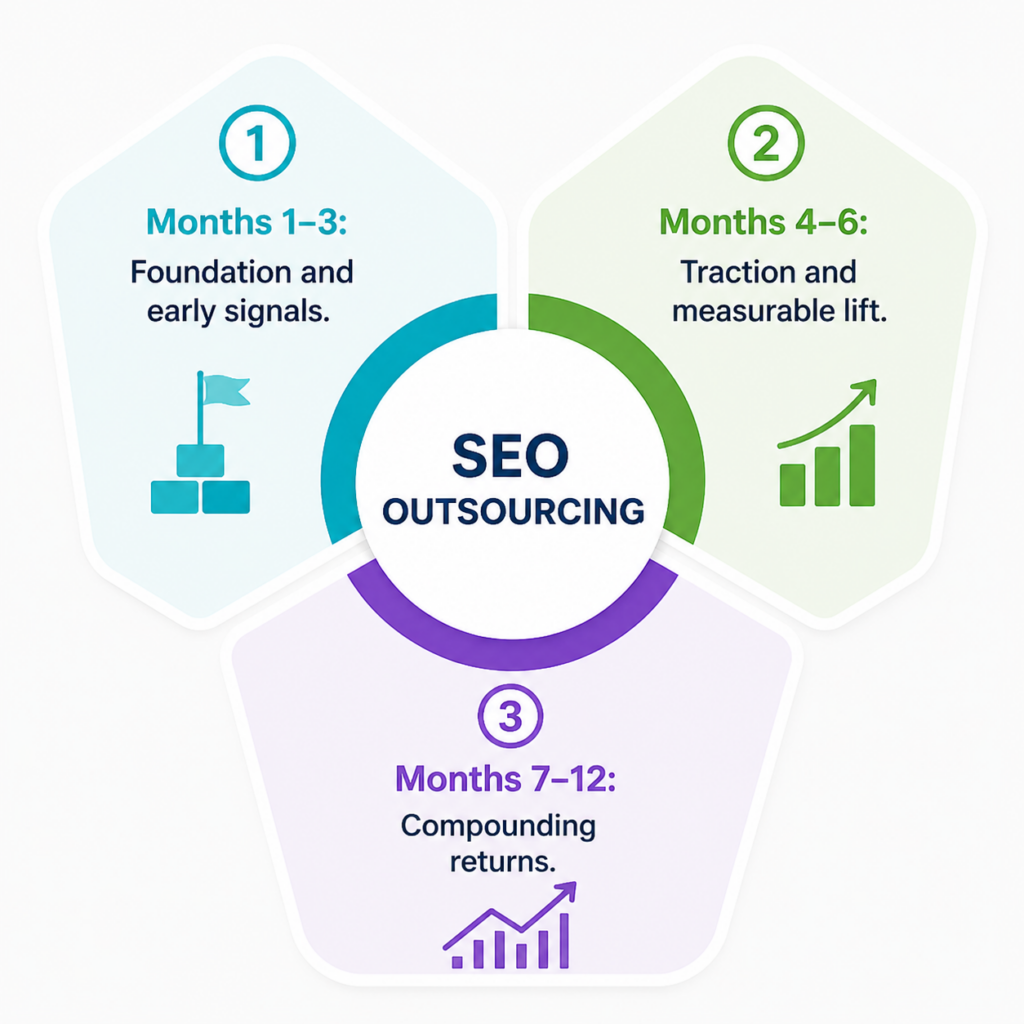
Months 1–3: Foundation and early signals. The first three months are primarily diagnostic and structural. A comprehensive technical audit, keyword architecture, on-page revisions, initial content — these take time to implement and even more time for search algorithms to evaluate. You should not expect dramatic traffic movement in month two. What you should see is a clear work record: audit completed, issues resolved, content published, outreach underway. Providers who promise rapid traffic gains in this window are either misleading you or planning tactics that won’t hold up over time.
Months 4–6: Traction and measurable lift. By month four or five, if the technical base is solid and content is publishing consistently, you’ll start seeing real movement. Pages entering the top 20, early organic conversions from long-tail queries, click-through rates improving as meta snippets are refined. This is also the period when link building starts contributing meaningfully to authority signals. For most businesses in moderate-competition environments, a 20–40% increase in qualified organic sessions by the end of month six is both realistic and meaningful.
Months 7–12: Compounding returns. This is where a well-executed program starts to feel like a genuine business asset rather than a recurring expense. Content published in months two through four matures in authority. Links from months three through six compound. Pages that were hovering at the edge of page one move into positions that drive real volume. Businesses in competitive verticals with well-executed programs can realistically see 80–150% organic traffic growth by month twelve versus their pre-engagement baseline.
For a detailed look at what influences these timelines and why different industries see results at different rates, our honest analysis of how long search optimization takes to show results covers the specific variables — including when early movement is genuinely achievable.
The compounding logic of organic search:
Unlike paid advertising — which stops entirely the moment you pause the budget — well-built organic visibility accumulates. A page that ranks in month 6 typically continues to rank, and often climbs further, through months 12, 18, and beyond. This is why the cost per qualified lead from organic search tends to decrease over time, while paid channels generally inflate in cost as competition increases.
What about smaller businesses with tighter resources? In the context of SEO outsourcing for small business, timelines are often more favorable than people expect. Local and niche operators typically compete in lower-pressure environments, which means a targeted technical and content effort can produce visible movement in 60 to 90 days rather than the six months more typical of competitive national markets. The key is matching the scope and strategy to the actual competition level — rather than applying enterprise-grade tactics where they aren’t needed.
Why Finding a Genuinely Responsible Partner Is Harder Than It Looks
There’s an uncomfortable truth about this industry that doesn’t get enough attention: search optimization attracts a disproportionate number of providers who are skilled at acquiring clients but inconsistent — sometimes egregiously so — at serving them. Part of this is structural. Results take months, cause-and-effect is hard to demonstrate to a non-technical client, and there are countless ways to appear productive without moving any needle that actually matters to a business.
When done right, SEO outsourcing delivers compound returns that in-house teams rarely match in the early months. The providers who deliver real, lasting results tend to be the quietest ones in the market. Less time on aggressive outbound sales, more time on the actual work. They tell you things you don’t want to hear — “this timeline is optimistic,” “this keyword cluster is too competitive for your current domain profile,” “your site has a rendering issue that’s going to delay meaningful movement by six weeks.” That kind of honesty is commercially uncomfortable. But it’s the mark of a team genuinely focused on your outcomes, not on preserving the retainer for another quarter.
The best SEO outsourcing companies also invest in educating their clients over the life of the engagement. They explain what they’re doing and why. They alert you when an algorithm update affects your category. They flag a competitor gaining ground before you notice it in the data. None of this appears in a proposal — it only reveals itself after the work begins. Which is precisely why references from actual clients matter so much, and why any provider who deflects that request should give you pause.
We reward our partners — and do so consistently.
At World SEO Agency, we run a structured SEO referral program that pays marketers and business partners from 15% of the client’s monthly budget — every month, for the lifetime of that engagement. No caps, no expiry, no fine print. It’s one of the most competitive referral rates in this space, and it’s how we recognize the people who trust us enough to put their reputation behind a recommendation. If you work with businesses that need organic growth, this is worth a look.
Another thing worth saying plainly: the benefits of SEO outsourcing extend well beyond cost efficiency. When you work with a team that’s actively managing twenty or thirty similar projects, they develop a pattern recognition that in-house specialists rarely accumulate — because no single organization cycles through enough situations fast enough to build that library of experience. That cross-project intelligence is one of the most underappreciated advantages of the external model, and it compounds over the course of a relationship.
Why World SEO Agency Is Worth Your Attention
The comparison below lays out what makes our engagement model different — not in abstract marketing language, but in concrete terms that show up in how we actually work:
| Factor | World SEO Agency | Typical provider |
|---|---|---|
| Performance milestone | 90-day documented benchmarks with full accountability | Verbal commitments, no formal milestone structure |
| Monthly reinvestment | From 15% of your monthly budget reinvested into your campaign every month | Fixed scope only — no additional contribution |
| Pricing model | Transparent, all-inclusive — no hidden extras or surprise invoices | Base fee plus frequent add-on charges for items that should be standard |
| Account ownership | Client owns all platforms, accounts, and content from day one | Accounts sometimes created under provider name “for ease of management” |
| Referral program | From 15% monthly to partners and marketers, ongoing | One-time referral fee or no program at all |
| Reporting depth | Full monthly report: traffic, conversions, technical health, links, competitive movements | Position report only, disconnected from actual business outcomes |
| Industry experience | Cross-sector portfolio; strategy tailored to your competitive environment | Generic onboarding, same template applied regardless of industry |
Industry expertise that comes from real project history
We don’t present generic strategies dressed up with your logo. Before recommending anything, we examine your actual competitive landscape, your current technical standing, and the realistic distance between where your site sits today and where it could be in twelve months with focused, consistent work.
Every person at World SEO Agency works across active projects in real industries — which means the knowledge stays current, grounded in what’s actually happening in search right now, not in case studies from three years ago. We’ve worked across e-commerce, professional practices, local businesses, SaaS platforms, and international markets. That breadth matters because it means we’ve already encountered — and worked through — the problem you’re most likely facing today.

90-day performance milestone
We stand behind our work with a structured 90-day performance framework. Rather than asking you to wait indefinitely and simply trust the process, we document what should be measurable within the first three months — and hold ourselves accountable to those benchmarks. If we’re not on the trajectory we committed to, we say so openly and adjust the strategy. No deflection, no fine print, no vague reassurances.
Affordable pricing without cutting corners
Our pricing is structured so that businesses at different stages can access real, professional-grade work — not a stripped-down version of it packaged to look comprehensive. We don’t apply enterprise-scale pricing to mid-market scope, and we don’t pad engagements with deliverables that won’t move your business forward. What you pay for reflects what you actually need.
All-inclusive system with no hidden costs
Every engagement includes technical work, content strategy, link building, analytics setup, and account management within the base scope. There are no surprise invoices for “additional hours” or “scope outside the retainer” that were obviously part of what needed to happen from the beginning. What’s in the agreement is what gets done. That’s how we believe every client relationship should work.
Beyond that, we allocate a minimum of 15% of your monthly budget back into your campaign — additional link placements, content production, competitive analysis. This isn’t a promotional line; it’s built into how we operate every account, every month.
Want to discuss your project? Get a direct consultation with one of our search experts. Send a request and we’ll come back to you within one business day with a frank assessment of where your site stands today and what a realistic engagement would look like for your specific goals.
Frequently Asked Questions
What is SEO outsourcing, and is it actually different from just hiring an agency?
At its core, it means delegating your search optimization work to an external team rather than building or maintaining an internal capability. An agency is the most common vehicle for that — but you can also outsource to specialized freelancer collectives or white-label providers. The defining difference from a standard hire is that the expertise, tooling, and established processes already exist. You’re buying running capacity, not constructing it from the ground up.
Can a small business with a genuinely limited budget see real results from an external search team?
In many cases, smaller businesses see faster relative gains than larger ones — precisely because they operate in less saturated competitive environments. A local service business doesn’t need the same program as a national retailer.
Entry-level packages in the $1,000–$1,500 range can deliver meaningful organic growth for local or niche businesses when the strategy is targeted and realistic. The critical mistake is expecting national scale results from a local budget. Honest scoping at the outset determines everything.
Who owns the content and the backlinks when the engagement ends?
You do — without qualification. Content published to your site is your intellectual property. Backlinks point to your domain and remain there regardless of who built them or when the relationship ended. Any provider who implies otherwise in the agreement or in conversation is one to walk away from. Always review IP and data ownership clauses before signing anything.
What does a strong SEO outsourcing contract include that most people overlook?
Beyond scope and price, the most commonly skipped clauses are: data ownership (who holds analytics accounts and platform access at all times), exit terms (notice period and what happens to work in progress), performance benchmarks (what gets measured, against what baseline, and by when), and content approval rights (who signs off before publication). These aren’t bureaucratic details — they’re the practical difference between a partnership that works and one that creates problems.
How can I verify that a provider’s link building approach is safe for my site?
Ask them to walk you through a recent specific example: the target publication, how the outreach was initiated, how the placement was agreed upon, and what anchor text strategy guides their decisions. A legitimate team answers all of that in plain language without hesitation. “Proprietary methods” and “our private network” are phrases that should end the conversation.
Is it realistic to run internal strategy alongside outsourced execution at the same time?
Not only realistic — it’s often the most efficient model for mid-size businesses. An internal strategist handles priorities, brand voice, and business alignment. The external team runs technical implementation, content production, and link acquisition at volume. Making this work well requires a defined RACI framework so each deliverable has a clear owner and nothing falls between the two teams.
What happens if a partner’s tactics cause a Google penalty on my site?
This risk is real and your agreement should address it explicitly. A responsible provider conducts a backlink audit at the start of any engagement to flag pre-existing risks, and runs their own acquisition against documented quality criteria. If a penalty results from their work, they should be obligated — in writing — to assist with the reconsideration request and remediation process at no additional cost to you.
How many providers should I evaluate before choosing one?
Three to five is a practical range. Fewer than three doesn’t give you enough comparison points to distinguish a polished pitch from a track record of real work. More than five and the evaluation process itself becomes a distraction from running your business.
Concentrate your shortlist on teams that have demonstrable results in your category, ask substantive questions during the discovery conversation rather than rushing to a proposal, and don’t treat price as the primary differentiator.
What’s the actual difference between white-label arrangements and direct outsourcing?
White-label means the external team delivers work under your brand — common when marketing or web agencies resell search work to their own clients. Direct outsourcing means you, as the business, engage the provider directly. Both can deliver strong outcomes. The operational distinction is who manages the client relationship and whose name appears on deliverables. For marketing agencies looking to expand their offering without building internal capacity, white-label is often the most scalable path.
If the team underperforms against agreed benchmarks, what leverage do I actually have?
Entirely dependent on your contract. With documented performance benchmarks and a defined cure period in the agreement, you have both leverage and a clear process for addressing it. Without those terms — just a retainer with no conditions attached — your leverage is limited to whatever the exit notice period allows. Never sign without measurable KPIs formally recorded in the agreement.
Do I need to come to the team with content ideas, or does the team drive that process?
A capable external team brings content strategy to the relationship — topic ideation driven by keyword data, competitive gap analysis, and search intent mapping. Your role is to review topics for business alignment, provide subject matter accuracy input, and approve drafts before publication. The division is collaborative: the team leads the strategic and editorial process; you provide domain knowledge and final sign-off. Neither side does it alone.
How frequently should I receive reporting, and what should it actually contain?
Monthly at minimum. Each report should cover organic traffic trends, goal completions by channel and page, keyword movement in the context of traffic rather than position alone, backlink profile changes, technical health status, and a plain-language summary of what was completed and what’s planned for the next period.
If your current provider sends you a position table and nothing else, that’s not a report. It’s a way of filling thirty seconds of your inbox without saying anything meaningful about whether the investment is working.
Can an outsourced search team effectively handle a large e-commerce catalog with thousands of product pages?
Large catalogs are often where technical optimization delivers the most immediate impact. Crawl budget management, faceted navigation handling, duplicate content from product variants, structured data for shopping results — these are precisely the areas where experienced external specialists have the deepest accumulated knowledge.
Content strategy for e-commerce also differs meaningfully from lead-generation sites: category page optimization, buying guides, and comparison content typically deliver higher ROI than product-adjacent blog posts. A team with real e-commerce experience recognizes that distinction from the first conversation.
Why do some agencies deliver consistently and others charge the same rates for far less?
Process discipline and accountability culture — two things that are invisible in a proposal but immediately apparent once the work begins. The agencies that deliver consistently have documented workflows, QA checkpoints, and a culture where specialists are expected to explain their decisions. Those that don’t tend to rely on client inertia and the complexity of the discipline to obscure the fact that not much is actually happening. The best protection is a written scope with measurable deliverables — every month, not just at signing.