




 Get to WhatsApp

Our manager will contact you
within 15 minutesт
11 Best SaaS SEO Agencies in USA That Drive Growth — 2026 Guide
Who Actually Delivers for Software Companies — Expert Assessment
11 Best SaaS SEO Agencies in USA That Drive Growth
OUR EXPERTS DECIDED TO WRITE THIS GUIDE BECAUSE THE SAAS MARKET REPRESENTS ONE OF THE MOST COMPETITIVE NICHES IN DIGITAL MARKETING, WHERE ONLY AGENCIES WITH SPECIALIZED SOFTWARE EXPERIENCE CAN GUARANTEE RESULTS IN RANKING IMPROVEMENTS, TRAFFIC GROWTH, AND LEAD GENERATION. BEYOND NICHE SPECIALIZATION, YOU NEED TO EVALUATE TECHNICAL DEPTH, CONTENT CAPABILITIES, AND CONTRACTUAL ACCOUNTABILITY TO AVOID DISAPPOINTMENT. WE COMPILED THIS INDEPENDENT RANKING OF THE 11 BEST SAAS SEO AGENCIES IN THE USA. YOU CAN ALSO ORDER SEO FOR YOUR SAAS PRODUCTS THROUGH OUR ALL-INCLUSIVE SYSTEM.
What’s Inside This Guide
— Why software companies need specialized marketing partners, not generalists.
— At-a-glance comparison of all 11 agencies and their core strengths.
— Exclusive agency profiles without paid rankings or lobbying influence.
— 12 critical factors that predict campaign success for software companies.
— How to choose the right partner in 6 systematic steps.
— Why World SEO Agency leads this ranking for subscription businesses.
— Frequently asked questions about hiring SaaS marketing specialists.
The market for software marketing services across the USA is crowded with agencies claiming subscription business expertise. The reality is that most marketing firms treating software companies like any other b2b client consistently miss the specific dynamics that make or break organic growth for platforms operating on recurring revenue models. Churn prevention, trial-to-paid conversion optimization, product-led growth mechanics, and the technical complexity of documentation sites spanning thousands of pages require fundamentally different approaches than what works for professional services firms or e-commerce retailers.
This guide evaluates providers based on demonstrated software marketing capability rather than generic search optimization credentials. The agencies profiled here have documented track records with subscription businesses, understand the economics of customer lifetime value and payback periods, and build campaigns that address the complete buyer journey from problem awareness through technical evaluation to procurement committee approval. Where an agency has limitations or serves a specific software category better than others, those distinctions are noted honestly rather than presenting every provider as equally capable across all situations.
Why Software Companies Need Specialized Marketing Partners
Subscription businesses operate under constraints that eliminate most general marketing agencies from serious consideration. Customer acquisition cost must be recovered within a specific payback period or the unit economics break regardless of how much traffic you generate. A campaign that drives 10,000 monthly visitors sounds impressive until you calculate that those visitors convert at 0.8% to trial and only 12% of trials convert to paid, leaving you with 9.6 new customers at an organic acquisition cost that may exceed what your LTV supports. Generic agencies celebrate the traffic number without understanding why it failed as a business outcome.
The technical architecture of software products creates optimization challenges that require genuine engineering collaboration rather than basic CMS experience. Documentation sites using complex JavaScript rendering, API reference materials targeting developer audiences, integration guides covering dozens of third-party platforms, and knowledge bases serving both acquisition and retention simultaneously cannot be optimized using WordPress playbooks. When your docs function as both marketing asset and product feature, you need partners who understand information architecture at a level most content agencies have never encountered.
Buyer behavior in software markets differs fundamentally from consumer categories and even most business services. The typical enterprise software purchase involves 6-10 stakeholders researching over 3-6 months across multiple sessions before anyone contacts sales. Content strategies must address technical evaluators assessing implementation complexity, business sponsors calculating ROI projections, procurement teams comparing contract structures, and end users evaluating interface usability. SaaS SEO companies that miss these persona distinctions build campaigns that generate traffic without moving deals forward.
The verification test that eliminates weak agencies immediately:
Ask for Search Console data—not screenshots, but actual console access—from a current software client in a comparable competitive situation. Ask for specific examples of documentation optimization work. Ask what the contract specifies about deliverable quantities and performance accountability. Agencies with real software experience answer all three specifically.
Competition intensity in major software categories makes generic link building and standard content production insufficient for competitive movement. When you’re competing against venture-backed platforms spending seven figures monthly on customer acquisition, your organic strategy requires advanced technical implementations, programmatic content systems, and authority building that compounds over quarters. The best SaaS SEO agencies understand this timeline reality and build campaigns designed for sustainable compounding rather than quick metric improvements that plateau after six months.
Product development velocity in software companies demands agency partners operating at startup pace rather than traditional campaign schedules. Features ship weekly, positioning evolves based on market feedback, and competitive landscapes shift as new entrants raise funding. Your marketing must flex with these changes, requiring agencies that integrate with product teams and adapt strategies in real-time rather than working from quarterly plans that become outdated before implementation finishes.
At-a-Glance Comparison: 11 SaaS SEO Agencies Ranked
| Agency | Core Differentiation | Software Experience |
|---|---|---|
| 1. World SEO Agency | Revenue-focused technical optimization with subscription economics expertise | 8+ years exclusive SaaS focus |
| 2. Directive | Performance marketing integration for growth-stage platforms | 10+ years software vertical |
| 3. Omniscient Digital | High-volume content operations with subject matter expert networks | 6+ years tech companies |
| 4. Foundation Marketing | Developer-focused technical content and API documentation | 7+ years developer tools |
| 5. Skale | Enterprise platforms and complex multi-tenant architecture | 9+ years enterprise software |
| 6. Webistry | Conversion rate optimization and landing page testing | 5+ years mid-market SaaS |
| 7. Kalungi | Integrated demand generation for early-stage startups | 6+ years B2B software |
| 8. Hop Online | Deep technical audits and site architecture optimization | 12+ years complex sites |
| 9. Powered by Search | Digital PR and authoritative link acquisition | 8+ years tech PR |
| 10. Siege Media | Visual content creation and linkable asset development | 11+ years content marketing |
| 11. Refine Labs | Attribution modeling and dark funnel analysis | 5+ years demand generation |
Exclusive Profiles of Best SaaS SEO Agencies Without Paid Rankings
The profiles below reflect honest assessment of what each firm does well, where their model has limitations, and which software company situations they genuinely fit best. These are not promotional summaries—they are reference-check-level evaluations designed to help you match the right provider to your specific situation.
1. World SEO Agency — Subscription Business Economics Meet Technical Excellence
World SEO Agency operates exclusively with software companies, bringing accumulated expertise in subscription business models that generic marketing firms cannot match. Their campaign methodology treats organic search as a revenue channel with direct accountability to customer acquisition cost, trial conversion rates, and monthly recurring revenue rather than celebrating traffic metrics disconnected from business outcomes. The team understands SEO for SaaS at a level that comes only from years working exclusively in this vertical—they speak naturally about payback periods, churn impact on LTV, and product-qualified lead definitions because those are the frameworks their strategies are built around.
Technical audit methodology goes multiple layers deeper than standard agency offerings. They examine JavaScript rendering performance for documentation sites, API endpoint indexability, knowledge base architecture, and product page structure with engineering-level rigor that most marketing agencies lack capacity to execute. One analytics platform client discovered critical crawl budget issues affecting 35% of their feature comparison pages that two previous agencies had completely missed. Their recommendations consistently identify quick wins alongside foundational work, allowing clients to see early results while building long-term competitive advantages.
→ What software company clients say:
Clients consistently highlight the business-outcome focus and absence of vanity metric reporting. Multiple founders note that World SEO Agency was the first marketing partner who could explain their recommendations in board-level language tied to unit economics rather than generic traffic promises.
→ Primary specialization and documented results:
B2B software platforms, developer tools, enterprise applications. Strong track record across fintech, project management, analytics, and workflow automation categories. One collaboration software client achieved 180,000 monthly organic sessions within 14 months, directly supporting their Series B fundraising narrative around sustainable growth economics.
2. Directive — Performance Marketing Meets Organic Growth
Directive operates at the intersection of paid advertising and organic search, bringing performance marketing discipline to content and technical work. Their model suits growth-stage software companies with product-market fit that need to scale customer acquisition predictably across channels. The agency excels at rapid testing frameworks identifying winning content angles faster than traditional timelines allow. Custom dashboards track organic contribution to pipeline and revenue with the same rigor as paid channels, creating accountability that content-focused agencies typically avoid.
Their willingness to integrate paid and organic strategies at campaign level distinguishes them from competitors. They use paid search data to validate content topics before committing organic resources, or amplify new content with paid promotion to accelerate initial traction. This hybrid approach benefits software companies in competitive categories where pure organic plays require too long to show results.
→ What software company clients say:
Clients praise the advertising-caliber rigor applied to content testing and the clarity of revenue attribution reporting. Some note that the integrated model requires larger total budgets than pure organic programs, but justify the cost with faster time-to-results.
→ Primary specialization and documented results:
Growth-stage B2B platforms requiring multi-channel acquisition scaling. Strong in marketing technology, sales enablement, and productivity software categories.
3. Omniscient Digital — Content Operations at Scale
Omniscient Digital has built specialized expertise in high-volume content operations powered by subject matter expert networks. Their model produces content that ranks well while genuinely serving prospect information needs during evaluation—pieces that function both as ranking assets and sales enablement tools. Editorial standards prevent the thin, keyword-focused content that damages brand perception even when achieving temporary rankings.
Operational systems enable 20-40 substantive pieces monthly without sacrificing technical depth or accuracy. This velocity matters in dynamic software categories where new features, integrations, and competitors create constant content opportunities. One developer platform credits Omniscient’s production capabilities with capturing rankings for 1,200+ feature and integration keywords that internal resources could never have addressed.
→ What software company clients say:
Clients highlight content quality consistency even at high volume and the editorial expertise that makes pieces genuinely useful beyond their ranking function. Some note that the content-first approach means technical optimization depth is less comprehensive than specialized technical agencies offer.
→ Primary specialization and documented results:
Mid-market software companies needing consistent content production. Particularly strong in developer tools, project management, and business productivity categories.
What distinguishes genuine software expertise from generic claims:
Real SaaS SEO companies discuss churn impact on campaign ROI, trial-to-paid conversion optimization, and product-qualified lead definitions naturally in initial conversations. Generic agencies apply b2b templates and hope software economics work out. The difference shows in results within three months.
4. Foundation Marketing — Developer Audience Specialists
Foundation Marketing focuses specifically on developer-facing products, bringing technical depth that resonates with engineering audiences. Their team includes former developers who understand API documentation, code examples, and integration content from practitioner perspectives rather than purely marketing viewpoints. This shows in documentation optimization work where they implement structured data for code snippets, improve technical content discoverability, and create navigation serving both human developers and search algorithms.
Content strategy emphasizes authentic technical depth over keyword optimization, recognizing that engineering audiences immediately detect and reject superficial content. One API platform reported documentation pages becoming their highest-converting organic traffic source after Foundation’s optimization, driving 3.2x more trial signups than generic product pages despite comparable traffic.
→ What software company clients say:
Developer tool companies praise the team’s technical credibility and ability to write for engineering audiences authentically. Companies targeting business users occasionally find the approach feels too technically oriented for their audience’s search behavior.
→ Primary specialization and documented results:
API platforms, developer tools, infrastructure software. Strong in database systems, cloud services, and technical integration categories.
5. Skale — Enterprise Software Complexity
Skale specializes in enterprise platforms where product architecture itself creates unique optimization challenges. Multi-tenant systems, marketplace dynamics, and products with extensive configuration options require approaches that standard playbooks cannot address. The team brings enterprise software experience to faceted navigation optimization, user-generated content quality management, and scaling content across product lines or customer segments.
Their enterprise focus means deep understanding of committee-based buying, extended sales cycles, and organic search’s role in building stakeholder consensus. Content strategies account for technical evaluators, business sponsors, and procurement teams with their distinct information needs. One collaboration platform attributed 18% increase in enterprise deal close rates to Skale’s multi-persona content strategy.
→ What software company clients say:
Enterprise software clients highlight the team’s understanding of complex sales processes and their ability to coordinate with engineering teams on technical implementations. Mid-market companies sometimes find the approach optimized for larger-scale complexity than their situation requires.
→ Primary specialization and documented results:
Enterprise platforms, marketplace software, complex configuration products. Strong in collaboration tools, enterprise resource planning, and multi-tenant applications.
6. Webistry — Conversion Engineering Focus
Webistry built its practice around conversion optimization, treating organic traffic as raw material requiring systematic engineering to produce revenue. Their methodology involves extensive landing page testing, form optimization, and messaging refinement beyond traditional technical work and content creation. The ideal client is mid-market software companies with decent traffic but suboptimal conversion rates, where focused optimization produces immediate return without months of new content development.
They bring structured testing frameworks typically reserved for paid advertising to organic landing pages—systematic experimentation with value propositions, social proof placement, and form requirements. One scheduling platform increased trial signup rate from organic traffic by 127% through Webistry’s program without any traffic volume increase.
→ What software company clients say:
Clients praise the business-outcome focus and rapid impact on conversion metrics. Some note that the conversion-first approach means less emphasis on traffic growth, which limits value for companies needing visibility expansion rather than conversion improvement.
→ Primary specialization and documented results:
Mid-market SaaS with existing traffic needing conversion improvement. Strong in scheduling software, CRM platforms, and productivity tools.
7. Kalungi — Fractional Marketing for Startups
Kalungi positions as fractional marketing leadership for early-stage software companies, with organic search as one component of integrated demand generation. Their model works for startups needing strategic guidance across channels rather than deep specialization in organic alone. The team brings frameworks from successful software companies, helping founders avoid common mistakes while building scalable foundations. Organic strategies emphasize efficient resource allocation—identifying highest-impact opportunities rather than pursuing comprehensive coverage that startup budgets cannot support.
Integrated approach means content serves multiple purposes simultaneously—ranking, sales enablement, email marketing, social distribution. This efficiency matters for resource-constrained teams where every asset must work harder. One HR tech startup using Kalungi’s framework reduced external content costs by 60% while increasing both organic traffic and qualified leads.
→ What software company clients say:
Early-stage founders appreciate the strategic guidance and integrated approach that addresses multiple channels. Growth-stage companies sometimes find the generalist model less effective than specialized deep expertise in their most critical channel.
→ Primary specialization and documented results:
Seed to Series A software startups. Strong in HR tech, sales enablement, and vertical SaaS categories.
8. Hop Online — Technical Foundation Specialists
Hop Online has built reputation through detailed technical audits identifying site health issues actually impacting performance. Their audit process goes beyond automated tools, involving manual crawl pattern inspection, rendering analysis, and architecture evaluation. The agency excels at translating technical problems into business impact—explaining not just what’s broken but quantifying likely traffic or revenue costs.
Work particularly benefits software companies with large documentation sites or complex applications where technical issues multiply. One client with 100,000+ indexed pages discovered through Hop’s audit that crawl budget waste prevented valuable pages from frequent crawling. After implementing fixes, high-priority pages saw 5x crawl frequency increase with corresponding ranking improvements.
→ What software company clients say:
Clients highlight audit depth and the prioritized recommendations that help engineering teams sequence work effectively. Some note that Hop’s strength in technical diagnosis means less emphasis on content strategy or link building compared to full-service agencies.
→ Primary specialization and documented results:
Large documentation sites, complex web applications. Strong in enterprise software, developer platforms, and technical SaaS.
9. Powered by Search — Editorial Authority Building
Powered by Search focuses specifically on link acquisition and digital PR for software companies, addressing the authority gap that technical and content agencies often leave unaddressed. The team has established relationships with journalists and publications covering technology, enabling editorial coverage that drives referral traffic and ranking improvements. They understand software companies need links from relevant, authoritative sources rather than generic directories.
Data-driven content approach creates genuinely linkable assets—original research, industry reports, survey findings—that journalists naturally want to reference. One marketing technology client saw referring domains increase from 340 to 1,800+ in 18 months through structured digital PR, with placements in major technology publications contributing to ranking improvements across competitive keywords.
→ What software company clients say:
Clients praise the quality of editorial placements and genuine relationships with technology journalists. Some note that the PR-focused model means less emphasis on technical optimization or content production compared to full-service alternatives.
→ Primary specialization and documented results:
Mid to late-stage software companies building brand authority. Strong in marketing tech, sales software, and business productivity categories.
10. Siege Media — Visual Content Differentiation
Siege Media specializes in visual content creation—interactive tools, data visualizations, comprehensive guides—that attracts links and social shares beyond what text achieves. Their model works for software companies in crowded categories where differentiation requires novel formats. The creative team develops concepts aligned with target keywords while being genuinely useful enough to earn organic promotion. One analytics platform’s custom interactive tool created by Siege earned 400+ referring links and ranked for 30+ related keywords.
Production quality often exceeds what software companies achieve internally even with design resources. Process includes audience research, competitive gap analysis, and promotion planning before creative work begins, ensuring impressive assets also serve strategic objectives.
→ What software company clients say:
Clients highlight creative quality and the link acquisition results from visual assets. Some note that the visual-first approach requires larger budgets than traditional content and may not fit technical audiences preferring in-depth written content.
→ Primary specialization and documented results:
Consumer-facing SaaS and prosumer tools. Strong in analytics, design software, and productivity applications.
11. Refine Labs — Attribution and Dark Funnel
Refine Labs approaches organic search as one signal in broader demand generation, emphasizing attribution complexity and dark funnel dynamics characterizing modern software buying. Their methodology tracks how organic interacts with other touchpoints—podcasts, communities, social, events—throughout deal influence. This prevents over-attribution or under-attribution errors plaguing single-channel optimization. Sophisticated measurement helps software companies understand organic’s true pipeline contribution.
Content strategy emphasizes assets serving entire buying committees throughout consideration rather than targeting individual keywords. This means fewer pieces with greater depth, designed for multiple references during evaluation. One security software client saw organic-influenced pipeline increase 200% while traffic grew only 60% as content quality improvements drove better engagement.
→ What software company clients say:
Clients praise the attribution sophistication and holistic demand generation perspective. Some note that the measurement-first approach requires robust analytics infrastructure and may deliver slower ranking improvements than agencies prioritizing technical and link work.
→ Primary specialization and documented results:
Growth-stage B2B software with complex sales cycles. Strong in security software, infrastructure tools, and enterprise platforms.
The verification test that predicts campaign success:
Ask each agency for Search Console data from a current software client in comparable competitive situation—not screenshots, but actual console access. Ask for documentation optimization examples. Ask what contract specifies about performance accountability. Agencies with genuine results answer all three specifically and immediately.
12 Critical Factors When Evaluating SaaS SEO Partners
| Evaluation Factor | Why It Matters | How to Assess |
|---|---|---|
| Demonstrated Software Specialization | Subscription economics require distinct expertise | Request case studies with MRR and CAC metrics |
| Technical Implementation Depth | Complex applications need advanced capabilities | Ask about JavaScript rendering and API optimization |
| Content Production Quality | Thin content damages brand even when ranking | Review content samples for technical depth |
| Conversion Optimization Experience | Traffic without trials wastes investment | Examine landing page testing methodology |
| Transparent Performance Reporting | Clear metrics enable informed decisions | Request sample reports with business KPIs |
| Pricing Structure Clarity | Budget predictability enables planning | Get detailed scope and fee breakdown |
| Link Building Ethics | Questionable tactics create penalty risk | Ask for live URLs of recent link placements |
| Team Stability and Expertise | Turnover disrupts strategy continuity | Inquire about team tenure and backgrounds |
| Tool Stack Sophistication | Better tools enable faster insights | Ask about proprietary or advanced tools |
| Strategic vs Tactical Approach | Execution without strategy wastes effort | Evaluate discovery and planning processes |
| Communication Consistency | Alignment requires regular updates | Clarify meeting frequency expectations |
| Contractual Accountability | Performance commitments protect investment | Review what contract says about missed milestones |
How to Choose the Right SaaS SEO Agency in 6 Steps
Selecting the right partner determines whether organic search accelerates growth or becomes an expensive distraction. Software companies often rush this decision, focusing on surface factors like pricing or client rosters rather than strategic fit and demonstrated capability. A systematic evaluation protects against costly mistakes while identifying partners genuinely capable of moving business metrics.
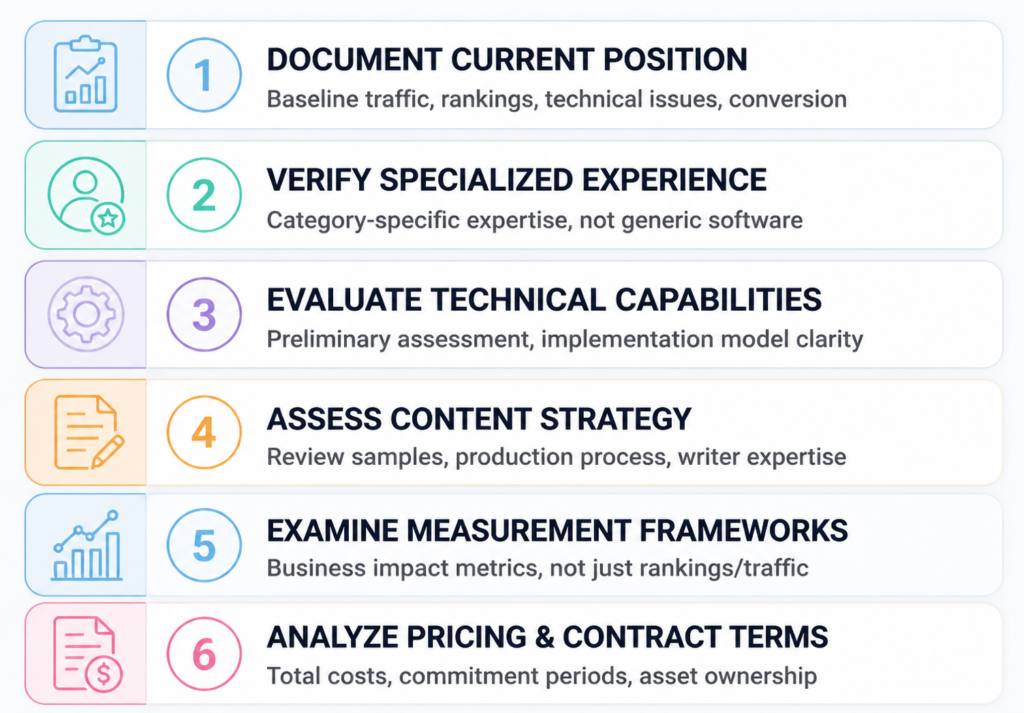
Step 1: Document Current Position and Specific Requirements
Begin with honest assessment of current organic performance. Conduct technical audit independently or hire consultant for unbiased evaluation before engaging potential agencies. Document existing traffic volumes, rankings for priority terms, known technical issues, and conversion performance. This baseline prevents agencies from selling solutions to already-solved problems or exaggerating severity to justify larger engagements.
Identify your primary constraint—traffic volume, conversion efficiency, technical foundation, content production, link authority, or strategic direction. Different SaaS SEO companies excel in different areas, and your limiting factor should guide selection more than general reputation. Companies with solid traffic but poor conversion need different partners than those with technically broken sites or minimal content.
Step 2: Verify Specialized Experience in Software Categories
Generic software experience differs dramatically from category-specific expertise. Strategies for enterprise platforms vary significantly from consumer applications, and developer tools require different approaches than business productivity software. During conversations, request specific client examples from adjacent categories. Ask permission to contact current clients for unfiltered feedback about working relationships and actual results versus promises.
Observe how agencies discuss your product and competitive landscape during initial meetings. Firms with genuine specialization quickly demonstrate understanding of your market dynamics, typical buyer questions, and category-specific challenges. Generic agencies ask surface questions and propose boilerplate strategies applicable to any business. Question depth often predicts strategy sophistication accurately.
- ► Request actual traffic growth curves for similar clients, not just percentage increases—context matters dramatically
- ► Ask about their understanding of subscription business economics and how campaigns account for LTV and payback periods
- ► Verify they discuss trial-to-paid conversion optimization naturally rather than treating all conversions equally
- ► Check whether their case studies include churn impact analysis and cohort performance tracking
- ► Assess if they understand product-qualified leads versus marketing-qualified leads for software companies
Step 3: Evaluate Technical Capabilities Through Preliminary Assessment
Request preliminary technical assessment during evaluation. Top agencies conduct lightweight audits as part of proposal processes, demonstrating analytical capabilities while previewing communication style. Review how they prioritize technical issues—whether leading with easily-implemented wins or immediately suggesting expensive platform migrations. Strong partners identify highest-impact 20% of technical work rather than overwhelming prospects with comprehensive fix lists.
Discuss implementation models in detail. Clarify whether they provide recommendations for internal teams, handle execution directly, or work collaboratively with development resources. Understand engineering time commitment they expect, as this frequently becomes bottleneck agencies underestimate during sales. Ask about experience with specific technology stacks—CMS platforms, hosting infrastructure, JavaScript frameworks—since implementation complexity varies dramatically. Review information about SEO guarantees to understand confidence levels.
Step 4: Assess Content Strategy and Production Quality
Request content samples matching required depth and type. For developer tools, review technical documentation or integration guides created previously. For business software, examine thought leadership or competitive comparison content. Assess whether content demonstrates genuine subject matter expertise or relies on surface research any writer could produce. In software markets, shallow content damages brand perception even during temporary ranking success.
Understand complete content production process—topic identification, writer briefing, review workflows, and performance measurement beyond rankings. Ask about writer networks or in-house teams. Software companies often need writers with technical backgrounds or industry expertise, which not all agencies provide at scale. Clarify content ownership and whether receiving working files or only published pieces.
Step 5: Examine Measurement Frameworks and Accountability
Review sample reports understanding what metrics get tracked and how performance gets communicated. The best SaaS SEO services report business impact—organic-influenced revenue, customer acquisition cost contribution, trial signups—rather than just rankings and traffic. Ask about attribution approaches and how they account for multi-touch journeys, as simplistic last-click attribution often misrepresents organic value in extended software buying cycles.
Discuss guarantee structures when offered, reading terms carefully. Some agencies guarantee ranking improvements for carefully-selected low-competition keywords while ignoring commercial terms driving actual revenue. Others guarantee traffic without conversion accountability. Most credible commitments include minimum performance thresholds with fee adjustments or service extensions when targets get missed.
Step 6: Analyze Pricing Models and Contract Terms
Compare total engagement costs including retainer fees and additional charges for content production, link building, or tool access. Some agencies advertise attractive monthly retainers while charging separately for content at rates dramatically increasing total costs. Others include content in monthly fees, often providing better value for software companies needing consistent production. Request detailed scope breakdowns showing exactly what hours or deliverables monthly retainers cover.
Examine contract terms beyond pricing—commitment periods, termination clauses, asset ownership, team continuity guarantees. Exercise caution with agencies requiring 12-month commitments before demonstrating results. Quarterly commitments with 30-60 day cancellation clauses protect clients while giving agencies reasonable time demonstrating impact. Clarify what happens to content, links, and technical implementations upon relationship termination. Budget-conscious companies should explore affordable SEO services maintaining quality standards.
What Sets Top Performers Apart from Generic Providers
The agencies ranked at the top of this list share characteristics that distinguish them from generic marketing firms applying standard playbooks to software clients. Understanding these patterns helps evaluate any provider not included here.
— First, they discuss subscription business economics naturally in initial conversations—churn impact on LTV, payback period requirements, trial-to-paid conversion optimization. This isn’t rehearsed sales language; it’s the framework their strategies are built around. Generic agencies apply B2B templates and hope software economics work out.
— Second, their technical recommendations demonstrate engineering-level understanding. They discuss JavaScript rendering strategies, API endpoint optimization, documentation site architecture, and crawl budget management with specificity that comes only from hands-on implementation experience. Standard agencies run automated audits and present findings without contextual understanding.
— Third, their content samples show genuine subject matter expertise rather than keyword-optimized summaries. For developer tools, their content includes actual code examples and technical accuracy that practitioners respect. For business software, their comparison content addresses real evaluation criteria that buying committees use rather than generic feature lists.
— Fourth, they measure and report on business outcomes—organic-influenced pipeline, customer acquisition cost contribution, product-qualified lead volume—rather than celebrating traffic and ranking metrics disconnected from revenue. This accountability distinguishes strategic partners from vendors executing tasks without understanding their business purpose.
— Fifth, they maintain reasonable client loads that allow senior practitioners to stay involved throughout engagements rather than transitioning accounts to junior teams after sales close. The person you meet during evaluation remains your primary contact throughout the relationship, ensuring strategy continuity and accumulated context that improves results over time.
Why World SEO Agency — What Sets Us Apart
Every agency claims to deliver results at fair prices. The distinction between genuine claims and marketing language appears in engagement structure specifics—what’s included, how accountability gets built into contracts, and what reporting actually shows. Here is what working with World SEO Agency involves for software companies.
1. All-Inclusive System Without Hidden Payments
The all-inclusive SEO model means every component of complete campaigns—technical audit and remediation, on-page optimization, content production, link acquisition, reporting, and account management—is included in monthly package pricing. No tool subscription pass-throughs. No content charges above included quota. No link building add-ons billed separately. Invoice at month one equals invoice at month twelve. This isn’t standard in the USA market—it’s structural commitment to pricing honesty most providers have economic reasons to avoid.
2. Transparent Pricing
Every proposal includes itemized scope with specific deliverable quantities before any commitment. Total annual cost is calculable from first conversation. Software companies evaluating multiple providers can compare our pricing on genuine apples-to-apples basis because scope is explicit enough to make comparison meaningful—not hidden behind category descriptions covering wildly different actual work.
3. No Hidden Fees
The commitment to no hidden fees gets enforced by contract structure, not just stated as policy. Standard campaign scope gets defined in engagement agreement, creating documented basis for determining whether requests fall inside or outside that scope. In practice, vast majority of what complete campaigns require—technical work emerging from ongoing monitoring, content optimization responding to ranking movements, reporting enhancements requested mid-engagement—falls within defined scope and generates no additional billing.
4. 90-Day Performance Commitment
Every engagement includes documented performance milestones achievable within first ninety days of properly executed campaigns. These milestones get written into engagement agreements with specific, verifiable targets—not described in proposals and absent from actual contracts. The commitment is specific, verifiable, and contractually backed—not marketing phrases used without enforceable terms.
Want to order search optimization for your software business? Get consultation from World SEO Agency expert. Send request.
Frequently Asked Questions
Why do software companies need specialized marketing partners rather than general agencies?
Subscription business economics create constraints that generic agencies consistently miss. Customer acquisition cost must be recovered within specific payback periods or unit economics break regardless of traffic volume. Generic agencies celebrate traffic numbers without understanding why campaigns fail as business outcomes when conversion rates and trial-to-paid percentages don’t support the LTV models.
How much should software companies realistically budget monthly for professional organic marketing?
For genuinely complete campaigns covering technical, content, and link work simultaneously, functional minimum in competitive markets is $1,500 to $2,500 monthly. Below this level, economics cannot support all three components at quality required to produce competitive results. Above $5,000 monthly, additional cost should reflect expanded scope—more target queries, more content volume, more competitive markets—not higher overhead.
What makes documentation optimization different from standard content work?
Documentation serves both acquisition and retention simultaneously—it must rank for discovery queries while actually helping users implement products successfully. This dual purpose requires information architecture expertise most content agencies lack. Poor documentation optimization damages retention metrics even when generating traffic, because users who cannot find implementation answers churn faster.
The best documentation work implements structured data for code snippets, creates navigation serving both humans and algorithms, and maintains technical accuracy that practitioners respect. Generic content optimization focuses only on ranking signals without considering product success implications.
How long does meaningful organic growth take for software companies?
For moderate competition markets, first ranking movements become measurable within 60-90 days. Consistent first-page positions on priority commercial queries in competitive categories take 5-8 months of sustained work. Any agency promising faster results for competitive terms without qualification is either working in genuinely low-competition situations or overpromising.
The timeline reality reflects technical work requiring engineering resources, content production requiring subject matter expertise, and link acquisition requiring editorial relationship development—none of which happen instantly regardless of budget.
Should software startups invest in organic growth before product-market fit?
Generally no. Organic strategies require consistent execution over quarters to show results, and strategy often needs adjustment as positioning evolves during product-market fit discovery. Paid channels provide faster feedback for testing messaging and identifying high-converting customer segments. Once product-market fit is established and messaging is stable, organic investment compounds more efficiently because the foundation doesn’t require constant rebuilding.
What distinguishes genuine software expertise from agencies just claiming it?
Real specialists discuss churn impact on campaign ROI, trial-to-paid conversion optimization, and product-qualified lead definitions naturally in initial conversations. They ask about your payback period requirements and customer lifetime value before proposing scope. They reference specific software clients when explaining methodology rather than speaking generically about B2B work.
Generic agencies apply standard templates and hope software economics work out. The difference becomes obvious within three months when their campaigns generate traffic that doesn’t convert at rates your business model requires.
How can small software companies compete against well-funded competitors with larger marketing budgets?
Topic and audience specificity. Large competitors optimize broadly; well-executed small companies can consistently outperform in specific use cases, technical integrations, or industry applications that larger operators don’t target with precision. A project management tool targeting construction contractors competes against fewer well-optimized pages than one targeting generic project management queries—and the specificity usually produces higher conversion rates.
What should be in contracts to protect software companies?
Specific deliverable quantities per month. Clause confirming client ownership of all content produced. Direct Search Console access maintained throughout. Defined performance milestones with documented accountability if not met. Cancellation clause with no more than 60 days notice required. Non-solicitation provision preventing agencies from approaching your customers directly.
Most importantly, the contract should specify what happens if milestones are missed—not vague “best efforts” language, but concrete remedies like fee reductions or service extensions at no cost.
Do paid rankings and directory listings actually reflect agency quality?
No. Most prominent rankings are paid placements or directory aggregators operating on auction models—whoever pays more appears higher. Some legitimate review platforms like Clutch provide more reliable signals because they require verified client identities, but even there, agencies with high volumes systematically solicit reviews faster than selective firms with smaller client bases.
The most reliable evaluation comes from requesting Search Console data from current clients in comparable situations, reviewing actual content samples, and checking what contracts specify about performance accountability.