




 Get to WhatsApp

Our manager will contact you
within 15 minutesт
AI Search Optimization: Full Guide to Improving Brand Visibility [2026]
GEO, AI Overviews, and What Actually Works
AI Search Optimization: Full Guide to Improving Brand Visibility
Quick answer:
AI search optimization — also known as generative engine optimization (GEO) — is the practice of structuring content, authority signals, and technical foundations so that AI-driven platforms cite, summarize, and surface your content in their generated responses. This guide covers every layer of that practice: from understanding how different AI systems select sources, to the specific content and technical changes that move the needle on visibility in generated results. It is written for marketers, SEO practitioners, and business owners who want to understand this shift without having to parse academic papers or reverse-engineer systems through trial and error.
What’s Inside This Guide
— What is AI Search Optimization (GEO)?
— How to Optimize for Google AI Overviews.
— ChatGPT and Perplexity SEO: Best Practices.
— AI Search Ranking Factors.
— Measuring Brand Visibility in AI Search.
— Frequently asked questions.
There is a version of this conversation that gets unnecessarily complicated very quickly — one that involves training data cutoffs, retrieval-augmented generation architectures, and the differences between autoregressive language models and traditional inverted index systems. All of that is real and technically interesting, but it is not the most useful starting point for someone who runs a business or manages a marketing team and wants to understand what is actually changing and what to do about it. The more useful starting point is behavioral: what is different about how people now find information, and what does that mean for how your content needs to be written and structured to remain discoverable?
The shift is real and it is not trivial. A meaningful portion of what used to be traditional search traffic — the kind that started with a query box and ended with a list of blue links — is now being intercepted by generated summaries that answer the question without requiring the user to click anywhere. Some of those summaries cite sources prominently. Some credit them in footnotes. Some use the content as raw material for an answer and reference nothing at all. Understanding which category your content falls into, and how to influence that categorization, is what AI search optimization is fundamentally about.
What is AI Search Optimization (GEO)?
Generative engine optimization (GEO) is a term that emerged to describe a specific challenge: traditional search optimization was built around getting pages ranked in a list. The new challenge is getting content cited, referenced, or synthesized by systems that generate answers rather than ranking pages. The techniques overlap but they are not identical, and treating them as the same thing produces campaigns that optimize for one system while inadvertently neglecting the other.
The core mechanism of generative AI systems that produce search-style answers — Google’s AI Overviews, ChatGPT with browsing enabled, Perplexity, and the growing category of AI assistants with real-time web access — is retrieval followed by synthesis. The system identifies a set of sources it considers relevant and authoritative for a given query, retrieves content from those sources, and synthesizes that content into a coherent response. The citation behavior varies by platform: Perplexity tends to cite explicitly and numerously, Google AI Overviews cites selectively, and ChatGPT’s citation behavior depends on whether it is in browsing mode or drawing from training data.
The distinction that matters most in practice:
Traditional search optimization asks: “Is this page ranking in position one for this query?” Generative engine optimization (GEO) asks a different question: “When someone asks about this topic, is my content part of what the system draws on to construct its answer?” These are related but not equivalent. A page can rank well organically and still not appear in AI-generated responses if its content structure doesn’t match the format those systems prefer for extraction.
What determines whether a given piece of content is selected as a source for a generated response is not fully documented by any of the major platforms — which is honest, since the selection process involves multiple model-specific factors that change with each system update. But the observable patterns across platforms point to a consistent set of signals: content that is factually grounded, clearly attributed to a named expert or organization with demonstrated topic authority, structured in a way that makes specific claims easy to extract, and hosted on a domain with a credibility track record in the relevant category, consistently performs better as a source in generated responses than content that lacks these characteristics.
This is why AI search optimization is not a separate discipline from traditional authority-building and content quality work — it is an extension of it, with some specific additions. The foundation of a good traditional search campaign — a technically healthy site, strong editorial content, credible inbound links from relevant sources — remains the foundation of effective generative optimization. What changes is the layer above that foundation: how content is formatted, how claims are attributed, how specific and direct the answers are, and how the entity behind the content is represented across the web.
The Relationship Between Traditional Search and Generative Systems
One of the more persistent misconceptions in the current marketing conversation is that AI-driven search and traditional organic search are competing systems and that optimizing for one means neglecting the other. In practice, the overlap is substantial. The same signals that indicate credibility and authority to a traditional ranking algorithm — inbound editorial links from credible publications, consistent entity representation across authoritative data sources, content that demonstrates genuine subject matter expertise — also indicate to generative systems that a source is worth drawing on.
The difference lies in the content layer. Traditional algorithms heavily weight link signals, page-level technical factors, and query-keyword alignment. Generative systems weight those factors too, but they also evaluate content differently — they are trying to extract specific, reliable information that can be incorporated into a coherent answer, which means content that is written as a collection of factual claims with clear attribution and organized around direct answers to specific questions performs better as a generative source than content optimized primarily around keyword presence and topic coverage breadth.
| Signal Type | Traditional Search Weight | Generative System Weight |
|---|---|---|
| Inbound editorial links from credible domains | Very high | High — domain credibility signal |
| Named author with topic expertise credentials | Medium — E-E-A-T signal | Very high — attribution quality |
| Direct, specific answer to a defined question | Medium — featured snippet factor | Very high — extractable answer format |
| Structured data / schema markup | Medium — rich result eligibility | Medium — machine-readable structure |
| Keyword density and topic coverage breadth | Medium-high | Low — generative systems prioritize precision |
| Page load speed and Core Web Vitals | Medium — ranking signal | Medium — crawlability affects indexing |
| External mentions across trusted publications | High — domain authority | Very high — entity reputation signal |
How to Optimize for Google AI Overviews
Google’s AI Overviews appear at the top of results for a significant and growing proportion of queries, particularly informational ones where the user is seeking an answer rather than navigating to a specific destination. The presence of an AI Overview for a given query does not necessarily suppress organic clicks uniformly — the click behavior depends on whether the overview fully answers the question or whether it triggers further investigation — but it does fundamentally change the visibility landscape for that query. Being cited within an overview is now at least as commercially valuable as ranking in position one for many informational queries.
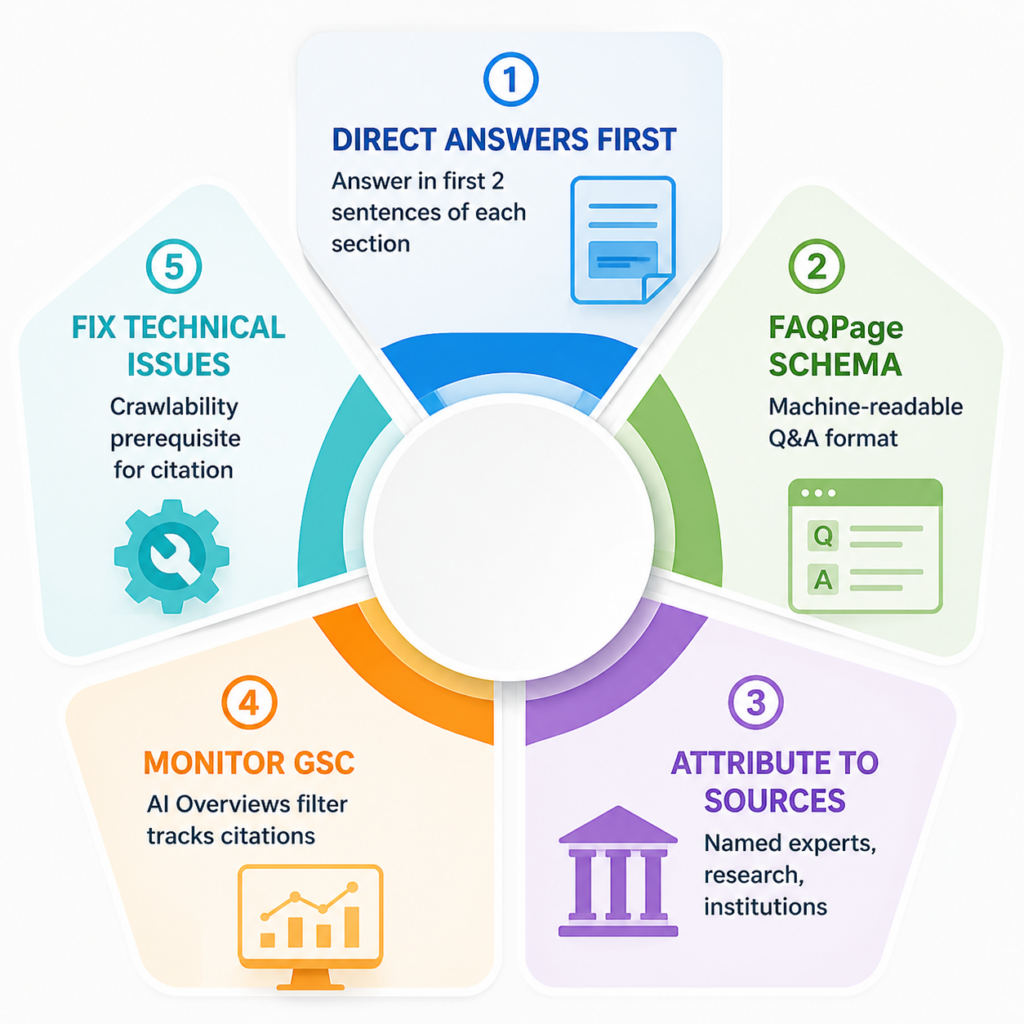
To optimize content for AI overviews, the starting point is understanding what types of content Google’s systems prefer to extract for these summaries. The observable pattern is consistent: overviews tend to draw on content that includes a clear, direct answer to the query question stated near the top of the relevant section, factual claims supported by specific data or named authoritative sources, and organizational structure that allows the system to identify which portion of a longer piece addresses the specific query being answered.
- ► Structure long-form content around specific questions with direct answers in the first two sentences of each section — not as a lead-up but as the answer itself
- ► Include FAQPage schema markup on pages where the content is organized around question-answer pairs — this makes the structure machine-readable in a format Google’s systems are trained to recognize
- ► Attribute specific claims to named experts, published research, or established institutional sources — claims without attribution are less likely to be extracted for a generated response because the system cannot verify the provenance
- ► Monitor which of your pages currently appear cited in overviews using Google Search Console — the AI Overviews filter in the performance report provides impression and click data for queries where your site is cited
- ► Ensure the page’s technical health does not restrict crawlability — a page that Google cannot efficiently crawl and render cannot be drawn on for overview citations regardless of its content quality
Site speed is a foundational technical requirement for any page you want included in AI-generated responses. If Google’s crawler cannot access your content efficiently, or if the rendering time is excessive, the page is effectively invisible to the systems that build these summaries. Two tools that provide direct diagnostic data on this are Google PageSpeed Insights and the Core Web Vitals report in Search Console. A basic check of your current technical standing can be run with the following curl command to assess Time to First Byte:
curl -o /dev/null -s -w "Time to First Byte: %{time_starttransfer}s\nTotal Load Time: %{time_total}s\n" https://www.yourdomain.com/
A Time to First Byte above 600 milliseconds indicates a server response issue that needs addressing before any content optimization work will achieve its full potential. For most sites, the fixes involve server-side caching configuration, CDN implementation, or database query optimization — not content changes.
The structured data implementation that helps most:
FAQPage schema applied to question-answer content sections is the single most impactful structured data addition for AI Overview citation eligibility. The implementation is straightforward — it marks up the question and answer pairs in a format that allows Google’s systems to identify and extract them independently of the surrounding page context. It does not guarantee citation, but it removes a structural barrier that prevents consideration.
An example of correctly structured FAQPage schema for a content section looks like this:
{
  "@context": "https://schema.org",
  "@type": "FAQPage",
  "mainEntity": [
    {
      "@type": "Question",
      "name": "What is generative engine optimization?",
      "acceptedAnswer": {
        "@type": "Answer",
        "text": "Generative engine optimization (GEO) is the practice of structuring content and authority signals to improve citation and reference frequency in AI-generated search responses."
      }
    }
  ]
}
ChatGPT and Perplexity SEO: Best Practices
ChatGPT and Perplexity operate differently from Google’s AI Overviews in ways that affect what optimization practices matter most. Google’s overviews are generated within a search interface where the organic results and the generated summary coexist — the user sees both simultaneously. ChatGPT and Perplexity are conversational interfaces where the generated answer is the entire product; there is no accompanying list of results that the user can turn to if the answer is unsatisfactory. This changes the nature of citation: in Perplexity particularly, source attribution is prominent and the user is actively invited to explore the cited sources. In ChatGPT with browsing, citations are present but their visibility depends on how the user has configured their session.
The question of how to rank in AI search — specifically on these conversational platforms — is not meaningfully different from the question of how to become a source that language models and retrieval systems treat as authoritative. The practical answer involves three components: entity authority (how well-represented your brand or domain is across the web as a credible source on relevant topics), content precision (how directly and specifically your published content answers the questions these systems receive), and technical accessibility (how easily these systems can crawl, render, and extract your content).
How to improve brand visibility in AI search on platforms like Perplexity requires specific attention to the citation pattern these systems exhibit. Perplexity tends to cite sources that appear prominently in organic search results for the query being answered — which means that organic ranking work and generative optimization work are more tightly coupled on Perplexity than on platforms that draw more from training data. Improving your organic visibility for a topic through the practices described in the local SEO guide directly improves your citation frequency on Perplexity for queries where local context is relevant.
For SEO for generative AI platforms more broadly, the content formatting principles that produce the best results are consistent: write in complete, self-contained statements that can be extracted from their context without losing meaning; use specific numbers and named sources rather than qualitative claims without grounding; organize content around the question the reader is actually asking rather than around the topic as a subject; and keep the gap between the question and the direct answer as short as possible.
What Perplexity’s citation behavior reveals about content quality signals:
Perplexity’s citation pattern is one of the most useful indirect signals available for understanding how AI systems evaluate source quality. Pages that are cited frequently across different query phrasings of the same underlying question tend to have specific characteristics: named authorship with verifiable credentials, clear publication dates, specific factual claims with source attribution, and a domain that is consistently cited for the relevant topic area across multiple queries.
One practical implication of this is that content attribution matters more than it did in traditional search optimization. A page that lists the credentials of its author — their professional background, institutional affiliation, or verifiable expertise in the subject area — is a more credible source candidate for a generative system than an anonymously authored page covering the same topic with equal factual accuracy. This is not primarily a technical signal; it is a content editorial decision. Assigning named authors to content, maintaining author pages with genuine biographical information, and linking those author pages to verifiable external profiles (professional directories, publication histories, academic credentials) all contribute to the entity credibility signal that generative systems weight heavily.
AI Search Ranking Factors
The AI search ranking factors that consistently influence citation and reference frequency across platforms can be organized into four categories: entity authority, content quality signals, technical accessibility, and recency. None of these is unique to the generative context — all four matter in traditional search as well — but their relative weighting and the specific ways they manifest differ in the generative environment.
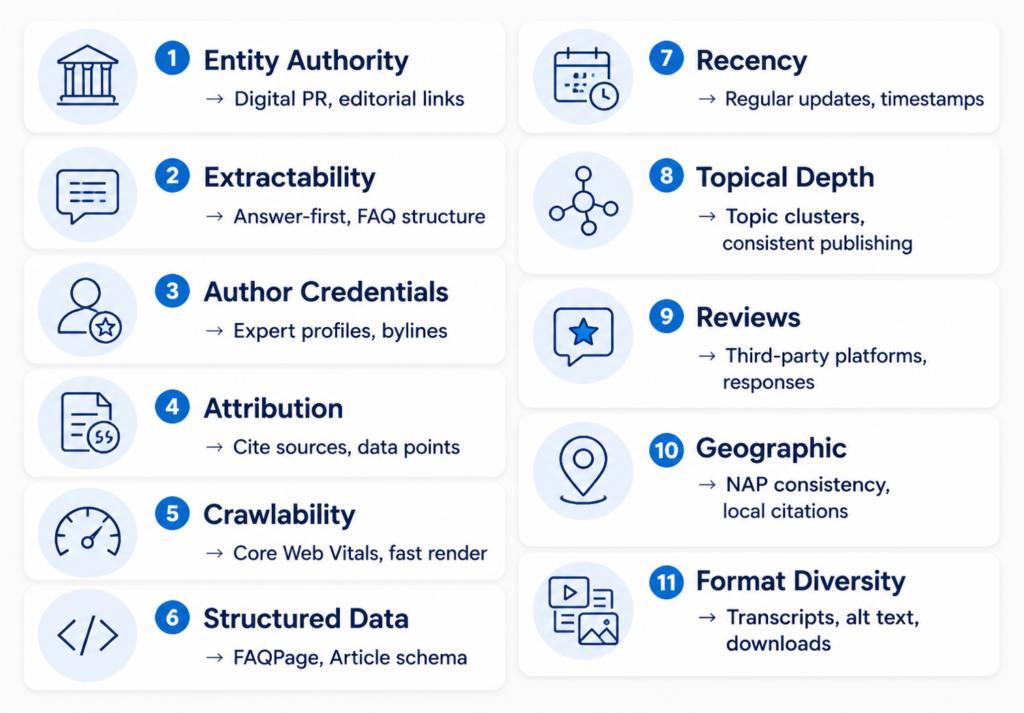
Entity authority is the most significant differentiating factor between sources that are consistently cited and those that are occasionally cited. An entity — a brand, a publication, a named individual — that is represented consistently across a wide range of credible external sources on a specific topic sends a signal that generative systems weight as a credibility indicator. This is not simply about domain authority in the traditional link-count sense; it is about the coherence and breadth of the entity’s representation across the information ecosystem. A brand that is mentioned in industry publications, referenced in professional directories, discussed in podcast transcripts, cited in academic literature within its field, and described consistently across structured data sources has a stronger entity authority signal than one whose credibility evidence is limited to its own website, regardless of how high-quality that website’s content is.
| Ranking Factor | What It Means in Practice | How to Improve It |
|---|---|---|
| Entity authority and external mentions | How widely the brand or domain is referenced as a credible source across the web | Digital PR, editorial link building, podcast appearances, industry directory listings |
| Content directness and extractability | How easily a specific answer can be extracted from the content for inclusion in a generated response | Answer-first formatting, FAQ structure, clear headings that match question phrasings |
| Named author expertise credentials | Whether the content is attributed to a verifiable expert with documented topic knowledge | Author pages with credentials, external profile links, bylines on all substantive content |
| Factual specificity with attribution | Whether claims are specific, quantified, and attributed to verifiable sources | Cite primary sources, include specific data points, reference named studies or institutions |
| Technical crawlability and render speed | Whether the page can be efficiently accessed and its content fully extracted | Core Web Vitals optimization, server response time, JavaScript rendering audit |
| Structured data implementation | Whether the content structure is machine-readable in formats AI systems recognize | FAQPage, Article, Person, Organization, and HowTo schema where applicable |
| Content recency and update frequency | Whether the information is current and the page is actively maintained | Regular review cycles, update timestamps, removal of outdated data and claims |
| Topical depth within a defined subject area | Whether the domain demonstrates sustained expertise in the topic area | Topic cluster content architecture, consistent publication on related subjects |
| Third-party review platform presence | Whether the entity is represented with verifiable reviews on established platforms | Systematic review acquisition, active platform management, response consistency |
| Geographic authority for local queries | Whether the entity’s location and service area are consistently represented across data sources | NAP consistency, local citation building, Google Business Profile management |
| Content format diversity | Whether the content exists in multiple formats that different retrieval systems can access | Video transcripts, podcast episode pages, image alt text, downloadable resources |
How to improve brand visibility in AI search at the entity authority level requires a sustained program of external presence building rather than on-site content work alone. This is where the discipline converges most clearly with traditional public relations and digital PR: securing editorial coverage in credible industry publications, maintaining an active presence in the professional databases and directories that authoritative systems draw on, and ensuring that the description of what your organization does is consistent across all external reference points.
For businesses with a local dimension to their client acquisition, the local SEO services infrastructure — consistent Name-Address-Phone representation, Google Business Profile management, local citation building — is directly relevant to entity authority in location-modified AI queries. A business that appears consistently and accurately across local data sources sends a stronger geographic entity signal than one whose information is fragmented across different sources with inconsistent details.
Measuring Brand Visibility in AI Search
Measuring how well a domain performs in generative contexts requires a different measurement framework from traditional rank tracking. Position one in a traditional results page is a clear, measurable data point. Citation frequency in AI-generated responses is less cleanly measurable because the responses vary by query phrasing, user session context, geographic location, and platform version — and because none of the major platforms provides direct API access to citation data in the way that traditional search platforms provide ranking data.
The practical measurement approach involves several overlapping methods rather than a single clean metric. First, systematic prompt testing: running a defined set of queries relevant to your brand and topic area across the major AI platforms on a regular cadence and recording whether and how your content is cited. This is labor-intensive but provides direct evidence of citation behavior that no indirect metric captures. Second, traffic pattern analysis in Google Analytics 4: generative platforms that drive clicks to cited sources appear in the referral traffic data, and the appearance of chatgpt.com, perplexity.ai, and related domains as referral sources provides indirect evidence of citation frequency even without direct citation monitoring. Third, brand mention monitoring across the web using tools like Brand24, Mention, or Ahrefs’ content explorer: external mentions of your brand name and domain across publications and discussion platforms contribute to entity authority and can be tracked systematically.
- ► Use Google Search Console’s AI Overviews filter in the performance report to track impressions and clicks from queries where your site is cited in an overview
- ► Monitor referral traffic from AI platforms in GA4 — chatgpt.com, perplexity.ai, and copilot.microsoft.com are the primary referral sources to track
- ► Run monthly prompt audits across the three major conversational platforms for your ten most commercially important topic queries
- ► Track external brand mentions using Brand24, Ahrefs Alerts, or Google Alerts as a proxy for entity authority growth
- ► Use structured data testing tools to verify that FAQPage and other schema markup is correctly implemented and eligible for extraction
How to improve brand visibility in AI search over time is measurable if you track the right signals consistently from a defined baseline. Establish that baseline before making significant content or technical changes so that the impact of those changes can be isolated and evaluated rather than inferred from ambiguous traffic trends.
Site Speed Optimization for AI Crawlability
Site speed is not typically the first topic that comes to mind when discussing generative optimization, but it is foundational in a way that most practitioners underestimate. AI-powered retrieval systems — including the systems Google uses to gather source content for AI Overviews — depend on efficient crawlability to index and access page content. A page that loads slowly, requires excessive JavaScript rendering time before content is accessible, or produces poor Core Web Vitals scores is at a structural disadvantage as a potential source for generated responses, regardless of the quality of its content.
The tools that provide the most actionable speed diagnostic data are Google PageSpeed Insights for page-level assessment, Chrome User Experience Report data in Search Console for field data across real users, and WebPageTest for detailed waterfall analysis of resource loading sequences. The most common issues that suppress Core Web Vitals scores on content-heavy sites are render-blocking JavaScript in the document head, unoptimized image delivery without lazy loading or modern format compression, and server response times above 200 milliseconds that delay everything downstream.
# Check server response time for your domain
curl -o /dev/null -s -w \
  "DNS lookup: %{time_namelookup}s\n\
  TCP connect: %{time_connect}s\n\
  TTFB: %{time_starttransfer}s\n\
  Total: %{time_total}s\n" \
  https://www.yourdomain.com/your-target-page/
For content sites optimizing for generative citation, the Interaction to Next Paint (INP) metric is worth specific attention. Pages with poor INP scores can appear unresponsive to users and to automated crawlers assessing rendering quality. The fix for most INP issues involves reducing the work performed by JavaScript event handlers during the initial page render — which often means auditing third-party scripts and deferring non-critical functionality until after the main content has loaded.
Reviews and Reputation Signals in Generative Contexts
Third-party reviews are a component of entity authority that generative systems draw on more directly than traditional algorithms did. When a system is determining whether to cite a business as a credible source on a topic related to its services, the presence of a consistent, positive, substantively-described review profile across established platforms contributes to the signal that the entity is a trusted actor in its category.
The primary tools for managing and monitoring the review ecosystem relevant to generative visibility are:
- ► Google Business Profile dashboard — primary platform for review monitoring and response management for local entity authority
- ► Trustpilot — high-domain-authority review platform that generative systems frequently draw on as a credibility signal for businesses
- ► Clutch — the primary B2B review platform referenced by AI systems when evaluating service provider credibility in professional categories
- ► Brand24 / Mention — brand monitoring tools that track where and how the entity is mentioned across the web, which is the upstream activity that feeds entity authority signals
- ► ReviewTrackers / Podium — multi-platform review aggregation and response management tools for businesses managing reviews across many platforms simultaneously
How to improve brand visibility in AI search through reputation management is not primarily about the star rating number — it is about the content of reviews. Reviews that describe specific outcomes, specific service components, and specific attributes of the business provide more useful entity signal to generative systems than reviews that simply express satisfaction without detail. Encouraging clients to describe their experience specifically — what they were trying to accomplish, what the outcome was, what they valued about the process — produces review content that is more useful both for prospective customers and for the AI systems that evaluate entity credibility.
The review content quality principle:
“Great service, highly recommend” contributes minimally to entity authority in a generative context. “They handled our corporate restructuring with genuine expertise in our specific industry — the technical knowledge they demonstrated in the first meeting convinced us they understood our situation” tells a generative system that this entity is credible in a specific domain with a specific client type. The specificity is the signal.
Frequently Asked Questions
Is AI search optimization the same thing as traditional SEO?
It shares a foundation with traditional SEO — technical site health, content quality, and authority signals matter in both contexts — but the content formatting requirements and the entity representation signals that generative systems weight most heavily are different from what traditional ranking algorithms prioritize.
How quickly can changes in content formatting affect citation frequency in AI Overviews?
Faster than most traditional SEO changes produce measurable results. Structural changes to how content is formatted — answer-first organization, FAQ schema markup, clearer heading structure — can influence citation eligibility within two to four weeks of recrawling. Entity authority changes take longer, typically three to six months, because they depend on external mention accumulation rather than on-site changes.
The fastest path to improved overview citation frequency is often a combination: implement structural changes immediately while running a parallel authority-building program with a longer runway.
Does generative engine optimization (GEO) work differently for local businesses?
Yes — local queries trigger different retrieval behavior. For location-modified queries, generative systems draw heavily on Google Business Profile data, local citation consistency, and review platform presence. The content optimization principles are the same, but the entity authority signals that matter most for local citation are different from those that matter for topical authority on national or global queries.
Can a small website compete with large publications for citation in AI-generated responses?
More effectively than in traditional organic search, actually. Generative systems select sources based on content precision and entity credibility for specific topics — not on domain-wide authority. A small site with narrow topical depth, named expert authorship, and well-structured direct answers can outcompete a large general-interest publication for citation on queries within that specific topic area.
What is the single most impactful change a content team can make to improve AI search citation frequency?
Writing direct answers in the first two sentences of every content section, rather than building toward the answer through context. Generative systems extract answers; they do not read for context the way a human reader does. Content that states the answer immediately and then supports it with context performs better as source material than content that leads with context and arrives at the answer at the end.
Does social media presence influence citation frequency in generative search?
Indirectly rather than directly. Social signals are not a direct ranking factor for generative citation. But a strong social presence contributes to entity authority by generating external references, brand mentions, and traffic signals that contribute to the credibility profile that generative systems evaluate. The relationship is upstream — social presence feeds entity signals that then influence citation behavior.
How does AI search optimization differ for B2B versus B2C businesses?
The core principles are the same, but the content strategy differs by audience. B2B generative optimization typically requires more technical depth, named institutional credibility, and presence on professional platforms like LinkedIn and Clutch. B2C optimization typically requires stronger consumer review platform presence and content that addresses high-volume informational queries at the research stage of the consumer decision process.
The authority-building channels also differ: for B2B, industry publication coverage and professional directory listings are higher-value authority signals than for B2C, where consumer review platforms and mainstream media citations carry more weight.
Is there a way to opt out of having your content used as a source for AI-generated responses?
Yes — robots.txt directives can be used to block specific AI crawlers from accessing your content. Google’s AI Overview crawler identifies itself as Googlebot; blocking it would also affect traditional organic crawling. Perplexity and other platforms use their own crawlers that can be blocked independently without affecting Google’s access.
How do structured data types beyond FAQPage help with AI search visibility?
Article schema with named author and publication date signals content provenance to retrieval systems. Person and Organization schema with consistent entity identifiers across multiple pages creates a machine-readable entity graph that contributes to the entity authority signal. HowTo schema for process-oriented content provides extractable step structures. Each schema type addresses a different dimension of the machine-readability requirement that contributes to citation eligibility.
What role does content update frequency play in AI search citation?
Recency is a meaningful factor for queries where the user’s implicit expectation is current information — market data, regulatory guidance, technology specifications. For evergreen content where recency is not a query intent factor, update frequency matters less than content precision and entity authority. The practical recommendation is to maintain a defined review cycle for high-priority content rather than publishing updates without a strategic rationale.