




 Get to WhatsApp

Our manager will contact you
within 15 minutesт
Monthly SEO Services: Complete Guide to Pricing & Packages
What You Pay, What You Get, What to Expect

Monthly SEO Services: Complete Guide to Pricing & Packages
In this guide I will explain what monthly SEO is — how to choose the right services and packages for your specific situation, and why this model has become the dominant approach for businesses and agencies alike. Whether you are evaluating your first ongoing SEO engagement or reconsidering an existing one, the goal here is to give you the information that makes the decision genuinely easier rather than more confusing. You can also order monthly SEO services through my agency by filling out the form on this page.
What’s Inside This Guide
— What monthly SEO services actually are and how they differ from project work.
— Monthly SEO vs one-time projects: a direct comparison.
— What’s included in monthly SEO packages at each tier.
— Pricing overview by business size and competitive situation.
— What’s included in our full-service SEO packages.
— Budget vs timeline: choosing the right entry point.
— Factors that affect monthly SEO pricing most significantly.
— Realistic results timeline: what to expect month by month.
— Average SEO ROI by industry.
— How to choose the right monthly SEO package for your business.
— Common mistakes businesses make with monthly SEO.
— DIY vs agency: which approach makes sense for you.
— Complementary channels that amplify monthly SEO results.
— Why World SEO Agency for your ongoing SEO partnership.
— Frequently asked questions.
There is a version of this conversation that gets overwhelming very quickly — pricing ranges that span an order of magnitude, package names that vary by provider, and outcome promises that range from cautiously realistic to obviously fictional. Most of the confusion is avoidable. The underlying logic of monthly SEO is not complicated: sustained, coordinated work on technical health, content quality, and external authority compounds over time in a way that one-time projects cannot replicate. The challenge is understanding what that work actually involves at each investment level, and whether the specific provider you are evaluating is genuinely delivering it.
What Monthly SEO Services Actually Are
Monthly SEO — often called a retainer model — is an ongoing arrangement where an agency or consultant performs continuous optimization work on your website across every relevant dimension: technical infrastructure, content creation and optimization, and external authority building. The distinction from a one-time project is not primarily about duration. It is about the nature of the work itself. Search engine optimization is not a problem you fix once and then move on from. It is an environment that changes continuously — algorithm updates, competitor activities, shifting search patterns, new content opportunities — and the businesses that maintain consistent rankings over years are those whose campaigns are actively managed rather than periodically revisited.
The compounding effect is the central argument for monthly over project-based work. A technical fix implemented in month one improves the environment in which month two’s content lands. The content published in month two earns links that strengthen month three’s rankings. The rankings achieved in month three produce data that informs month four’s strategy. Each element builds on the last, which is why the ROI trajectory of well-executed monthly SEO typically shows slow early returns followed by accelerating performance that eventually exceeds what any other customer acquisition channel produces.
The compounding principle in plain terms:
A business that runs a one-time SEO project and then stops will typically see an initial improvement followed by gradual erosion as competitors continue investing. A business on a consistent monthly program accumulates authority, content depth, and technical advantage that becomes increasingly difficult for competitors to close without matching investment over a sustained period.
Monthly SEO vs One-Time SEO Projects
The question of whether to invest in ongoing monthly work or a one-time project is sometimes framed as a budget question — and budget is a factor — but the more important variable is competitive context. In a genuinely low-competition niche with no established competitors investing in organic search, a well-executed one-time audit and optimization project can produce durable results because there is no competitive pressure eroding them. In any market where multiple established businesses are actively investing in content and authority, stopping your own investment while competitors continue theirs is a strategic loss regardless of the quality of your initial work.
| Factor | Monthly SEO Services | One-Time SEO Projects |
|---|---|---|
| Duration | Ongoing (6–12+ months) | Fixed (1–3 months) |
| Cost structure | $500–$50,000+ per month | $2,000–$30,000 total |
| Best for | Sustained growth, competitive markets | Audits, quick fixes, very low competition |
| Results timeline | 3–12+ months, compounding | Limited and time-bounded |
| Content creation | Regular (2–8+ posts per month) | Minimal or none |
| Link building | Continuous monthly acquisition | Limited to project scope |
| Algorithm maintenance | Included as standard | Not included |
| Strategic adaptation | Monthly based on performance data | Fixed at project start |
| ROI potential | High — compounds significantly over time | Medium — one-time boost that fades |
What’s Actually Included in Monthly SEO Packages
The gap between what different agencies include in their monthly programs is wider than most buyers realize. Two agencies charging the same headline monthly fee can be delivering fundamentally different scopes of work. Understanding the six core components of a complete monthly SEO program — and what each looks like at different investment levels — is the baseline knowledge that makes provider comparison meaningful rather than arbitrary.
Technical SEO Maintenance
Technical work in a monthly engagement is not a one-time audit delivered at the start and then forgotten. A well-managed monthly program includes ongoing monitoring of crawl health, site speed metrics, Core Web Vitals scores, indexation status, and the introduction of new technical issues as the site evolves. At the basic tier this looks like quarterly technical reviews with remediation recommendations. At higher tiers it includes monthly active monitoring with implementation support and weekly checks for critical issues.
- ► Crawl error monitoring and resolution — ensuring Googlebot can access and process every page that matters to the campaign
- ► Core Web Vitals tracking — page load performance, visual stability, and interactivity scores that affect both ranking and user experience
- ► Schema markup implementation and validation — structured data that helps search engines understand page content and improves rich result eligibility
- ► XML sitemap management and robots.txt configuration — controlling what gets indexed and in what priority
- ► HTTPS and security monitoring — ensuring technical integrity signals remain clean throughout the engagement
On-Page Optimization
On-page work in a monthly engagement covers the continuous process of optimizing existing pages and newly published content for the queries they are targeting. At the entry tier this might mean five to ten pages optimized per month — adjusting title tags, heading structure, internal linking, and content alignment with search intent. At the premium tier it scales to twenty or more pages monthly, with more sophisticated targeting based on performance data accumulated over time.
Content Creation
Content is the component where the difference between tiers is most visible. Entry-level monthly SEO packages typically include one or two articles per month at one thousand to fifteen hundred words. Growth packages move to three or four pieces monthly with longer formats. Premium packages produce six to eight or more substantial articles monthly, supported by content refreshes of older pieces that have accumulated ranking history but need updating to maintain their positions.
Content quality is not optional:
The content volume in a Monthly SEO package matters less than the quality of what is produced. Thin, keyword-stuffed articles are actively counterproductive in the current search environment. Every piece needs to be genuinely useful to the reader — which means substantive, well-researched, and written for the human asking the question rather than for the algorithm counting keywords. The agencies that produce content worth reading are the ones whose content actually earns links and generates qualified traffic.
Link Building
External authority building — acquiring links from credible, relevant websites through editorial outreach — is the component that most clearly separates agencies with genuine capability from those operating on templated methodology. At the entry level, link building in a monthly program might produce five to ten new links per month from lower-authority sources. At the growth tier this moves to ten to twenty links from a mix of authority levels. Premium and enterprise engagements produce twenty to fifty or more monthly links from high-authority editorial sources, sometimes including digital PR placements in major publications.
Local SEO Components
For businesses serving defined geographic markets, local SEO is a distinct workstream within the monthly program. It covers Google Business Profile management, local citation building and consistency maintenance, review acquisition strategy, and the creation of location-specific content that targets neighborhood and city-level queries. The value of local components is disproportionately high for service businesses — the map pack captures a significant share of mobile search clicks for local intent queries, and map pack rankings respond to profile and citation signals rather than purely to domain authority.
Reporting and Strategy
Every tier should include monthly reporting — keyword ranking movement, organic traffic trends, conversion events from organic sessions, and link acquisition records. The quality of reporting is itself an indicator of campaign quality: providers who share unfiltered Search Console data alongside their curated dashboards are more transparent than those whose reporting interface is the only window into campaign activity. Strategy calls — where the performance data is discussed and the next period’s priorities are agreed — should happen monthly at growth tiers and above.
Pricing Overview by Business Size
| Business Type | Monthly Investment | What You Get |
|---|---|---|
| Small local business | $500 – $2,000 | Local SEO, basic content, Google Business Profile optimization |
| Small business in competitive market | $2,500 – $5,000 | Full-service SEO, 2–4 posts per month, link building |
| Mid-market company | $5,000 – $10,000 | Advanced SEO, 4–6 posts per month, aggressive link acquisition |
| Enterprise | $10,000 – $50,000+ | Multi-site SEO, 8+ posts per month, PR-level links, dedicated team |
These ranges reflect the investment required for the scope of work those business types genuinely need to compete — not the minimum price at which any agency will accept an engagement. A local plumbing company in a mid-size US city typically does not need a $10,000 monthly program. A national insurance comparison platform almost certainly does. The correct investment level is determined by what the competitive threshold in your specific market actually requires, not by a generic tier chart.
On affordable entry points:
The full landscape of what different investment levels realistically cover — from entry-level local programs to full enterprise campaigns — is detailed in the guide to affordable SEO services, which covers pricing with enough specificity to inform realistic budget planning for different competitive situations.
What’s Included in Our Full-Service SEO Packages
| Package | Monthly Price | What’s Included |
|---|---|---|
| START A Profitable Start Get Started |
from $1,500 / month First result: 2 months |
Website optimization. Top 10 Google rankings. AI (GEO) under Google search. Local SEO with new page creation. Promoted pages: 10. Keywords: 30. |
| BUSINESS Customer Selection Get Started |
from $2,500 / month First result: 1 month |
Everything in START. Top 5 Google rankings. AI (GEO) optimization. Local SEO with new pages. Promoted pages: 20. Keywords: 100. Regular blog development. Organic backlinks. |
| INDUSTRY LEADER Everything Is Included Get Started |
from $3,500 / month First result: 2 weeks |
Full-service SEO. Top 3 Google rankings. AI (GEO) optimization. Local SEO. Unlimited pages and keywords. Regular blog. Organic backlinks. Technical improvements. Paid link building included. Financial performance commitment applies to this plan. |
Budget vs Timeline: Choosing the Right Entry Point
The relationship between monthly investment level and time to meaningful results is not linear — it is accelerating at higher budgets and flatter at lower ones. A $500 monthly program is not a slower version of a $5,000 monthly program; it is a structurally different scope of work that addresses fewer competitive variables simultaneously and produces narrower results. The correct question is not “what’s the minimum I can spend?” but “what’s the minimum that will actually move the needle in my specific competitive market?”
| Budget Available | Recommended Package | Expected Timeline to Strong Results |
|---|---|---|
| $500 – $1,500 per month | Basic / Starter | 9–18 months |
| $1,500 – $5,000 per month | Growth / Standard | 6–12 months |
| $5,000+ per month | Premium / Aggressive | 3–9 months |
These timelines assume a well-executed campaign in a reasonably competitive market. A new domain with no existing authority in a highly competitive national market will take longer at any budget level. An established domain with a clean technical foundation in a low-competition local market will see results faster. The guide on how long SEO takes to show results provides market-by-market context that makes these timelines more specific to different competitive situations.
Factors That Affect Monthly SEO Pricing Most Significantly
Monthly SEO pricing is driven by a combination of variables that are specific to the client’s situation rather than by the agency’s cost structure alone. The same agency can justifiably charge $1,500 per month for one client and $15,000 for another, not because of pricing strategy but because the scope of work required to achieve comparable results in those two situations is genuinely different by an order of magnitude.
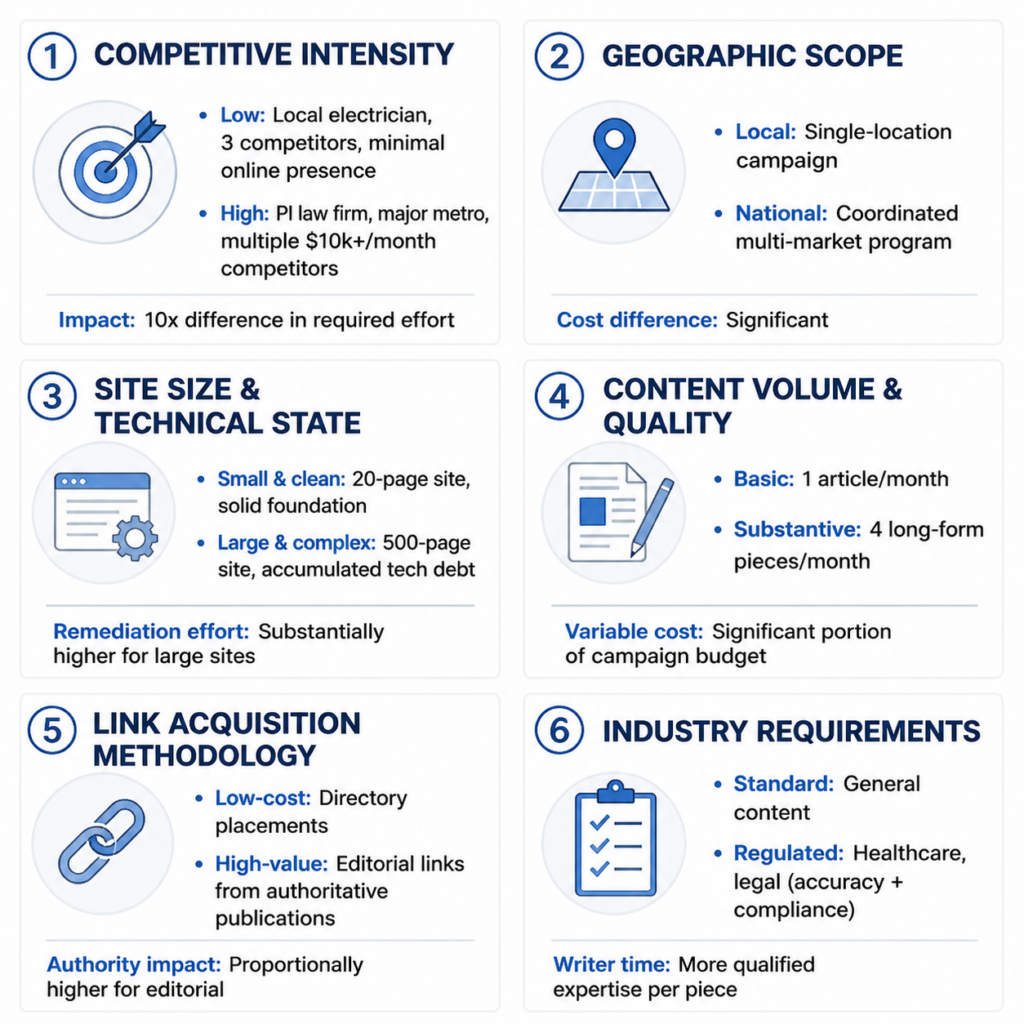
The most significant pricing driver is competitive intensity — how many well-resourced competitors are actively investing in organic search for the same queries the client wants to rank for. A local electrician in a mid-size city with three competitors who have minimal online presence operates in a completely different economic environment from a personal injury law firm in a major metro market where multiple established firms are running $10,000+ monthly programs. The second situation requires more content, more links, more technical refinement, and more strategic sophistication to produce meaningful movement — and that reality is reflected in the pricing.
- ► Geographic scope — local single-location campaigns cost significantly less than national or multi-location programs that require coordinated work across many markets simultaneously.
- ► Site size and current technical state — a 500-page site with accumulated technical debt requires substantially more remediation effort than a 20-page site built on a clean foundation.
- ► Content volume and quality requirements — the difference between one basic article per month and four substantive long-form pieces per month is a significant portion of a campaign’s variable cost.
- ► Link quality and acquisition methodology — editorial links from authoritative publications cost more to acquire than directory placements and produce proportionally more authority value.
- ► Industry-specific requirements — regulated industries like healthcare and legal require content that meets accuracy and compliance standards, which takes more qualified writer time per piece.
On link quality economics:
Low-quality links from directories and forum profiles cost $50–$100 each and contribute minimally to authority in competitive markets. Editorial links from credible niche publications cost $200–$500 and produce lasting authority. Links placed through digital PR in major publications cost $500–$2,000 per placement and produce the kind of domain authority that is genuinely difficult for competitors to close. The math on link quality versus quantity is unambiguous at any investment level above the very entry tier.
Realistic Results Timeline: What to Expect Month by Month
The expectation-setting conversation is where most agency-client relationships are either built on honest foundations or undermined from the start. Clients who are told they will see significant results in thirty days and then experience the reality of a three-to-six-month ramp-up period are primed for disappointment regardless of the actual quality of the campaign work. Honest timeline framing is not a weakness — it is the thing that makes a twelve-month engagement productive rather than a six-month engagement that ends in frustration.
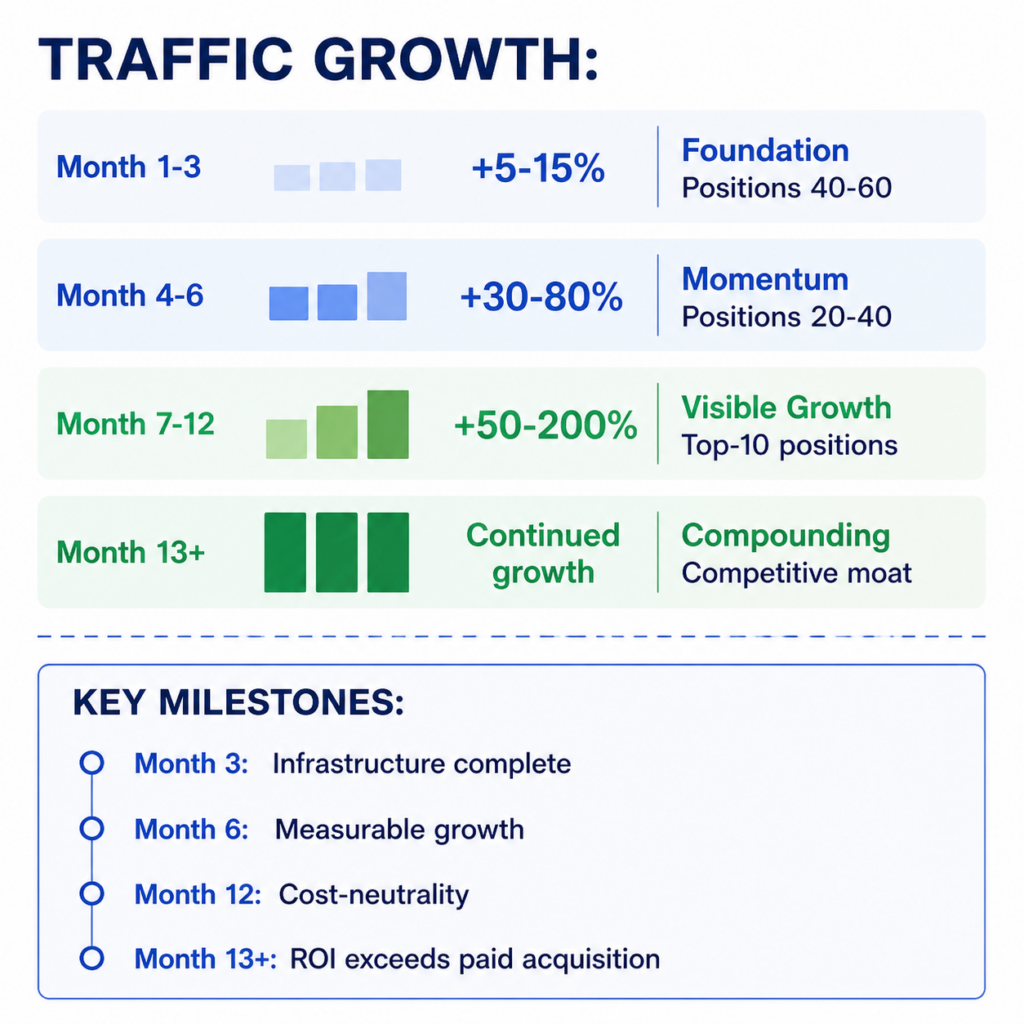
Months 1–3: Foundation and Early Infrastructure. The first three months of a well-run campaign are primarily infrastructure work. Technical issues are identified and remediated, which may produce immediate improvements in indexation and crawlability but rarely produces dramatic traffic movements. Initial content is published and begins accumulating indexing history. First links are acquired. The visible metric changes at this stage are typically modest — crawler errors reduced, a handful of new keyword rankings appearing in positions forty to sixty, a few percent improvement in organic traffic. This is working as intended, not underperforming.
Months 4–6: Momentum Building. Content published in the first quarter begins ranking. Links acquired early in the campaign start influencing authority signals. More pages are appearing in positions twenty to forty for target queries. Organic traffic growth becomes measurable — typically thirty to eighty percent above baseline at this stage for a well-run growth-tier campaign. Some queries are breaking into the top twenty for the first time.
Months 7–12: Visible Growth. The compounding effect becomes apparent. Multiple queries entering top-ten positions. Organic traffic at fifty to two hundred percent above pre-campaign baseline. Lead volume from organic sessions is measurable and attributable. The campaign is approaching or reaching cost-neutrality — what it costs monthly is offset by the value of the organic-sourced business it is producing.
Months 13 and beyond: Compounding Returns. This is where the ROI case for sustained monthly investment becomes unambiguous. The authority and content depth accumulated over the first year creates a compounding advantage that becomes increasingly expensive for competitors to replicate. Traffic growth continues, cost per organic lead continues falling, and the total return on cumulative investment accelerates past any reasonable paid acquisition alternative.
The most common reason campaigns underperform:
Stopping at month four or five — right before the compounding effect becomes visible. The businesses that abandon their monthly SEO programs during the foundation phase consistently attribute the decision to a lack of visible results. The businesses that maintain their programs through that phase consistently report that months seven through twelve produced more organic growth than they had expected when they started.
Average SEO ROI by Industry
| Industry | Typical Monthly Investment | Typical Monthly Leads at Month 12+ |
|---|---|---|
| Local services (plumbing, electrical, HVAC) | $1,500 | 20–40 qualified service calls |
| Legal (personal injury, family law) | $5,000 | 10–25 case inquiries |
| Healthcare (dental, chiropractic, medical) | $2,000 | 15–30 new patient appointments |
| E-commerce | $3,000 | Traffic-based revenue (highly variable) |
| B2B SaaS | $7,000 | 5–15 qualified demo or trial requests |
The break-even point for most businesses falls somewhere between month ten and month fourteen — the moment at which the organic revenue attributable to the campaign exceeds its cumulative cost to that point. After that threshold, the ROI trajectory steepens because the campaign’s accumulated assets (content, authority, technical optimization) continue producing returns without proportionally increasing cost. This is the economic case for sustained monthly investment rather than periodic project work — the return-on-investment curve in this model is one of the most favorable available in digital marketing when the campaign is well-executed and sustained through the compounding phase.
How to Choose the Right Monthly SEO Package
The selection process that produces the best outcomes runs through five practical steps regardless of industry, geography, or budget level.
Step one: Define your goals with enough specificity to be useful. “More traffic” is not a goal — it is a direction. “Twenty qualified leads per month from organic search within twelve months” is a goal that can be evaluated against a proposed campaign scope and budget. The specificity of your goal is what makes it possible to assess whether a given provider and package are plausibly capable of delivering it.
Step two: Assess your competitive environment honestly. Look at the websites currently ranking for your most commercially important queries. How much content do they have? How many backlinks does Ahrefs or SEMrush show for their domain? How technically sophisticated are their sites? The gap between your current position and theirs is the gap the campaign needs to close, and the cost of closing it scales with the size of that gap.
Step three: Evaluate budget against realistic timelines. Use the table above as a reference point. If your budget is at the entry tier but your competitive environment requires a growth-tier investment, you have two realistic options: increase the budget or narrow the geographic or topical scope of the campaign to a level where the budget is sufficient to compete.
Step four: Vet the provider’s actual delivery capability. Ask to see a sample monthly report — not a summary slide but the actual deliverable a client receives. Ask for the live URL log of links placed for a current client in the last three months and verify five of them independently. Ask specifically who will be working on your account and what their relevant experience is. These questions cannot be answered convincingly without genuine delivery capability behind them.
Step five: Review the contract structure before discussing price. The contract reveals the accountability architecture more reliably than any proposal. Look for specific deliverable quantities, performance milestone definitions, data ownership provisions, and exit terms. Vague category descriptions — “link building included,” “content as needed” — are the language of providers who want flexibility to underdeliver without contractual consequence.
Common Mistakes Businesses Make with Monthly SEO
The mistakes that most consistently undermine monthly SEO investment are not exotic or surprising. They are predictable patterns that appear repeatedly across businesses at every size and budget level, and most of them are avoidable with the right expectations set at the start.
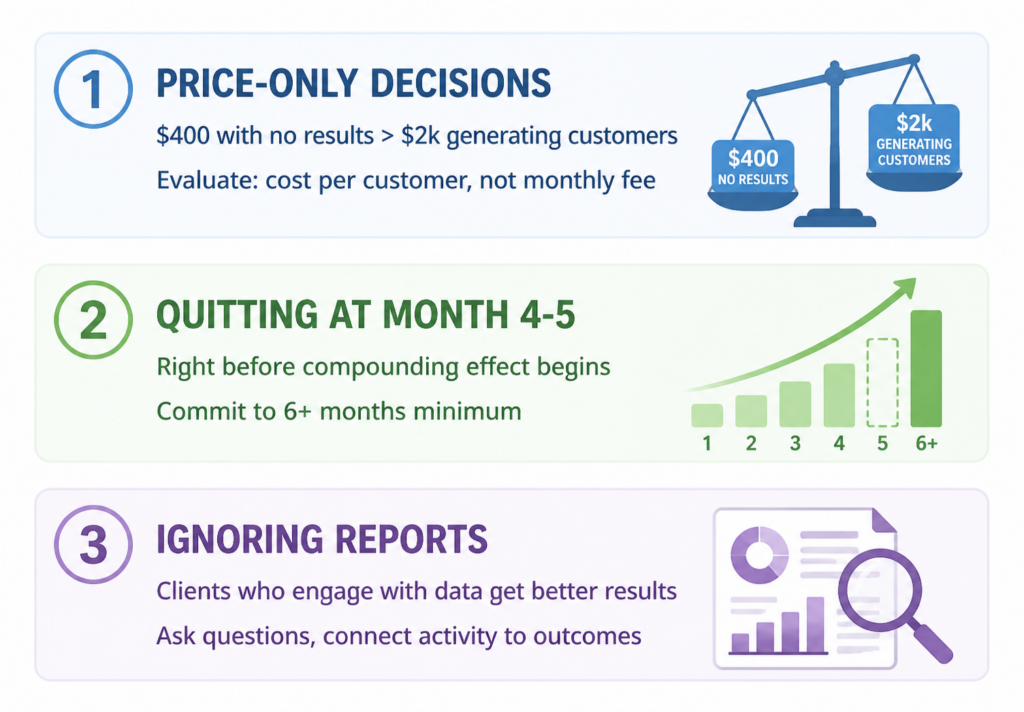
1) Choosing based on price alone. A $400 monthly program that delivers nothing wastes more money than a $2,000 monthly program that generates measurable organic revenue — not just more in aggregate but more per dollar, because the opportunity cost of not investing effectively is higher than the cost of the underperforming program. The correct evaluation metric is not monthly fee but expected cost per acquired customer relative to other channels.
2) Quitting during the foundation phase. More campaigns are abandoned at month four or five than at any other point — right at the boundary where the compounding effect begins to become visible. Businesses that commit to at least six months before evaluating results consistently report better outcomes than those who make that evaluation at month three.
3) Not reviewing monthly reports. Monthly SEO packages produce monthly reports for a reason. Clients who engage with their reports — asking questions, understanding the data, and connecting the activity described to the business outcomes they care about — consistently get more from their campaigns than those who treat the report as a bureaucratic formality.
On content quality as a non-negotiable:
The businesses that get the best results from their monthly SEO investment are those who insist on content quality as an absolute requirement rather than treating it as a variable that can be traded off against volume or cost. Thin, formulaic content produces thin results. Substantive, genuinely useful content earns the links and engagement that drive lasting ranking improvements. If a provider’s content samples don’t read like something a real expert wrote for a real reader, the campaign will underperform regardless of the technical and link-building work surrounding it.
DIY vs Agency: Which Approach Makes Sense for You
DIY organic optimization is a legitimate path for businesses with genuinely low competition, a founder or marketing team member willing to dedicate ten to twenty hours per week to learning and executing the discipline, and a budget below the threshold where agency investment is economically viable. The honest assessment: for most businesses in competitive markets, the time required to execute a complete monthly SEO program at the quality level needed to produce results exceeds the cost of professional management, and the opportunity cost of founder or marketing director time spent on execution rather than strategy is substantial.
The hybrid approach — where the business handles content creation and the agency handles technical and link building — can work well for content-rich businesses whose founders are strong writers with genuine subject matter expertise. In this model, the founder produces the thought leadership content that only they can write authentically, and the agency ensures it is technically optimized and supported by the authority-building work that makes it rank.
Complementary Channels That Amplify Monthly SEO Results
Monthly SEO operates most effectively not in isolation but as the organic foundation of a broader digital marketing system. Paid search campaigns running alongside an organic program produce cross-channel data that improves both — paid search keyword performance data informs organic keyword prioritization, and organic rankings reduce paid search costs for the same queries. Email marketing to the audience built through organic content extends the lifetime value of each acquired reader. Social media distribution of organic content accelerates the rate at which that content acquires links and engagement signals that feed back into ranking improvement.
The relationship between organic search and local visibility channels is particularly important for service businesses. Google Business Profile management, review acquisition strategy, and local citation building are all components that reinforce each other and that reinforce the organic campaign simultaneously. A business that ranks well in local organic results and maintains a strong map pack presence consistently captures a larger share of local search intent than one that excels in either channel independently.
The channel interaction that most businesses miss:
Running remarketing campaigns targeting users who arrived through organic search consistently improves the conversion rate from those organic sessions. A visitor who found your site through an informational search query, left without converting, and then sees a remarketing ad featuring your specific service is more likely to convert than a cold paid search prospect — because the organic session already created awareness and trust. The cost of remarketing against a warm organic audience is a fraction of cold prospecting at the same volume.
Why World SEO Agency for Your Monthly SEO Partnership
The agencies that produce the best long-term outcomes for clients are not always the largest or the most visible. They are the ones whose operational structure makes good outcomes more likely than bad ones — where accountability is written into the contract rather than expressed in the sales pitch, where the reporting is honest rather than curated, and where the scope is defined specifically enough that performance can be measured against it. Here is what working with World SEO Agency on a monthly program actually involves.
→ Industry Expertise
World SEO Agency has developed concentrated experience across legal, healthcare, real estate, e-commerce, financial services, and professional services verticals through sustained campaign work with clients across the United States and internationally. This means campaign strategy is built from genuine familiarity with how specific audiences search, what content formats they find credible, and what competitive dynamics characterize different markets — not from generic digital marketing methodology applied without vertical context.
→ 90-Day Performance Commitment
Every engagement includes documented performance milestones achievable within the first ninety days, written into the engagement agreement with specific and verifiable targets. At the INDUSTRY LEADER tier, a financial performance commitment is tied to specific ranking targets for the agreed query set. The commitment is specific and contractually backed — not a marketing phrase attached to a proposal that disappears before the contract is signed.
→ Affordable Pricing
Pricing reflects the actual scope required for the specific competitive environment — assessed honestly before any commitment is made. Every proposal includes itemized deliverable quantities. The total annual cost is calculable from the first conversation. No add-ons appear at month three, no tool subscriptions are passed through as separate charges, and no content charges above the included quota appear on any monthly invoice. Our monthly SEO pricing is transparent by design rather than by policy.
→ All-Inclusive System Without Hidden Payments
Technical work, content production, link acquisition, local optimization, reporting, and account management are all covered within the monthly package price. One invoice. Same amount. Every month. The structure eliminates the supplementary billing model — where agencies charge a headline retainer and then add content, links, and tools as separate line items — that inflates the effective cost of most agency engagements well above their advertised prices. Monthly SEO services at World SEO Agency are priced as a complete scope, not as a base fee with variables attached.
→ Working in the USA and Worldwide
World SEO Agency serves clients across the United States — with active campaigns in New York, Los Angeles, Chicago, Houston, Miami, Dallas, Phoenix, Seattle, Atlanta, and San Diego — and internationally in London, Dubai, Toronto, Sydney, and Singapore. These are core operating markets with active competitive intelligence and editorial network relationships, not occasional project locations. For businesses targeting specific geographic markets, this depth of operational knowledge matters in both strategy and execution.
Want to order monthly SEO services for your business? Get a consultation from a World SEO Agency expert. Send a request.
Frequently Asked Questions
How long should I realistically commit to a monthly SEO program before evaluating whether it is working?
Six months minimum to see whether the campaign is moving in the right direction. Twelve months to make a fair assessment of its full potential. The businesses that evaluate at three months and stop are almost always stopping right at the point where the compounding effect is about to become visible in the data.
Can I pause my monthly SEO program for a few months and then resume without losing progress?
Technically yes — rankings don’t disappear overnight when a campaign pauses. But the compounding trajectory resets. The authority accumulation stops, content publication stops, and competitors who continue investing don’t stop. Resuming after a six-month gap typically requires several months to return to the performance level that would have been maintained without the pause.
If budget is the constraint driving the pause consideration, a scope reduction is almost always a better option than a pause — maintaining lower-level activity through a budget-constrained period preserves the compounding trajectory better than stopping entirely.
What should I look for in a monthly SEO report to know whether my campaign is genuinely progressing?
Three metrics that indicate genuine progress: non-branded organic sessions trending upward (which means new people who don’t already know you are finding you), specific target keywords moving from positions thirty-plus into the teens and then into the top ten, and organic-attributed conversion events increasing proportionally with traffic. A report that shows only ranking improvements without traffic or conversion correlation may be tracking the wrong queries.
Is there a meaningful difference between monthly SEO packages from a local agency versus a national provider?
For locally-targeted campaigns, a local agency has geographic familiarity advantages — knowledge of local publications for link acquisition, familiarity with the local competitive landscape, and established relationships with local directories and citation sources. For national or international campaigns, geographic proximity to the client matters less than technical capability and vertical expertise. Evaluate on demonstrated results in comparable competitive situations, not on office location.
What happens to my website and rankings if I cancel my monthly SEO contract?
Technical improvements remain on the site permanently. Content remains indexed and continues generating traffic. Links placed on external sites remain live unless acquired through methods that create penalty risk. The practical consequence of cancellation is that active optimization stops — which means the site’s competitive position gradually erodes as competitors who continue investing accumulate the advantages that sustained campaigns produce.
How do I compare two agencies whose monthly SEO proposals seem similar on paper but have very different prices?
Ask both for specific deliverable quantities: exactly how many links per month, from what quality threshold of sources, with live URL verification provided monthly. Exactly how many pieces of content per month, at what word count, and with what editorial review process. Exactly how many pages will be technically audited and optimized in the first three months. The proposals that answer these questions specifically are comparable. The ones that use category descriptions without quantities are not.
Is monthly SEO worthwhile for a business that already receives strong referral business?
Referral networks are valuable but fragile — they depend on the continued activity and goodwill of the referral sources, and they don’t compound the way organic search does. A business that generates fifty percent of its clients from referrals and fifty percent from organic search is more resilient than one dependent on a single source. The question is not whether referral business is good — it clearly is — but whether organic search would add a channel that diversifies and strengthens the overall acquisition mix.
What is the most common reason a monthly SEO campaign produces disappointing results despite consistent investment?
A mismatch between investment level and competitive threshold. A $1,500 monthly program in a market where established competitors are spending $8,000 monthly cannot close the competitive gap regardless of execution quality — the scope of work it can fund is insufficient for the distance that needs to be covered. Honest competitive analysis at the start of a campaign is what prevents this mismatch from developing.
How does monthly SEO pricing change when adding a second or third location to an existing campaign?
Adding a location to an existing campaign typically costs forty to sixty percent of the original single-location program cost — because some work (technical infrastructure, domain authority building, content strategy) is shared, while location-specific work (local citations, location pages, Google Business Profile management) is additive. A $2,000 single-location program might scale to $3,200 for two locations rather than $4,000, reflecting the shared component efficiencies.
What is the difference between monthly SEO services and a project-based SEO audit, and when does each make sense?
A project audit is a point-in-time assessment of what needs to be fixed and what opportunities exist. It is useful as a starting point, as a due diligence exercise before acquiring a website, or as an internal capability assessment. It does not fix anything — it identifies what needs fixing. Monthly services implement fixes and then continue optimizing as conditions change. The audit is a diagnosis; the monthly engagement is the treatment.
Should I expect my SEO agency to also advise on conversion rate optimization for the traffic the campaign produces?
At growth tiers and above, yes. Driving more organic traffic to a site that converts poorly is a partial solution. The best monthly SEO programs include conversion rate analysis as a standard component — identifying pages where traffic arrives but users leave without converting, and testing changes to the conversion elements on those pages.
This is an area where the distinction between agencies that genuinely manage campaigns and those that execute tasks becomes visible. An agency focused on organic revenue rather than organic traffic volume naturally includes conversion analysis because the metric they care about is paying clients, not sessions.
How does the pricing for monthly SEO compare to other digital marketing channels on a cost-per-acquired-customer basis?
In most markets, after the compounding phase (typically twelve to eighteen months into a sustained campaign), organic search produces the lowest cost per acquired customer of any digital channel — lower than paid search, lower than social media advertising, and lower than most traditional channels. The caveat is the time dimension: paid channels produce customers in week two; organic channels produce them at a lower cost per acquisition but require sustained investment through the ramp-up period before that advantage materializes.
What does a monthly SEO agency actually do differently in month twelve than they did in month one?
The work changes substantially. Month one is dominated by audit, setup, and technical remediation. Month twelve is dominated by competitive intelligence analysis, content optimization based on twelve months of ranking data, link acquisition in the specific query clusters where rankings are closest to the top positions, and conversion analysis on the pages where accumulated traffic is not converting at expected rates. The campaign becomes more precise and more data-driven as it matures — which is why the results also improve disproportionately in the later months relative to the earlier ones.