




 Get to WhatsApp

Our manager will contact you
within 15 minutesт
How to Use Reddit and Quora to Grow Your Business: Best Practices
Two Platforms, One Goal: Turning Conversations Into Customers
MOST BUSINESSES EITHER IGNORE COMMUNITY PLATFORMS ENTIRELY OR USE THEM SO BADLY THEY GET BANNED WITHIN A MONTH. AUTHENTIC ENGAGEMENT ON REDDIT AND QUORA DRIVES REAL ORGANIC TRAFFIC AND BUILDS THE KIND OF AUTHORITY THAT CONVERTS — THIS IS THE PRACTICAL BREAKDOWN OF WHAT ACTUALLY WORKS AND WHY IT MATTERS FOR YOUR BUSINESS GROWTH.
How to Use Reddit and Quora to Grow Your Business: Best Practices
What’s Inside This Guide
1. Why These Platforms Deserve a Place in Your Strategy
2. How the Two Platforms Differ — and Why That Changes Everything
3. The Right Way to Approach Reddit Without Getting Destroyed
4. Building a Quora Presence That Actually Generates Business
5. What to Post, How Often, and What to Never Do
6. How Community Platforms Affect Your Search Visibility
7. Turning Platform Traffic Into Real Business Outcomes
8. Measuring What’s Working and What Isn’t
9. The Mistakes That Waste Months of Effort
10. FAQ
Why These Platforms Deserve a Place in Your Strategy
There’s a version of content marketing that most businesses practice: publish a blog post, share it on social media, run an ad if the budget allows, and wait. The results from this approach have been declining for years as every channel becomes more crowded and the cost of standing out rises proportionally. What hasn’t become more crowded is the space where people ask real questions and look for genuinely useful answers — the discussion forums and Q&A communities where authentic expertise still cuts through noise.
The two largest platforms in this category sit at opposite ends of the anonymity spectrum. One is built on community identity and collective voting that determines what gets seen; the other is built on individual expertise and professional credibility. Both have audiences that are actively seeking information — which means they’re receptive in a way that users scrolling social media feeds are not. Someone reading a discussion thread is looking for an answer. If your business provides that answer well, the goodwill and traffic that follow are earned rather than bought.
The organic search dimension adds a layer of strategic value that most businesses miss. Discussion threads and Q&A answers from these platforms frequently rank in Google search results — sometimes above well-optimized website pages from brands with significant authority. When someone searches for a specific question in your industry and a community thread is the first result, your answer within that thread is the first thing they read. That’s prime positioning in organic search without any traditional SEO effort applied to your own website.
The audience quality is the final argument. People who find information through question-and-answer communities and discussion forums tend to be further along in their decision-making process than people encountering a brand through a display ad or a social media post. They arrived because they had a specific question. If your response addresses that question and demonstrates genuine competence, the probability of a meaningful follow-up action — visiting your website, signing up for something, making contact — is substantially higher than it would be from cold traffic channels.
How the Two Platforms Differ — and Why That Changes Everything
Treating these two platforms as equivalent is one of the most common strategic errors businesses make when first engaging with community-based marketing. They have different cultures, different mechanisms for determining what gets seen, different rules about self-promotion, and different audience expectations. The strategy that works brilliantly on one will fail completely on the other.
The first platform operates through communities organized around specific topics — some broad, some extraordinarily narrow. Content within these communities rises or falls based on collective voting by members. The culture is skeptical of outsiders, allergic to overt promotion, and deeply loyal to contributors who consistently add genuine value. Trust is built slowly through participation history, and lost instantly through a single promotional misstep. Anonymity is the norm; personal branding is secondary to the quality of individual contributions.
The second platform is structured around individual expert profiles. Answers are associated with the person giving them, complete with professional credentials and a track record of previous responses. The platform surfaces answers through a combination of votes and algorithmic assessment of answer quality and completeness. The culture is more professional and somewhat more tolerant of explicit expertise positioning — though promotional content is still unwelcome. Personal branding matters significantly here in a way it doesn’t on the more anonymous platform.
| Dimension | Quora | |
|---|---|---|
| Identity model | Pseudonymous — username-based | Real name and credentials expected |
| Content ranking | Community upvotes determine visibility | Algorithm + upvotes determine ranking |
| Self-promotion tolerance | Very low — strict community rules | Moderate — acceptable with disclosure |
| Ideal posting frequency | Daily participation, 1–2 posts/week max | 3–5 detailed answers per week |
| Link policy | Links to own site only after karma is established | Links allowed if contextually relevant |
| Brand building potential | Indirect — through community reputation | Direct — expert profile drives authority |
| Google ranking potential | Very high — threads frequently rank in top results | High — answers rank for specific question queries |
| Content longevity | Active threads live; old threads fade fast | Good answers accumulate value over years |
| Community size range | From 50 members to 40+ million per community | Topic-based, not community-gated |
| Best content format | Conversational, direct, often irreverent | Structured, comprehensive, professional |
The Right Way to Approach Reddit Without Getting Destroyed
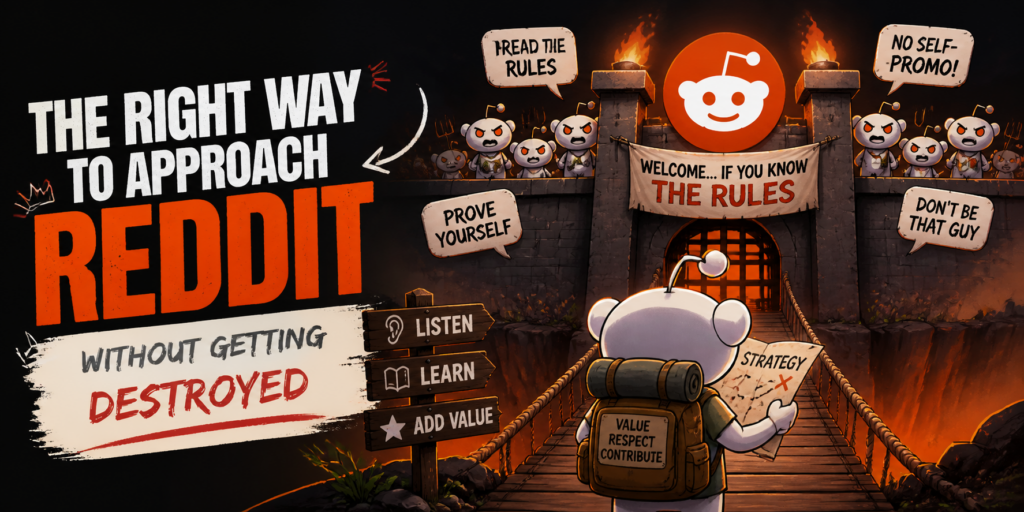
The Right Way to Approach Reddit Without Getting Destroyed
The first thing to understand about this platform is that it has a memory. Every comment, every post, every interaction you make is attached to your account history and visible to anyone who looks. Communities have members who specifically examine the history of new accounts that seem promotional. If your first twenty interactions are all upvoting your own content or directing people to your website, you will be identified and removed — often permanently, sometimes publicly in a way that damages your brand’s reputation within that community for years.
The correct starting approach is counterintuitive for most marketers: spend your first month doing nothing promotional. Join the communities that are relevant to your industry or your audience. Read. Comment on other people’s posts with genuinely useful responses. Ask questions. Participate in discussions that have nothing to do with your business. Build what the platform calls karma — a score that reflects your participation history — before ever mentioning your own work. This investment period feels slow and indirect, but it’s the only foundation that survives long-term.
Community selection is more strategic than it appears. Highly active communities with millions of members are competitive and often heavily moderated. Smaller, more specific communities — often called subreddits — can be significantly more valuable for business purposes despite their smaller audience, because the members are more precisely aligned with your specific niche, more likely to be genuinely interested in what you offer, and the volume of content is lower so individual high-quality contributions stand out.
📌 The 9:1 Participation Rule:
For every piece of content or comment that references your own work, make nine genuine contributions to the community that reference nothing about your business. This ratio isn’t an arbitrary social media best practice — it’s the threshold at which experienced community members stop seeing you as a marketer trying to extract value and start seeing you as a genuine participant who happens to have relevant expertise. Below this ratio, you’re always one skeptical commenter away from being called out publicly.
When you do eventually share your own content or mention your business, the framing matters enormously. “I wrote about this topic — here’s the link” is promotional and will be received as such. “Someone asked a similar question in another thread and I tried to address it comprehensively — it might help here too” is contextual and service-oriented. The underlying action is the same; the perception is completely different. The platform rewards answers that feel like they serve the community even when they also happen to serve the person giving them.
- ► Read each community’s rules before posting anything — they vary significantly and violations have immediate consequences
- ► Build at least 100 karma points through genuine participation before attempting any self-referential content
- ► Target communities with between 10,000 and 500,000 members for the best balance of audience size and content visibility
- ► Never create a new account specifically to promote your business — use or build a genuine account with authentic history
- ► Respond to comments on your posts — community members notice when contributors disappear after posting
Building a Quora Presence That Actually Generates Business

Building a Quora Presence That Actually Generates Business
The approach here is structured differently because the platform rewards expertise positioning in ways the other doesn’t. Your profile is your first and most persistent marketing asset on this platform. It should clearly state your professional background, the specific areas you’re knowledgeable about, and ideally include a credential or professional affiliation that gives readers context for why they should trust what you write. A vague profile bio produces vague credibility. A specific, professional profile bio positions every answer you write with authority before a reader processes a single sentence of your response.
Question selection is the skill that separates people who get results from those who don’t. There are millions of questions on the platform — the vast majority with either no answers, poor answers, or answers from people without relevant expertise. These unanswered or poorly-answered questions in your area of knowledge are the highest-leverage opportunities. An excellent answer to a question that receives consistent search traffic can generate inbound visits to your profile and website for years after you wrote it, compounding in value over time in a way that almost no other content investment does.
The structure of a high-performing answer on this platform follows a recognizable pattern. It begins with a direct, clear response to the question — not a preamble, not qualifications, not a throat-clearing paragraph about how complex the question is. Then it supports that answer with specific reasoning, evidence, or examples. Then it addresses the nuances or exceptions that a thoughtful questioner might follow up on. The whole thing should be readable without requiring the reader to work for the information. Answers that require effort to extract the core insight rarely perform well.
💡 The Long-Tail Answer Strategy:
The highest-traffic questions on any platform attract many competing answers. Instead of trying to outcompete dozens of established experts on broad topics, target specific, detailed questions in your niche that have few or no good answers. A comprehensive answer to a specific question with consistent search volume outperforms a mediocre answer to a high-volume general question every time — and requires far less effort to maintain its top position over time.
Links to your own website or content are permitted when they genuinely serve the person asking the question — when the linked resource provides additional depth that the answer itself can’t reasonably contain. The test is honest: if you removed the link and the answer was still complete and useful, the link is probably promotional. If the answer is genuinely less useful without the additional resource, the link earns its place. Readers on this platform are sophisticated enough to recognize the difference, and so is the platform’s algorithm.
What to Post, How Often, and What to Never Do
Frequency on these platforms is a quality-versus-quantity trade-off that most businesses get wrong in the same direction: they post too often with too little care per contribution. A single excellent, detailed, genuinely useful response generates more authority and traffic than twenty mediocre ones — because the excellent response gets upvoted, shared, referenced by others, and occasionally surfaces in search results. The mediocre ones vanish into the noise. If you have thirty minutes to spend on community engagement, spending all of it crafting one excellent answer beats spending three minutes each on ten indifferent ones by a significant margin.
The content that consistently performs well across both platforms shares a characteristic: it’s genuinely specific. Generic advice — “it depends on your situation,” “make sure to do your research,” “there are many factors to consider” — is the content of people who want to appear helpful without taking the risk of being wrong. Specific advice — naming the exact tool, describing the precise process, giving the actual number — is the content of people who have done the thing they’re describing. Audiences on knowledge-seeking platforms have acute radar for the difference.
| Content Type | Performance Level | Why It Works or Doesn’t |
|---|---|---|
| Specific, experience-based answers | Excellent | Readers trust specificity; algorithms reward detailed responses |
| Contrarian takes with solid reasoning | Very good | Generates discussion and signals genuine thinking |
| Step-by-step process breakdowns | Very good | Saves and shares well; bookmarked for future reference |
| Generic opinion without evidence | Poor | Indistinguishable from other mediocre responses |
| Overt self-promotion | Damaging | Downvoted, reported, and remembered negatively |
| Honest mistake corrections | Good | Demonstrates expertise without self-aggrandizement |
| Personal case studies (anonymized) | Excellent | Real-world evidence is the most persuasive content format |
What to never do is a shorter but more important list. Never create multiple accounts to upvote your own content — both platforms detect this and the penalties are severe and permanent. Never copy your blog posts directly into answers — the format mismatch is immediately obvious and the content performs poorly. Never respond to every question with a variation of “this is complicated, hire a professional” — it’s evasive and contributes nothing. And never argue defensively in the comments when someone challenges your answer — engaging thoughtfully with criticism builds credibility, while defensiveness destroys it.
How Community Platforms Affect Your Search Visibility
This is the dimension of community engagement that most marketing guides either skip entirely or address superficially. The relationship between active participation on these platforms and your website’s search performance is real, measurable, and operates through several distinct mechanisms.
The most direct mechanism is the search ranking of the content itself. Both platforms have high domain authority in Google’s assessment, which means their pages rank well for question-based queries — particularly specific, long-tail questions that individual business websites rarely target directly. When you provide the best answer to a question that appears in search results, you’re capturing search visibility in a space that would be difficult or time-consuming to capture through your own website’s content alone. The traffic from that visibility arrives at your platform profile rather than your website directly, but the connection between profile and business is visible to interested visitors.
The indirect mechanism is brand search. When people encounter your contributions on these platforms and want to learn more, many of them will search for your name or your business name in Google. Brand searches signal to Google’s systems that there is genuine interest in your business — a quality and authority signal that correlates with improved organic performance more broadly. Growing your presence on high-authority platforms generates brand search volume that benefits your website’s ranking potential across all queries, not just the ones directly related to the platform content.
📈 How Community Engagement Drives Organic Traffic — A Simplified Flow:
You answer a specific question on a high-authority platform
↓
The answer ranks in Google for that question query
↓
Readers visit the platform, read your answer, view your profile
↓
Interested readers search your name or visit your website directly
↓
Brand search signals increase, reinforcing your site’s authority with Google
↓
Broader organic rankings improve over time as authority compounds
The link signal is the third mechanism — and the most commonly misunderstood. Links from these platforms are typically “nofollow,” meaning they don’t pass traditional link equity in the way that editorial links from other websites do. This doesn’t make them valueless. Nofollow links contribute to a natural link profile, they drive direct referral traffic, and Google’s systems have acknowledged that they’re considered as signals even without traditional link equity. The primary SEO benefit of community platform links is not the direct authority pass — it’s the traffic and brand signal chain described above.
For a complete picture of how this community-level work connects to the broader organic search strategy that produces consistent website visibility, the local SEO guide covers the full system within which these platform tactics operate. And if you’re investing in community engagement but your website isn’t converting the traffic it receives, understanding why your website gets traffic but no leads addresses the conversion layer that determines whether platform-driven visits become actual business.
Turning Platform Traffic Into Real Business Outcomes
Here’s the gap that most community engagement strategies fail to bridge: the distance between “someone read my answer” and “someone became a customer.” Closing that gap requires thinking about your platform participation as the beginning of a customer journey, not a complete marketing action in itself.
Your profile on each platform is the bridge between the answer and the business. On the professional Q&A platform, this means a complete, compelling profile with a clear description of what you do and who you help, a professional photo, credentials that establish relevant expertise, and a link to your website or a specific landing page. On the community-based platform, this means a profile bio that’s specific enough to be intriguing without being promotional, and a username that’s either your name or your brand if the account is being used for business purposes.
📍 The Profile-to-Landing-Page Connection:
The single highest-leverage improvement most businesses can make to their community engagement strategy costs nothing and takes under an hour: create a dedicated landing page on your website specifically for visitors arriving from these platforms. A page that says “Welcome — if you found me through a community answer, here’s more about what I do and how I can help” outperforms a generic homepage for this audience every time. Specificity of context drives conversion, and platform visitors who feel recognized convert at dramatically higher rates than those who land on a standard homepage with no connection to how they arrived.
- ► Create a dedicated landing page on your website for visitors arriving from these platforms — specific context outperforms generic homepages
- ► Use UTM parameters on any links you include to track exactly how much traffic each platform sends
- ► Include an email capture mechanism on pages receiving platform traffic — not every visitor is ready to buy immediately
- ► Make your platform answers complete enough to be valuable on their own — visitors who feel they got the full answer are more likely to trust you enough to explore further
- ► Follow up with commenters who engage positively with your answers — this direct outreach converts at a much higher rate than passive profile visits
The relationship between what you say on these platforms and what your website communicates needs coherence. If your community presence positions you as an expert in a specific area and your website doesn’t clearly reflect that expertise, the visitor who moves from platform to site experiences a disconnect that undermines conversion. The platform creates the expectation; the website needs to fulfill it. For a thorough examination of how to build a website that converts the traffic it receives, the guide on how to get more online customers covers the full conversion picture.
Measuring What’s Working and What Isn’t
Community engagement is notoriously difficult to measure compared to paid advertising or email campaigns, because the conversions it drives are often indirect and delayed. Someone who reads your answer in February might search for your business in May. The attribution chain is real but not cleanly trackable through standard analytics. This doesn’t mean measurement is impossible — it means you need to measure the right things and accept that some of the value will appear in metrics that seem unrelated at first glance.
The metrics worth tracking directly are: referral traffic from each platform (visible in Google Analytics under acquisition sources), brand search volume over time (visible in Search Console as branded query impressions), and the conversion rate of referral visitors from these sources compared to your average conversion rate. Platform referral visitors who convert at a higher rate than average are self-selecting for intent — they arrived because they read your expertise and chose to find out more. That self-selection is valuable and worth quantifying.
Track your most upvoted or engaged answers on each platform. These are your best-performing content assets in this channel — equivalent to your highest-performing blog posts in terms of ongoing traffic generation. Monitor them periodically to see whether they’re maintaining their search rankings and their upvote visibility. When they start declining, an update or expansion of the answer often restores their performance. This maintenance approach treats community answers as living content assets rather than one-time publications.
The Mistakes That Waste Months of Effort
The most common mistake is starting with the wrong objective. Businesses that approach these platforms with the goal of generating quick leads fail consistently. The platforms are structurally designed to resist that approach — they reward genuine contribution and penalize extraction. The businesses that succeed treat community engagement as a long-term brand and authority building investment, and they’re patient about the timeline between participation and measurable business impact. That patience is not passive; it’s strategic.
The second most common mistake is inconsistency. Community presence is built on pattern recognition — community members and algorithms both develop a sense of which contributors are reliable sources of useful content over time. A burst of activity followed by weeks of silence followed by another burst produces no accumulated authority. A steady, modest cadence of genuine contributions over months produces compounding reputation that is difficult for competitors to replicate quickly. Showing up consistently matters more than showing up impressively on any given day.
Ignoring the comment section of your own answers is a tactical error that surprises many first-time community marketers. The comments on a well-received answer are often where the highest-intent engagement happens. People who have specific follow-up questions, who want to challenge an aspect of your reasoning, or who want to share their own related experience — these are exactly the people most likely to convert into actual customers if they have a positive interaction with you directly. Treating the comment section as a passive space that manages itself is leaving your highest-value leads unattended.
Attempting to build presence on too many platforms simultaneously is the final structural mistake. The effort required to participate meaningfully in community-based channels is front-loaded and requires consistent attention. Spreading that effort across four platforms produces mediocre presence on all of them. Concentrating it on one or two platforms — whichever are most relevant to your specific industry and target audience — produces meaningful authority on those platforms. That concentrated authority generates better business outcomes than diluted presence across many channels. The guide on guaranteed SEO services covers how to evaluate whether any marketing channel is producing the outcomes it should — including community-based approaches that are difficult to measure cleanly.
Frequently Asked Questions — Honest Answers
👉 I’ve been active on Reddit for two months and gotten zero website traffic. Is it even worth continuing?
Two months is not enough time to evaluate the channel honestly. Community reputation compounds slowly — the accounts that generate consistent traffic from these platforms typically have six to twelve months of participation history behind them. The more relevant question at the two-month mark is whether your participation is producing upvotes and positive engagement within the community. If yes, the traffic follows as your profile accumulates visibility. If your answers are consistently ignored or receiving no engagement despite genuine effort, the problem is likely the communities you’ve chosen or the content format you’re using — not the channel itself.
🔍 Can I create a business account rather than participating as an individual?
On the community-based platform, business accounts are typically received with deep skepticism and are subject to stricter promotional rules than individual accounts. Many successful community-driven businesses have their founders or team members participate as individuals representing the company rather than as a branded account. The personal credibility transfer is more powerful than the brand mention, and individual accounts face fewer automatic suspicions about promotional intent.
On the Q&A platform, the opposite is somewhat true — professional positioning is valued, and making your business affiliation clear in your profile is not just acceptable but actually helps with credibility signaling. The key distinction is between positioning and promotion: stating your professional background is positioning; every answer ending with a call to contact your business is promotion.
⚠️ My competitor seems to be dominating several relevant communities. Is it too late to enter?
Competition on community platforms works differently from search rankings. A competitor who has established presence in a community hasn’t locked you out of it — they’ve validated that the community is worth investing in. Focus on the questions they haven’t answered well, the niches within the broader topic where their contributions are thinner, and the emerging discussions where no established voice has yet formed. Community reputation is built contribution by contribution, not domain by domain. The space is large enough for multiple credible voices in most topics, and a single excellent answer can establish your presence more effectively than months of mediocre ones from a competitor.
💰 Does paying for advertising on these platforms help or hurt organic community standing?
These are entirely separate tracks. Paid advertising on community platforms doesn’t improve or damage your organic community standing. Your paid ads appear in designated spaces with clear labels; your organic participation appears in community threads. The platforms don’t algorithmically reward or penalize organic content based on whether you’re also running paid campaigns. That said, running paid ads doesn’t substitute for organic participation — they reach different audiences through different mechanisms, and the trust signals that organic community presence builds are not replicable through paid placements. Use both if the budget allows, but don’t conflate them strategically.
📌 Is there any risk to my brand from participating openly in community forums?
Yes, and it’s worth taking seriously. Community forums are public, searchable, and permanent. A poorly worded response, an overconfident claim that turns out to be wrong, or an argument with a community member that goes badly can surface in search results associated with your name or business for years.
The risk management approach is straightforward: never post when you’re frustrated, never make claims you can’t support, acknowledge mistakes openly rather than deleting comments when possible, and maintain the standard in every contribution that you’d be comfortable with a future customer reading. The upside of community engagement is real; so is the downside of doing it carelessly.
🔹 Can I repurpose my community answers as blog content on my own website?
Yes — and this is one of the more efficient content strategies available. An answer that performs well on a community platform has been validated by a real audience as genuinely useful. Expanding that answer into a full blog post on your own site, with additional depth and context, creates website content that you already know addresses a real question that people care about. The reverse is also true with care: blog content can be adapted into community answers, though the formatting needs to change significantly — a directly helpful, conversational tone works in community contexts; a formal blog post structure does not. Never simply copy and paste between formats.