


 Get to WhatsApp

Our manager will contact you
within 15 minutesт
How to Generate Qualified Leads for SaaS: 7 Strategies That Convert
Practical channel breakdown with costs and timelines
How to Generate Qualified Leads for SaaS: 7 Strategies That Convert
Software companies operating in crowded markets face a specific challenge that product-focused founders often underestimate: building something genuinely useful is not enough to attract the clients who need it. The gap between a functional product and a pipeline full of qualified prospects is a marketing problem, not a development one. This article examines the channels and approaches that actually move the needle for lead generation for SaaS businesses — not in theory, but in practice, with attention to what each channel costs, how long it takes to produce results, and where most teams make avoidable mistakes.
What’s Inside This Guide
- — Strategy 1: Organic search and SEO as the foundation of sustainable lead flow.
- — Strategy 2: Google Ads, remarketing, and paid acquisition done right.
- — Strategy 3: Deep service page optimization and semantic coverage.
- — Strategy 4: Information-driven blog content that captures mid-funnel demand.
- — Strategy 5: Local SEO and Google Business Profile for geo-targeted reach.
- — Strategies 6 and 7: Social media, LinkedIn, and YouTube as lead accelerators.
Strategy 1: Organic Search and SEO as the Foundation of Sustainable Lead Flow
There is a reason experienced growth teams at software companies consistently return to organic search as their primary long-term channel. Paid traffic stops the moment you stop funding it. Content and authority built through consistent SEO work compounds quietly over months and years, generating leads without a per-click cost attached to each one. For a SaaS business with recurring revenue ambitions, that compounding dynamic is enormously valuable.
But organic search for software companies is not the same as organic search for a local restaurant or a retail brand. The queries are more technical, the buyers are more skeptical, the competition is often entrenched, and the conversion path is longer. Someone searching for “CRM integration for accounting firms” is not going to fill out a contact form on their first visit. They are researching, comparing, assessing credibility, and looking for evidence that you understand their specific context. Your content and site architecture need to reflect that.
The compounding argument for SEO:
A well-optimized article targeting “custom banking software development cost” may take four to six months to reach page one. Once there, it generates qualified traffic every month without additional spend. After twelve months, that single piece of content may have produced more leads than an equivalent paid campaign — at a fraction of the ongoing cost.
The practical starting point for SEO for SaaS lead generation is a thorough keyword and intent mapping exercise — not just finding queries with search volume but understanding what stage of the buying process each query represents. Navigational queries (“CompanyX pricing”), informational queries (“how much does ERP development cost”), and commercial queries (“best project management software for construction companies”) require completely different content treatments and convert at very different rates.
For software companies specifically, the technical side of SEO deserves more attention than it typically receives. Sites built on complex JavaScript frameworks often have indexation issues that prevent pages from being crawled and ranked properly. Page speed on product and feature pages is frequently neglected in favor of visual richness. Schema markup for software products, pricing, and reviews is underutilized across the industry. These are not glamorous fixes, but they are often the difference between a site that ranks and one that does not — despite having strong content.
If you want a curated view of how the best agencies approach organic growth for software products, the guide covering 11 best SaaS SEO agencies offers a useful benchmark for what serious execution looks like at this level.
Strategy 2: Google Ads, Remarketing, and Paid Acquisition Done Right
Paid search is the fastest way to generate a lead for a software product — and also one of the fastest ways to waste a significant budget without getting much to show for it. The difference between a Google Ads campaign that produces qualified pipeline and one that produces clicks with no conversions almost always comes down to targeting specificity, landing page alignment, and the way remarketing is used once someone has already interacted with the brand.
For lead generation for software companies, broad keyword targeting in Google Ads is consistently ineffective. Generic terms like “project management software” or “CRM system” carry enormous competition and attract buyers at wildly different stages, from curious students doing research to enterprise procurement teams with budget allocated. The cost-per-click for these terms is high precisely because everyone is bidding on them, and the conversion rate is low because the intent is diffuse. Tighter targeting around specific use cases, industries, and integration needs produces better results at lower cost per qualified lead.
Remarketing is where most SaaS companies leave money on the table:
The majority of visitors who land on a software product page do not convert on the first visit. A properly configured remarketing sequence — showing relevant ads to previous visitors as they browse other sites, use YouTube, or search again — keeps your product visible during the consideration period and dramatically improves the conversion rate from traffic you have already paid to acquire.
Landing page design is arguably more important than the ads themselves. A visitor who clicks an ad about “inventory management software for wholesale distributors” and arrives at a generic homepage has almost certainly lost interest within fifteen seconds. The page needs to confirm the exact match between the query and the offer, present credibility signals immediately (case studies, client logos, specific results), and make the next step — a demo request, a free trial, a discovery call — frictionless and low-commitment.
The question of how much does SaaS lead generation cost through paid search is highly context-dependent. In broad terms, software companies should expect to spend between $3,000 and $8,000 per month to run a properly structured Google Ads campaign with dedicated landing pages and a remarketing layer. Enterprise software targeting corporate buyers in competitive categories will require significantly more. The cost per lead in software categories typically runs between $80 and $400 depending on the niche and targeting quality — and improving that number is almost always a landing page optimization challenge rather than a bidding strategy challenge.
Strategy 3: Deep Service Page Optimization and Semantic Coverage
This is one of the most underutilized levers in the entire toolkit for software companies, and the reason it works so well is straightforward: specific queries are dramatically less competitive than generic ones, and the people typing them are dramatically further along in their buying process. Someone searching for “software development for banking applications Los Angeles” is not browsing — they are shopping.
The standard approach most software companies take to their website is to have a homepage, a general services page, and perhaps a few case study pages. This gives organic search almost nothing to work with. The semantic footprint is tiny. There are no pages that match specific queries from buyers in specific industries looking for specific types of software. Creating those pages — and building them properly, with real depth rather than thin marketing copy — is one of the highest-leverage organic investments available.
What does a properly built service page look like in this context? It goes significantly deeper than a few paragraphs of description and a contact form. It addresses the specific concerns a buyer in that vertical has: typical project timelines, integration considerations, compliance requirements, pricing ranges, common challenges that arise during development, and how your approach addresses them. It includes a substantial FAQ section that anticipates the questions a qualified prospect is likely to ask before committing to a conversation. It uses the language of the industry, not the language of your internal product documentation.
- ➤Dedicated pages for each software category: ERP, CRM, banking, logistics, healthcare, legal
- ➤Integration-specific pages: “Salesforce integration services,” “QuickBooks API development”
- ➤Technology stack pages: “React Native app development,” “Python backend development for fintech”
- ➤Compliance and regulatory pages: “HIPAA-compliant software development,” “SOC 2 ready application architecture”
- ➤FAQ blocks on every major service page covering pricing, timelines, team structure, and post-launch support
- ➤Case study integration within service pages, not hidden in a separate portfolio section
The SEO impact of this approach is significant and relatively fast compared to competing for broad category terms. A page targeting “custom accounting software development for mid-size manufacturers” may rank within three to five months because almost no one else has built that page with genuine depth. And the lead who finds it through that specific query is already pre-qualified in a way that a visitor from a generic ad never is. This is the core logic behind SaaS marketing strategies that prioritize long-tail organic capture over short-term brand visibility.
For a broader understanding of what professional SEO services for software products cover and how they are structured, the page on SEO services for SaaS provides a detailed breakdown worth reviewing before making any investment decisions.
Strategy 4: Information-Driven Blog Content That Captures Mid-Funnel Demand
The informational blog is not a nice-to-have for software companies — it is one of the primary mechanisms through which how to generate leads for SaaS becomes a systematic, scalable process rather than a one-off activity. The reason is simple: the vast majority of buyers in the software space spend weeks or months researching before they speak to a vendor. A company that is present and useful during that research phase has a significant trust advantage when the buyer finally does initiate contact.
The type of content that drives qualified traffic for software companies is not generic thought leadership or industry trend commentary. It is specific, practical, question-answering content that addresses the queries buyers are actually typing during their research phase. “How much does it cost to develop a custom CRM?” “What is the difference between SaaS and on-premise deployment?” “How long does ERP implementation take for a company with 200 employees?” “Which compliance certifications does healthcare software need in California?” These are real questions with specific answers, and the companies that answer them thoroughly and clearly build authority and trust in ways that no amount of advertising can replicate.
One critical mistake in SaaS content marketing:
Publishing content about your company’s perspective on industry trends is not the same as publishing content that answers buyer questions. The former attracts industry peers. The latter attracts prospects. Both have value, but confusing them leads to blogs that generate social shares but almost no leads.
Content also serves a conversion function that gets underappreciated in planning discussions. A visitor who has read three articles on your blog, each of which demonstrated specific expertise in their industry’s software challenges, arrives at your contact page with a fundamentally different level of trust than someone who landed on your homepage from a cold ad. The content has done pre-selling work that no sales team can replicate at scale. This is why lead generation for it companies with a consistent content program tends to produce leads that convert to clients at significantly higher rates than leads from paid channels alone.
If you are looking at this from a diagnostics angle — your blog is attracting traffic but the leads are not materializing — the analysis of why your website gets traffic but no leads is worth reading before you produce more content, because the problem is often not the content volume but the conversion architecture around it.
Content Plan for SaaS Topics: 3-Month Framework
| Period | Article Topic | Target Intent |
|---|---|---|
| 1 | How much does custom CRM development cost for a mid-size company? | Commercial — budget research |
| 1 | Banking software development: compliance requirements and typical project scope | Informational — industry-specific |
| 1 | CRM integration with QuickBooks: what it takes and what it costs | Commercial — integration research |
| 2 | How long does ERP implementation take? A realistic timeline breakdown | Informational — pre-purchase |
| 2 | Online service development for logistics companies: features, costs, and platforms | Commercial — vertical-specific |
| 2 | HIPAA-compliant software development: what developers need to know in practice | Informational — compliance-focused |
| 2 | SaaS vs on-premise: which deployment model is right for a growing business? | Informational — comparison |
| 3 | How to choose a software development partner: 10 questions to ask before signing | Commercial — vendor evaluation |
| 3 | Accounting software development: modules, integrations, and pricing ranges | Commercial — product research |
| 3 | What does custom software development actually include? A breakdown of deliverables | Informational — expectation setting |
Strategy 5: Local SEO and Google Business Profile for Geo-Targeted Reach
There is a widespread assumption among software companies that local search optimization is not relevant to them — that because software is delivered digitally and clients can be anywhere, geography does not play a role in how they are found. This assumption costs a significant number of software businesses a reliable stream of high-converting leads every month.
The reality is that many buyers of custom software development and SaaS solutions actively search with geographic intent. “Software development company in Los Angeles,” “CRM integration services Chicago,” “custom ERP development New York” — these queries exist, they have commercial intent, and they convert at exceptional rates because the person typing them has already decided to work with a local or regionally based team. Competition for these terms is considerably lower than for national terms, and a well-optimized local presence can capture this traffic consistently.
Google Business Profile for software companies:
A fully optimized GBP listing — with complete service descriptions, category selections that match your actual offerings, regular posts, and a consistent review acquisition process — can generate local visibility that would otherwise require months of competitive organic work. It is one of the fastest ways to appear in local search results for high-intent commercial queries.
Google Business Profile optimization for a software company or development agency follows the same principles as for any professional services business, with some specific emphases. Service categories need to reflect the actual nature of the work — not just “software company” but the specific types: custom software development, web application development, API integration services. The description should use the language buyers use when they search, not internal product terminology. And the review strategy needs to be systematic: asking satisfied clients for reviews consistently, responding to every review promptly, and using the Q&A section to pre-answer the most common questions buyers ask before contacting you.
For software companies targeting clients in specific metropolitan areas, building location-specific landing pages that pair with the GBP listing amplifies the effect significantly. A page dedicated to “software development services in Houston” that links to and is referenced from the GBP profile creates a coherent local signal that improves visibility for geo-modified queries across the board. The local SEO guide covers the full architecture of how these elements work together in practice.
Strategies 6 and 7: Social Media, LinkedIn, and YouTube as Lead Accelerators
Social media and video content occupy a specific and often misunderstood role in the lead generation mix for software companies. They are rarely primary lead sources in the way that organic search or paid acquisition are. But they play a critical supporting role in shortening the consideration cycle, building the kind of familiarity that converts skeptical prospects into warm ones, and distributing the content created through other channels to audiences that would not have found it otherwise.
LinkedIn is the most commercially relevant social platform for B2B software companies and development agencies. The audience is professional, the targeting capabilities for paid campaigns are genuinely useful for reaching specific buyer profiles (industry, company size, job function, seniority level), and the organic reach for thought leadership content — when it is genuinely useful rather than promotional — is higher than on most other platforms. A founder or lead engineer who publishes substantive content about specific technical challenges, implementation lessons, or industry observations builds credibility with exactly the audience most likely to become clients.
- ➤LinkedIn: thought leadership posts from founders and senior engineers, case study summaries, and targeted paid campaigns to specific buyer personas
- ➤Facebook: community engagement in industry-specific groups, retargeting campaigns to website visitors, and brand awareness content for consumer-facing SaaS products
- ➤Instagram: useful primarily for employer branding and culture content that attracts talent, secondarily for B2C-oriented software products
- ➤YouTube: product walkthroughs, feature explainer videos, client testimonials, and how-to content that answers buyer questions in video format
- ➤X (formerly Twitter): industry commentary and engagement with the developer community, useful for developer tools and open-source adjacent products
YouTube deserves specific attention because it is consistently underused by software companies despite being the second-largest search engine in the world. A structured channel that publishes product walkthrough videos, implementation tutorials, client case study interviews, and answers to specific buyer questions serves multiple functions simultaneously: it builds trust with prospects in the consideration phase, it ranks in YouTube search for relevant queries, and it gives your team an owned media asset that compounds in value over time without ongoing per-view costs.
The format that converts best on YouTube for software companies is not polished brand video — it is specific, useful content that solves real problems. A fifteen-minute walkthrough of how your software handles a specific compliance scenario, explained clearly by someone who knows the subject deeply, will outperform a two-minute brand film in both views and lead conversion. The audience watching it is pre-qualified. They searched for that specific topic, they found your content, and they are now spending fifteen minutes with your brand before they ever visit your website.
Channel Comparison: Investment, Cost, and Time to First Results
| Channel | Approximate Monthly Investment | Time to Measurable Results |
|---|---|---|
| Organic SEO (full-service) | $1,500 – $5,000 | 3–6 months for initial rankings; 6–12 months for consistent lead flow |
| Google Ads (search + remarketing) | $3,000 – $10,000+ (ad spend + management) | 2–6 weeks for first leads; optimization takes 2–3 months |
| Service page SEO build-out | $500 – $2,000 per page (one-time) | 3–5 months per page to reach competitive positions |
| Blog content program | $800 – $3,000 (4–8 articles/month) | 4–8 months before organic traffic becomes consistent |
| Local SEO + Google Business Profile | $400 – $1,200 | 4–10 weeks for local pack visibility improvements |
| LinkedIn organic + paid | $1,000 – $4,000 (ad spend + content) | 4–8 weeks for paid; 3–6 months for organic authority |
| YouTube channel development | $1,200 – $3,500 (production + publishing) | 4–9 months before channel gains consistent search traction |
| Facebook/Instagram retargeting | $500 – $2,000 (ad spend) | 2–4 weeks for first results; ongoing optimization required |
Additional Lead Sources Worth Building Into Your Strategy
Beyond the seven core channels, several supplementary lead sources consistently produce results for software companies that invest in them properly. The common thread is visibility in places where your buyers are already present and already looking for what you offer.
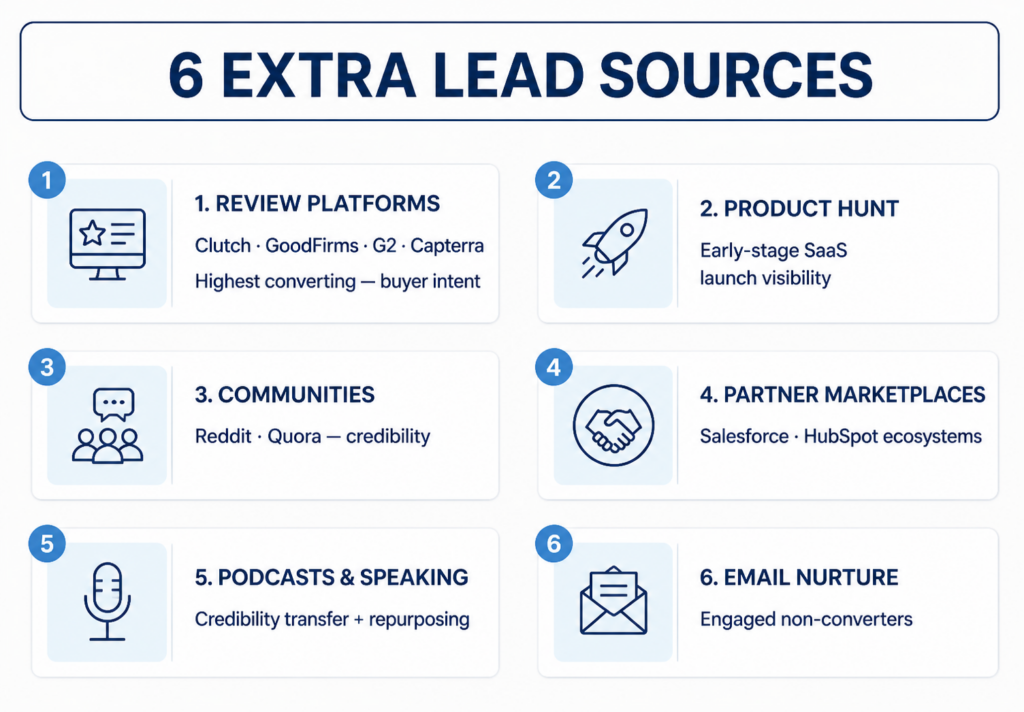
Industry directories and review platforms are among the highest-converting sources for software and development services. Clutch, G2, UpCity, GoodFirms, and similar platforms receive consistent traffic from decision-makers who are actively comparing vendors. A well-maintained presence on two or three of these platforms — with complete profiles, genuine reviews from past clients, and accurate service categorizations — generates leads at a cost-per-acquisition that is difficult to beat through advertising. The buyers who come through these platforms have typically already decided to purchase; they are evaluating which company to purchase from.
- ➤Clutch and GoodFirms: primary directories for development and IT services companies, with strong buyer intent traffic
- ➤G2 and Capterra: software-specific review platforms where buyers compare products and services directly
- ➤Product Hunt: useful for early-stage SaaS products seeking initial user acquisition and visibility
- ➤Reddit and Quora: community presence in relevant technical and business subreddits and topic threads, useful for building organic visibility and credibility
- ➤Partner and integration marketplaces: listing your product in Salesforce AppExchange, HubSpot’s marketplace, or similar platforms connects you directly with users of complementary software
Podcast appearances and speaking slots at industry events — both virtual and in-person — are another often-overlooked source of high-quality leads. A founder who speaks at a conference attended by their target buyer profile generates brand recognition and direct inquiries that no digital campaign can replicate. The credibility transfer from being invited to speak is immediate and significant, and the content can be repurposed into written and video formats that extend its reach well beyond the original audience.
Email sequences for prospects who have engaged with content but not converted are another channel worth building systematically. A visitor who downloaded a white paper or read four blog articles is signaling interest without initiating contact. A well-structured email nurture sequence — not aggressive sales outreach, but genuinely useful content delivered at a measured pace — keeps the company present in that prospect’s awareness during the consideration period and significantly increases the probability of eventual conversion.
The question of how much does SaaS lead generation cost across all channels combined depends heavily on which mix you pursue and at what investment level. A realistic full-stack program combining organic, paid, content, and platform presence typically runs between $5,000 and $15,000 per month for a mid-size software company. The ROI case is straightforward when each new client represents a recurring revenue relationship worth tens of thousands of dollars annually.
For practical guidance on converting the website traffic that your lead generation efforts produce, the analysis of how to generate leads from your website addresses the conversion side of the equation with specific, implementable recommendations.
The best lead generation software argument:
When people search for best lead generation software, they are often looking for a tool to automate prospecting. But for software companies, the highest-performing lead generation tool is usually the website itself — when it is properly structured, technically sound, and filled with content that matches exactly what buyers are searching for at each stage of their decision process.
Understanding how to generate leads for SaaS is ultimately about building multiple channels that reinforce each other rather than relying on a single source. Organic search brings in buyers who are actively researching. Paid search captures buyers who are ready to act. Content builds trust during the consideration period. Social and video maintain presence and accelerate the familiarity that converts strangers into clients. And review platforms and directories close the loop by providing the social proof that turns interest into commitment.
SaaS lead generation services from a specialized SEO agency rather than a generalist marketing firm will typically produce better results in this category precisely because the channel mix, content strategy, and technical SEO requirements for software companies are specific in ways that require genuine domain knowledge to execute correctly. A generalist team will approach a software company’s marketing the same way they approach a retail brand’s — and the difference in outcome reflects that mismatch.
Why World SEO Agency Is the Right Partner for SaaS Growth
1. Industry Expertise in SEO for SaaS
We work specifically with software companies, development agencies, and technology-adjacent businesses. This means our team understands the buyer psychology, the query patterns, the competitive dynamics, and the conversion challenges of this category in a way that non-specialist agencies do not. Our content writers understand the difference between a CRM and an ERP. Our technical team knows what JavaScript framework issues do to indexation. That domain knowledge is reflected in every deliverable we produce.
2. 90-Day Performance Commitment
On our top-tier plan, measurable progress on agreed metrics is expected within 90 days. If we have not delivered against the targets defined at the start of the engagement within that window, we continue working at no additional charge until we do. This is not a sales phrase — it is written into the contract. We take on projects we have assessed as winnable, which means we are selective about the clients we accept and rigorous about the strategy we propose.
3. Affordable Pricing
Our plans are structured to be accessible to growing software companies that are not enterprise-scale but are serious about building sustainable lead flow. We do not believe quality search optimization should be available only to companies with massive marketing budgets. The pricing reflects real, full-service work without the overhead of agencies that charge premium rates primarily to cover their office leases and account management layers.
4. All-Inclusive System With No Hidden Costs
Every component described in our plans is included in the stated price. Content, technical implementation, link acquisition, reporting — nothing is gated behind an upsell. The price in the proposal is the price you pay. We operate this way because we believe transparent commercial relationships produce better long-term outcomes for both sides.
5. Working in the US and Globally
Our team works with software companies across the United States and in international markets including Europe, the Middle East, and Southeast Asia. We have hands-on experience with multilingual SEO, country-specific search behavior, and the technical requirements of multi-region digital infrastructure. Whether your market is a single US city or a multi-country enterprise rollout, the strategic fundamentals we apply remain consistent — only the execution adapts.
Want to order services to promote your software company? Get a consultation from an SEO expert. Submit your request.
❓ Frequently Asked Questions
— Is it realistic to generate qualified leads through organic search alone for a software company?
For most software companies, organic search alone is not enough in the early stages — the timeline is too long. But combined with paid acquisition in the first six to twelve months, it becomes the most cost-effective lead source once it matures. The goal is to reduce dependence on paid over time, not eliminate it overnight.
— How specific do service pages need to be to rank effectively?
Very specific. A page titled “Software Development Services” competes against thousands of results. A page titled “Custom Inventory Management Software for Wholesale Distributors” competes against almost none — and attracts buyers who are already pre-qualified by the specificity of their search.
Depth matters as much as specificity. The page needs to answer the questions a buyer in that vertical would actually have, not just name the service and add a contact form.
— What is a realistic cost per lead for a software development company using Google Ads?
Depending on the niche and targeting quality, $100 to $400 per lead is typical. Enterprise software targeting corporate buyers in highly competitive categories can run significantly higher. Improving landing page conversion rates is almost always more effective than reducing bids.
— Does a software company really need a presence on LinkedIn if it already invests in SEO?
Not mandatory, but valuable. LinkedIn reaches buyers who are not actively searching but are open to discovering solutions. It shortens the consideration cycle for buyers who encounter your brand through other channels and then verify credibility through your LinkedIn presence before making contact.
— How many articles per month does a SaaS blog need to publish to see meaningful SEO results?
Quality and strategic alignment matter more than volume. Four well-researched, buyer-focused articles per month targeting specific long-tail queries will outperform twelve thin pieces targeting generic terms. Start with a content audit to identify gaps before committing to a publication frequency.
— What makes SaaS lead generation different from lead generation for other B2B categories?
The consideration cycle is longer, buyers are more technically sophisticated, and the decision often involves multiple stakeholders. Content needs to address different buyer personas — technical evaluators and business decision-makers — simultaneously, with material that satisfies both without alienating either.
The SaaS category also has a higher concentration of comparison shopping, making review platform presence and content that directly addresses competitive alternatives more important than in categories with fewer substitutes.
— Is YouTube worth the investment for a development company with a small team?
If production quality is manageable and the topics are genuinely useful, yes. A small channel with twenty focused videos answering real buyer questions will consistently outperform a polished channel with five brand videos. The investment in time is significant, but the lead quality from video-first buyers tends to be high.
— What is the first thing a software company should fix if its website has traffic but no leads?
Almost always the conversion architecture: unclear calls to action, a contact form that asks for too much information before establishing trust, or a mismatch between what the page promises and what the visitor actually finds. Traffic and conversion are separate problems requiring separate solutions.
— How long before SaaS lead generation through content marketing becomes self-sustaining?
Typically twelve to eighteen months of consistent publishing before organic content becomes a reliable, independent lead source. The curve is slow initially and then accelerates as domain authority accumulates and more articles reach competitive positions simultaneously.
— Is it worth investing in review platforms like Clutch for a newly launched development company?
Yes, and the earlier the better. Building a review presence takes time because reviews accumulate gradually. A company that starts on Clutch or G2 in its first year of operation has a significant advantage over competitors who wait until they already need the leads to begin building their profile.