


 Get to WhatsApp

Our manager will contact you
within 15 minutesт
Website Promotion Services for Small Businesses in Los Angeles: What Actually Works
A Practical Guide, Not Theory
Our team put together this detailed guide so you understand how we promote websites for small businesses in Los Angeles, which tools we use, what is included in the services, what it costs, and how long results take. We want to show you why our approach to online marketing is effective and why clients in this city keep coming back. This is a full guide from our experts. You can also order website promotion services in Los Angeles from our agency on an all-inclusive basis, including small business SEO services in LA. Submit a request using this form and receive a free audit.

Website Promotion Services for Small Businesses in Los Angeles
Sharing the Secrets of How We Promote Websites in Los Angeles
⚡ Quick Answer
For a small business in Los Angeles, the most reliable path to consistent website traffic and customer calls is a combination of search engine optimization, a focused Google Ads campaign, a well-structured site with detailed service and location pages, a blog that answers real questions, and a claimed Google Business Profile. Social media, YouTube, outreach, and link building amplify everything else once the foundation is solid. Expect the first measurable signals in two to four months and meaningful compounding after six to twelve.
What’s Inside This Guide
— Why promoting a business in Los Angeles is a different problem.
— Search engine optimization: the channel that owns your future.
— Google Ads and remarketing without waste.
— Site architecture: service pages, location pages, and FAQ blocks.
— The blog that answers real questions and attracts buyers.
— Google Business Profile: the listing that closes trust gaps.
— Social media on Facebook, Instagram, and LinkedIn.
— YouTube product walkthroughs and service reviews.
— Outreach, organic mentions, and link building done right.
— Frequently asked questions from business owners.
Why Promoting a Business in Los Angeles Is a Different Problem
People talk about Los Angeles as one city. In practice it is about fifteen cities stitched together by freeways, and each of them has its own character, its own buyer, and its own search behavior. A plumber in Encino is not competing with the same list of businesses as a plumber in Long Beach. A salon in Silver Lake attracts clients who search differently from the same salon in Calabasas. Any website promotion strategy that treats the entire metro as a uniform market is guessing, and guessing here is expensive.
The scale of competition is the second reality. This is one of the largest consumer markets in the country, which attracts vendors from outside the city, national chains, and online-only businesses that run ads locally. A business that relies on walk-in traffic or word of mouth is usually sharing the sidewalk with competitors who invest heavily in being found first. The question is not whether to promote. The question is which combination of channels makes sense for the budget, the customer type, and the stage the business is at.
The third reality is that buyers here have high expectations and low patience. A website that loads slowly on a phone, hides the phone number, or answers the wrong questions on the homepage does not get a second chance. The visitor closes the tab and calls the next result. Getting people to the site is half the job. The other half is making sure the site earns their attention in the first seven seconds. If you have ever wondered why your website gets traffic but no calls, the answer almost always lives in those seven seconds.
The neighborhood effect
Search results in Los Angeles shift with location. Someone searching from Culver City and someone searching from Pasadena will see different businesses in the map pack, even for identical queries. This is not a glitch. It is geography working as intended, and it is exactly why neighborhood-specific pages and a well-managed profile matter more in this market than in smaller cities.
What actually works in this market is a layered approach. No single channel carries a business from invisible to fully booked on its own. Organic search builds the lasting asset. Paid search buys speed and data. The site earns trust once people arrive. The blog captures people who are still deciding. Social media keeps the brand present during the long pause between first visit and first purchase. Video proves the work is real. Links from other sites tell search engines the business is worth showing. Each layer supports the others, and removing one weakens the whole.
This guide walks through every layer with enough practical detail to plan a real campaign, choose the right tools, set honest timelines, and decide what to do first with a limited budget. It is written for owners and marketing leads who have been burned by vague promises and want to understand what they are actually buying. For a wider view of how the digital market is structured in this city, our overview of the Los Angeles SEO agency landscape gives useful context before you evaluate any provider.
Search Engine Optimization: The Channel That Owns Your Future
If I could keep only one channel for a local business in Los Angeles, it would be organic search, and the reason is not simply traffic volume. It is the quality of the conversation that happens before a visitor ever arrives. Someone who found you by reading your answer to a question they typed is already a half-qualified buyer. They have seen how you explain things. They know what you charge, roughly. They understand the problem you solve. Paid ads can interrupt. Organic search can persuade.
The practical starting point is the foundation: the technical layer that search engines use to decide whether your pages are worth indexing and ranking. A slow page, especially on a phone, is a ranking disadvantage and a trust problem at the same time. A site that hides content inside JavaScript that crawlers cannot read is invisible regardless of how well the visible copy is written. Duplicate URLs created by filters or parameters confuse crawlers and split ranking signals between pages that should be consolidated. Fixing these things first is not glamorous, but it is the work that makes everything else pay off faster.
After the technical layer, attention moves to on-page relevance. Each service page should be built around the question a buyer actually asks, not around how the business describes its own work. A cleaning service page that opens with the company’s founding story and a list of values is wasting the first screen. A page that opens with the problem the visitor has, explains what the service includes, shows what it costs roughly, and tells them what happens next is doing the job. This is not copywriting technique. It is a plain decision to put the reader first.
Local signals are where Los Angeles businesses often leave the most on the table. Name, address, and phone number must match exactly across every directory, the Google Business Profile, and the website itself. A mismatch between the suite number on a directory and the one on the site is a small inconsistency that search engines register as uncertainty. The more certain a search engine is that a business is real, in a specific place, serving a specific area, the more confidently it shows that business to nearby searchers.
How long does organic search take?
Most businesses see their first keyword movements between months two and four, meaningful traffic between months five and eight, and compounding returns after month twelve. The timeline compresses when the technical foundation is clean from the start and the content addresses genuine questions. It extends when the site has accumulated problems that need untangling before new work can take effect.
Authority is the third pillar, and it is where most small businesses stall. Authority comes from places that mention or link to the business from outside. A local journalist quoting the owner. A neighborhood blog reviewing the service. A chamber of commerce listing. A supplier directory. A satisfied client writing a detailed review that uses natural language about the work. These signals accumulate slowly, and they cannot be manufactured quickly without taking risks that sometimes unwind months of honest work. Build them patiently, and they hold their value for years.
For businesses exploring what this involves at a practical level, our page on local SEO services describes the specific components of a neighborhood-level campaign in plain language. And if the goal is growing site traffic significantly, the guide on how to get 1000 visitors a day to your website is honest about the effort that requires, which makes it more useful than most.
What our approach to SEO for small business in Los Angeles looks like in practice:
- ➜A full technical audit in the first two weeks, with a prioritized repair list and a clear owner for each item
- ➜A keyword map built from real search data and customer conversations, organized by service and location
- ➜Rewritten service pages that answer buyer questions rather than recite company descriptions
- ➜Location-specific pages for each neighborhood or city the business actually serves
- ➜Citation cleanup and consistency across the directories that matter in Los Angeles specifically
- ➜Monthly reporting tied to calls, form submissions, and booked appointments, not keyword positions alone
Our Six-Stage Promotion Method That Produces Lasting Results
Most agencies push all the levers at once and then struggle to explain what moved and why. We sequence the work deliberately, because each stage creates the conditions the next one needs. Here is the order and the reasoning behind it.
Stage 1: Internal optimization and technical health. Before anything else, the site needs to work correctly. That means every important page loads fast on mobile, all content is crawlable, URLs are clean, redirects are correct, structured data is present and accurate, and the analytics captures the events that matter. This is not visible to customers. It is visible to search engines and to us when we review performance. Getting it right takes two to four weeks and shortens every subsequent timeline.
Stage 2: Conversion readiness. Traffic without conversion is a cost center. We review every key page from the perspective of a first-time visitor who has never heard of the business. The phone number should be in the top corner, not the footer. The first screen should state what the business does, where it operates, and why it is worth calling. Pricing, process, and credentials should be visible without scrolling past three sections of marketing text. We fix these things before scaling traffic, because fixing them after is slower and more expensive.
Stage 3: Building the blog and content library. Once the foundation is sound, we begin publishing content that answers the questions buyers ask before they contact a business. Each article is built around a real query, written by someone who understands the subject, and linked to the relevant service page. The blog serves two purposes simultaneously: it brings in organic visitors at the awareness stage, and it supports the authority of the product and service pages it links to.
Stage 4: Organic link growth. With content published and indexed, we begin the quiet work of earning mentions and links from outside the site. Directories, community publications, supplier sites, and industry associations are the natural starting points. Guest posts on relevant blogs and quotes in local news follow. This work is slow but durable. A link from a trusted source that has been in place for two years does more than ten links from sources that appeared last month.
Stage 5: Traffic scaling through new pages. As authority builds, we expand the site with additional useful pages: new service variants, deeper FAQ coverage, comparison pages, neighborhood guides, and resource documents. Each new page captures a different set of queries and links to the pages around it, widening the semantic footprint without duplicating or diluting what already exists.
Stage 6: Paid link building. Only after the organic foundation is established do we introduce paid link building through vetted placements on real, relevant sites. At this stage, the domain has enough natural signals that quality additions amplify rather than distort. We document every placement and share the report with the client. We do not use private networks, bulk packages, or any source we would not want a client to see.
Google Ads and Remarketing Without Waste
Paid search gets a bad reputation among small businesses that have burned budget on broad targeting, mismatched landing pages, and campaign structures designed to look active rather than to convert. Done carefully, it is the fastest way to put the business in front of buyers who are ready to act, test messages that later improve organic pages, and cover the gap while organic authority is still building.
The most common mistake is match type. Broad match for a local service business in a competitive city will eat a budget with searches that have nothing to do with the offer: job seekers, researchers, people in other cities, and people comparing prices they have no intention of paying. Start with exact and phrase match on bottom-of-funnel queries where the person is plainly ready to call or book. Add a negative keyword list on day one and review the search terms report every week. That single habit recovers more budget than most optimization tools.
The landing page must match the promise in the ad, not the homepage. If the ad says same-day availability, the page must say it, alongside the conditions that apply. A generic homepage is not a landing page. A page written for the exact offer in the exact ad, with a clear headline, the service details, trust signals such as licenses and reviews, and a prominent phone number and form, converts at a rate that a homepage never will.
Remarketing is where ads quietly earn their keep for local service businesses. Someone who visited the pricing page and left is worth more than a cold visitor. Build separate audiences for people who viewed pricing, people who started a contact form and stopped, and people who read the blog. Write different messages for each. The person who abandoned the contact form does not need a brand awareness message. They need an answer to the objection that stopped them, which is usually timing, trust, or cost.
For a clear-headed comparison of when to invest in ads versus when organic is the better move, the analysis of Google Ads or organic search is worth reading before allocating any budget. The answer depends on the stage of the business and the competitive density of the market, which varies by neighborhood and category across Los Angeles.
Performance Max for small businesses
Google’s Performance Max campaigns can work for local businesses once there is a track record of conversions to train on. Without conversion data, the algorithm guesses and usually spends on broad intent that does not produce calls. Run standard search campaigns for at least ninety days, then introduce Performance Max with brand exclusions and a tight asset group. Never let it run without monitoring the asset-level report.
Site Architecture: Service Pages, Location Pages, and FAQ Blocks That Capture Long-Tail Searches
A website that lists services on a single page called “What We Do” is passing on most of the search traffic in its market. Each distinct service, each service variant, and each neighborhood the business serves is a separate topic in the mind of a searcher, and a searcher who cannot find the specific thing they are looking for does not browse. They leave.
The practical goal is to give every meaningful combination of service and location its own page. A pest control company in Los Angeles does not simply offer pest control. It offers ant treatment, rodent exclusion, termite inspection, bed bug heat treatment, cockroach prevention, and recurring maintenance plans, delivered in Westwood, Santa Monica, Culver City, Mar Vista, and a dozen other neighborhoods. Each of those combinations is a search someone types. Each of them deserves a page.
The same logic applies to FAQ blocks, and they tend to be underbuilt on almost every small business site I have reviewed. Support tickets, chat logs, sales call recordings, and the “People also ask” boxes in search results are all sources of real questions. Collect ten to fifteen for each main service and answer them honestly, plainly, and in complete sentences. A well-built FAQ block captures long-tail searches that the main copy never touches, reduces inbound calls about basic questions, and gives search engines a clear picture of the topic the page covers.
Beyond FAQs, the blocks that earn their space on a service page include a plain-language explanation of what the service involves, a pricing range with the factors that affect it, a step-by-step description of what happens after a customer contacts the business, a list of what is and is not included, photos or video of real work, reviews that mention the specific service, and a clear next step. A page with all of these blocks is a destination. A page with a paragraph and a contact form is a placeholder.
The Blog That Answers Real Questions and Attracts Buyers
A blog for a local service business is not a place for company updates, press releases, or articles about industry trends that customers have no reason to read. It is a question-answering machine. Every post should exist because someone, somewhere, typed a specific question into a search engine, and the business has a credible answer. That is the entire brief.
Where do topics come from? The honest answer is not keyword tools, though those help confirm volume. The best topics come from inside the business: the questions the receptionist hears every Monday, the objections the sales person encounters on the phone, the things customers say they did not understand until after the job was done, and the comparisons buyers make between the business and alternatives. These are real questions from real people, and articles that answer them earn their place in search results through relevance rather than through any technique.
Format matters less than clarity. A short article that answers one question plainly, links to the relevant service page, and ends with an obvious next step is more valuable than a long article that covers everything loosely. For businesses with limited writing resources, a consistent publishing schedule of two or three focused articles per month outperforms a burst of twenty articles published once and then abandoned for six months. Search engines reward freshness and reliability. So do readers.
The blog also supports the services pages in a way that advertising cannot. An article about how to choose a licensed contractor links naturally to the page describing the company’s licensing, insurance, and process. An article about the difference between two service approaches links to both service pages and helps buyers decide. These internal connections build a web of relevance that makes the whole site stronger, not just the individual articles.
Update old articles, do not only write new ones
An article about regulations, pricing, or processes that was accurate eighteen months ago may now mislead readers. Outdated content loses rankings and costs trust. Build a review calendar for existing articles, update the substance where it has changed, refresh the publish date to signal the current version, and check that every internal link still goes somewhere useful.
Google Business Profile: The Listing That Closes Trust Gaps Before the First Click
When a local buyer searches for a service, they usually see a map panel before they see any websites. That panel shows the business name, category, photos, hours, review count, and rating. A buyer scans this in about three seconds and decides whether to click or move on. A profile with seven photos, forty reviews, and correct hours beats a profile with one stock image and twenty reviews, before the visitor has seen a single word on the website.
The setup is not complicated, but it has to be exact. The business name on the profile must match the name on the website and in every directory. The primary category must reflect the main service, not a broad category chosen because it sounds safer. Service areas must list the specific neighborhoods or cities where the business genuinely operates, not a radius drawn around an arbitrary center point. Photos should show real work, the team, and the actual location, not stock images of people looking professional.
Reviews are the heart of the profile, and they cannot be manufactured or rewarded without risk. The best review strategy is a consistent, light process: a short message sent after each completed job, a link that takes the customer directly to the review form, and a reply to every review, including the negative ones, within forty-eight hours. A measured, specific reply to a poor review often reassures prospective buyers more than ten five-star reviews, because it shows the business takes feedback seriously and responds like a grown-up.
The posts feature is underused by almost every small business in Los Angeles. Weekly or twice-monthly posts about recent projects, seasonal offers, or useful tips keep the profile active and give search engines a signal that the business is current. They rarely drive significant direct traffic, but they contribute to the overall impression of a business that is engaged and alive rather than listed and forgotten.
Social Media: Facebook, Instagram, and LinkedIn Without Vanity Metrics
Social media will not be the top source of calls for most local service businesses, and that is an honest statement to make at the start of a section about it. What social platforms do reliably is keep the business visible during the long pause between a buyer’s first awareness and their eventual decision to contact someone. In services with long consideration cycles, such as home renovation, legal help, or financial planning, this visibility matters more than the engagement numbers suggest.
Facebook remains the most practical platform for reaching local adult buyers. The organic reach of company pages is limited, but the combination of a business page, participation in local community groups, and targeted ads reaches a wider and more varied audience than most other platforms at a comparable cost. For businesses that deal primarily with other businesses, LinkedIn is worth the investment. A founder or expert who publishes short, useful posts on LinkedIn, comments on clients’ and partners’ content, and maintains an up-to-date company page builds professional authority that advertising cannot replicate.
Instagram works well for businesses whose work is visual: contractors, landscapers, designers, food businesses, salons, fitness studios, and anyone whose finished product is worth photographing. Short reels showing before and after, explaining a process, or answering a common question often reach more people than polished branded content, because the format feels personal and the algorithm favors it. The tone should be direct and human, not polished. A clip of the owner explaining why a common assumption about their industry is wrong will outperform a produced brand video most of the time.
Whatever platforms you choose, the content calendar should be built from real material. Customer questions become posts. Finished jobs become photos. Owner opinions about common misconceptions become short videos. Repurposing material from blog articles saves time and creates consistency. Posting three times a week every week is worth more than posting every day for a month and then going quiet for six weeks. Consistency signals reliability, and reliability is the first thing a nervous buyer is looking for.
YouTube: Walkthroughs and Real Work That Prove the Service
Video is the format that removes doubt fastest. A buyer who has watched three minutes of a contractor explaining their process, showing a finished job, and answering the questions every customer has at the beginning is in a fundamentally different position than a buyer who read the same information as text. The watch experience creates familiarity. Familiarity creates trust. Trust creates calls. This is not a theory. It is a pattern that shows up repeatedly in attribution data once tracking is set up properly.
YouTube is also the second-largest search engine, and videos from it appear regularly in Google results. A video titled to match a real search query, with a helpful description and accurate chapters, picks up organic views from people who were looking for exactly that information. These views cost nothing once the video is made, and they continue arriving for months or years after publication. That economics is different from paid ads, where the views stop the moment the budget stops.
The formats that work for local service businesses are not polished brand films. They are screen recordings with voice-over explanations, walkthroughs of a finished project, honest comparisons of approaches, answers to the five questions every new customer asks, and short responses to recent reviews or social media comments. A microphone that records clearly, decent lighting, and an edit that removes the long pauses are enough. Production value matters less than the usefulness of what is said.
Keep titles written in the language customers use, not the language the industry uses internally. Put a chapter index in the description so viewers can jump to the part they care about. Embed each video on the relevant service page and mark it up with VideoObject structured data. Add a transcript, either uploaded directly or placed in the description. These small steps improve the chance that a video appears in search results for the subject it covers.
One rule for all video content in regulated industries
Show real accounts and real data only when the owner explicitly consents and the information is anonymized where appropriate. Use demo scenarios and clear labels. In professional services, one careless video that reveals client information or implies a promise the service cannot keep creates problems that no subsequent content can fix.
Outreach, Organic Mentions, and Link Building Done Right
The word “link building” covers a range of activities that have almost nothing in common with each other, from genuine relationship-building that earns editorial references to bulk packages that damage the sites they are supposed to help. Knowing the difference matters, because the wrong approach in a local market can undo months of honest work and require a recovery effort that costs more than prevention would have.
Outreach marketing, in the useful sense, is the act of connecting with people who have platforms and sharing something with them worth publishing. A local journalist covering home improvement stories may be interested in a contractor’s perspective on a building code change. A neighborhood blogger reviewing local services may not know the business exists. A community organization may be looking for expert contributors. These conversations take time and produce one or two links each, but those links come from real sources that real readers trust, and search engines are very good at noticing the difference.
Organic mentions from free sources come from activity that the business would do anyway if it were paying attention. A detailed profile in a local chamber of commerce directory. A listing on the relevant professional association website. A comment on a community forum that answers a question without selling anything. A guest post on a local blog. A submission to a resource directory in the industry. A Medium or Substack piece that links back to a relevant service page. None of these individually changes rankings. Together, over six to twelve months, they build a profile of mentions that tells search engines the business is real, present, and worth showing.
Paid link building is a separate activity and a later-stage one. It involves working with real publishers to place content on their sites, disclosing the relationship where required, and documenting every placement so the client can see exactly where their brand appears. Done through vetted sources with editorial standards, it accelerates the authority-building process without introducing the risk that comes from bulk packages. Done through private networks or low-quality sites, it creates a liability that often surfaces months after the placement, when everyone involved has moved on. For more context on what responsible acquisition looks like, our guide to link building covers the approach and the common mistakes in practical terms.
A short checklist for the organic and outreach layer:
- ➜Claim and complete profiles on the directories most relevant to the specific industry and city
- ➜Write one genuine guest post per month on a blog that the target customer actually reads
- ➜Answer questions on community forums in a helpful way that includes a relevant link naturally
- ➜Publish occasional pieces on platforms like Medium that link to the main site
- ➜Maintain a list of local journalists and editors and provide useful input when they cover relevant topics
The Tools We Use Every Day, With Links to the Full Reviews
Every recommendation we make is backed by data from tools rather than intuition. Here is the stack we rely on and what each does in practice. Prices shift frequently, so verify current terms before building a budget.
Ahrefs is the primary tool for backlink research, content gap analysis, and competitive intelligence. The link intersect report finds publishers that link to multiple competitors but not to the client, which is the most efficient starting list for outreach. The top pages report shows which of a competitor’s articles draw real traffic. The keyword explorer builds query maps from seed terms. We use it every week.
Semrush handles position tracking at scale, advertising research, and market analysis. Its topic research tool is useful for identifying the sub-topics surrounding a broad theme. Its advertising intelligence shows what a competitor pays for and which ads have been running long enough to suggest they convert. For teams that also run paid campaigns, the combination of search and advertising data in one platform saves significant time.
Google Search Console is open in a browser tab on every working day. The queries report, filtered with regex to separate branded from non-branded traffic, shows exactly which terms are bringing people to which pages. URL inspection after any significant site change confirms what the crawler sees rather than what the browser shows. The index coverage report surfaces pages with problems before they affect rankings. It is free, authoritative, and underused.
Google Analytics 4, connected to the CRM where the business tracks actual customers, turns visit data into revenue data. Standard out-of-the-box reports tell you how many people came. Custom reports joined with business events tell you which pages produced calls and bookings. The difference between these two views is the difference between marketing data and business data.
Screaming Frog is the crawling tool we use for technical audits. With JavaScript rendering turned on, it shows what search engines actually see on React and Vue-based sites, which often differ significantly from what the browser shows. Custom extraction pulls title tags, descriptions, word counts, and structured data types from every URL in one pass.
Microsoft Clarity records sessions and produces heatmaps. For a business that wants to understand why a contact form is not converting, watching twenty session recordings is faster and more informative than reading a month of analytics reports. We use it with all sensitive fields masked and recording limited to public, pre-login pages.
CallRail connects phone calls to the marketing source that produced them. When a client tells us that the phone is ringing more since the campaign started, we can confirm which pages, which keywords, and which campaigns deserve the credit. Without call tracking, local service business attribution is guesswork dressed as reporting.
Core SEO Tools That Are Included in Our Services
| Tool | Primary Function | How We Use It in Client Campaigns |
|---|---|---|
| Google Search Console | Search performance and indexing | Query analysis, URL inspection after releases, branded versus non-branded traffic separation, weekly monitoring. |
| Ahrefs | Backlinks, content gaps, competitor research | Link intersect reports for outreach targeting, top competitor page analysis, monthly link profile reviews. |
| Semrush | Position tracking and market data | Weekly rank tracking by service and location, topic research for content planning, ad competitor monitoring. |
| Screaming Frog | Technical site crawling | JavaScript rendering audits, structured data extraction, redirect chain mapping, broken internal link detection. |
| Google Analytics 4 with CRM data | Visitor behavior and conversion analysis | Landing page revenue attribution, organic cohort analysis, goal funnels tied to real customer outcomes. |
| Microsoft Clarity | Session recordings and heatmaps | Identifying form abandonment points, mobile layout issues, and navigation friction before they appear in analytics. |
| CallRail | Call tracking and attribution | Connecting inbound calls to the page, keyword, and channel that produced them for honest reporting. |
Full Growth Checklist: Channels, Budgets, and Time to First Results
| Activity | Tools and Typical Budget | Time to First Results |
|---|---|---|
| Technical site audit and repair | Screaming Frog, Search Console; from $800 to $3,500 one-time or inside a retainer | 2 to 5 weeks |
| Conversion page review and copy improvements | Clarity, GA4; from $400 to $1,500 one-time | 1 to 3 weeks |
| Keyword research and site map | Ahrefs or Semrush; from $600 to $2,000 one-time | 2 to 4 weeks |
| Service page rewrites | Writers; from $200 to $600 per page | 3 to 6 months to rank |
| Location-specific pages | Writers; from $150 to $400 per page | 2 to 5 months per page |
| FAQ blocks on service pages | Support log review plus writers; from $100 to $250 per block | 2 to 4 months |
| Blog publishing, three articles per month | Writers and editors; from $900 to $3,000 per month | 4 to 8 months |
| Google Business Profile setup and ongoing management | Native tools, review software; from $100 to $350 per month | 2 to 6 weeks |
| Citation cleanup and consistency | BrightLocal or Whitespark; from $150 to $500 one-time | 3 to 8 weeks |
| Google Ads search campaigns | Ads Editor; ad spend from $1,500 per month plus 10 to 20 percent management | 2 to 5 weeks for first data |
| Remarketing audiences | GA4 audiences; from $300 to $1,000 per month in spend | 3 to 6 weeks |
| Social media content, three posts per week | Scheduling tool, designer; from $700 to $2,500 per month | 2 to 4 months for brand warmth |
| YouTube videos, two per month | Screen recorder, editor; from $200 to $1,200 per video | 3 to 6 months |
| Outreach and organic mentions | Ahrefs, outreach email tool; from $600 to $2,500 per month | 3 to 8 months |
| Paid link building from vetted placements | Placement database, Ahrefs; from $800 to $3,000 per month | 4 to 9 months for ranking impact |
How to read these timelines honestly
The ranges shown assume a site with no serious existing penalties, a clean technical foundation once repairs are complete, and consistent execution over the period shown. Businesses starting from a weaker position take longer. Businesses in less competitive neighborhoods or categories may see results sooner. No honest provider can be more precise than this without knowing the starting point.
If your priority right now is online marketing for small business without a large upfront investment, our page on affordable SEO services shows how the scope and sequencing can be adjusted to match a smaller budget while still producing meaningful results over time. The key is choosing the right starting activities rather than trying to run all channels at once with insufficient budget for any of them.
When website promotion Los Angeles is the goal, the clearest path is usually technical foundation first, conversion pages second, local profile and citations third, and then content and links in parallel. That sequence makes each investment pay off faster than starting with content on a site that cannot be crawled correctly or ads on a page that does not convert.
What’s Included in Our SEO Packages in Los Angeles? More Profitable and Durable Than Google Ads Alone
| Package | Monthly Price | What’s Included |
|---|---|---|
| START A Profitable Start Get Started → |
from $1,500 / month First result: 3 months |
Website optimization. Top 10 Google rankings. AI (GEO) under Google search. Local SEO with new page creation. Promoted pages: 10. Keywords: 30. |
| BUSINESS Customer Selection ★ Get Started → |
from $2,500 / month First result: 2 months |
Everything in START. Top 5 Google rankings. AI (GEO) optimization. Local SEO with new pages. Promoted pages: 20. Keywords: 100. Regular blog development. Organic backlinks. |
| INDUSTRY LEADER Everything Is Included Get Started → |
from $3,500 / month First result: 1 month |
Full-service SEO. Top 3 Google rankings. AI (GEO) optimization. Local SEO. Unlimited pages and keywords. Regular blog. Organic backlinks. Technical improvements. Paid link building included. Financial commitment applies to this plan. |
Advantages of Our SEO Agency: Why Los Angeles Businesses Choose Us
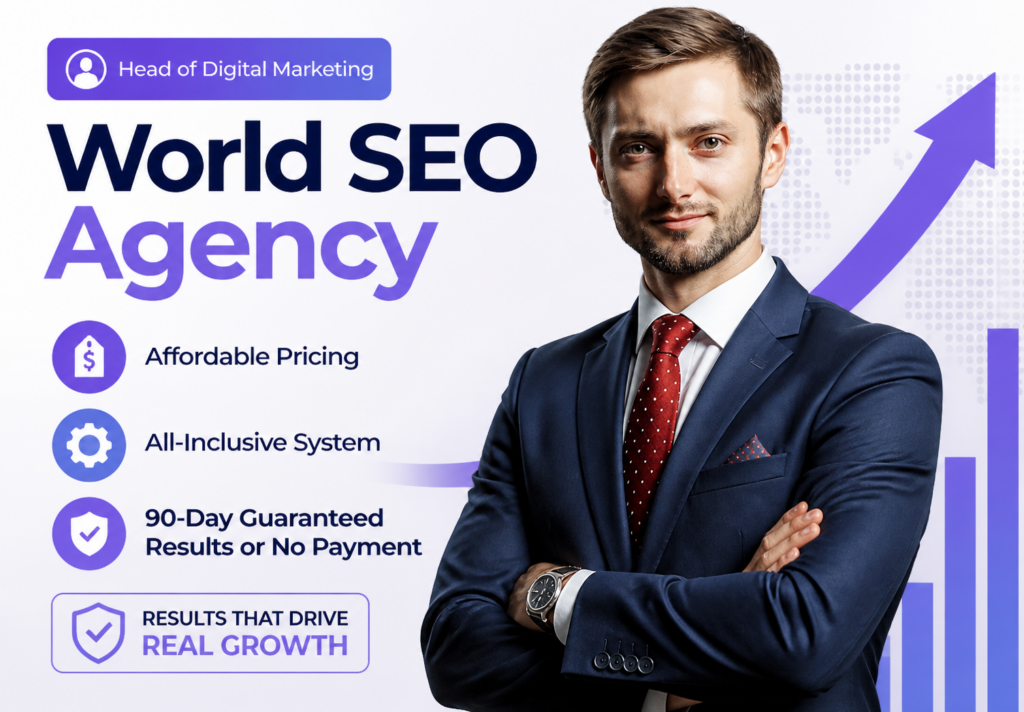
World SEO Agency works with local service businesses, professional practices, and digital brands across Los Angeles and beyond. Here is what the working relationship looks like in practice.
→ 90-Day Performance Commitment
Every engagement begins with a defined plan: which technical issues will be fixed, which pages will be published, which signals should move, and when we sit down together to compare what was promised with what happened. If the agreed benchmarks are not met, we restructure the plan with the client rather than changing the subject. The timeline is honest, and so is the review.
→ Affordable Pricing
Packages begin from $1,500 per month and scale with the number of services, locations, and competitive conditions the business faces. A three-person salon and a twelve-staff legal practice should not pay the same bill, and they do not. The price in the proposal matches the work in the scope, and the invoice matches both. For businesses comparing costs, our page on website marketing services Los Angeles covers what affects the price of a local campaign and how to evaluate whether a quote reflects real work.
→ All-Inclusive System With No Hidden Charges
Technical repairs, service pages, blog content, local profile management, link acquisition, tracking, and monthly reporting are all inside the scope. There are no separate invoices for the tools we use, no surprise fees for extra articles, and no explanation at month three that additional services are needed to see results. The number in the proposal is the number on every invoice.
→ We Work in Los Angeles
Our team understands the specific competitive conditions, neighborhood dynamics, and buyer behavior in this market. We know which directories matter for Los Angeles businesses and which ones do not. We know how search patterns differ between neighborhoods. We know which categories are saturated and which have genuine room to rank. This market knowledge is not transferable from a generalist approach, and it shows in the work.
→ We Bring Industry Expertise Across Many Categories
We have worked with contractors, healthcare practices, legal firms, food and hospitality businesses, real estate agencies, financial service providers, e-commerce brands, and technology companies. Each category has its own search behavior, trust requirements, and compliance considerations. We do not apply a single template. We apply the experience we have built across all of these categories to the specific situation in front of us.
Want to order SEO promotion services for your website in Los Angeles? Get an expert consultation. Submit a request.
❓ FAQ
How long before the phone actually rings more from the website?
Most businesses see the first traceable calls from organic traffic between months four and seven.
The timeline shortens when the technical foundation is clean from the start and the site has existing content to build from. It lengthens when the starting point has accumulated problems. We set expectations at the beginning of every project so the answer is not a surprise six months in.
Should we run ads while SEO is still building?
Yes, if the budget allows both. Ads produce data quickly: which terms produce calls, which landing pages convert, which offers get clicked. That data feeds back into the organic work. The mistake is running ads without also investing in the site, because paid traffic on a poor page wastes both the ad spend and the visitor.
What is the difference between a local listing and a backlink?
A local listing is a business profile on a directory, mapping service, or review platform. A backlink is a reference from one website to another. Both send signals to search engines, but they work differently. Listings confirm that the business is real and consistent. Backlinks from relevant, trusted sites increase the authority that determines how well a site can compete for important queries.
Can we do any of this ourselves without an agency?
Yes, with significant time investment. Claiming your Google Business Profile, writing honest answers to customer questions, publishing one useful blog article per month, and asking satisfied customers for reviews are all things an owner can do without technical expertise. These basics make a real difference. Where most owners run out of time is in the technical, competitive, and content work that requires consistent daily attention.
Why do some sites rank without obvious effort?
Often because the domain is older and has accumulated authority over years, the category has less competition in that specific area, or the site benefits from links built by a previous owner or developer. Apparent effortlessness in rankings is usually past work compounding. The same effect is achievable, with patience and consistent effort. What looks passive is usually a reservoir built over time.
Is social media traffic worth the time it costs?
It depends on the business type. For services with long consideration cycles, social presence keeps the brand visible during the gap between first awareness and first contact. For businesses with quick purchase decisions, the time investment may be better placed in search and local profiles. We recommend starting with two platforms the owner can maintain genuinely rather than spreading across five with thin content.
What happens if the business moves or changes its phone number?
Update every directory, the Google Business Profile, the website footer and contact page, and every structured data reference on the same day.
A mismatch between information sources tells search engines that at least one source is wrong, which creates ranking uncertainty. The update takes a few hours done carefully, and skipping it costs months of local visibility.
How many blog articles do we need before it starts helping?
There is no magic number, but a consistent output of two or three focused articles per month, maintained over six months, typically produces measurable organic traffic from informational queries. The quality of each article and the alignment with real buyer questions matters more than the total count. Twenty precise articles outperform a hundred unfocused ones.
How do we know if the campaign is actually working?
By tracking the events that matter to the business: inbound calls, completed contact forms, booked appointments, and new customer inquiries, with each one attributed to its source. If a campaign can only show keyword positions and traffic numbers, it is showing activity rather than results. We set up call tracking and goal attribution in the first month of every engagement so both sides of the conversation have the same data.
Is link building safe, or will it get the site penalized?
Link building from real publishers with real editorial standards and documented placements is safe and effective. Bulk packages from networks built for the purpose of selling links are risky and become more so over time. The difference is in the source: if a link comes from a site a human being would visit for a real reason, it is an asset. If it comes from a site that exists only to distribute links, it is a liability.