




 Get to WhatsApp

Our manager will contact you
within 15 minutesт
White Label SEO Services: A Complete Guide to Partnering with an Agency
The Partnership Model, Explained Honestly

White Label SEO Services: A Complete Guide to Partnering with an Agency
Finding a responsible white label SEO agency is harder than most people expect. The partner you choose will represent your brand in front of clients who trust you — and if the work falls short, you are the one who answers for it, not the provider working behind the scenes. I’ve been on both sides of this arrangement, and in this guide I share what I’ve actually learned: how the model works, what separates a reliable provider from one that will quietly underdeliver, how pricing structures should be set up, and what the process of becoming an SEO reseller looks like when it’s done correctly. You can also order white label SEO directly through my company — we operate on an all-inclusive model, with a 90-day performance commitment and a partner reward structure that pays 15% of the client’s monthly budget back to you every month. I genuinely don’t know where else you’d find those terms.
What’s Inside This Guide
— What Are White Label SEO Services?
— White Label SEO Services vs. White Label SEO Reseller: What’s the Difference?
— Core Services a White Label SEO Company Should Offer.
— How to Choose the Right Provider: An 8-Point Checklist.
— How to Become an SEO Reseller in 6 Steps.
— Common Mistakes When Using White Label SEO Services.
Every agency reaches a point where client demand outpaces what the internal team can deliver. It might happen at month four, when two new retainer clients come in the same week and the workload suddenly doesn’t fit the calendar. It might happen when an existing client asks whether you handle technical SEO or content production — and you realize that saying no is going to cost you the account. Or it might happen more gradually, as the business grows and the gap between what clients expect and what you can realistically execute without burning out your team quietly widens. The instinct at that point is often to hire — but hiring is slow, expensive, and carries risk if the workload doesn’t sustain itself at the new staffing level.
The alternative that a significant portion of the agency market has settled on — and which many agencies now treat as a permanent structural component rather than a temporary fix — is building the delivery side of the business through a white label arrangement. The client relationship stays with you. The billing stays with you. The brand stays with you. The execution is handled by a specialist provider operating entirely behind the scenes, using your name, your report templates, and your communication style. Done well, this model allows an agency to offer a complete, high-quality service at a price point that supports healthy margins — without the overhead of building a full in-house delivery team. Done poorly, it creates exactly the kind of brand risk that keeps agency owners up at night.
This guide exists to close the information gap between those two outcomes.
What Are White Label SEO Services?
The term “white label” comes from product manufacturing, where a producer creates a good that a retailer then sells under its own brand name. The buyer never knows — or, in most cases, doesn’t particularly care — who made the product. The brand on the label is the brand they chose to buy from, and that relationship is what matters commercially. The same logic applies in the service industry: white label SEO services are search optimization campaigns delivered by one provider but presented to the end client entirely under the branding of the agency that sold them.
In practical terms, the model works like this. A team — whether a web design studio, a broader digital marketing firm, or a consultancy — takes on a client who needs search optimization work. Rather than staffing that work internally, it contracts with a specialist provider to handle execution. The provider does the keyword research, the technical audits, the content production, the link acquisition, and the reporting. But the reports carry the front-facing brand’s logo, the email communication comes from that brand’s own domain, and the client has no visibility into who is actually doing the work. The brand manages the client relationship; the provider manages the campaign.
The core distinction worth understanding early:
White label is not the same as outsourcing in the conventional sense, and it is not the same as referring clients to a third party. In a white label arrangement, the agency retains full ownership of the client relationship, the billing, and the brand presentation. The provider is invisible. That invisibility is the product — and maintaining it requires choosing a partner who understands how to operate that way.
Where white label SEO differs from simply hiring freelancers is primarily in scope and structure. A freelancer typically handles one component — a technical audit, a batch of content, a round of outreach. A white label SEO company handles the entire campaign as an integrated operation, which means the strategy, the execution, and the reporting are all coordinated by the provider rather than assembled from separate contractors by the team. This matters because campaign quality depends on components working together: content targeted at specific query clusters, link acquisition pointing to those same pages, and technical foundations that don’t limit what the content and links can achieve. Fragmented execution across separate freelancers makes that coordination the agency’s problem. A proper white label partner makes it their problem.
The practical example that illustrates the model most clearly is a web design studio that builds sites for small businesses. It is good at design, development, and client communication. When clients ask about search visibility — which they eventually do, because they want their new site to be found — it has two choices: say it’s outside their scope and potentially lose the account, or offer it as a service delivered through a white label arrangement. The second option expands revenue, deepens client relationships, and requires no change to the internal team or hiring plans. The white label provider handles everything behind the brand wall.
White Label SEO Services vs. White Label SEO Reseller: What’s the Difference?
These two terms are often used interchangeably, which creates genuine confusion about what different arrangements actually involve. They describe related but meaningfully different models, and understanding the distinction matters before committing to any specific partnership structure.
White Label SEO Services
In the pure white label services model, the reseller commissions campaign work from a provider on a client-by-client basis. The provider executes under the reseller’s brand, delivers to the reseller’s specifications, and is paid a wholesale rate for the work. The reseller marks up that wholesale rate to the client-facing price and keeps the margin. There is no predefined package structure — the scope is determined by what the client needs, and the wholesale pricing reflects that scope. This model offers the most flexibility but also requires the most management on the reseller’s side, because each engagement needs to be scoped, briefed, and reviewed independently.
White Label SEO Reseller
A white label SEO reseller arrangement typically involves a predefined set of packages — tiered by scope, deliverable quantity, and price — that the reseller sells to clients at a markup over the wholesale cost. The provider has already structured the offer; the reseller’s job is to find buyers, handle the client relationship, and manage the margin between what they pay the provider and what they charge the client. This is a more productized model that requires less scoping work per client but also less customization per campaign.
SEO Reseller Program
An SEO partner program is the formal partnership framework that a provider builds to support partners at scale. It typically includes branded reporting templates, a dedicated account management layer, marketing materials partners can use under their own brand, volume-based pricing tiers that improve margins as the partner grows, and in some cases a financial incentive structure — referral fees, revenue shares, or performance bonuses — that rewards partners for the volume and quality of the clients they bring. A well-structured partner program is what separates a provider who is capable of handling white label work from one who has built a business around it.
| Model | Control Level | Margin Potential |
|---|---|---|
| White label SEO services (custom) | High — scope defined per client | Variable — depends on how well you scope and price |
| White label SEO reseller (packaged) | Medium — packages are predefined | Predictable — fixed wholesale cost against your retail price |
| SEO reseller program (formal) | Medium-low — provider structure governs scope | Scalable — volume tiers improve unit economics over time |
| Freelancer network (assembled) | High — but coordination burden is yours | Variable — margin depends on how well you manage utilization |
| In-house SEO team | Full — complete execution control | Compressed — high fixed cost, slow to scale |
One thing most comparison guides don’t mention:
The model that works best depends less on which option looks best on paper and more on how your sales process, client communication style, and internal capacity actually operate. If you win clients through custom proposals and detailed scoping conversations, you are probably better suited to the custom white label model. If you sell productized services from a menu, the package structure will be easier to manage. Match the model to how you actually sell, not to how you wish you sold.
Why Agencies Use White Label SEO — 7 Key Benefits
The commercial logic of the white label model is straightforward enough that it doesn’t need much embellishment. But the practical benefits are more specific than the headline version suggests, and understanding the specifics is what helps agencies decide whether the model fits their situation — and what to realistically expect if it does.
- ► Scale without hiring or training. Adding a new service line through a white label arrangement takes weeks, not months. There is no job posting, no interview process, no onboarding period, and no training investment. The provider’s existing team absorbs the new client work immediately.
- ► Expand service offerings without building new capabilities. A web agency can begin offering full search optimization campaigns the same week it signs a white label agreement. The client sees a broader, more capable agency; the internal team handles the same work it always has.
- ► Protect and improve margins through wholesale pricing. A quality white label provider charges wholesale rates that leave meaningful room for the company markup. For the team, the margin is cleaner than in-house delivery because there are no fixed staffing costs against variable client revenue.
- ► Keep clients under your brand. The client relationship remains with the agency through the entire engagement. There is no risk of the provider approaching your client directly, and no awkward conversation about who is actually doing the work.
- ► Faster delivery and faster onboarding. A specialist provider has existing processes, templates, and tooling already in place. New clients move from signed contract to active campaign faster than they would if the team were building the delivery process alongside the client work.
- ► Access to specialists the agency couldn’t afford to hire full-time. Technical SEO specialists, digital PR practitioners, content strategists with vertical expertise — these are expensive hires. A white label provider gives the company access to all of them at the wholesale rate for the client’s campaign.
- ► Free up the internal team for the work only they can do. Client strategy, relationship management, creative direction, business development — the activities that build the agency’s reputation and deepen client trust are best handled internally. Execution that can be delegated to a specialist provider should be, so the internal team can focus where the impact is highest.
Core Services a White Label SEO Company Should Offer
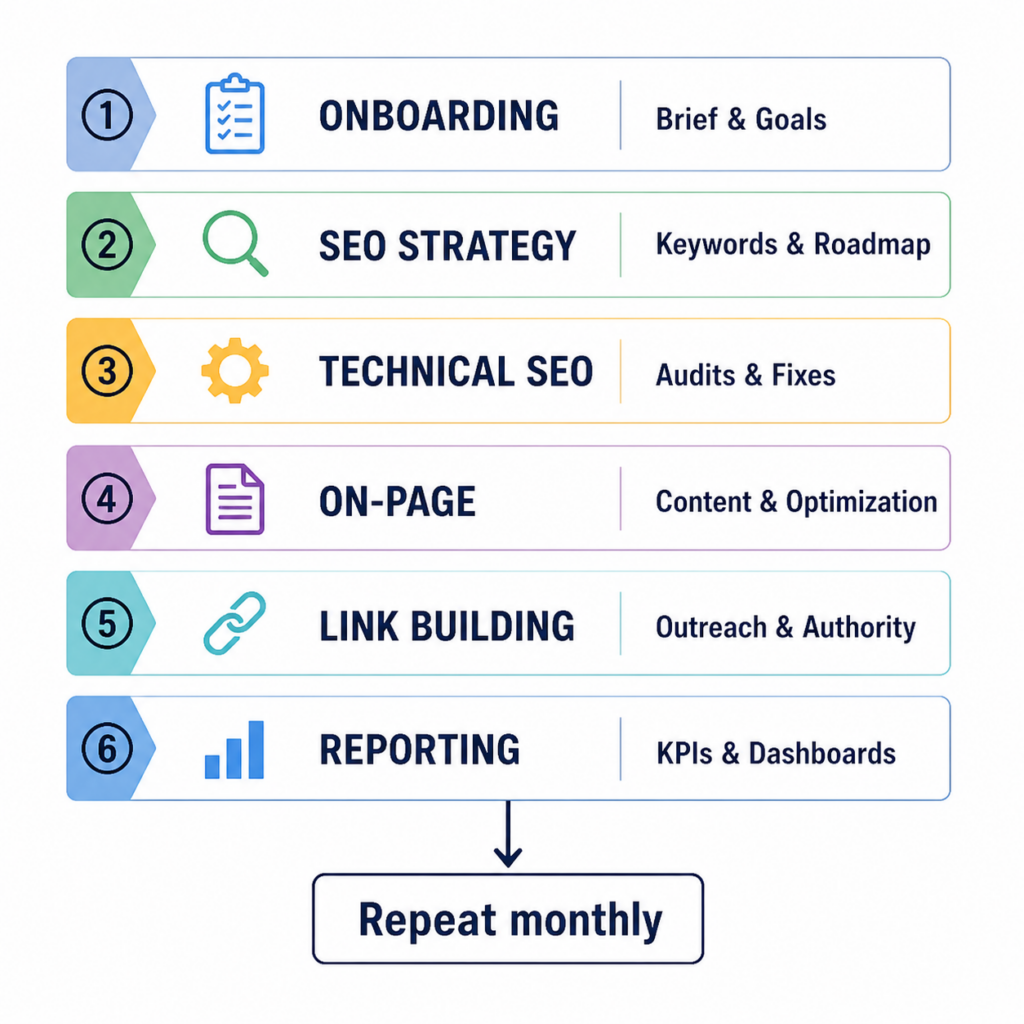
Not every provider that describes itself as a white label SEO company offers a genuinely complete service. Some specialize in specific components — link acquisition, or content production — and handle other campaign elements superficially or not at all. This matters because a campaign that lacks any one of the core components will underperform regardless of how well the remaining components are executed. Before committing to any partnership, it’s worth verifying that the provider’s scope covers the full list of what a complete campaign requires.
→ Keyword Research and Strategy
The foundation of every campaign is a clear understanding of which queries the target audience is actually using, at what intent stage, and with what competitive threshold for achievable positions at the current authority level. Keyword research done at this level of specificity takes time and requires genuine analytical capability — it is not a one-hour deliverable produced by a tool report. A provider who treats it as a commodity deliverable is likely to produce a list of target queries rather than a genuine strategy.
→ Technical SEO
Technical audit and remediation covers crawl efficiency, indexation, Core Web Vitals, mobile rendering, structured data implementation, redirect architecture, and the range of site-level issues that prevent pages from ranking at their potential regardless of content quality or link acquisition. This is specialist work that requires both diagnostic capability and the ability to communicate findings in a way that enables implementation — whether by the client’s developer, the agency’s developer, or the provider’s own technical team.
→ On-Page Optimization
On-page work — optimizing title tags, heading structures, meta descriptions, internal linking patterns, and content alignment with target query intent — is the component that most directly connects the keyword strategy to the pages that need to rank. It requires judgment about what already exists on the page, what the competing pages look like, and what changes will produce the highest impact relative to the effort involved. Template-driven on-page optimization applied without competitive context is one of the most common quality gaps in low-cost white label execution.
→ Content Creation and Copywriting
Content production at a quality level that produces results — original, substantive, editorially reviewed writing that serves the reader’s actual information needs while aligning with the target query cluster — is both the most important and the most difficult component for providers to deliver consistently at scale. It is also the component most frequently degraded in cheaper arrangements, where AI-generated or lightly edited text is delivered as the equivalent of purpose-written content. Verifying content quality before committing to a provider is essential: request a sample, and read it as a reader, not as an SEO evaluator.
→ Link Building and Digital PR
Link acquisition — building the authority signals that tell search algorithms a page is worth ranking well — is the component where the gap between affordable SEO services and cheap automated execution is most consequential. Manual editorial outreach to real publications with genuine organic audiences produces links that compound in value over time. Private blog networks, link farms, and automated directory submissions produce links that may temporarily inflate metrics before triggering the kind of algorithmic response that takes months of remediation work to recover from. Always ask for live URLs of recent link placements and verify them independently before trusting any provider’s link quality claims. Realistic expectations about what campaigns at different investment levels can produce are well covered in the guide on how long SEO takes to show results.
→ Local SEO and Google Business Profile
For agencies serving small and medium businesses, local campaign management — Google Business Profile optimization, citation building, review management strategy, and location-specific content — is frequently the highest-value component of the engagement. It produces visible results faster than broader organic authority building, and it directly affects the map pack positions that drive the majority of calls and direction requests for service businesses. A white label provider who treats local work as a secondary add-on rather than a primary campaign component is not the right fit for agencies serving this client type.
→ Reporting and Dashboards
White label reporting — rank tracking, traffic analysis, link acquisition logs, and performance summaries presented under the reseller’s brand — is the client-facing deliverable that determines whether the relationship feels professional and accountable. The best providers offer branded dashboard access for clients, custom-formatted monthly reports, and the option for the reseller to add its own commentary and recommendations before delivery. Proprietary dashboards that restrict what data the front-facing party can see or export are a structural red flag rather than a feature.
A service checklist worth running before you sign:
Keyword research with competitive difficulty analysis — must-have. Technical audit with prioritized action plan — must-have. On-page optimization with quality review — must-have. Content production with editorial oversight — must-have. Link building with live URL verification — must-have. Local SEO management — must-have for SMB-focused agencies. Branded white label reporting — must-have. Dedicated account manager — strongly recommended. Custom onboarding templates — nice to have. Volume-based pricing tiers — nice to have.
How to Choose the Right White Label SEO Reseller: An 8-Point Checklist
The market contains a wide range of providers, and the variation in delivery quality, operational reliability, and partnership structure is considerable. Price is not a reliable proxy for quality at any tier of the market — there are expensive providers who underdeliver and mid-range providers who outperform expectations consistently. The evaluation framework that produces the best selection decisions focuses on specific, verifiable evidence rather than on sales presentations and proposal documents.
| Evaluation Criterion | What to Look For | Red Flag |
|---|---|---|
| Case studies and results | Verifiable Search Console data for comparable campaigns | Unverifiable bar charts, no client industry context |
| Full white label capability | Reports, dashboards, and communications carry your brand | Provider logo appears anywhere in client-facing materials |
| Pricing transparency | Specific wholesale costs per deliverable or package before commitment | Pricing only available after discovery calls or NDAs |
| Dedicated account manager | Named contact, direct line, documented response time SLA | Generic support inbox, rotating contacts |
| Tool ownership | Provider uses and owns professional-grade tool stack | Tool subscription costs passed through to the agency |
| Turnaround times and SLAs | Documented delivery timelines per component, contractually specified | “We aim to deliver within…” language without contractual commitment |
| Capacity and scalability | Can onboard multiple new clients simultaneously without quality drop | Waitlists, slow onboarding, limited team bandwidth |
| Contract and exit terms | Clear minimum commitment, fair cancellation clause, content ownership | Automatic renewal, long lock-in without performance accountability |
| Link quality verification | Live URLs provided monthly, independently verifiable | Aggregate domain metrics only, no live URL log |
Beyond the checklist, there is one practical test worth running before any decision is made: request a sample deliverable. A sample technical audit, a sample content brief, a sample monthly report in the white label format. The quality of what they produce when they know it is being evaluated is the floor, not the ceiling, of what you will receive in an active engagement. If the sample doesn’t meet your standard, the ongoing work won’t either.
The question most agencies forget to ask:
What happens when something goes wrong? Deliverables are delayed. A campaign underperforms for two consecutive months. A link placement turns out to be on a site that was subsequently penalized. How does the provider respond — and what is the contractual basis for resolving it? The answer to this question tells you more about the partnership than any sales conversation will.
White Label SEO Pricing: What to Expect
The pricing structure in white label arrangements typically works on a wholesale-to-retail model: the provider charges a wholesale rate, the reseller marks that rate up to the client-facing price, and the difference is the margin the reseller keeps. The wholesale rate is usually meaningfully below what the front-facing party would charge for the equivalent work if it were delivering it in-house — which is what makes the economics of the model work for both parties.
Typical Monthly Retainer Ranges
At the entry level — campaigns covering foundational on-page work, basic technical health, and limited content production — wholesale monthly costs typically run from $400 to $900. At the growth tier — full campaigns with consistent link acquisition, regular content production, and technical optimization — wholesale costs range from $900 to $1,800 per month. At the advanced tier — high-competition markets, expanded content programs, digital PR-level link building — wholesale costs reach $1,800 to $3,500 per month. The agency’s retail markup typically adds 40 to 80 percent above the wholesale cost, depending on the market, the client’s budget expectations, and how the team has positioned its own service pricing.
Per-Project and Per-Deliverable Pricing
Some providers offer per-deliverable pricing alongside or instead of monthly retainers — a fixed cost per link placement, per content piece, per technical audit. This model works well for agencies that want to commission specific components for clients who are already managing some campaign elements in-house, or for agencies that want to test a provider’s quality on a contained scope before committing to a full retainer arrangement.
For those looking at the full range of what professional search optimization can cost at different service tiers, the guide to affordable SEO services covers the complete pricing landscape with enough specificity to be useful for setting your own retail prices and evaluating where a proposed wholesale rate sits relative to market.
How to Become an SEO Reseller in 6 Steps
The process of becoming an SEO reseller is more straightforward than most people expect — the complexity is not in getting started but in building the systems that make the arrangement work consistently at scale. The six steps below describe the sequence that produces the most reliable outcome for agencies entering this model for the first time.
Step 1: Define your target niche and service scope. The agencies that perform best as resellers are those who are clear about which clients they are serving, what those clients need, and what scope of campaign is appropriate for their market and budget level. Trying to resell everything to everyone produces pricing confusion and campaign scope mismatches. Start with the client type you already work with and the needs you already understand.
Step 2: Choose your white label provider carefully. Use the 8-point checklist above. Request samples. Run a small test engagement before committing to a full partnership agreement. The provider you choose will be operating under your brand — the selection decision is worth more time than most agencies give it.
Step 3: Set your retail pricing and packages. Build your client-facing packages around the wholesale scope your provider delivers, with a markup that reflects your market positioning and covers your account management time. Be specific about what each package includes — vague package descriptions create client expectation problems that are always resolved at the agency’s expense.
Step 4: Build your branded onboarding and reporting process. The client’s experience of working with you on search optimization begins with onboarding — how you collect access credentials, how you communicate the campaign plan, how you set timeline expectations, and how the first monthly report lands. All of these touchpoints should carry your brand and reflect your communication standards, not the provider’s defaults.
Step 5: Introduce the service to existing clients first. Your existing client base is the easiest initial market for a new service offering because the trust foundation is already established. Identify clients who have expressed interest in organic visibility, or whose business could clearly benefit from improved search positioning, and introduce the service as an expansion of your existing relationship.
Step 6: Build a repeatable sales and delivery process. The agencies that scale most successfully as resellers are those who systematize both sides of the arrangement — a consistent process for selling and scoping new campaigns, and a consistent process for briefing, reviewing, and reporting on active ones. Without that systematization, growth creates management overhead that consumes the margin the model was supposed to protect.
- ► By day 30: Provider selected, agreement signed, branded reporting templates in place, first client onboarded and active.
- ► By day 60: First monthly report delivered under your brand, first ranking movements visible in Search Console, first client review conversation completed.
- ► By day 90: Second or third client onboarded, delivery process running without manual coordination overhead, initial margin picture clear enough to evaluate pricing adjustments.
What most guides don’t tell you about the 90-day mark:
At 90 days, most agencies have enough data to know whether their chosen provider is going to work long-term — not because campaigns have necessarily produced major results yet, but because the operational patterns are clear. Is the provider hitting delivery timelines? Are the deliverables arriving at the quality standard that was agreed? Is the account manager responsive and proactive? These operational signals are the leading indicators of campaign outcome, and 90 days is enough time for them to become unmistakable.
Common Mistakes When Using White Label SEO Services
The majority of negative experiences with white label arrangements trace back to a small number of predictable errors — most of which occur before the first campaign deliverable is ever produced. Understanding these mistakes in advance is the most reliable way to avoid them.
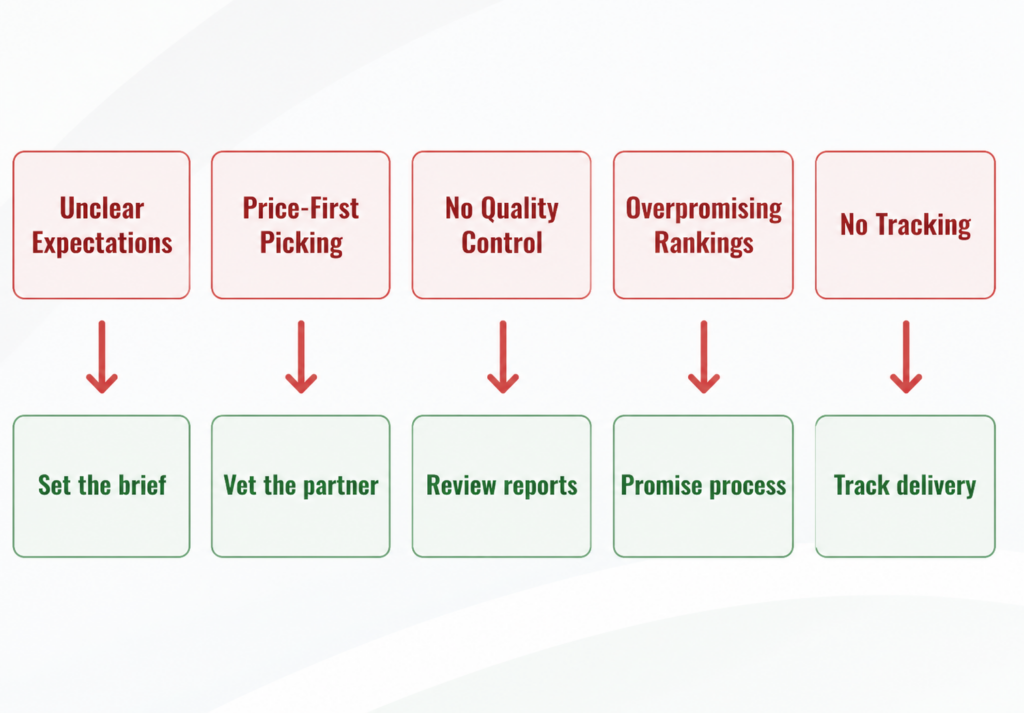
Not setting client expectations before the campaign starts. The most common source of client relationship problems in white label campaigns is the gap between what the client expected to happen and when, and what the campaign’s realistic timeline actually looked like. Organic authority builds over months, not weeks — and clients who were sold on the idea of “being on the first page” without a clear timeline framework will start questioning the arrangement at month two, before the compound effect has had time to develop. Setting specific, realistic expectations at the engagement start — and documenting them — protects both the client relationship and the agency’s position when those conversations happen.
Choosing a provider based on price alone. The cheapest wholesale option is almost always cheap for a reason — either the quality standard is below what it needs to be, the scope is incomplete, or the execution relies on methods that carry long-term risk. The wholesale rate that makes the margin look best on a spreadsheet can easily produce client results that are bad enough to cost the relationship entirely. Evaluate on value, not on price alone.
No quality control process. Handing client briefs to a provider and delivering their output directly to clients without any review step is the fastest path to brand damage. Establish a review checkpoint for every deliverable — content, links, reports — before it reaches the client. Not because you distrust the provider, but because you are the one the client holds accountable for what they receive.
Overpromising ranking outcomes. Position promises — “we’ll get you to page one within 60 days” — are commitments no agency can make in good faith, regardless of who is doing the execution. Search results are determined by an algorithm that weighs hundreds of variables continuously. The agency that promises specific positions is either ignorant of how search actually works or is setting up a client relationship for a difficult conversation. Commit to process, effort, and realistic benchmarks — not to positions by specific dates.
Not tracking what the provider is actually delivering. Monthly invoices are paid, reports arrive, the client seems reasonably satisfied — and then six months in, a closer look at the Search Console data reveals that the position trends don’t match the report narrative, or that the link log contains domains that weren’t independently verified. Maintaining direct access to the client’s Search Console and cross-referencing it with provider reports every month is basic operational hygiene, not excessive mistrust.
White Label SEO vs. In-House SEO vs. Freelancers
| Factor | White Label | In-House Team |
|---|---|---|
| Startup speed | Fast — days to weeks | Slow — months to hire and onboard |
| Fixed cost | Low — variable with client volume | High — salaries, tools, management overhead |
| Execution control | Medium — dependent on provider quality | Full — complete visibility and direction |
| Scalability | High — add clients without adding headcount | Limited by team size and hiring pace |
| Specialist access | Broad — technical, content, links all covered | Limited by who you can afford to hire full-time |
| Brand risk | Present — provider quality affects client outcomes | Lower — execution is visible and controllable |
| Best suited for | Growing agencies adding services without headcount | Large agencies with sustained, predictable volume |
For a deeper look at how local search optimization fits into a broader agency service offering — and what clients in competitive local markets actually need from a campaign — the Local SEO Guide covers the full landscape in enough detail to inform how you scope and brief local campaigns through a white label arrangement.
Why Finding a Responsible Partner Is Harder Than It Looks
The honest version of this conversation is one that most provider-side guides understandably skip: the white label market contains a significant proportion of providers who are competent at selling the arrangement and considerably less competent at delivering it. The gap between “signs a compelling partnership agreement” and “produces results that hold up over twelve months of an active client engagement” is wide enough that agencies who have gone through a failed white label partnership describe the experience as one of the more damaging things that has happened to their client relationships.
The reasons are structural. A provider who underdelivers can lose the reseller client and move on to the next one. The front-facing party, however, loses something more significant: the trust of the end client, who was relying on it to have vetted and managed the quality of the work being delivered under its name. Recovery from that kind of trust breakdown is slow and expensive. The evaluation discipline described in the 8-point checklist above is not overcaution — it is proportionate diligence for a partnership that carries real brand risk.
The SEO услуги под своим брендом (white label SEO) model works best when both parties treat the arrangement as a genuine partnership rather than a transactional vendor relationship. That means the provider is invested in the client outcomes, not just in invoicing the agency monthly. It means communication flows openly when problems arise rather than being managed around. It means the provider’s accountability structure is built into the contract, not just described in the sales pitch. These are not standard features of most white label arrangements — which is exactly why finding a provider who operates this way is genuinely difficult.
We reward the agencies and marketers who work with us:
World SEO Agency operates a formal SEO referral program that pays partners 15% of the client’s monthly budget every month the engagement is active. Not a one-time referral fee. Not a discount on your own services. A recurring monthly payment for every client you bring in, for as long as that client remains active. If you’re an agency, a consultant, or a marketing professional who works with businesses that need search optimization, this is a more economically significant arrangement than anything most providers in this market are offering. Details are on the SEO referral program page.
What’s Included in Our Full-Service SEO Packages?
| Package | Monthly Price | What’s Included |
|---|---|---|
| START A Profitable Start Get Started |
from $1,500 / month First result: 2 months |
Website optimization. Top 10 Google rankings. AI (GEO) under Google search. Local SEO with new page creation. Promoted pages: 10. Keywords: 30. |
| BUSINESS Customer Selection Get Started |
from $2,500 / month First result: 1 month |
Everything in START. Top 5 Google rankings. AI (GEO) optimization. Local SEO with new pages. Promoted pages: 20. Keywords: 100. Regular blog development. Organic backlinks. |
| INDUSTRY LEADER Everything Is Included Get Started |
from $3,500 / month First result: 2 weeks |
Full-service SEO. Top 3 Google rankings. AI (GEO) optimization. Local SEO. Unlimited pages and keywords. Regular blog. Organic backlinks. Technical improvements. Paid link building included. Financial performance commitment applies to this plan. |
World SEO Agency vs. a Typical White Label Provider
| Partnership Factor | World SEO Agency | Typical Provider |
|---|---|---|
| Performance commitment | 90-day contractual milestone with financial accountability | Best-effort language, no contractual performance baseline |
| Partner reward structure | 15% of client monthly budget paid to referring partner every month | One-time referral fee or no referral structure at all |
| Pricing model | All-inclusive — one invoice, no add-ons, no hidden charges | Base retainer plus link building, content, and tool add-ons |
| White label reporting | Fully branded under your agency, direct Search Console access retained | Proprietary dashboards that limit what the agency can see or export |
| Link quality | Manual editorial outreach, live URLs provided monthly | Aggregate metrics reported, live URLs not consistently provided |
| Account management | Named specialist, documented SLA, direct communication channel | Shared support inbox, rotating contacts, variable response times |
| Geographic coverage | Active campaigns across US, UK, Australia, EU, Middle East | Concentrated in one or two markets, limited international capability |
Why World SEO Agency — What Sets Us Apart

The agencies that work with us consistently tell us the same thing: they came in with reasonable expectations and found that the operational reality matched — or exceeded — what the proposal described. That is not a low bar in this market; it is actually a meaningful differentiator. Here is what the arrangement looks like in specific terms.
1) Industry Expertise
World SEO Agency has built concentrated vertical experience across legal, healthcare, professional services, e-commerce, real estate, home services, and financial services through sustained client work over many years. Campaigns in these categories are built with the specific competitive dynamics, content standards, and editorial ecosystems of each industry in mind — not with generic methodology applied without vertical context. This matters enormously for link acquisition quality and for content that meets the accuracy expectations of specialized professional audiences.
2) 90-Day Performance Commitment
Every engagement includes documented performance milestones achievable within the first ninety days of a properly executed campaign. These milestones are written into the engagement agreement. At the INDUSTRY LEADER tier, a financial performance commitment is tied to specific ranking targets for the agreed query set. The commitment is contractually enforceable — not a marketing phrase used without supporting terms in the agreement.
3) Affordable Pricing
Pricing at World SEO Agency reflects the actual scope of work required for the specific competitive environment — assessed honestly before any commitment is made. Every proposal is itemized with specific deliverable quantities. The total annual cost is calculable from the first conversation. No add-ons appear at month three. The price quoted is the price paid, throughout the engagement, without exception.
4) All-Inclusive System Without Hidden Payments
Technical work, content production, link acquisition, rank tracking, reporting, and account management are all included in the monthly package price. One invoice. Same invoice. Every month. No change orders for standard campaign scope, no tool subscription pass-throughs, no content quotas that trigger per-piece billing above the headline figure. This is the structure that makes genuine partnership economics possible for the agencies we work with.
5) Working Across the USA and Worldwide
World SEO Agency maintains active campaigns across the United States — including New York, Los Angeles, Chicago, Houston, Phoenix, Philadelphia, San Antonio, San Diego, Dallas, San Jose, Austin, Jacksonville, Fort Worth, Columbus, and Charlotte — and internationally in London, Sydney, Paris, Berlin, Dubai, Singapore, and Toronto. These are core operating markets with active competitive landscape knowledge and editorial network relationships, not occasional project locations.
Want to order services or discuss a white label partnership? Get a consultation from a World SEO Agency expert. Send a request.
Frequently Asked Questions
What is white label SEO and how is it different from standard outsourcing?
Standard outsourcing means the client knows work is being handled externally. White label means the client sees only your brand — the provider is entirely invisible. The distinction matters commercially: you retain full ownership of the client relationship, the billing, and the long-term account value.
How much do white label SEO services actually cost at the wholesale level?
Entry-level wholesale pricing typically runs $400 to $900 per month for foundational campaigns. Growth-tier campaigns run $900 to $1,800. Advanced campaigns in competitive markets reach $1,800 to $3,500. These ranges assume complete scope — if a provider is pricing below the floor, something important is excluded.
Can I become an SEO reseller without any technical SEO knowledge myself?
Yes — the point of the model is that the provider supplies the technical capability. What you need is the ability to manage client relationships, communicate campaign progress clearly, and evaluate the quality of what the provider delivers.
That last part matters more than most guides acknowledge. You don’t need to know how to perform a technical audit, but you need to know enough to recognize whether the one you received is a real analysis or a templated report that doesn’t engage with your client’s actual site.
Is white label SEO disclosed to clients, or is it standard practice to keep it confidential?
Most agencies do not disclose the white label arrangement, and there is nothing legally or ethically problematic about that. Clients are hiring the agency for outcomes — the staffing and delivery model is the agency’s operational decision. What matters is that the work is real and the results are genuine.
How do I prevent my white label provider from approaching my clients directly?
Non-solicitation clauses in the partnership agreement are the standard protection. Any reputable provider will accept these terms without resistance. Additionally, maintaining full ownership of all client platform credentials — Search Console, Analytics, Google Business Profile — ensures that no dependency on the provider is created at the client access level.
How long does it take for white label SEO reselling to become genuinely profitable?
For most agencies, the model reaches meaningful profitability at three to four active retainer clients. At that point, the wholesale cost is covered by a manageable client base, the delivery process is running without significant management overhead, and the margin per client is predictable enough to model growth reliably.
The agencies that struggle to reach profitability are usually those who underpriced their retail packages at launch or who are spending too much management time on provider quality control — both of which are solvable with better initial pricing and partner selection decisions.
What’s the difference between a white label SEO partnership and a referral program?
In a referral program, you pass the client to the provider and receive a one-time or recurring fee for the introduction — but the client relationship transfers to the provider. In a white label arrangement, you retain the client relationship permanently. The provider never interacts with your client directly.
What contract terms should I absolutely insist on before signing a white label agreement?
Specific deliverable quantities per month. A non-solicitation clause covering all clients introduced through the arrangement. Content ownership assigned to the agency. Direct platform access maintained throughout. Defined SLAs with consequences for repeated failure to meet them. And a cancellation clause that doesn’t lock you in beyond 30 to 60 days notice.
How do I handle a situation where my white label provider misses a deadline and the client is expecting the deliverable?
Own it with the client — delay explanations without excuses, and give a specific revised timeline. Escalate to your account manager at the provider immediately with a written record. If deadline failures become a pattern rather than an exception, it is a signal about the provider’s capacity, not about isolated operational issues.
Can white label SEO work for niche or highly specialized industries where generic content won’t cut it?
It can — but it requires selecting a provider with documented vertical experience in the specific category, not just general campaign capability. Ask to see content samples from comparable industry clients before committing. In specialized industries, the content quality bar is set by what informed readers in that field find credible, not by what reads well to a general audience.
What’s the best way to quality-check link placements delivered by a white label provider?
Request the live URL of every link in each monthly report. Open the page and confirm it is indexed in search results, has genuine organic traffic visible in any estimation tool, and contains topically relevant content rather than an unrelated page where a link was inserted. This check takes fifteen minutes per report and is the single most reliable quality signal available.
Should I tell my sales team how the white label model works when they’re selling campaigns?
Yes — your sales team needs to understand the delivery model well enough to set accurate client expectations around timelines, reporting, and communication. They don’t need to disclose the white label arrangement, but they need to be able to answer questions about process without creating promises the delivery model can’t keep.
What happens to active client campaigns if I decide to switch white label providers mid-engagement?
Technical improvements made to the site remain in place. Content you own remains published. Links placed externally remain live unless the previous provider used methods that carry penalty risk. The transition risk is primarily operational — a gap in delivery momentum that can affect ranking stability during the switch period.
The practical approach is to overlap providers during a transition month where possible, so the new provider’s onboarding is complete before the previous one’s deliverables stop. This minimizes campaign disruption and gives the new provider enough context to continue without losing strategic thread.
Is there a minimum number of clients needed to make a white label arrangement worth pursuing?
Operationally, one client is enough to start — there is no volume threshold required to access a quality white label partnership. Economically, the model reaches its best unit economics at three to five active retainers, where the management overhead per client drops and the margin per client becomes predictable enough to plan around meaningfully.
How do I evaluate whether my white label provider is actually building authority or just generating activity reports?
Compare the position trend data in Search Console directly against the deliverable log. If links are being placed and content is being published but target query positions are not improving over a six-month period, the activity is not translating to authority — which means either the strategy is wrong, the deliverable quality is insufficient, or the competitive threshold in the target market is higher than the investment level can address.