




 Get to WhatsApp

Our manager will contact you
within 15 minutesт
Real Estate Marketing: How to Get Clients Online – Digital Guide 2026
9 Proven Marketing Channels for Agents, Teams & Agencies

Real Estate Marketing: How to Get Clients Online – Digital Guide
As an expert in SEO and digital marketing for real estate with extensive hands-on experience, I’ve compiled the most effective tools for attracting customers and growing sales. You don’t need to test unknown promotional tactics or reinvent the wheel — focus on traffic sources that have already proven their worth and genuinely deliver results. In this space, what works first and foremost is SEO, local promotion, and remarketing in Google Ads for building brand awareness, whether you’re running a full real estate agency or working as an independent agent. I’ve broken everything down by channel, timeline, and realistic cost. Covering how to get real estate clients without wasting budget on experiments is the whole point of this guide. You can also order promotion for your business through my agency on an all-inclusive basis — send a request through the form below. Real estate marketing done properly is a system, not a one-off campaign.
What’s Inside This Guide
— 9 proven digital marketing channels for agents, teams and agencies.
— How to Choose the Right Marketing Strategy for Your Real Estate Business.
— Top tools and platforms to scale your marketing efforts.
— Content plan and channel cost comparison.
— Common mistakes that drain budget without results.
— Why World SEO Agency for your real estate promotion.
— Frequently asked questions.
Most agents and brokers understand, at least intuitively, that their next client is probably searching for something online right now. The question is never whether digital channels matter — they clearly do, and the evidence is everywhere. The question is which channels deserve the investment, in what sequence, and at what budget level relative to the competitive environment in the markets being targeted. That question is harder than it looks, partly because there is an enormous amount of conflicting advice available, and partly because what works for a luxury broker in Miami is genuinely different from what works for a solo buyer’s agent in a mid-size Midwest city.
This guide does not offer generic advice. It offers a framework built from the reality of how people actually search for property and agents — what they type, when they type it, how far through the decision process they are when they hit a website, and what it takes to convert that interest into an actual conversation. The nine channels covered here are not a wishlist; they are the channels that, in combination, account for the overwhelming majority of qualified lead generation for the real estate businesses that are doing online marketing well right now.
9 Proven Digital Marketing Channels: How to Attract Clients for Agents, Teams & Agencies
Before going channel by channel, it’s worth establishing the architecture of the whole system. These nine channels do not operate in isolation — they reinforce each other. Organic search traffic converts better when the website experience is strong. Paid advertising produces better ROI when organic presence already gives the brand credibility. Video builds the trust that makes the first inquiry call less friction-filled. Understanding how the pieces connect is what separates businesses that get occasional results from those that build a reliable client acquisition machine.
1. SEO — Organic Search as the Foundation
Search engine optimization is not one tactic among many in the real estate marketing mix — it is the infrastructure that everything else either benefits from or compensates for. When someone types “condos for sale in Brickell” or “how to sell my house in Austin without an agent” into Google, the agent or agency that appears at the top of those results has a structural advantage that no amount of paid advertising fully replicates. Organic rankings generate clicks without per-click cost, they compound over time, and they carry an implicit credibility signal that paid placements do not.
The most important shift in thinking about SEO for this sector is moving away from chasing broad, high-competition phrases and toward building deep coverage of specific, intent-rich queries. A page optimized for “buy apartment in Hollywood Florida” is competing against far fewer established pages than one targeting “buy apartment in Florida” — and the person searching the specific phrase is much further along in their decision process. Building hundreds of pages at this level of specificity, each one genuinely useful and properly optimized, is the strategy that produces durable organic visibility across a wide range of customer intent.
For a detailed look at what professional SEO services for real estate agency campaigns look like in practice — including what technical, content, and authority-building work is required at different competitive levels — the linked resource covers the full scope. And for a realistic understanding of how long organic campaigns take to produce measurable results at different investment levels, the guide on how long SEO takes to show results provides the honest timeline context that most providers are vague about.
The semantic architecture principle:
The wider your site’s coverage of specific property types, neighborhoods, price ranges, and buyer situations, the more organic queries it can rank for simultaneously. One well-optimized page per micro-topic beats one generic page trying to cover everything — both for ranking potential and for conversion quality.
2. Google Business Profile Optimization
For agents and agencies with a physical office — or even a defined service area — the Google Business Profile is often the highest-ROI optimization task available. Map pack positions drive a disproportionate share of local search clicks, particularly on mobile, and the map pack is dominated by Business Profile signals rather than website authority signals. This means that an agent who has invested heavily in website SEO but neglected their profile can be outranked in the map pack by a competitor with a weaker website but a more complete and actively managed profile.
The practical work of profile optimization goes beyond completing all available fields — though that is the starting point. Active management means posting property updates and neighborhood content regularly, responding to every review within a reasonable timeframe, adding photo content that reflects the current listings and the team, and keeping the services section updated with the specific transaction types and market areas the business handles. The review acquisition process deserves particular attention: the quantity, recency, and response pattern of reviews are all visible ranking signals, and a systematic process for requesting reviews from satisfied clients at the point of transaction completion is one of the simplest high-impact activities available. The complete guide to Google Business Profile optimization covers the full optimization checklist in detail.
3. Category and Neighborhood Page Optimization
One of the most underused strategies in this sector is building a systematic library of category-specific landing pages that match the precise search patterns of active buyers and renters. Not one “properties” page that lists everything — but individual pages for each meaningful combination of property type, location, price tier, and buyer situation that exists in the markets being served.
A well-structured site for a Miami-area agency might include dedicated pages for: buying a condo in Brickell, luxury apartments in Coconut Grove, townhouses for sale in Coral Gables, two-bedroom apartments in Wynwood, waterfront properties in Miami Beach, and investment properties near Miami International Airport. Each page is optimized for the specific queries associated with that combination, includes genuine content about the neighborhood and property type, and provides a clear path to inquiry. The same approach applied to FAQ content — “How much does a two-story house in Miami cost?”, “What are the average apartment prices in the Hollywood district?” — targets the informational queries that buyers research before they are ready to talk to an agent, positioning the site as the authority they return to when they are.
4. Google Ads and Remarketing
Paid search is the channel that bridges the gap between starting SEO and seeing organic results — and it remains valuable even after organic visibility is established, because it provides coverage for high-intent queries where organic position three or four doesn’t capture the click volume that position one does. In competitive markets where the cost per click for transactional property queries runs high, the key discipline is not avoiding paid search but managing it with enough precision to maintain acceptable cost-per-lead economics.
Remarketing is the component of paid advertising that most businesses in this sector underinvest in, despite its consistently favorable ROI characteristics. A visitor who spent four minutes on a listing page for a specific property type in a specific neighborhood has revealed detailed intent information — and serving that visitor display ads featuring similar properties, agent credentials, and market insight content over the following thirty days is far more efficient than cold prospecting for new visitors at the same volume. Understanding what competitors are spending and how they are targeting is also a meaningful advantage — the guide to how to find your competitors’ Google Ads budget walks through the methodology in detail.
Remarketing budget allocation principle:
For most real estate advertisers, allocating 20–30% of the total paid budget to remarketing consistently produces better cost-per-conversion outcomes than increasing prospecting spend by the same amount. The audience is warmer, the message can be more specific, and the conversion rate reflects that specificity.
5. Content Marketing and Informational Blog
The informational blog is not a vanity project — it is the mechanism by which an agent or agency builds organic reach for the research-phase queries that precede most serious property transactions. Buyers who are twelve months from purchasing are asking questions like “what is the average cost of a single-family home in Scottsdale?” and “what are the best neighborhoods in Dallas for families?” The agency that provides genuinely useful answers to those questions at the research stage is positioned as the trusted expert when that buyer’s timeline accelerates.
The content types that generate the most qualified organic traffic in this sector are neighborhood guides, market update analyses, buyer and seller process walkthroughs, cost breakdowns for specific property types in specific locations, and comparative guides that help buyers understand trade-offs between neighborhoods or property configurations. Each piece should be written for the reader’s actual questions — not for keyword density — and should be substantive enough to actually answer the question rather than gesture at it.
- ► Neighborhood guides covering schools, amenities, commute times, and price trends — updated at least annually
- ► Market update posts covering recent sales data, inventory levels, and price movement for specific submarkets
- ► Buyer process walkthroughs: “What does buying a condo in [city] actually involve, step by step?”
- ► Cost breakdown posts: “How much does it cost to buy a two-bedroom apartment in [neighborhood]?”
- ► Investment analysis pieces targeting buyers evaluating rental yield potential in specific zip codes
- ► Comparative guides: “Living in [Neighborhood A] vs [Neighborhood B] — what’s the real difference?”
6. Local SEO and Neighborhood-Level Targeting
Local SEO in the real estate context extends well beyond the Business Profile. It encompasses the full technical and content infrastructure that determines how well a site ranks for location-modified queries — and in most property markets, the location modifier is present in the overwhelming majority of high-intent searches. The buyer who types “homes for sale near Buckhead Atlanta” is not interested in a national portal result that happens to have Atlanta listings — they want a source with real knowledge of that specific neighborhood.
Building local authority means creating genuine geographic content that covers the markets being served at a level of specificity that national portals and aggregator sites cannot match. It means acquiring local citations and directory placements consistently and accurately. It means building inbound links from local news sources, community organizations, and neighborhood-specific publications that signal geographic relevance to search algorithms. And it means structuring the site’s internal architecture so that geographic relevance is clearly communicated at every level — from the URL structure through the heading hierarchy to the internal linking pattern between neighborhood pages. For businesses that want to understand what this looks like at scale, the guide on how to get 1,000 visitors a day to your website covers the traffic architecture required.
7. Social Media Marketing
The role of social media in a real estate marketing system is primarily trust-building and audience development rather than direct lead generation — though the two are connected. An agent who consistently shows their knowledge of a specific market, their process for serving buyers and sellers, and their results through social content builds an audience of people who already trust them before the first conversation. That trust translates into faster conversion cycles, lower objection rates, and higher referral volume from clients who feel connected to the agent through ongoing content exposure.
Instagram and Facebook are the primary platforms for residential agents — Instagram for visual property content, market lifestyle posts, and Stories that give a behind-the-scenes view of the work, Facebook for neighborhood community engagement and the older buyer demographic that remains active on the platform. LinkedIn is the correct investment for agents focused on commercial transactions, investment properties, or developer relationships — the professional context of the platform matches the professional decision-making process for commercial buyers better than Instagram’s consumer-entertainment format does. How to attract clients for agents, teams and agencies through social media is not about posting frequency — it is about content that answers the questions the target audience is actually asking.
8. Video Marketing: YouTube and Property Walkthroughs
Video is the format that closes the credibility gap between a prospect finding an agent online and feeling comfortable enough to call them. A written bio and a photograph establish basic presence. A ten-minute neighborhood walkthrough shot from the agent’s perspective, with commentary about what makes specific streets different from others and what different buyer profiles typically prioritize in that area, establishes expertise and personality in a way that no written content can replicate.
YouTube is both a hosting platform and a search engine — and property-related searches on YouTube generate significant organic traffic for agents who have built even a modest library of genuinely useful video content. Virtual tours of specific listings capture buyers who are researching remotely. Educational content — “what first-time buyers in Miami need to know about closing costs” — captures research-phase prospects and builds subscriber audiences that can be converted through ongoing content exposure over months. The production quality threshold is lower than most agents assume: a modern smartphone, basic audio equipment, and natural lighting produce content that viewers find credible if the substance is genuine.
9. Marketing Packaging: Offers, Anchors, and Conversion Hooks
The final channel is not a traffic source — it is the conversion layer that determines how much of the traffic produced by all other channels actually turns into inquiries. Most real estate websites present property listings and contact information. The highest-converting ones present a clear reason to take action now, a specific offer that makes the value proposition concrete, and a low-friction path to an initial conversation that doesn’t require the prospect to commit to anything before they are ready.
Effective conversion elements in this sector include: free market valuation tools for homeowners considering selling, buyer consultation booking with a specific agenda (“30-minute call to identify the top three neighborhoods matching your criteria and budget”), downloadable neighborhood guides gated behind email capture, and urgency signals tied to genuine market conditions rather than artificial scarcity. The packaging of these elements — how they are presented, how they are sequenced in the visitor journey, and how they are followed up after initial engagement — is what separates sites that generate occasional inquiries from those that produce a consistent flow of qualified conversations.
How to Choose the Right Marketing Strategy for Your Real Estate Business
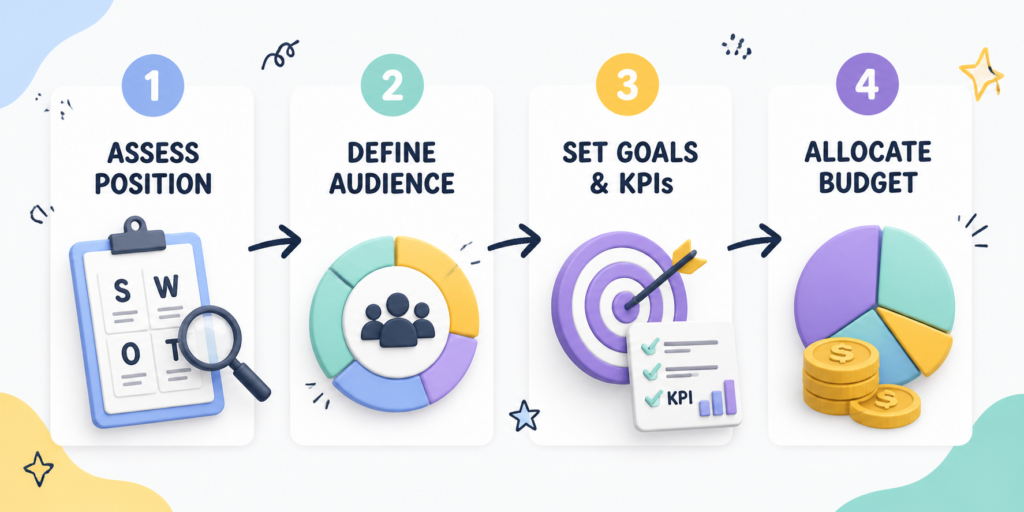
How to get real estate clients is a question that sounds simple but has answers that vary considerably depending on where a business currently sits in its development, what market it operates in, and what resources — time, budget, and internal capability — are realistically available. A framework that works for this decision process runs through four assessment steps in sequence.
1. Assess Your Current Position
Before adding any new channel, audit what currently exists and how it is performing. Where is existing website traffic coming from? What is the current conversion rate from visitor to inquiry? Are there existing rankings for any valuable queries, and if so, how stable are they? What paid campaigns are currently running, and what cost-per-lead are they producing? This assessment almost always reveals that some existing activities are underperforming not because the channel is wrong but because execution quality is insufficient — and fixing execution on existing channels frequently produces more immediate return than launching new ones.
2. Define Your Target Audience Precisely
First-time buyers in the $300,000 to $500,000 range, luxury buyers above $2 million, out-of-state investors seeking rental properties, and seniors downsizing from large family homes are four completely different audiences with different information needs, different platform behaviors, different decision timelines, and different trust signals. The marketing strategy that works for one group will significantly underperform for another. The clearer the audience definition — not just demographics but decision stage, primary concern, and geographic focus — the more precisely every channel can be tuned.
3. Set Measurable Goals and Track the Right Metrics
The goal of “getting more clients” is not measurable in a way that allows campaign optimization. The goal of “generating 15 qualified buyer inquiries per month at a cost per lead below $200, with a conversion rate from inquiry to consultation above 40%” is measurable, and every channel investment can be evaluated against it. Lead volume, cost per lead, conversion rate from lead to appointment, and appointment-to-transaction conversion rate are the metrics that connect marketing spend to business outcomes — and they should be tracked from the start of any campaign rather than retrospectively.
4. Allocate Budget Across Channels Realistically
The most common budget allocation error in this sector is concentrating all available spend in paid advertising while underinvesting in the organic channels that compound over time. Paid channels produce leads while the spend continues — and stop producing them immediately when the spend stops. Organic channels require more patient investment but produce traffic and leads that persist and grow without corresponding ongoing cost. A sustainable allocation for most businesses in this sector balances both: enough paid activity to generate near-term leads while the organic infrastructure is being built, and enough organic investment to reduce paid dependency over time as organic visibility grows.
Top Tools and Platforms to Scale Your Marketing Efforts
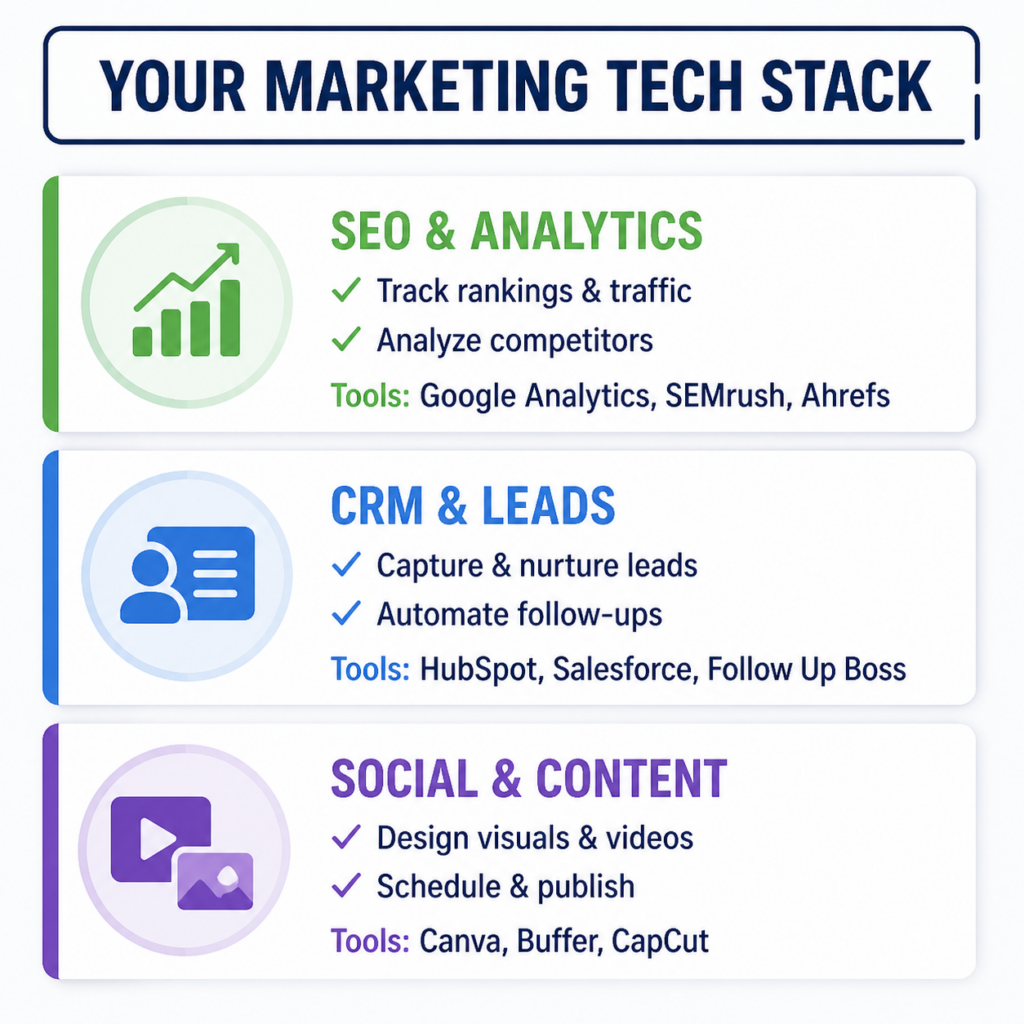
The tools a real estate business uses for marketing determine both the quality of execution and the efficiency of the team time invested in it. The following categories cover the tooling required for each major channel area.
1) SEO and Analytics Infrastructure
Google Search Console provides the direct performance data from Google’s own index — query impressions, click-through rates, average position, and indexation status — that should be the starting point for any SEO review. Google Analytics 4 provides the behavioral data: how visitors move through the site, where they exit, and what paths lead to conversion events. Ahrefs or SEMrush provide competitive intelligence — what queries competitors are ranking for, what their authority profile looks like, and where link acquisition opportunities exist in the specific market. For local citation management, BrightLocal or Moz Local provide automated monitoring and correction of NAP inconsistencies across the directory ecosystem.
2) CRM and Lead Management
Follow Up Boss is the CRM most commonly used by high-performing residential agents and teams because it is built specifically for real estate workflows — inquiry routing, follow-up sequence management, and lead source attribution are all configured for the specific patterns of real estate lead management rather than adapted from a generic sales CRM. HubSpot is a stronger option for agencies that want more sophisticated marketing automation and content-to-lead attribution capabilities. Regardless of which CRM is chosen, the discipline of using it consistently — logging every inquiry, recording every touchpoint, tracking every lead through the pipeline — is what makes the data useful for optimization decisions.
3) Social Media and Content Production
Hootsuite or Buffer handle multi-platform scheduling and provide the analytics needed to evaluate content performance across platforms without logging into each one separately. For visual content production without a designer, Canva covers the full range of social media formats and allows brand templates to be saved for consistent output. For video production, CapCut handles mobile-first editing with enough capability for the property tour and neighborhood walkthrough formats that perform best on YouTube and Instagram. The combination of these tools allows a solo agent or a small team to maintain a consistent content presence across platforms without dedicating excessive time to production logistics.
One tool many agents overlook:
Loom — a simple screen and camera recording tool — is genuinely useful for creating quick video responses to complex buyer questions, recording neighborhood market updates without a full production setup, and sending personalized video follow-ups after initial inquiries. The human presence of a direct-address video converts better than an equivalent text email in almost every test we have run.
Channel Investment and Results Timeline
| Channel | Estimated Monthly Cost | Time to First Results |
|---|---|---|
| Local SEO | $500 – $2,500 | 3 – 6 months |
| Google Business Profile optimization | $200 – $600 | 4 – 8 weeks |
| Google Ads (search + display) | $1,000 – $8,000 | 2 – 4 weeks |
| Remarketing campaigns | $300 – $1,500 | 2 – 3 weeks |
| Content marketing and blog | $400 – $2,000 | 2 – 5 months |
| Social media management | $300 – $1,800 | 1 – 3 months |
| YouTube and video marketing | $500 – $2,500 | 2 – 4 months |
| Email marketing and CRM automation | $150 – $800 | 3 – 6 weeks |
| Referral and partnership programs | $0 – $500 (setup cost) | 1 – 3 months |
Content Plan for Real Estate Topics — 2 Months
| # | Article Topic | Period |
|---|---|---|
| 1 | How much does a two-bedroom apartment in Miami cost? | 1 |
| 2 | Best neighborhoods in Los Angeles for first-time buyers | 1 |
| 3 | What to check before buying a condo in Florida | 1 |
| 4 | Is it better to rent or buy in Austin right now? | 1 |
| 5 | How long does it take to buy a house in the US? | 1 |
| 6 | Apartment prices in the Hollywood district — what buyers are actually paying | 2 |
| 7 | Investment property near downtown Chicago — rental yield analysis | 2 |
| 8 | How to sell your home faster — what actually works in a slow market | 2 |
| 9 | Moving to Dallas — what to know about neighborhoods before you buy | 2 |
| 10 | What closing costs do buyers pay in New York — a full breakdown | 2 |
Additional Ways to Find Customers
Beyond the nine primary channels, several supplementary approaches consistently produce qualified contacts for agents and agencies who use them deliberately rather than occasionally. Mortgage broker partnerships are among the most reliable — a buyer who has just been pre-approved for financing is at the highest-intent stage of the purchase journey, and a referral arrangement with one or two local mortgage professionals puts an agent in front of those buyers at exactly that moment. The same logic applies to partnerships with real estate attorneys, home inspectors, and relocation services companies.
Community engagement — participating actively in neighborhood Facebook groups, local forums, and community events — builds the kind of geographic authority that advertising cannot buy. Agents who are recognized as knowledgeable and helpful community members, rather than as salespeople, consistently report higher referral rates and lower resistance in initial conversations. Digital community involvement through platforms like Nextdoor, which is specifically built for neighborhood-level communication, provides a scaled version of this approach that doesn’t require physical event attendance to produce results.
- ► Mortgage broker referral agreements — structured monthly or per-transaction, targeting buyers immediately post-preapproval
- ► Nextdoor and neighborhood Facebook group presence — answering property questions publicly builds local authority over time
- ► Relocation company partnerships — corporate relocation generates consistent buyer volume that is independent of local market sentiment
- ► Past client referral incentive programs — a structured “thank you” offer for introductions produces more referrals than relying on goodwill alone
- ► Podcast or webinar hosting on local market topics — positions the agent as an authority and generates email subscribers who can be nurtured over time
The referral multiplier effect:
Agents who systematically ask for referrals at the right moment — not at contract signing, but sixty to ninety days after move-in when the client’s positive experience is freshest — report referral rates two to three times higher than those who rely on clients to volunteer introductions spontaneously. Timing the ask is as important as making it.
Common Mistakes That Drain Budget Without Results
1) Ignoring Mobile Experience
Property searches happen overwhelmingly on mobile devices, and a website that loads slowly, presents listings in a format that requires desktop navigation, or places contact forms below the fold on small screens is losing a significant percentage of the traffic it generates before any conversion opportunity occurs. Mobile optimization is not a nice-to-have feature — it is the primary user experience for the majority of visitors, and treating it as secondary to desktop design produces measurable lead loss that is usually invisible to the business because the dropped visitors simply don’t appear in conversion data.
2) Buying Leads Instead of Building a System
Third-party lead purchase — buying buyer or seller leads from Zillow, Realtor.com, or aggregator platforms — is often the default starting point for agents who want immediate activity without the investment required to build owned channels. The problem with this approach is structural: the economics of purchased leads deteriorate over time as competition for the same leads increases, the leads are simultaneously sold to multiple agents in most cases, and building a business on purchased leads creates permanent dependency on a cost that cannot be reduced through investment or optimization. The agents who build the most durable businesses are those who invest in channels they own — their website, their content, their review profile — that produce leads whose cost decreases as the asset matures.
3) Inconsistent Activity and Absent Follow-Up
The most common failure mode across every digital channel is inconsistency — posting regularly for six weeks and then stopping, responding to inquiries promptly for a month and then letting them sit for two days, publishing blog content for a quarter and then abandoning it. Every channel in the digital marketing system requires sustained, consistent activity to produce compounding results. The agent or agency that publishes content, engages with audiences, and follows up with leads on a consistent schedule for twelve months will dramatically outperform one that executes brilliantly for short bursts separated by inactivity.
4) Not Measuring ROI by Channel
Without channel-level attribution, marketing budget decisions are based on instinct rather than evidence. An agent who is spending $2,000 per month on paid search and $800 per month on social media but tracking only total lead volume cannot determine which channel to increase, which to reduce, and which to cut entirely. Setting up proper source tracking — UTM parameters on all paid links, call tracking numbers for different channels, and consistent lead source recording in the CRM — is the operational foundation that turns marketing spend from a cost center into a measurable investment.
Case Study: How a Miami Real Estate Agency Grew to 40+ Clients in 90 Days
A mid-size Miami-area agency came to us with a specific problem: significant monthly spend on Zillow lead purchases, declining conversion rates from those leads, and no owned digital presence to fall back on. The website had not been updated in three years, the Google Business Profile was incomplete, and there was no content strategy of any kind. Every new client came through either paid lead platforms or personal referral — and the economics of the paid leads were getting worse every quarter as more agents competed for the same inventory.
The strategy we implemented ran in three parallel tracks. First, technical and content infrastructure: rebuilding the website around a neighborhood-page architecture covering the fifteen submarkets the agency served, optimizing the Google Business Profile, and launching a systematic review acquisition process targeting the agency’s existing satisfied clients. Second, paid channel restructuring: reducing Zillow spend by 60% and reallocating that budget to Google search campaigns targeting high-intent buyer queries in the specific Miami submarkets, with remarketing sequences set up for every visitor who spent more than two minutes on a listing page. Third, content production: twelve neighborhood guide articles published over the first ten weeks, each targeting a specific combination of location and buyer type.
The results at ninety days: 43 qualified buyer consultations booked through owned channels, a cost per lead from Google Ads 40% below what the Zillow leads had been costing, and first-page organic rankings for eleven of the fifteen neighborhood-specific queries targeted in the content program. The Google Business Profile had accumulated 22 new reviews in the period, improving map pack position from outside the top ten to consistently showing in positions two through four for the agency’s primary service area queries.
Your 30-Day Action Plan: Where to Start
The most common reason businesses in this sector delay getting started with digital marketing is the size of the total landscape — it looks like too much to tackle, so nothing gets started. The correct approach is sequential: identify the two or three highest-impact activities available at the current stage, execute those well, and add channels as the first ones are producing results. Here is the correct sequence for most businesses starting from a low base of digital presence.
- ► Week 1: Audit the current website for technical issues, mobile performance, and conversion elements. Fix anything that is actively losing visitors.
- ► Week 1–2: Complete and optimize the Google Business Profile. Launch a review acquisition process targeting the last twenty satisfied clients.
- ► Week 2–3: Set up Google Analytics 4 and Search Console properly, with conversion tracking for inquiry forms and phone clicks.
- ► Week 3–4: Publish the first two neighborhood guide articles targeting the highest-priority local queries in the primary service area.
- ► Week 4: Launch a small-scale paid search campaign targeting the two or three highest-intent query types in the primary service area, with remarketing pixels installed on all key pages.
The right resources for building beyond this foundation include the affordable SEO services guide for understanding what professional search optimization looks like at different investment levels, and the complete guide to digital marketing for real estate agents for channel-by-channel strategy depth beyond what a single article can cover.
Why World SEO Agency for Your Real Estate Promotion
Every agency claims expertise in digital marketing for property businesses. The distinction between a general claim and a genuine capability is visible in the specificity of what a provider can describe about their methodology, their results, and their accountability structure. Here is what the World SEO Agency engagement model actually involves.
→ Industry Expertise in Internet Marketing and Advertising for Real Estate
World SEO Agency has developed concentrated experience across the real estate vertical through sustained campaign work with agents, brokerages, and development projects across competitive US markets and internationally. This means campaign strategy is built on genuine familiarity with how property buyers and sellers actually search — not generic digital marketing methodology applied without vertical context. The content standards, keyword architecture, and authority-building approach for a residential brokerage are meaningfully different from those for a commercial portfolio, and our campaigns reflect those differences from the first strategy session.
→ 90-Day Performance Commitment
Every engagement at World SEO Agency includes documented performance milestones achievable within the first ninety days of a properly executed campaign. These milestones are written into the engagement agreement with specific, verifiable targets — not described in a proposal and forgotten after signing. At the top package tier, a financial performance commitment is tied to specific ranking targets for the agreed query set. The commitment is enforceable because it is specific, not because it sounds reassuring in a sales conversation.
→ Affordable Pricing
Pricing at World SEO Agency reflects the actual cost of delivering the specified scope for the specific competitive environment being targeted. Every proposal includes itemized deliverable quantities before any commitment is made. The total annual cost is calculable from the first conversation — there are no surprise add-ons at month three, no tool subscriptions billed separately, no content charges above the included quota. The price that is quoted is the price that is paid, throughout the engagement, without exception.
→ All-Inclusive System Without Hidden Payments
Technical work, content production, link acquisition, local optimization, reporting, and account management are all covered within the monthly package price. One invoice. Same amount. Every month. The structure that makes genuine affordability possible is not discounting individual components — it is eliminating the supplementary billing model that inflates standard retainer costs well above their headline figures by the time the first quarterly review arrives.
→ Working Locally in the USA and Worldwide
World SEO Agency maintains active campaigns for real estate clients across the United States, including New York, Los Angeles, Miami, Chicago, Houston, Dallas, Phoenix, San Diego, Seattle, and Atlanta — and internationally in markets including London, Dubai, Toronto, and Sydney. These are not occasional project locations; they are core operating markets where we have competitive landscape knowledge, editorial network access, and campaign history that supports accurate strategy from day one rather than building market familiarity at the client’s expense.
Want to order promotion for your real estate business? Get a consultation from a World SEO Agency expert. Send a request.
Frequently Asked Questions
How much does real estate marketing actually cost per month for a solo agent?
For a solo agent starting from minimal digital presence, a realistic minimum monthly investment covers Google Business Profile management ($200–$400), basic content production ($300–$600), and a small paid search budget ($500–$1,000). Total: $1,000–$2,000 per month as a functional starting point.
What is the single highest-ROI marketing activity for a new agent with a limited budget?
Completing and actively managing the Google Business Profile. It is free to set up, directly affects map pack visibility for local queries, and the review acquisition process it supports has the fastest conversion to actual inquiries of any activity available at zero media cost.
How do agents generate clients from YouTube without a large subscriber base?
YouTube functions as a search engine, not just a social platform. A video titled “What to know before buying a condo in Brickell Miami” will generate organic views from people searching that phrase regardless of subscriber count. Fifteen well-optimized neighborhood videos produce more qualified traffic than a channel with 10,000 subscribers posting generic content.
Is digital marketing for real estate agents the same as for brokerages?
The tools overlap but the priorities differ. Solo agents benefit most from personal brand building — their name, face, and local expertise are the differentiator. Brokerages benefit more from geographic coverage breadth and category authority. The channel mix shifts accordingly: video and LinkedIn for agents, category page architecture and paid search for brokerages.
Digital marketing for real estate agents also has a shorter trust-building window — prospects are evaluating a person, not just a company — which makes video and social proof elements disproportionately important in the agent’s individual marketing mix.
How to get real estate clients from Instagram when the feed is saturated with property posts?
The accounts that stand out are not the ones posting the most listings — they are the ones posting the most useful, specific local knowledge. Neighborhood comparison posts, price transparency content, and behind-the-scenes process content generate more saves and shares than listing announcements, and saves are the metric that drives algorithmic distribution.
How long before a new blog generates meaningful organic traffic for a property business?
For neighborhood-specific and FAQ-style content in low-to-medium competition markets, first ranking movements typically appear within sixty to ninety days. Consistent traffic from a content program requires four to six months of regular publishing. The mistake most agents make is publishing for two months, seeing minimal traffic, and stopping — before the compounding effect has time to develop.
What is the best marketing for real estate businesses targeting out-of-state buyers?
Relocation-focused content targeting search queries like “moving to [city] from [origin state]” combined with YouTube neighborhood tours produces the highest-quality out-of-state leads. These buyers are researching remotely and consume more content per decision than local buyers — meaning content depth and video presence have outsized impact on this segment.
How to grow real estate business using remarketing without a large existing website audience?
Start with a small paid search campaign to generate the initial visitor volume needed to build remarketing audiences. Even 200 to 300 monthly visitors to a listing page creates a retargetable audience within the first month. The remarketing campaign can then run at low cost against that warm audience while the organic channels are being built.
The efficiency of remarketing relative to cold prospecting is significant enough that building the audience — even through small initial paid campaigns — is worth the upfront cost before organic traffic reaches meaningful volume.
Should a real estate agency manage digital marketing in-house or hire an external company?
In-house management works when there is a dedicated person with genuine digital marketing capability, time to execute consistently, and the tools budget to work effectively. External management makes sense when the internal team’s time is better spent on client-facing activities, when the competitive market requires specialist capability the internal team doesn’t have, or when the cost of a quality external company is below the fully loaded cost of an equivalent in-house hire.
What tracking setup is needed before starting paid advertising for a property business?
Google Analytics 4 with conversion events configured for form submissions and phone link clicks. Google Search Console connected to the domain. Call tracking numbers assigned to each major traffic source. Lead source fields in the CRM populated at every inquiry. Without this infrastructure, budget decisions are based on impression and click data rather than on actual lead and revenue outcomes.