




 Get to WhatsApp

Our manager will contact you
within 15 minutesт
How Local Businesses Get More Google Reviews: 15 Proven Tactics
Turn Happy Customers Into Visible Proof
How Local Businesses Get More Google Reviews: 15 Proven Tactics
Customer reviews are not a vanity metric. For any business that depends on local foot traffic, phone calls, or service-area searches, they are one of the most consequential trust signals in the entire customer acquisition process. People read them before calling. They read them before booking. They read them before walking through your door. And yet most businesses treat the process of collecting them as an afterthought — something that happens passively, if at all. This guide covers 15 tactics that change that. From understanding why customers don’t leave feedback unless you make it easy, to building systems that generate a steady, organic flow of opinions month after month — it’s all laid out as plainly as possible.
What’s Inside This Guide
— Why Customer Feedback Matters More Than Most Businesses Realize.
— The Ask Problem: Why Most Businesses Get This Wrong.
— 15 Proven Tactics to Get More Ratings and Feedback.
— The Best Tools for Managing and Collecting Feedback.
— How to Respond to Customer Feedback the Right Way.
— Common Mistakes That Kill Your Feedback Strategy.
— FAQ: Feedback Strategy for Service Businesses.
Knowing how to get more Google reviews in a consistent, sustainable way is one of those skills that separates growing businesses from those perpetually stuck below competitors who seem to attract trust effortlessly. The question is not whether to pursue this — it is how to systematize it rather than treat it as a one-time effort. The tactical gap between those two groups is smaller than most people assume — and this guide closes it.
Why Customer Feedback Matters More Than Most Businesses Realize
There’s a number that tends to stop people cold when they first hear it: roughly 98% of consumers read online opinions before making a purchasing decision. That statistic has been circulating in marketing circles for a few years now, and while exact numbers vary by study, the directional reality is consistent — the overwhelming majority of people who find your business through search will check what other people have said before deciding whether to contact you. Feedback is not supplementary information. For most customers in most categories, it is the primary filter separating the businesses they’ll consider from the ones they’ll scroll past.
For companies competing in local search specifically, the impact is compounded. The map pack — those three listings that appear above the organic results for location-based searches — uses rating quantity and quality as a significant ranking input. A company with 200 ratings averaging 4.7 stars occupies a structurally different competitive position from one with 12 averaging 3.9, even if the underlying service quality is identical. The ratings are, in effect, social proof made visible at the exact moment a potential customer is deciding who to call. Understanding the mechanics of Google Business Profile optimization helps clarify just how directly these signals influence where your business appears in those critical local results.
The Trust Gap Is Real:
Studies consistently show that consumers trust online feedback nearly as much as personal recommendations from people they know. A company with fewer than 10 ratings is often perceived as unproven — regardless of how long it has been operating. The count is a proxy for experience in the customer’s mind, and that perception directly influences whether they pick up the phone.
The trust dynamic also works in a compounding way. Businesses with strong feedback profiles attract more clicks from search results, which generates more customer visits, which creates more opportunities for new submissions — a virtuous cycle that, once started, requires far less effort to maintain than it did to initiate. The challenge is getting that cycle started deliberately, rather than waiting for it to happen at whatever pace customers happen to feel motivated enough to write something unprompted.
The Ask Problem: Why Most Businesses Get This Wrong
The most common reason businesses don’t have the rating volume their service quality deserves is simple: they don’t ask. Or they ask in a way that makes the process feel like friction rather than a natural continuation of a positive experience. Most people who have a genuinely good experience with a business don’t spontaneously open a browser and write about it. It’s not that they don’t want to help — it’s that the moment passes, other things compete for attention, and unless the pathway is made immediately clear and easy, the intention evaporates before it becomes action.
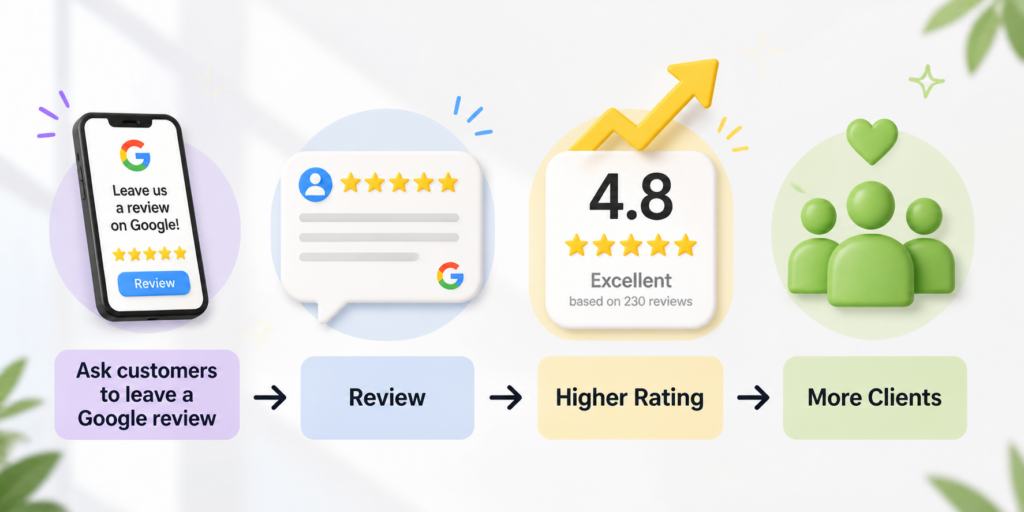
The second category of error is asking at the wrong moment. Asking in the middle of a transaction, before the full value of the service has been delivered, produces lower conversion and lower quality responses. Asking in the immediate aftermath of a complaint — even a resolved one — produces the same result. The timing of the ask is as important as the ask itself, and getting this right requires thinking systematically about the customer journey rather than inserting the request wherever it happens to be convenient for the business. A thorough understanding of the full local search context helps here — our Local SEO Guide covers how customer touchpoints feed into broader visibility signals.
The Right Moment Formula:
Ask immediately after the customer has experienced the peak value of your service — not before, not days later. For a restaurant, that’s when the meal is finished and the check hasn’t arrived yet. For a contractor, it’s the day after the job is completed. For a medical practice, it’s at checkout following a successful appointment.
Peak satisfaction is the window. Miss it, and the likelihood of follow-through drops sharply.
The third mistake is making the process too complicated. If a customer has to search for your business manually, navigate to the feedback section, and figure out how to submit a rating — most of them won’t, even if they fully intended to. Every additional step between intention and action is an attrition point. The businesses that consistently collect the most ratings are those that have reduced that pathway to a single tap or click, using a direct link that opens the submission form immediately without any intermediate navigation required.
15 Proven Tactics to Get More Ratings and Feedback
Tactic 1 — Generate and Use Your Direct Review Link
Before any other tactic makes sense, you need a direct link to your submission form. This is the URL that, when clicked, opens the star-rating and text entry interface immediately — without the customer having to find your listing themselves. You can generate this through your Business Profile dashboard. Once you have it, shorten it with a tool like Bitly or create a branded redirect from your own domain, and use that link in every channel where you communicate with customers.
https://search.google.com/local/writereview?placeid=YOUR_PLACE_ID
Replace YOUR_PLACE_ID with the unique identifier for your Business Profile. You can find this in your profile dashboard or by searching your business name in Maps and pulling the ID from the URL. This single link, deployed consistently across email signatures, SMS follow-ups, receipts, and signage, is the foundational infrastructure that all other tactics depend on. Knowing how to achieve this at scale starts here — with a link that removes every possible barrier between intention and submission.
Tactic 2 — Ask in Person at the Right Moment
A direct, personal ask from a staff member who has just delivered excellent service is still the highest-converting method available. It works because it’s human. The customer is already in a positive emotional state, the relationship is present and real, and a genuinely enthusiastic request — “if you’ve had a good experience today, we’d really appreciate it if you shared your thoughts — here’s the link, it only takes a minute” — lands very differently from an automated email arriving three days later. Train your team to make this ask naturally, without pressure, and at the right moment in the interaction.
Tactic 3 — Send a Follow-Up SMS
SMS has an open rate that most other channels can’t approach — typically above 90%, compared to email open rates that often sit between 20% and 35%. A short, direct text message sent within an hour of service completion, with your direct link included, catches customers while the experience is still fresh and the phone is already in their hand. Keep the message brief: acknowledge the visit, express genuine appreciation, and include the link. No more than two or three sentences. Anything longer reduces conversion.
Hi [Name], thanks for visiting [Business Name] today! If you have a moment, we'd love your feedback: [short.link/review] — it means a lot to the team.
Tactic 4 — Add the Link to Your Email Signature
Every outbound email your team sends is a passive acquisition opportunity. Adding a simple line to the email signature — something like “Enjoyed working with us? Share your experience here [link]” — puts the request in front of customers repeatedly, without requiring any active effort after the initial setup. This is particularly effective for service businesses where ongoing email communication is a natural part of the client relationship.
Tactic 5 — Include a Request on Your Receipts and Invoices
Printed and digital receipts are physical touchpoints that many businesses use only for transactional information. Adding your link — ideally as a scannable QR code — converts them into acquisition tools at a moment when the customer has just completed a transaction and the experience is current. A QR code that opens the form directly eliminates the friction of typing a URL on a mobile device and produces meaningfully higher conversion than a printed web address.
[QR Code] → https://yourdomain.com/review
"Scan to share your experience — it takes less than 60 seconds."
Tactic 6 — Create a Dedicated Feedback Page on Your Website
A page on your website that explains why feedback matters, thanks customers for their support, and provides a clear, prominent link to submit a rating serves multiple purposes. It gives you a destination to direct people to from multiple channels. It creates a shareable URL that you can use in marketing materials. And it signals to visitors who land on it organically that customer input is something you take seriously — which is itself a trust signal for new customers who are evaluating whether to engage with you.
Tactic 7 — Use Post-Purchase Email Sequences
Automated email sequences triggered by a transaction or service completion allow you to time the request with precision. A sequence that sends a genuine thank-you on day one, a check-in on day three asking if everything is satisfactory, and a feedback request on day five — once the customer has had time to fully experience the outcome — consistently outperforms a single immediate request.
- ► Day 1 — Thank you email with no ask; just express genuine appreciation for their business
- ► Day 3 — Check-in email asking if everything met expectations
- ► Day 5 — Feedback request with direct link and brief, warm explanation of why it matters
- ► Day 10 — Single follow-up if no submission posted, framed as a gentle reminder
- ► Stop after two attempts — persistent follow-up erodes goodwill and produces lower quality responses
Tactic 8 — Train Your Entire Team, Not Just Front-of-House
Feedback acquisition is a whole-business discipline, not a front-desk responsibility. Technicians, delivery drivers, account managers, and support staff all have direct customer contact moments where a natural, well-timed ask can outperform any automated system. Training the team means giving every customer-facing employee the language, the link, and the confidence to make the ask without it feeling scripted or pushy. Companies that build this into their service culture — rather than delegating it to one person or one automated touchpoint — generate rating volume at a fundamentally different rate.
Train Once, Benefit Forever:
A team that knows how and when to ask for feedback doesn’t need to be reminded each week. A single training session that covers the right language, the timing, and where to find the direct link is all it takes to embed this habit into daily operations.
The return on that one-hour investment compounds with every customer interaction from that day forward.
Tactic 9 — Place a Request Card at Your Physical Location
A small, professionally designed card displayed at checkout, on waiting room tables, or near the exit with a QR code linking directly to the submission form converts passive foot traffic into acquisition opportunities. The card should be simple: a brief explanation of why feedback matters, the QR code, and no more than one sentence of instruction. Overcrowding the card with information reduces the likelihood that anyone will act on it. Clean design and a single clear call to action outperform elaborate layouts every time.
Tactic 10 — Respond to Every Existing Piece of Feedback
This tactic is often overlooked in acquisition guides, but it belongs here because it directly influences how many new submissions you receive. Potential contributors look at how a business responds to existing feedback before deciding whether to add their own voice. A business that responds thoughtfully to every entry — positive and negative — signals that the input is genuinely valued, not collected and ignored. That signal encourages new participants to take the time. The compounding credibility benefits are also documented in our full guide on Google Search Console performance tracking, where you can see how engagement signals from the profile feed into broader organic visibility.
Tactic 11 — Highlight Feedback Across Your Marketing Channels
When customers see that input is actively featured — shared on social media, quoted on the website, mentioned in newsletters — they understand that their contribution will actually be seen and used. This creates a sense of meaningful participation that motivates action. Share a standout five-star comment on your social stories with a call to action. Feature a genuine quote in your next email campaign. Put a recent testimonial on your homepage. Each of these actions serves two purposes simultaneously: social proof for new customers and a visible incentive for existing ones to contribute their own voice.
Make Feedback Feel Meaningful:
When a customer sees their comment featured on a business’s social media, it creates a reciprocal motivation for others to do the same. People want to feel heard. Showing publicly that you read and share customer input transforms the act of leaving feedback from a form submission into a small act of community contribution — and that shift in framing significantly increases voluntary participation rates.
Tactic 12 — Use WiFi Login as a Touchpoint
For businesses with customer-facing physical locations — cafes, salons, retail stores, medical waiting rooms — a WiFi captive portal that displays a feedback request as part of the login flow converts an existing behavioral touchpoint into an acquisition moment. The customer is already on their phone, already waiting for internet access, and already engaged with a screen. A well-designed portal that offers WiFi access in exchange for a moment’s consideration produces measurable results with zero additional staff effort after initial setup.
Tactic 13 — Ask Specifically, Not Generically
The language of the ask matters significantly. “Please leave us a review” produces lower conversion than a specific prompt that guides the customer toward what to write. “If you could mention how the installation process went for you, that would be incredibly helpful for people who are considering working with us” gives the customer a starting point, which removes the blank-page anxiety that often stops people from writing even when they intend to. Specific prompts produce longer, more detailed, and more credible responses — which are also more persuasive to potential customers reading them later.
Tactic 14 — Monitor and Act on Feedback Insights
The content of what people submit is a direct data feed from your customer base. Patterns in what people mention positively tell you what to emphasize in your marketing. Patterns in what people flag as areas for improvement identify specific service delivery or communication gaps that, once addressed, produce better experiences and therefore better scores going forward. Building a monthly analysis into your operations — even informally, as a fifteen-minute read-through of the previous month’s submissions — creates a feedback loop that progressively improves both the product and the profile simultaneously. Integrating this analysis with what you see in your Local SEO services reporting helps connect qualitative customer signals to quantitative ranking movements.
Tactic 15 — Integrate Requests Into Your CRM
For businesses with a customer relationship management system, integrating the feedback request workflow means that no customer who has completed a transaction falls through without receiving a timely, relevant ask. CRM-triggered requests can be personalized with the customer’s name, the specific service they received, and the staff member who served them — all of which increase conversion rates compared to generic batch messages. This level of automation requires some initial setup investment, but it produces a consistent, scalable process that operates without requiring ongoing manual effort.
Volume + Recency = Ranking Power:
It is not enough to collect 100 entries and stop. Search algorithms weight recency heavily — a profile that received its last submission eight months ago signals lower active engagement than one that received three last week.
Building a sustainable, ongoing system rather than a one-time push is what separates businesses with durable map pack positions from those whose counts stagnate after an initial effort.
The Best Tools for Managing and Collecting Feedback
The tools you use to manage acquisition and monitoring make a real difference in how consistently the system operates. Below is an overview of the most practical options across different business sizes and needs. Understanding the right software layer to support the manual and human elements of the strategy is itself an important part of the work.
| Tool | Primary Function | Best For |
|---|---|---|
| Google Business Profile | Feedback management and response, direct link generation | All businesses — the starting point, non-negotiable |
| Birdeye | Multi-platform monitoring, automated request sequences | Multi-location businesses with high customer volume |
| Podium | SMS-based requests, conversation management | Service businesses with strong SMS communication workflows |
| Grade.us | Funnel building, agency-friendly multi-client management | Agencies managing acquisition for multiple clients |
| ReviewTrackers | Monitoring across 100+ platforms, sentiment analysis | Businesses that need cross-platform visibility and reporting |
| NiceJob | Automated campaigns, social proof widgets | Small businesses wanting simple automation without complexity |
| Yext | Listing management, reputation monitoring, response tools | Brands managing listings and reputation at scale |
| Whitespark | Local citation building, reputation management integration | Businesses focused on comprehensive local search visibility |
| Zapier | Workflow automation connecting CRM, email, and feedback tools | Businesses building custom request automations without code |
| HubSpot CRM | Customer journey tracking, automated email sequences | Growing businesses with structured sales and service pipelines |
Choosing the right combination depends on your customer volume, the number of locations you manage, and whether you want a done-for-you system or prefer custom workflows. For most small businesses just starting to systematize acquisition, beginning with your Business Profile’s native tools plus a simple SMS workflow is sufficient. More sophisticated tooling is worth the investment once the foundational process is working and you understand where your conversion bottlenecks actually are.
How to Respond to Customer Feedback the Right Way
Responding to what customers write is where many businesses show a surprising lack of strategic thinking. Each response is public — read by every future customer who looks at your profile, not just the person who wrote the original entry. A response that comes across as defensive, dismissive, or templated does more damage than the absence of a response. A response that is genuine, specific, and proportionate to the content reinforces the quality signal of the original feedback and adds a layer of brand personality that potential customers notice.
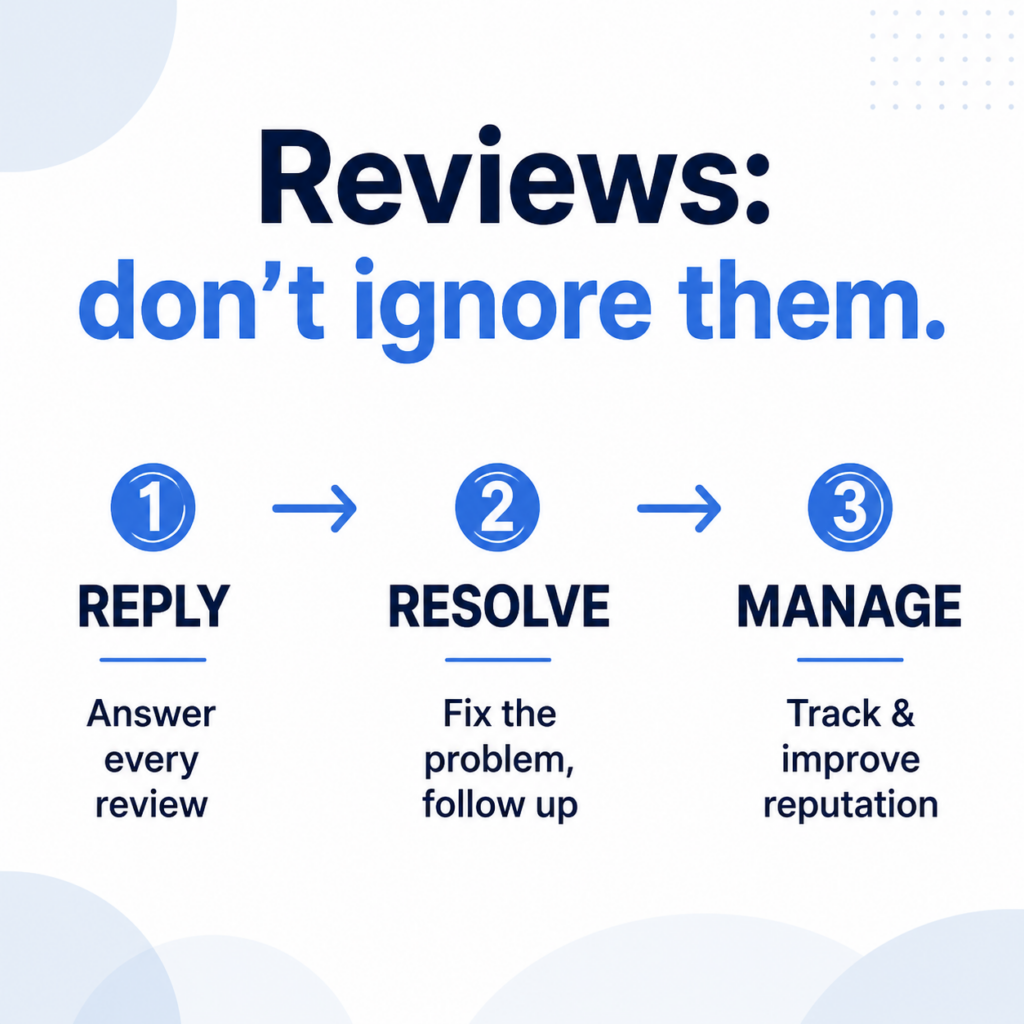
For positive entries, the response should be brief, genuine, and specific enough to show that someone actually read what was written rather than copying a template. Mentioning the specific service or staff member referenced — where appropriate — demonstrates real engagement. For negative entries, the response discipline is more demanding: acknowledge the experience without admitting fault where facts are disputed, express genuine concern, and offer to resolve the issue through a direct channel rather than debating specifics in the public thread.
- ► Respond within 24 hours — delayed responses to negative feedback allow the narrative to sit unchallenged
- ► Personalize every response — use the reviewer’s name and reference something specific from their comment
- ► Keep positive responses concise — two to four sentences is sufficient; longer responses feel performative
- ► Never offer incentives in a public response — this violates platform policies and signals desperation
- ► Assign clear ownership — one person should be responsible for responses so the voice and timing stay consistent
Common Mistakes That Kill Your Feedback Strategy
Even businesses that understand the importance of ratings make predictable errors that undermine their acquisition efforts. The most damaging is purchasing submissions — a practice that violates Google’s policies, is increasingly detectable through behavioral pattern analysis, and produces a profile that sophisticated customers can identify as artificial. A sudden surge of generic five-star entries from accounts with no prior activity, all arriving within a week of each other, is a pattern that erodes credibility faster than a few genuine three-star comments would.
The second major error is ignoring the process entirely after an initial campaign. Acquisition is an ongoing operational discipline, not a project with a completion date. Companies that run a one-time push, collect 40 entries, and then stop end up with a profile that looks increasingly dated as months pass without new activity. The recency of what people write is a visible trust signal — a customer deciding between two options who sees that one has its most recent entry from eighteen months ago will interpret that as a sign of declining engagement, regardless of what the content says.
Never Incentivize Submissions:
Offering discounts, gifts, or any other incentive in exchange for a rating violates platform policies and, if detected, can result in submissions being removed or the Business Profile being penalized. Beyond the policy risk, incentivized entries tend to be shorter, more generic, and less credible to readers — precisely the opposite of what a strong profile requires.
A third error that’s less discussed but equally consequential is failing to connect the feedback strategy to the broader local SEO infrastructure. Ratings don’t operate in isolation — they interact with how complete and consistent your Business Profile is, how your website content aligns with the service areas you’re targeting, and how your citation profile reinforces your geographic relevance. Any local business running a feedback acquisition campaign that operates independently of these other factors will produce partial results. The review strategy works best when it is integrated into a comprehensive visibility plan — not treated as a standalone activity.
The question of how to get more Google reviews consistently — month after month, not just during a campaign sprint — ultimately comes down to system design. A local business that generates steady feedback is not doing anything mysterious. It has identified the key customer touchpoints where a natural ask can be made, built simple infrastructure to support that ask, and built the habit of responding to every piece of input it receives. The 15 tactics in this guide — each designed to remove the friction between a satisfied customer and the act of sharing their experience — are the building blocks of that system.
Frequently Asked Questions
Can I ask a customer to edit or remove a negative entry if the issue was resolved?
You can ask — politely, privately, and only after the issue has been genuinely resolved to the customer’s satisfaction. There’s no mechanism to force an update, and pressuring someone typically produces the opposite result. The better approach is resolving the issue so thoroughly that the customer wants to update their comment without being asked.
Does responding to what customers write actually affect search ranking?
Active response patterns signal engaged profile management, which is a factor in local search ranking. Profiles with consistent response activity — especially when the responses to reviews are personalized and timely — tend to have higher overall engagement metrics and better algorithmic credibility.
The ranking impact is difficult to isolate in isolation, but every serious local SEO practitioner includes response consistency as a standard optimization activity — because campaign data consistently supports doing so.
How many ratings does a business actually need to compete in local search?
There’s no universal threshold — it depends entirely on your competitive market. In a small town with limited competition, 20 well-distributed entries may be more than sufficient. In a major metro market in a competitive service category, 200 may be the minimum entry point for map pack consideration. The relevant benchmark is your actual competitors’ counts in the specific queries you’re targeting.
What’s the most effective single change a business can make to increase volume immediately?
Generate your direct submission link and start sending it to customers by SMS immediately after service completion. This one change, applied consistently, produces more responses per month than any other single intervention for most service businesses. The friction reduction from a direct link versus asking someone to search for you manually is the difference between a 5% conversion rate and a 25% rate on the same underlying ask.
Is it a problem if all submissions come from a narrow window of time?
A sudden cluster of entries arriving within a short period can trigger automated scrutiny from platform quality systems, particularly if the posting accounts have limited prior activity. It’s a pattern associated with coordinated or purchased submissions. Distributing your acquisition effort consistently over time produces a more natural velocity pattern and avoids the risk of removal that sudden spikes can create.
Sustained, moderate, consistent acquisition is structurally more durable than periodic campaign bursts — both for algorithm credibility and for maintaining the recency signal that keeps your profile looking actively engaged. Businesses that truly understand this process treat feedback acquisition as an always-on discipline, not a quarterly project.
Should I prioritize platform ratings over niche-specific directories?
For most service businesses, the primary search platform is the non-negotiable first priority — simply because it’s where the majority of local searches originate and where the signal most directly influences map pack visibility. That said, industry-specific platforms matter in certain categories: Yelp for restaurants, Healthgrades for medical practices, Avvo for legal services. Build the primary foundation first, then expand to the platforms most relevant to your specific industry.
What should I do if a fake negative entry appears on my profile?
Flag it for removal through your Business Profile management interface, providing as much specific detail as possible about why it violates content policies. The removal process can be inconsistent — many legitimate requests are initially declined. Document your case, submit the flag, respond publicly in a way that addresses future readers without escalating the content, and escalate through official support channels if the initial request is rejected.