




 Get to WhatsApp

Our manager will contact you
within 15 minutesт
Lead Generation for Lawyers: Complete Guide [Strategies + Tools]
Proven Channels, Realistic Costs, Actionable Steps
![Lead Generation for Lawyers: Complete Guide [Strategies + Tools]](https://www.worldseoagency.com/wp-content/uploads/2026/10/lead_generation_for_lawyers-1024x712.png "Lead Generation for Lawyers: Complete Guide [Strategies + Tools]")
Lead Generation for Lawyers: Complete Guide [Strategies + Tools]
I have specialized in legal marketing and website promotion for over ten years, and if you want to understand how to generate leads for lawyer practices that actually convert, the first thing to accept is this: there are no shortcuts that hold up. The main sources of lead generation for your practice can be broken into three categories — your website, which you promote through SEO, local SEO, Google Business Profile, and Google Ads; social media platforms including Instagram, Facebook, and LinkedIn; and specialist legal directories and portals where prospective clients search by location and practice area. Of these three, I lean heavily toward the first and have the most hands-on experience with it. It is the most accessible channel from a standing start, and it produces inquiries faster than most practitioners expect when executed correctly. You can also order SEO for your website through my agency on an all-inclusive basis — we handle everything from technical setup to Google rankings. Send a request through the form below.
What’s Inside This Guide
— What is lead generation for lawyers and why it is different from other industries.
— Top strategies to attract qualified clients to your practice.
— Service page optimization and semantic architecture for law firms.
— Tools, cost estimates, and timelines for each channel.
— Content plan for legal topics across three months.
— Additional client acquisition channels beyond the primary nine.
— Case studies: what results actually look like in practice.
— Common mistakes that drain budget without producing cases.
— Why World SEO Agency for your legal practice promotion.
— Frequently asked questions.
— Action checklist: where to start today.
Legal marketing occupies a specific position in the broader digital marketing landscape — one where the stakes of a poor strategy are higher than in most other categories, and where the gap between what the market spends and what it gets back in qualified cases is wider than almost anywhere else. The average cost per lead in legal ranges from $50 for basic informational inquiries to well over $500 for personal injury and complex family law cases in major metro markets. Most firms spending in this range are generating volume without the qualification infrastructure to convert that volume into actual retained clients. This guide is about fixing that disconnect — not just generating more inquiries, but generating the right ones and converting them efficiently.
What Is Lead Generation for Lawyers — and Why the Economics Are Different
What is lead generation for lawyers in practical terms? It is the systematic process of identifying individuals or organizations with a legal problem, bringing them into contact with your practice at the moment they are actively seeking help, and converting that initial contact into a retained client. The definition sounds simple. The execution is complicated by three characteristics specific to legal that don’t apply in most other service categories.
First, the lifetime value of a client varies enormously by practice area and case outcome — a personal injury case that settles well might generate $50,000 in fees from a single referral relationship, while a straightforward will drafting generates $500 once and rarely repeats. This asymmetry means the acceptable cost per acquisition is different for every practice area, and conflating them produces budget allocation decisions that either underfund the high-value channels or overspend on low-value ones.
Second, trust is the primary decision variable. A person searching for a family law attorney is not shopping for the cheapest option the way they might shop for a contractor — they are looking for someone they believe will handle one of the most stressful situations of their life competently and with their interests genuinely prioritized. The marketing materials, the website experience, the review pattern, and the initial consultation call are all trust-evaluation steps, not just awareness channels. The practices that generate the most qualified inquiries are those that understand this and build their entire digital presence around demonstrating competence and care rather than around generating click volume.
The qualification gap most firms ignore:
Generating 200 inquiries per month sounds impressive until you discover that 160 of them are outside your jurisdiction, outside your practice area, or cannot afford your fees. Lead volume without qualification infrastructure is an expensive way to keep your intake team busy without filling your calendar with paying clients. Build the qualification layer before scaling the traffic.
Third, the decision cycle is longer than most digital marketing frameworks assume. A person who downloads your guide to divorce proceedings in California is not ready to retain you today — they may be months away from filing, or still deciding whether to proceed at all. The practices that convert the most of their organic traffic into actual clients are those with a nurturing system that stays in contact with prospective clients through the research phase and is present when they move to the decision phase. This is where most law firm marketing falls apart: generating the initial contact but having no system for the period between first inquiry and retained case.
Proven Strategies to Generate Qualified Client Inquiries
1. SEO as the Long-Term Foundation
Search engine optimization is the channel that produces the highest-quality inquiries for most legal practices over a sustained period — not because it generates the most volume, but because the intent of a person who finds your site through organic search is typically more specific and further along in the decision process than someone who sees a display ad. A person who types “estate planning attorney in Phoenix” and clicks through to your practice page has already identified their need, identified the solution category, and is now evaluating providers. That is a fundamentally different conversation from cold outreach or interruption advertising.
SEO for lawyer lead generation operates across three levels simultaneously: technical site health that allows the site to be crawled and indexed efficiently; on-page optimization that aligns page content with the specific queries used by prospective clients in the target geographic market; and authority building through editorial links from credible publications that signal to search algorithms that the practice is a trusted source of legal information. The third component — link acquisition — is the one most practices underinvest in, which is why their organic visibility plateaus despite technically clean sites with well-written content.
For a complete breakdown of what professional SEO services for lawyers involve at each competitive level, including the technical and authority-building work required for different market sizes, the linked resource covers the full scope. And for realistic timelines — because organic campaigns require patience that most practitioners don’t anticipate — the guide on how long SEO takes to show results provides the month-by-month context that most providers are vague about.
2. Google Ads and Remarketing
Paid search is the channel that bridges the gap between starting an organic campaign and seeing its results — and for practices in highly competitive markets like personal injury in New York or criminal defense in Los Angeles, it remains a necessary component of the full marketing system regardless of organic performance. The economics of legal paid search are unforgiving: cost per click for competitive terms in major markets runs $30 to $150, which means a campaign that converts poorly is an extremely expensive way to generate zero cases. The practices that run profitable paid search campaigns are those who have invested in the conversion infrastructure before scaling the ad spend.
Local Services Ads with the Google Screened badge deserve specific attention for legal practices. These ads appear above traditional paid search results, carry a trust signal from Google’s verification process, and charge per lead rather than per click — which changes the economics significantly for practices in categories where click-to-call conversion rates are high. For family law, estate planning, and immigration practices in moderate-competition markets, Local Services Ads frequently produce a lower effective cost per qualified lead than traditional Google Ads campaigns.
Remarketing is the component of paid advertising that most legal practices underinvest in despite its consistently favorable performance. A person who spent six minutes on your divorce services page, read three articles on your blog about custody arrangements, and then left without contacting you has revealed detailed intent information. Serving that person display and social ads featuring your attorney credentials, client outcomes, and a low-friction consultation offer over the following thirty days costs a fraction of what acquiring a new cold visitor costs — and converts at substantially higher rates. Understanding what competitors are spending helps calibrate your own investment level; the guide to how to find your competitors’ Google Ads budget walks through the methodology.
3. Google Business Profile — The Most Underused Asset in Legal Marketing
For practices serving clients in a defined geographic area, the Google Business Profile is often the highest-ROI optimization task available. Map pack results dominate the visible space for local legal queries on mobile — which is where the majority of urgent legal searches happen — and the ranking signals for map pack positions are different from those for organic results. A practice can have a strong website but a weak profile and lose significant map pack visibility to competitors whose sites are technically inferior but whose profiles are more completely and actively managed.
The practical work of profile optimization goes beyond completing all available fields. Active management means posting content updates regularly, responding to every review — positive and negative — within a short timeframe, keeping the services section updated with specific practice areas rather than generic categories, and adding photo content that reflects the team and the office environment. The review acquisition process is particularly critical: the quantity, recency, and content specificity of reviews are all ranking signals, and a systematic process for requesting reviews from satisfied clients at case resolution is one of the simplest high-impact activities available to any practice. The complete guide to Google Business Profile optimization covers the full technical and content checklist.
Service Page Optimization: The Semantic Architecture Strategy
One of the most significant missed opportunities in legal website strategy is the failure to build a comprehensive library of practice-specific service pages that match the precise search patterns of prospective clients. Most law firm websites have a single “practice areas” page that lists their services. The practices generating the most organic client inquiries have individual pages — often dozens of them — for each meaningful combination of service type, client situation, and geographic market.
The principle is straightforward: a person who has just been served with divorce papers in Cook County is not typing “lawyer” into Google. They are typing something far more specific — “what happens to my house in a contested divorce in Illinois” or “how long does divorce take in Chicago.” The practice whose website has a page specifically addressing those questions, optimized for those queries, and structured to guide that reader toward booking a consultation is the one that captures that inquiry. The competing firm with a generic divorce law page loses it.
- ► Individual pages for each distinct practice area: family law, estate planning, personal injury, criminal defense, immigration, business litigation, employment law
- ► Sub-pages for specific case types within each practice: within family law — divorce, child custody, spousal support, adoption, prenuptial agreements
- ► Location-modified pages for multi-area practices: “divorce attorney in [neighborhood],” “estate planning lawyer in [suburb]”
- ► FAQ sections on each service page addressing the five to eight most common questions clients ask before retaining for that specific matter
- ► Process explanations that walk the prospective client through what working with your firm on that type of matter actually looks like, step by step
- ► Cost transparency sections that address the question every prospective client is thinking but most firms refuse to answer directly
This architecture serves two purposes simultaneously. From a search perspective, each page can be optimized for a distinct query cluster, which dramatically expands the range of searches the site can rank for without competing against itself. From a conversion perspective, a visitor who lands on a page specifically about their situation finds content that speaks directly to their circumstances — which reduces the trust-building work the page needs to do before they take the next step.
4. Content Marketing and the Informational Blog
The blog is not optional for practices that want to build organic visibility at scale. It is the mechanism that captures the research-phase queries — “how much does a divorce cost in Texas,” “what is the difference between a will and a trust,” “can I sue my employer for wrongful termination in California” — that precede most retained client relationships. These queries have lower commercial intent than “hire a divorce attorney near me,” but they are asked by the same people, months before they are ready to make a call. The practice that provides genuinely useful answers at the research stage is positioned as the trusted expert when the prospect moves to the decision stage.
The content types that generate the most qualified organic traffic in the legal category are: detailed how-to guides for specific legal processes, cost breakdown articles that answer the pricing questions directly and honestly, comparison pieces that help prospective clients understand trade-offs between approaches, and neighborhood or jurisdiction-specific guides that cover the legal landscape of the specific courts and administrative bodies the prospective client will need to navigate. Each piece should be written for the reader’s actual question — not for keyword density — and should be substantive enough to actually answer what was asked rather than gesture at it and redirect to a consultation form.
5. Social Media: Platform-by-Platform Strategy
Social media for legal practices serves a different function than it does for consumer brands — the goal is trust building and authority demonstration rather than viral reach or entertainment. The platform choice should be driven by the client type being targeted: Instagram and Facebook for family law, personal injury, and consumer-facing practice areas where the decision maker is an individual; LinkedIn for corporate law, employment law, and business transaction practices where the decision maker is a business owner, HR director, or general counsel.
The content that performs best on Facebook and Instagram for legal practices is not promotional — it is educational and humanizing. Short video explanations of common legal misconceptions, process walkthroughs for specific case types, and behind-the-scenes content that lets prospective clients see the people behind the firm consistently outperform pure promotional content in reach, engagement, and the downstream metric that actually matters: consultation requests. LinkedIn content for corporate-focused attorneys works differently — thought leadership articles on regulatory developments, commentary on legal trends affecting specific industries, and genuine engagement with the professional community the practice serves builds the credibility that produces B2B client relationships.
The LinkedIn opportunity most corporate attorneys miss:
Consistent publication of substantive commentary on legal developments in the specific industries your clients operate in — not generic legal updates but genuinely useful analysis of what a regulatory change means for a CFO or a founder — builds the kind of professional visibility that results in direct inbound inquiries from businesses that found you through your content rather than through a directory or a referral.
6. Email Marketing and Lead Nurturing
The gap between initial inquiry and retained case is where most law firm marketing investment is wasted. A prospective client who downloads a guide, fills out a contact form, or attends a webinar has signaled interest — but may be weeks or months away from being ready to retain counsel. Without a systematic nurturing sequence that delivers value during that interval, the practice loses the case to a competitor who stays present through the research phase.
An effective nurturing sequence for legal practices segments contacts by practice area and delivers content relevant to their specific situation: a person who downloaded the estate planning guide receives a monthly digest of practical guidance on trust administration, beneficiary designations, and asset protection — content that keeps the practice visible and credible during the months between initial contact and eventual retention. The email content should be genuinely useful rather than promotional; the conversion happens not because of a sales email but because of the accumulated trust built through months of valuable, relevant information delivered consistently.
7. Referral Programs and Professional Partnerships
The highest-quality leads most legal practices receive come from referrals — existing clients, other attorneys outside the practice area, and professional advisors whose clients have legal needs. Building a systematic referral network is not an accidental outcome of doing good work; it requires intentional relationship development and a clear process for making referrals easy to give and receive.
The most productive partnership categories for legal referrals vary by practice area but typically include: financial advisors and CPAs for estate planning and business law practices; real estate agents and mortgage brokers for real estate transaction and landlord-tenant practices; therapists and family counselors for family law practices; and primary care physicians and chiropractors for personal injury practices. These referral relationships require cultivation — regular contact, mutual value delivery, and making the referral process as frictionless as possible for the referring party.
8. Legal Directories and Platforms
Avvo, Justia, FindLaw, Super Lawyers, and Martindale-Hubbell are the major directories where prospective clients search for legal services by practice area and location. The question of whether to pay for premium placement on these platforms is practice-area and market-specific: in categories like personal injury and DUI defense in major metro markets, the paid placement competition is intense enough that organic directory rankings are difficult to achieve without premium investment. In less competitive practice areas and smaller markets, well-optimized free profiles frequently generate meaningful inquiry volume without paid placement.
The optimization principles for directory profiles mirror those for the Google Business Profile: complete every available field, use practice-area-specific language in the bio and services sections, accumulate reviews systematically, and maintain the profile actively rather than setting it up once and leaving it unchanged. A profile with 50 recent reviews and current activity consistently outranks a premium-paid listing with 5 reviews and stale content — which tells you something important about where the investment should go.
Lead Generation Tools: Cost and Timeline Comparison
| Channel / Tool | Estimated Monthly Cost | Time to First Results |
|---|---|---|
| Local SEO and Google Business Profile | $500 – $2,500 | 4 – 10 weeks for profile; 3 – 6 months for organic |
| Google Ads (search campaigns) | $1,500 – $15,000 ad spend | 2 – 4 weeks |
| Local Services Ads (Google Screened) | $500 – $3,000 (pay per lead) | 1 – 3 weeks after verification |
| Remarketing campaigns | $300 – $1,500 | 2 – 3 weeks |
| Content marketing and blog | $600 – $3,000 | 2 – 5 months |
| Social media management | $400 – $2,000 | 1 – 3 months |
| Email marketing and CRM automation | $150 – $800 | 3 – 6 weeks |
| Legal directory listings (Avvo, FindLaw) | $100 – $1,000 | 2 – 6 weeks |
| YouTube channel and video production | $500 – $2,500 | 2 – 4 months |
How much does lawyer lead generation cost — the honest answer:
How much does lawyer lead generation cost depends entirely on the practice area and market. Personal injury in a major metro can run $300 – $600 per qualified lead through paid channels. Estate planning in a mid-size market might produce qualified inquiries at $40 – $80 through organic search. The cost figures above are channel costs, not per-lead costs — and the per-lead figure is what actually tells you whether the channel makes financial sense for your specific practice economics.
Content Plan for Legal Topics — 3 Months
| # | Article Topic | Period |
|---|---|---|
| 1 | How much does a divorce attorney cost — a full breakdown by case type | 1 |
| 2 | What to expect during your first consultation with a family law attorney | 1 |
| 3 | How long does estate planning take and what documents do you actually need? | 1 |
| 4 | Can I sue my employer for wrongful termination — what the law actually says | 1 |
| 5 | What happens to shared debt in a divorce — who is responsible? | 2 |
| 6 | Personal injury claim timeline — how long before you receive a settlement? | 2 |
| 7 | The difference between a will and a living trust — which one do you need? | 2 |
| 8 | How to choose a business attorney when forming an LLC or corporation | 2 |
| 9 | What does a criminal defense attorney actually do — step by step through a case | 3 |
| 10 | Child custody arrangements explained — types, court factors, and how decisions are made | 3 |
Additional Client Acquisition Channels
YouTube: The Underused Authority Builder
YouTube is both a hosting platform and a search engine — and legal topics generate consistent organic search traffic on the platform for attorneys who invest in video content. A personal injury attorney with a YouTube channel covering topics like “what to do immediately after a car accident,” “how insurance companies calculate settlement offers,” and “when to hire a personal injury attorney versus handling the claim yourself” is building an audience of prospective clients who are researching their options months before they are ready to call anyone. The trust built through video — where the prospective client sees and hears the attorney, not just reads text attributed to them — significantly accelerates the conversion process when those viewers eventually reach the decision stage.
Production quality for YouTube legal content does not require a studio. A clean background, adequate lighting, a lavalier microphone, and substantive content that genuinely answers the questions viewers are asking produces results. The attorneys who have built the most successful YouTube presences in the legal category are those who film consistently, optimize their video titles and descriptions for the search queries their target audience is actually using, and include a clear path to contact in every video.
Specialist Legal Portals and Online Communities
Beyond the major directories, several specialist platforms generate meaningful legal inquiry volume for specific practice areas. Nolo.com attracts buyers actively researching legal topics and connects them with attorneys in their area. Lawyers.com provides a directory and Q&A format that allows attorneys to demonstrate expertise while generating profile visibility. Avvo’s Q&A forum — where attorneys can answer publicly posted legal questions — builds credibility and searchable content simultaneously. State bar referral services and local bar association member directories provide additional visibility in the geographic markets where the practice operates. The best lead generation software for intake management — tools like Clio Grow, Lawmatics, and the intake features of legal practice management platforms — integrates with these channels to ensure every inquiry is captured, tracked, and followed up on regardless of source.
- ► Nolo.com attorney directory — strong organic traffic from research-phase legal queries
- ► Avvo Q&A forum — public answers to legal questions build indexed credibility content
- ► Lawyers.com profile — Martindale-Hubbell affiliate with high domain authority for local search
- ► State bar referral service — verified leads from prospective clients who have specifically requested a referral
- ► Court Listener and PACER — for attorneys building authority through published case documentation
Podcasting for Authority Building
Podcasting occupies a specific and underused position in legal marketing — it builds a sustained relationship with an audience of prospective clients and referral sources over time through a format that requires no visual attention from the listener. A family law attorney who hosts a weekly podcast addressing the legal and practical questions families face during divorce and separation is building an audience of people who are in, or adjacent to, exactly the situation that produces their clients. The compounding effect of a podcast archive — where every episode remains available and searchable indefinitely — means that the investment made in episode one continues generating audience and authority years later. Lawyer marketing strategies that include audio content consistently produce higher referral rates than those limited to written content alone, because the relationship depth created through repeated audio exposure is stronger than what static content builds.
Case Studies: What Results Actually Look Like
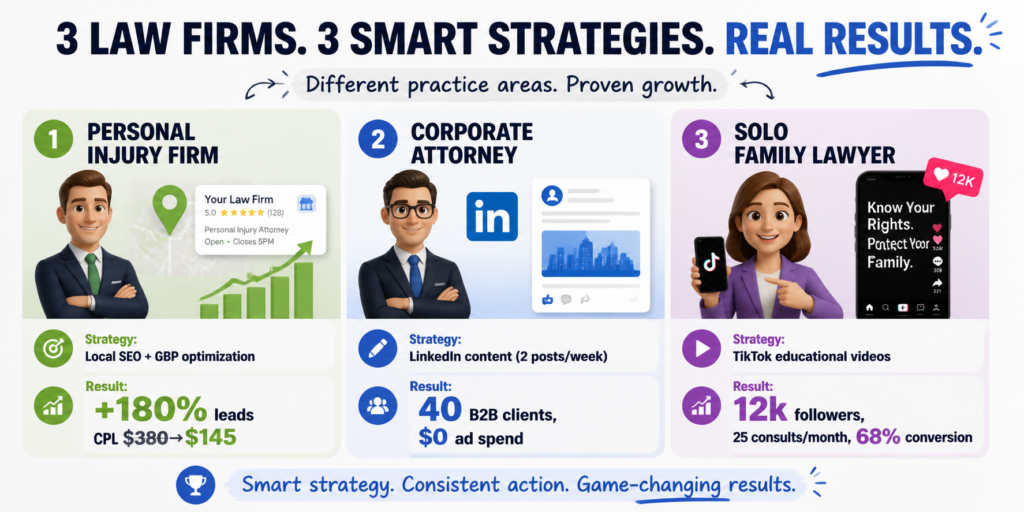
Case 1: Personal Injury Firm — 180% Lead Increase Through Local SEO
A three-attorney personal injury firm in a mid-size southeastern market came in with a website that had not been updated in four years, a Google Business Profile with nine reviews and incomplete category information, and no local citation presence worth measuring. Their paid search spend was generating leads at $380 per qualified case inquiry — a cost that barely justified itself given their average fee on smaller cases.
The strategy focused first on the Google Business Profile: completing every field, launching a systematic review request process targeting the firm’s existing satisfied clients, and posting weekly content updates featuring case outcomes and legal tips. Within eight weeks, the profile was ranking in the map pack for the firm’s primary service area queries. Simultaneously, technical work on the website addressed crawl efficiency and page speed issues that had suppressed organic rankings for years. Six location-specific service pages were built covering each county the firm served, each optimized for the geographic query patterns of that specific area. At month six, organic leads had increased 180% against baseline, and the blended cost per qualified case inquiry across all channels had dropped from $380 to $145.
Case 2: Corporate Attorney — 40 B2B Clients Through LinkedIn
A solo corporate attorney specializing in startup formation and venture financing spent six months publishing two substantive LinkedIn articles per week — not promotional content, but genuine analysis of regulatory developments relevant to early-stage founders and their investors. Each article ended with a specific, practical recommendation rather than a generic “consult an attorney” disclaimer. The audience grew gradually over the first three months and then accelerated as the content was shared within founder and investor communities. By month six, the attorney was receiving an average of three to four inbound messages per week from founders or their advisors seeking representation for transactions in exactly the categories the articles addressed. Forty new B2B clients over the period, with an average engagement value well above the personal services categories, came entirely from organic LinkedIn presence — with no paid promotion of any article.
Case 3: How to Generate Leads for Solo Practice Lawyer Through TikTok
How to generate leads for solo practice lawyer in a competitive family law market was the challenge facing a recently established solo practitioner who had left a larger firm with client relationships but no owned digital presence. With a limited marketing budget and no organic search history, she launched a TikTok account posting two short videos per week addressing the questions she heard most frequently in consultations: “Can I file for divorce without a lawyer?”, “What happens to my retirement account in a divorce?”, “How long does the divorce process actually take?” The content was direct, specific, and spoke to the anxiety that prospective clients feel about the process rather than about legal theory. Within three months, the account had accumulated 12,000 followers and generated 25 consultation bookings in a single month — primarily from viewers who had watched multiple videos and described feeling like they already knew and trusted the attorney before they made contact. The conversion rate from consultation to retained client ran at 68% over that period, against an industry average closer to 40%.
Common Mistakes That Drain Budget Without Producing Cases
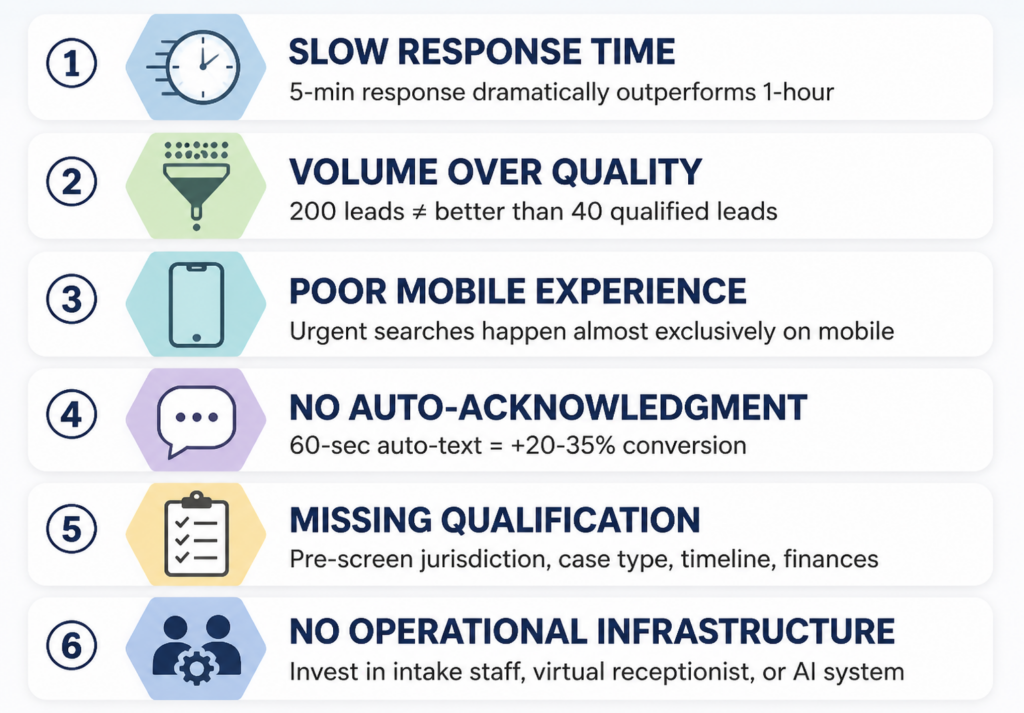
1) Slow Response to Initial Inquiries
The research on response time in legal intake is consistent and unambiguous: practices that respond to initial inquiries within five minutes convert at dramatically higher rates than those that respond within an hour, and those that respond within an hour significantly outperform those that respond within a day. A prospective client who submits a contact form while sitting in their car outside the courthouse is evaluating three or four practices simultaneously. The first attorney whose office calls them — not texts, not emails, calls — within five minutes earns a disproportionate share of retained cases regardless of what the subsequent conversation reveals about comparative qualifications. Building the operational infrastructure for rapid response — whether through dedicated intake staff, a virtual receptionist service, or an AI-assisted first-response system — is as important as any marketing channel investment.
2) Generating Volume Without Qualification
The most expensive mistake in legal lead generation is optimizing for inquiry volume rather than inquiry quality. A campaign that generates 200 contacts per month at $30 each looks better than one generating 40 contacts at $120 each — until you track them through to retained clients and discover that the first campaign produced 8 cases and the second produced 22. Qualification infrastructure — intake questions that identify jurisdiction, case type, timeline, and financial situation before the attorney’s time is invested — is what separates lead generation for lawyers that produces revenue from lead generation that produces busy intake teams and thin caseloads.
3) Ignoring Mobile Experience
Legal searches happen on mobile at a higher rate than most attorneys assume — and urgent searches, the ones that produce immediate consultation requests, happen almost exclusively on mobile. A website that loads in six seconds on a smartphone, presents contact information in a format that requires scrolling to find, or uses contact forms that are difficult to complete on a mobile keyboard is losing a significant portion of its most motivated prospective clients before any conversation occurs. Mobile optimization is not a secondary concern — it is the primary user experience for the majority of visitors who will ever encounter your practice online.
The five-minute rule in practice:
Set up automated text message responses to all contact form submissions that fire within 60 seconds of submission. The text should acknowledge receipt, provide a specific timeframe for a call, and include a calendar link for scheduling. This single operational change consistently improves lead-to-consultation conversion rates by 20 to 35% without any change to the marketing spend that generated the inquiry in the first place.
How to Measure Whether Your Lead Generation Is Actually Working
The metrics that matter in legal lead generation are not the ones that most marketing dashboards display by default. Click volume, impression share, and social media reach are activity metrics that tell you whether the campaign is running — not whether it is producing cases. The metrics that connect marketing investment to business outcomes are: cost per qualified lead by channel, lead-to-consultation conversion rate by intake method, consultation-to-retained-client conversion rate by practice area, and ultimately cost per retained client against average case fee for each matter type.
Building the analytics infrastructure to track these metrics requires: Google Analytics 4 with conversion events configured for form submissions, phone click events, and consultation bookings; call tracking numbers assigned to each major marketing channel so that phone inquiries are attributed to their source; UTM parameters on all paid traffic links; and a CRM that captures lead source at intake and tracks the case through retention. Without this infrastructure in place before scaling any channel’s spend, the budget allocation decisions that follow are based on instinct rather than evidence — which is how practices end up spending heavily on channels that generate volume without revenue.
For practices evaluating what level of SEO investment makes sense relative to their competitive market and practice area, the guide to affordable SEO services covers the realistic price landscape from entry-level to full-service with enough specificity to inform budget planning decisions. Lawyer lead generation services at the professional level should include the full technical, content, and authority-building scope described above — not just keyword optimization or monthly reporting with no implementation behind it.
Action Checklist: Where to Start Today
- ► Complete and actively manage your Google Business Profile — all fields, regular posts, systematic review requests
- ► Build dedicated service pages for your top three practice areas with FAQ sections and clear conversion paths
- ► Set up call tracking numbers by channel before launching any paid campaigns
- ► Install a CRM with intake tracking and configure automated responses to all new inquiries
- ► Launch a content plan of one substantive blog article per week targeting the research-phase queries most common to your practice area
- ► Configure remarketing pixels on all site pages and launch a retargeting campaign targeting visitors who spent more than two minutes on service pages
Why World SEO Agency for Your Legal Practice Promotion

Legal marketing is one of the most competitive and compliance-sensitive categories in digital marketing. The practices that get the best results from their digital investment are those who work with partners who understand the specific competitive dynamics, content standards, and conversion requirements of the legal category — not with generalist agencies applying standard methodology to a specialized situation. Here is what working with World SEO Agency on legal marketing actually involves.
1) Industry Expertise in SEO for Lawyers
World SEO Agency has developed concentrated experience across the legal vertical through sustained campaign work with solo practitioners, boutique firms, and multi-attorney practices across the United States and internationally. This means campaign strategy is built on genuine familiarity with how prospective legal clients actually search — what queries they use at each stage of the decision process, what trust signals they look for before contacting a practice, and what content formats produce the highest conversion rates for specific practice areas. The keyword architecture, service page structure, and authority-building approach for a family law practice are meaningfully different from those for a corporate litigation firm, and our campaigns reflect those differences from the first strategy session.
2) 90-Day Performance Commitment
Every engagement with World SEO Agency includes documented performance milestones achievable within the first ninety days. These milestones are written into the engagement agreement with specific, verifiable targets — not described in a proposal and forgotten after signing. At the top package tier, a financial performance commitment is tied to specific ranking targets for the agreed query set. The commitment is enforceable because it is specific, not because it sounds reassuring in a sales presentation.
3) Affordable Pricing
Pricing at World SEO Agency reflects the actual cost of delivering the specified scope for the specific competitive environment — assessed honestly before any commitment is made. Every proposal includes itemized deliverable quantities before any financial commitment. No add-ons appear at month three. No tool subscriptions are passed through to clients as separate charges. The price quoted in the proposal is the price on every invoice throughout the engagement, without exception.
4) All-Inclusive System Without Hidden Payments
Technical work, content production, link acquisition, local optimization, reporting, and account management are all covered within the monthly package price. One invoice. Same amount. Every month. The structure that makes genuine affordability possible is eliminating the supplementary billing model that inflates standard retainer costs well above their headline figures — not discounting individual components to a level that cannot fund complete campaign execution.
5) Working in the USA and Worldwide
World SEO Agency serves legal clients across the United States — with active campaigns in New York, Los Angeles, Chicago, Houston, Miami, Phoenix, Dallas, San Diego, Atlanta, and Seattle — and internationally in markets including London, Toronto, Sydney, and Dubai. These are core operating markets with active competitive landscape knowledge, not occasional project locations. For legal practices targeting clients in specific metro areas, this geographic depth matters: campaign strategy and authority building require familiarity with the local competitive landscape, not just general SEO methodology applied without market context.
Want to order promotion for your legal practice? Get a consultation from a World SEO Agency expert. Send a request.
Frequently Asked Questions
How long does it take to see results from legal lead generation efforts?
Paid search produces inquiries within two to four weeks of launch. Google Business Profile optimization typically shows map pack improvement within four to eight weeks. Organic content and SEO results take three to six months to develop measurable traction, with compounding growth continuing for years as the content library and authority profile build.
What is the best channel for a newly solo attorney with a limited starting budget?
Google Business Profile optimization first — it is free, produces results faster than any other organic channel, and the review acquisition process it supports is the single highest-ROI activity available at zero media cost. After the profile is performing, a small Local Services Ads budget produces qualified leads at a predictable per-lead cost while organic channels are being built.
Content marketing is the second priority for budget-constrained practices — one substantive article per week written genuinely for the prospective client’s actual questions costs primarily time rather than money and compounds over months into meaningful organic visibility.
Is buying leads from platforms like Avvo worth it for established practices?
It depends on the cost per lead relative to your average case fee and conversion rate from purchased leads. Most practices that test purchased leads from legal directories report conversion rates below 10% from contact to retained client — which makes the effective cost per case very high relative to other channels. Test at small scale before committing significant budget.
How can a smaller firm compete with large firms in Google Ads given the budget disparity?
Geographic and practice-area specificity. Large firms bid broadly on high-volume terms; smaller practices can compete profitably on more specific queries where the cost per click is lower and the conversion rate is higher because the match between search intent and the specific service offered is tighter. A personal injury firm focused on motorcycle accidents in a specific county can compete against firms spending ten times as much by targeting the specific queries those larger budgets don’t focus on.
What is more important in legal lead generation — inquiry volume or inquiry quality?
Quality, without question. Fifty qualified inquiries from prospective clients in your jurisdiction, with your practice area’s case type, at a financial threshold that makes retention viable, will produce more revenue than 500 unqualified contacts at the same per-lead cost. Building qualification into the intake process — not just accepting every contact as a lead — is the operational discipline that separates profitable lead generation programs from expensive ones.
Can AI tools be used for first-response qualification without harming the client experience?
Yes, with the right framing. AI-assisted chat tools that acknowledge the inquiry immediately, collect basic qualifying information — jurisdiction, case type, timeline — and schedule a human call within a defined window produce better prospective client experiences than voicemail or a 24-hour email response. The key is transparency: the tool should not pretend to be a human, and the human follow-up it promises must happen when it promises.
What content format produces the highest conversion rate for legal websites?
Practice-specific cost and process pages that answer the two questions every prospective client has before they contact any attorney: “How much will this cost me?” and “What will the process actually look like?” Practices that answer these questions directly and honestly on their website convert visitors to consultation requests at significantly higher rates than those who withhold cost and process information to force a consultation call.
Is LinkedIn worth investing in for practices focused on individual clients rather than businesses?
Primarily not for direct client acquisition — the audience for consumer legal services is not concentrated on LinkedIn. However, LinkedIn is valuable for building referral relationships with the professional advisors who regularly encounter clients with legal needs: financial planners, CPAs, real estate professionals, and HR practitioners all have professional LinkedIn presences and are receptive to relationship development there in ways they are not on consumer social platforms.
How should a practice track which marketing activities are actually producing retained clients?
Through consistent lead source capture in the CRM at intake and matter tracking from first contact through retained status. Every inquiry should be logged with its source channel, and every matter should be tagged to the inquiry source. Monthly review of cases retained by originating channel — not just leads generated by channel — produces the attribution data that drives rational budget allocation decisions.