




 Get to WhatsApp

Our manager will contact you
within 15 minutesт
What is Digital Marketing? A Complete Guide to All Channels in 2026
The Full Discipline Explained From First Principles
What is Digital Marketing? A Complete Guide to All Channels
The most complete guide in Google on what is digital marketing. We examine the sequence of work, promotion channels from SEO to AI and content marketing. We explain where to start, what budget to allocate to each tool, how to measure ROI effectiveness, and what tasks should be set for the next 12 months.
Types, Examples, and Channels — Everything You Need to Start and Scale
— What is digital marketing — a working definition that actually helps you make decisions.
— How does digital marketing work — the mechanics behind each channel.
— Digital marketing channels: a complete breakdown by function and budget.
— Main instruments, types, and real-world examples.
— Digital marketing vs traditional marketing: when each approach makes sense.
— What is digital marketing strategy and how to build one that holds up.
— 12-month implementation roadmap and checklist.
— Frequently asked questions.
What Is Digital Marketing — A Working Definition
Here is the version of the answer that actually helps you make decisions: what is digital marketing is the practice of reaching, engaging, and converting prospective customers through channels that exist on the internet and connected devices. That is the complete definition in one sentence. Everything else — the channel names, the platform specifics, the attribution models — is detail in service of those three verbs: reach, engage, convert.
The introductory version you will find in most guides — “promoting products and services through digital channels” — is accurate but not useful. It describes the what without touching the why or the how, which are the parts that actually inform business decisions. Understanding what is digital marketing in the version that is useful means understanding that every channel you might invest in is a mechanism for moving prospective customers through a defined sequence: they become aware that you exist, they develop some level of trust or interest, they take an action that produces revenue. Different channels do different parts of that job. The mistake most businesses make is treating all of them as equivalent and spreading budget thin across many rather than investing meaningfully in the few that best match their customer’s actual behavior.
The distinction that changes how you allocate budget:
Some digital channels are demand capture — they intercept people who are already looking for what you sell. Search advertising and organic search are the primary examples. Others are demand creation — they generate awareness and interest in people who were not actively looking. Social advertising and display are examples. Businesses that confuse these two functions consistently underfund demand capture channels where intent is high and conversion is relatively easy, and overfund demand creation channels where the attribution is harder and the conversion path is longer.
The phrase what is digital marketing examples comes up frequently because the abstract definition doesn’t fully communicate the range of what the discipline covers. A concrete example set: a law firm that appears in the map pack when someone searches “personal injury attorney near me” — that is local search optimization. A software company whose blog post ranks first for a question their target users commonly ask — that is content-driven organic search. A retailer whose ads follow a visitor who browsed a product page across other websites — that is retargeting. An e-commerce brand that earns fifty percent of its revenue through an email list built over several years — that is owned media working at full maturity. Each of these is a different channel with different economics, different timelines, and different skill requirements. Together, they constitute the discipline.
How Does Digital Marketing Work — The Mechanics Behind the Results
How does digital marketing work at the mechanical level? Every channel operates through a version of the same basic sequence: targeting (identifying who to show the message to), messaging (deciding what the message says and what format it takes), delivery (getting the message in front of the identified audience through the chosen channel), and conversion (turning the response to that message into a measurable business outcome). The sophistication of each step varies enormously by channel and investment level, but the sequence is universal.
Search channels — both paid and organic — work through intent matching. The user expresses a need through a query, and the channel attempts to match that query to the most relevant available response. In paid search, relevance and bid determine which ads appear. In organic search, relevance, authority, and technical accessibility determine which pages rank. In both cases, the business is not interrupting the user — it is responding to an already-expressed intent, which is why search channels consistently produce higher conversion rates than interruption channels at equivalent traffic volumes.
Social channels work through audience matching and content consumption. The platform accumulates behavioral and demographic data that allows advertisers to target users by interest, behavior, life stage, professional role, or any number of other characteristics. The content — whether organic posts or paid ads — then competes for attention within a feed or timeline where users are primarily consuming content from people and accounts they have chosen to follow. The conversion path from social is typically longer than from search because the user was not actively seeking what the brand offers at the moment of exposure.
Email and owned media channels work through relationship equity. The user has already given permission for communication — by subscribing, by purchasing, by registering — which means the engagement baseline is higher than for any channel where the contact is cold. The economics of owned email lists are the most favorable of any digital channel for mature businesses precisely because there is no media cost per reach: sending to a list of fifty thousand subscribers costs the same as sending to ten thousand. The investment is in building the list, and the returns compound as the list grows.
Digital Marketing Channels: A Complete Breakdown
| Channel | Primary Function | Typical Starting Budget |
|---|---|---|
| Organic Search (SEO) | Demand capture — long-term authority building | $1,000 – $5,000/month (agency) |
| Paid Search (Google Ads) | Demand capture — immediate intent-based traffic | $1,500 – $10,000/month (ad spend) |
| Social Media Advertising | Demand creation — audience targeting and awareness | $1,000 – $8,000/month |
| Email Marketing | Retention and conversion of existing audience | $200 – $1,500/month |
| Content Marketing | Authority building and organic traffic at scale | $800 – $4,000/month |
| Influencer Marketing | Credibility transfer and audience reach | $500 – $50,000+ per campaign |
| Display and Programmatic | Awareness and retargeting across web properties | $1,000 – $5,000/month |
| Video Marketing (YouTube) | Authority, trust, and product demonstration | $500 – $3,000/month (production) |
| Affiliate Marketing | Performance-based distribution through partners | Commission-based (5% – 30% per sale) |
| AI Search Optimization (GEO) | Visibility in AI-generated search responses | Integrated into SEO investment |
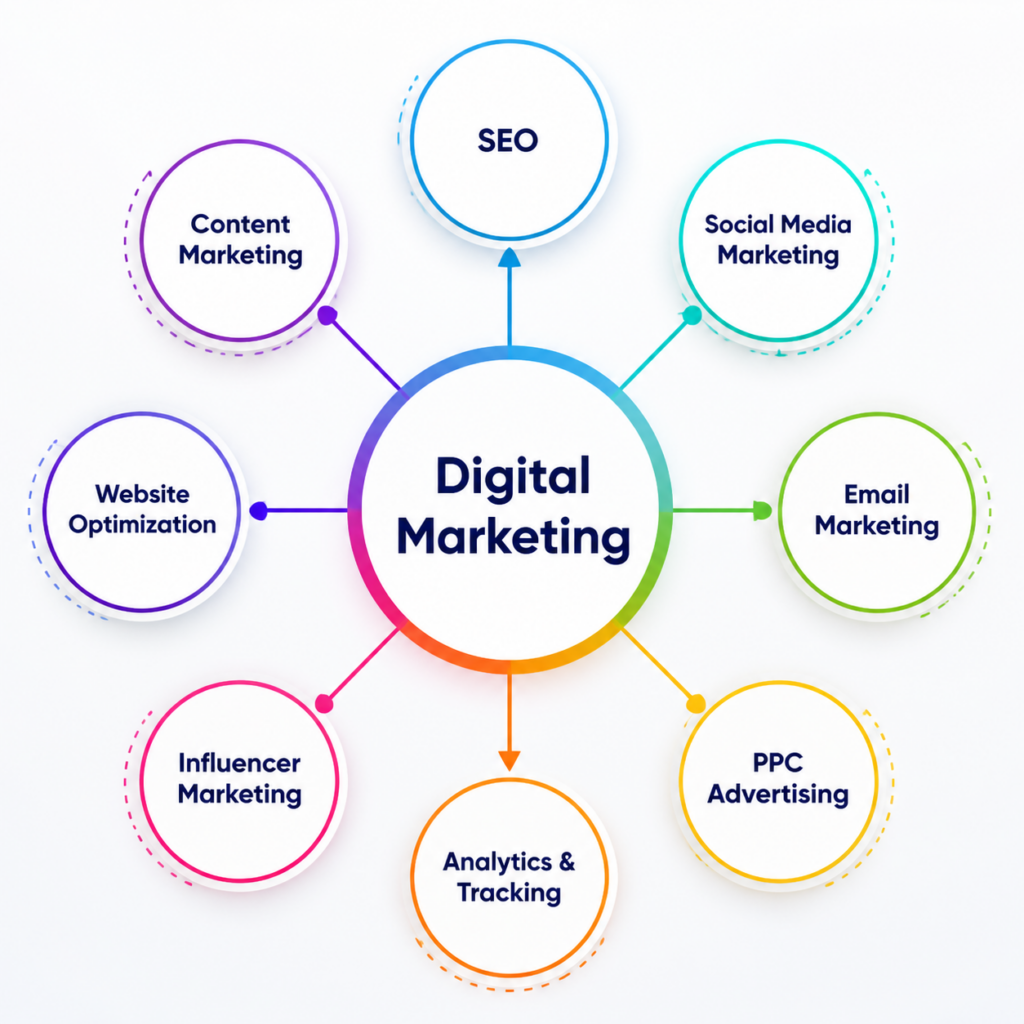
The digital marketing channels listed above are not equally relevant to every business. The right selection depends on three variables: where your prospective customers actually spend their attention online, what stage of the buying journey they are in when they encounter your brand, and what the economics of customer acquisition look like in your specific competitive environment. A B2B software company and a local restaurant both operate through digital channels, but the channels that matter most to each are almost entirely different. Treating them as if the same investment mix applies universally is one of the most expensive mistakes in marketing budget planning.
The channel selection principle that most guides skip:
Before selecting channels, map the customer journey for your specific buyer. Where do they first become aware that a solution exists? Where do they research options? Where do they make the final decision to contact or purchase? The channels that appear most frequently at the decision stage of your specific buyer’s journey are the ones worth investing in first. Every other channel is secondary until the decision-stage capture is working efficiently.
Main Instruments, Types, and Real-World Examples
What is digital marketing examples in practice — not in theory? The following breakdown covers each major instrument, what type of business it serves best, and what a realistic working example looks like. This is more useful than a category description because it shows the discipline functioning in actual competitive conditions rather than as an abstract framework.
1. Organic Search and Content
A healthcare clinic in Austin creates a library of five hundred pieces of content over three years addressing every question their patients research before booking an appointment. By month eighteen, their organic traffic accounts for sixty percent of new patient inquiries. The cost per acquired patient from organic search is approximately forty dollars — compared to two hundred dollars from Google Ads for the same acquisition. This is content-driven organic marketing working at maturity. The guide to what is SEO covers the full technical and strategic framework behind organic search in detail.
2. Paid Search Advertising
A roofing company in Dallas runs Google Ads targeting “emergency roof repair” queries during storm season. The campaign produces calls within hours of going live, at a cost per lead of ninety dollars. The same company’s organic campaign is running simultaneously, and over eighteen months, the organic cost per lead drops to thirty-five dollars while the paid campaign remains at ninety dollars. The rational response: maintain paid as a volume supplement while organic matures, then reduce paid spend as organic captures a higher proportion of the intent-driven traffic.
3. Social Media Advertising
An e-commerce brand selling premium pet products runs Facebook and Instagram campaigns targeting pet owners who have recently moved to a new city — a behavior signal available through the platform’s targeting data. The ads feature video content showing the product in use. Initial campaigns produce purchase rates of one to two percent. After six months of creative testing, the top-performing ad variants produce three to five percent purchase rates from cold audiences. The platform’s data infrastructure is what makes this level of behavioral targeting possible — which is the core value proposition of social advertising relative to other interruption channels.
- ► Email sequences for abandoned cart recovery — automated messages sent to users who added products to a cart but did not complete purchase, typically producing five to fifteen percent recovery rates
- ► Retargeting campaigns on display and social networks — serving ads to users who visited specific pages on the site, extending the conversion window beyond the initial visit
- ► YouTube pre-roll advertising for product demonstration — video ads that appear before content your target audience consumes, used for product launches and brand awareness campaigns
- ► LinkedIn sponsored content for B2B lead generation — promoting content and lead forms to decision makers by job title, industry, and company size
- ► Podcast advertising for brand awareness and credibility transfer — host-read integrations in podcasts your target audience listens to, leveraging the trust relationship between host and listener
4. Influencer and Partnership Marketing
A supplement brand partners with fifteen fitness creators on YouTube and Instagram, providing free product in exchange for genuine reviews and tutorials. The campaigns produce trackable purchases through affiliate codes and links. The cost per acquired customer is sixty dollars — below their Google Shopping average of eighty-five dollars — with the additional benefit of content assets the brand can repurpose for paid social campaigns. The credibility transfer from trusted creators to an unknown brand is the specific value that influencer channels provide that no paid platform replicates.
5. Email Marketing and Marketing Automation
A B2B software company builds a content-driven lead generation system: prospective users download a technical guide from the website, enter an automated email sequence that delivers increasingly specific educational content over thirty days, and are offered a product demo at the point where engagement signals indicate purchase intent. The sequence produces demo bookings at a cost of forty dollars per demo — compared to three hundred dollars per demo through paid LinkedIn campaigns targeting the same audience. The differential is the quality of the relationship built through the email sequence before the ask is made.
The ROI measurement principle that most businesses apply incorrectly:
Most businesses measure channel ROI by looking at last-touch attribution — crediting the conversion to whichever channel the customer interacted with immediately before converting. This systematically overstates the ROI of demand capture channels (search, retargeting) and understates the ROI of demand creation channels (social, content, email nurturing) that moved the customer through the research and consideration phases before they were ready to convert. A multi-touch attribution model — which distributes credit across the full sequence of channel interactions that preceded conversion — produces a more accurate picture of which channels are actually driving business outcomes.
Digital Marketing vs Traditional Marketing
The comparison of digital marketing vs traditional marketing is most useful when framed around the specific advantages each offers rather than as a question of which is superior universally. Traditional channels — television, print, radio, outdoor — offer reach at scale in ways that no single digital channel matches. A thirty-second national television spot reaches an audience that no digital campaign can aggregate efficiently through individual ad placements. But traditional channels offer almost no targeting precision and limited measurement capability, which makes them economically irrational for most businesses operating below a significant revenue threshold.
The fundamental advantage of online marketing over traditional is measurability. Every interaction — every click, every page view, every form submission, every purchase — is recorded and attributable to a specific channel, campaign, and piece of creative. This measurement infrastructure allows for iteration at a speed that traditional channels cannot match: a digital campaign that is underperforming can be adjusted or paused immediately; a television buy that is underperforming must run through its contracted schedule. The ability to respond to performance data in real time is not a minor operational advantage — it is a structural advantage that compounds over months and years as each iteration improves on the previous one.
Internet marketing has also changed the competitive dynamics between large and small businesses in ways that favor the latter in specific categories. A small specialty retailer with no traditional advertising budget can build an organic search presence that outperforms major retailers for specific long-tail queries — because organic search rewards relevance and authority, not budget size. A boutique consulting firm can build a LinkedIn presence that reaches exactly the executive audience they serve — because social platforms allow precise targeting by role and organization, not just by demographic proxy. These dynamics don’t eliminate the advantages of scale, but they do open competitive avenues that traditional channels never offered to smaller operators.
What Is Digital Marketing Strategy and How to Build One
What is digital marketing strategy in the form that actually guides decisions? It is a documented framework that connects your business objectives to specific channel investments through a defined logic about why those investments will achieve those objectives in your specific competitive environment. The word “strategy” is overused to describe what are actually just tactical plans — a list of channels to invest in and amounts to spend. A genuine strategy answers the harder question: given who our customer is, how they currently make decisions, and what competitive alternatives they are evaluating, which sequence of channel investments will most efficiently produce the business outcomes we are targeting?
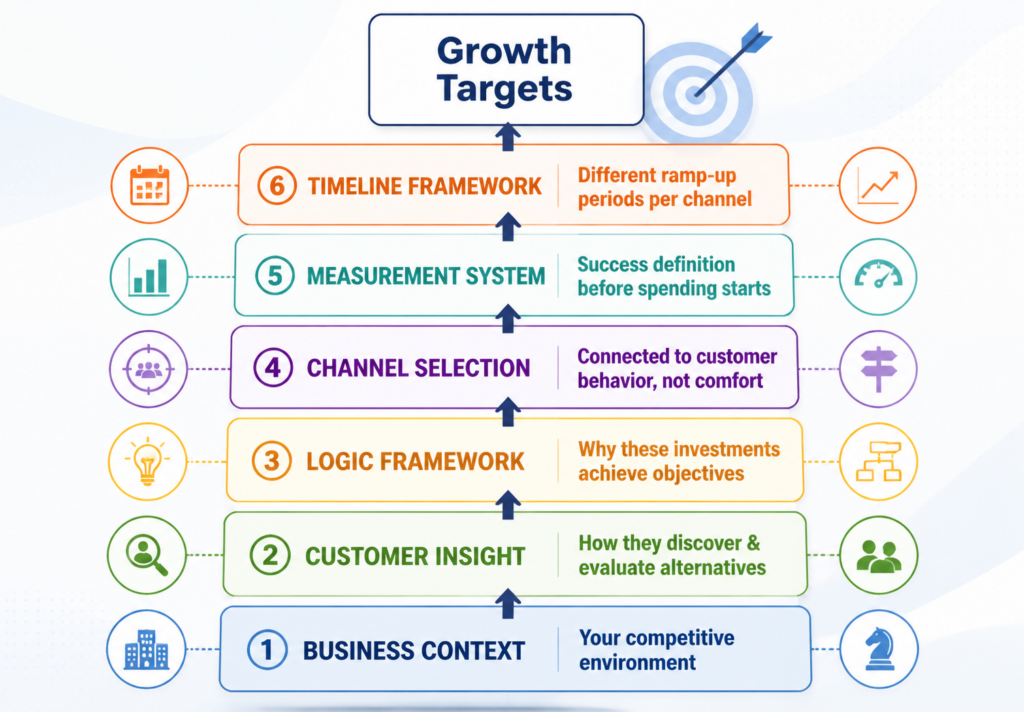
The elements that distinguish a real strategy from a tactical plan are: a specific customer insight that explains why the planned approach will work (not just “our target is professionals aged 35–55” but “our target is operations directors at manufacturing companies who discover vendor alternatives through industry association publications and LinkedIn content”); a channel selection rationale that connects the chosen channels to the customer’s actual behavior rather than to the marketer’s comfort or familiarity; a measurement framework that defines what success looks like at each stage of the campaign before spending begins; and a timeline that accounts for the different ramp-up periods of different channels rather than expecting all investments to produce results on the same schedule.
For guidance on the budget allocation component of strategy development — how to decide how much to invest across channels and how to adjust those allocations as performance data accumulates — the marketing budget planning guide covers the full framework with specific allocation recommendations for different business types and growth stages. And for businesses building internal teams to execute the strategy rather than outsourcing to agencies, the guide to how to build a digital marketing team covers the sequencing of hires and the capability model for teams at different investment levels.
The strategy mistake that wastes the most budget:
Building strategy around the channels the marketing team knows rather than around the channels where the target customer actually makes decisions. This produces competently executed campaigns on platforms where the target audience is not present in sufficient concentration to produce the required returns. The discipline of customer journey mapping — genuinely tracking how real customers discovered the business, evaluated alternatives, and made their decision — consistently reveals that the channels businesses assume are most important are not always the ones that actually drive conversions.
12-Month Digital Marketing Roadmap and Checklist
| Period | Priority Activities | Success Metric |
|---|---|---|
| Month 1–2 | Technical site audit, analytics setup, baseline measurement, competitor research | All tracking operational, baseline data documented |
| Month 1–3 | Keyword research, on-page optimization of priority pages, Google Business Profile setup | Technical issues resolved, 20+ pages optimized |
| Month 2–4 | Content production begins (2–4 pieces/month), email list building strategy launched | First content ranking movements, email list growing |
| Month 3–5 | Paid search campaigns launched with conversion tracking, social media profile optimization | First paid conversions tracked, cost per lead established |
| Month 4–6 | Organic link building program initiated, retargeting campaigns activated | First editorial links acquired, retargeting conversion rate measured |
| Month 5–7 | Email automation sequences built, social media content calendar established | Email open and click rates benchmarked, social engagement measured |
| Month 6–8 | First performance review, channel budget reallocation based on cost-per-lead data | Budget aligned to best-performing channels, underperformers adjusted |
| Month 7–9 | Content refresh of early pieces, video content production, influencer outreach initiated | Refreshed content ranking improvements, video view metrics established |
| Month 8–10 | Scale top-performing paid campaigns, expand organic content volume | Organic traffic 50%+ above baseline, paid ROI positive |
| Month 9–11 | CRO (conversion rate optimization) testing on high-traffic pages and landing pages | Conversion rate improvements documented per test |
| Month 10–12 | Annual strategy review, competitor gap analysis, channel expansion planning for next year | Full ROI documented, next-year budget framework built |
| Ongoing (all months) | Monthly reporting, analytics review, campaign optimization, content publication | Month-over-month improvement across priority metrics |
The sequencing in the roadmap above reflects a deliberate logic. Foundation before promotion: tracking and analytics must be operational before any paid campaigns launch, because running paid campaigns without measurement infrastructure is the equivalent of paying for deliveries without a way to know if they arrived. Technical health before content volume: publishing large amounts of content on a technically broken site produces diminished returns. Organic before heavy paid investment: establishing a baseline organic presence reduces dependence on paid channels and improves the long-term economics of the overall channel mix.
- ► Never launch paid campaigns before conversion tracking is verified — every dollar spent before tracking is operational is a dollar spent without the ability to evaluate its return
- ► Establish baseline metrics before any optimization work — you cannot demonstrate improvement without a documented starting point
- ► Review channel performance monthly and reallocate budget quarterly based on cost-per-acquisition data rather than on assumptions formed at campaign launch
- ► Build email capture into every significant content asset and paid landing page from day one — owned lists produce the highest long-term ROI of any digital channel once they reach meaningful scale
- ► Document what is being tested and why before each test begins — without this discipline, campaign history accumulates without producing learnable insights
What the 12-month mark actually reveals:
After twelve months of consistently executed multi-channel digital marketing, businesses that have maintained the discipline of measurement and iteration typically have a clear picture of two or three channels that drive the majority of their customer acquisition at acceptable cost, and four or five channels that produced insufficient return to justify continued investment at current levels. The twelve-month dataset is what makes the next year’s strategy genuinely evidence-based rather than hypothesis-based. This is when the compounding effect of systematic measurement becomes visible in the budget planning process.
Measuring ROI Across Digital Marketing Channels
The measurement framework for digital marketing ROI needs to be established before campaigns begin, not after results arrive. The reason is attribution: when multiple channels are running simultaneously and a customer converts after touching several of them, assigning credit for that conversion to the correct channel or channels requires a decision about attribution methodology that should be made deliberately rather than defaulting to the measurement system’s default setting (which is almost always last-touch attribution, which systematically distorts channel performance comparisons).
The practical measurement stack for most businesses running multi-channel campaigns involves Google Analytics 4 for traffic and conversion tracking, the advertising platforms’ own reporting for channel-specific performance, a CRM that captures lead source at intake and tracks revenue through the sales cycle, and an attribution model (typically linear or time-decay for businesses with longer sales cycles, last-touch for e-commerce with short decision cycles) applied consistently across all channel comparisons. The key principle is consistency: whatever attribution model is used, it should be applied to every channel comparison so that the relative performance assessments are meaningful.
Types of Digital Marketing and How to Prioritize Them
The types of digital marketing that exist are numerous, but the prioritization question — which to invest in first given a specific budget and competitive situation — has a more structured answer than most guides provide. The framework that produces the best allocation decisions is a simple two-by-two matrix: demand intensity (how actively are prospective customers searching for this category of solution?) on one axis, and audience concentration (how reliably can you identify and reach the target audience on this channel?) on the other.
High demand intensity and high audience concentration: organic search and paid search. These should be the first investments for most businesses, because the customer is actively looking for what you sell and the channel identifies them precisely through their search query. Low demand intensity but high audience concentration: LinkedIn for B2B, Pinterest for specific consumer categories. These work well for building awareness and consideration among a well-defined audience that is not currently searching but is receptive to relevant content. High demand intensity but lower audience concentration: display retargeting. The audience has shown intent through site behavior, and the channel keeps the brand present as they evaluate alternatives. Low demand intensity and lower audience concentration: broad social advertising. This is brand awareness investment, appropriate at scale but rarely the right first investment for resource-constrained businesses.
Frequently Asked Questions
Is it possible to run effective digital marketing on a very small budget — under $1,000 per month total?
Yes, but the channel mix looks very different. At under $1,000 per month total, the most rational allocation is: the majority toward organic search and content, which has no media cost and produces compounding returns over time; a small portion toward email list building infrastructure; and the remainder toward Google Business Profile optimization if the business has a local component. Paid advertising at this budget level produces too little data volume to optimize efficiently and should generally be deferred until the budget threshold that allows meaningful paid testing is available.
What is the single most important digital marketing channel for a business that has never invested in any of them before?
For most businesses, the answer is whatever captures high-intent demand in their specific category — which is usually organic search or Google Ads, depending on whether they have the patience for the organic ramp-up period or need leads immediately. The exception is local businesses, for whom Google Business Profile optimization is the highest-ROI first investment available because it produces map pack visibility for local-intent queries with minimal cost and a relatively short time to visible results.
The correct answer also depends on where the competition is. If direct competitors are heavily invested in search and you are starting from zero, the authority gap they have accumulated may make search a slow-start channel regardless of investment. In that case, social advertising — where authority doesn’t accumulate the same way — may produce faster initial results while the search presence is being built.
How do you know when to stop investing in a digital channel that isn’t producing results?
The evaluation timeline depends on the channel. Paid search should show cost-per-lead data within thirty days — if it’s not converting after sixty days with adequate budget, either the targeting, the creative, or the landing page experience has a fundamental problem worth diagnosing before spending more. Organic search should not be evaluated for results before month four at the earliest, and a fair full evaluation requires twelve months. Email marketing performance is measurable from the first campaign but should be evaluated over three to six months to account for list quality variance.
What is the difference between a digital marketing agency and a freelance digital marketer, and which produces better results?
The distinction is scope and execution capacity. A skilled freelancer can provide excellent strategic direction and manage one or two channels effectively. A full-service agency provides coordinated execution across multiple channels simultaneously, which is the model required for businesses that need SEO, paid search, content, and social running in parallel. Neither is universally better — the right choice depends on whether the primary need is strategic guidance or coordinated execution, and whether the budget supports the overhead structure of an agency or not.
Can AI tools replace human judgment in digital marketing campaign management?
AI tools are extremely effective at specific tasks within campaign management: generating content at volume, automating bid adjustments in paid campaigns, identifying patterns in large performance datasets, and personalizing email content at scale. They are not effective at the judgment calls that determine whether a strategy will work: understanding why a customer makes a specific decision, deciding what a brand should stand for in a competitive market, evaluating whether a creative approach is likely to build or undermine trust with a specific audience. The businesses that use AI tools most effectively treat them as execution accelerators for well-defined tasks, not as replacements for the strategic thinking that defines what those tasks should be.